

Living in France as a Foreigner: 12 Years of Challenges and Experiences
Thinking about long-term expat life in France? Discover the hidden realities of living in France after 12 years, including residency challenges, bureaucracy, cost of living vs quality of life, and what it truly takes to integrate into French society.
ACCESSIBLE LEARNING
Jagdish Nishad | Kim Shin
7/21/20267 min read
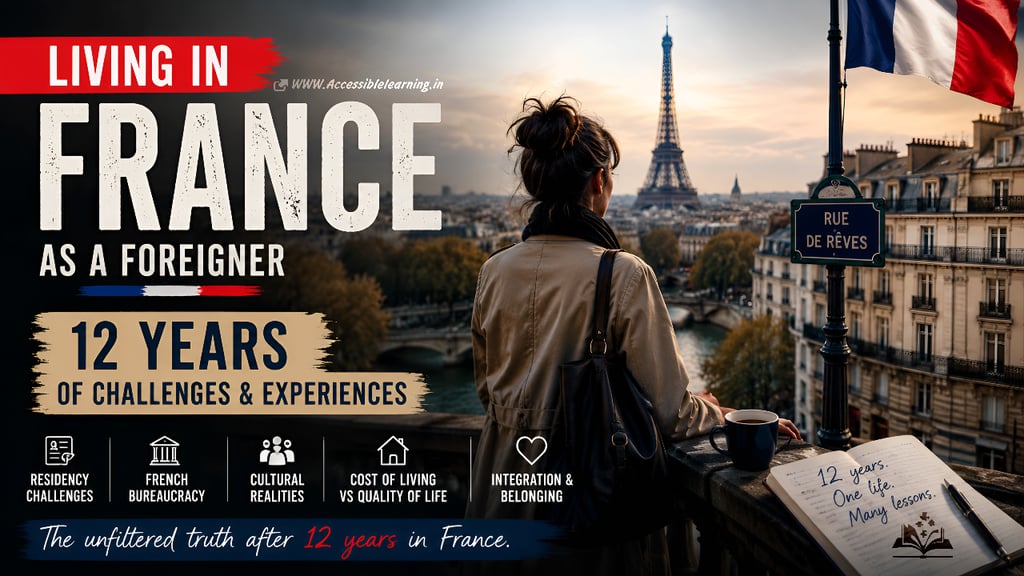
France has a remarkable talent for making newcomers fall in love before asking them to prove they belong.
The first months are intoxicating. Fresh bread from the neighborhood boulangerie. Long evenings on café terraces. High-speed trains that cross the country with precision. Walks along the Seine, vineyards in Burgundy, beaches on the Côte d'Azur, and medieval villages that seem untouched by time.
But twelve years changes the conversation.
This is no longer about sightseeing. It becomes about renewing residency permits, navigating tax declarations, understanding workplace expectations, raising children in the French education system, and discovering that genuine acceptance arrives much slower than legal residency.
Here is the unvarnished truth about long-term expat life in France.
The Illusion of Arrival
France is incredibly easy to admire.
It is considerably harder to enter.
The honeymoon usually lasts between one and three years. During that period, every inconvenience feels charming. You laugh about complicated paperwork. You celebrate finally opening a bank account. Even slow customer service becomes another "French experience."
Then life stops being temporary.
Your apartment in Paris's 11th arrondissement or Lyon's Croix-Rousse isn't a temporary address anymore. You begin paying local taxes, contributing to social security, using the healthcare system, and worrying about retirement instead of sightseeing.
The questions change.
You no longer ask where to find the best croissant.
You ask whether your residency renewal will be approved before your travel date.
You compare mortgage rates instead of hotel prices.
You start discussing school districts rather than museums.
Some foreigners discover this shift while living around Marseille's Prado district. Others experience it in Toulouse, Bordeaux, Strasbourg, Lille, or smaller regional cities where integration often moves differently than in Paris.
Ironically, the longer you stay, the less like a visitor you feel.
But that does not necessarily mean the system sees you as French.
That distinction matters.
The Cold Shower
What no one tells you before you pack your bags is that France does not measure integration by time. It measures consistency. After twelve years, many foreigners speak fluent French, understand local customs, pay taxes, and contribute to society.
Yet they often continue experiencing subtle reminders that they remain outsiders.
Not through hostility.
Through assumptions.
People still ask where you're originally from.
Administrative offices request additional documents from non-French nationals that locals never consider.
Professional networks often remain surprisingly local, built from university friendships and family relationships stretching back decades.
The emotional exhaustion isn't dramatic. It's cumulative.
Every prefecture appointment.
Every document translated by a certified translator.
Every renewal deadline.
Every conversation explaining your immigration history.
Every moment wondering whether your paperwork will arrive before your current residence permit expires.
None of these experiences individually feel overwhelming.
Together, they become a quiet psychological tax.
France rewards patience.
But it demands enormous amounts of it.

The Bureaucratic Reality (Legal Anchoring)
Emotion alone does not explain the foreign resident experience. Law does.
France has modernized parts of its immigration system, but long-term residency remains deeply structured around administrative compliance rather than convenience.
For most non-European residents, nearly every stage of life connects with the local Préfecture, where residence permits are processed and renewed. Many applications now begin through the national online immigration platform managed by the Administration Numérique pour les Étrangers en France (ANEF) before appointments or biometric processing continues locally.
Depending on circumstances, foreigners may hold residence permits under categories including the following:
Talent Passport (Passeport Talent)
Employee or Salaried Worker permits
Entrepreneur or Self-employed permits
Student residence permits
Family reunification permits
Visitor permits
EU Blue Card for highly qualified professionals
Each category carries different renewal conditions.
Changing careers can require changing immigration status.
Starting a business may involve demonstrating financial sustainability.
Periods spent outside France may affect future residency eligibility.
Meanwhile, European Union citizens enjoy freedom of movement under EU law but still encounter administrative obligations involving registration, taxation, healthcare enrollment, and social security depending on individual circumstances.
For those hoping to settle permanently, the long-term objective often becomes obtaining the Carte de Résident, generally valid for ten years, or eventually pursuing French nationality through naturalization.
Neither happens automatically.
Authorities evaluate factors including:
Continuous lawful residence
Stable financial resources
Respect for French law
Integration into French society
French language proficiency
Civic understanding and republican values
Naturalization is ultimately handled by the French Ministry of the Interior after extensive administrative review.
Recent years have also brought tighter attention to language expectations, integration requirements, digital processing systems, and document verification as France continues adjusting immigration policies in response to broader European migration debates.
This explains why many experienced expats describe French bureaucracy less as inefficient and more as relentlessly procedural. The system assumes documentation before explanation. Paperwork becomes proof of belonging.
The Hidden Economics Behind Daily Life
Many articles compare salaries. Very few compare expectations.
The cost of living vs quality of life in France depends almost entirely on where your income originates.
Paris can consume an enormous percentage of monthly earnings through rent alone.
Meanwhile, cities like Nantes, Rennes, Dijon, Clermont-Ferrand, or Angers often provide noticeably better housing value while maintaining excellent public services.
Healthcare remains one of France's greatest strengths.
Public transport reduces dependence on private cars.
Public education remains widely respected.
Yet these advantages exist alongside relatively high taxation and substantial social contributions.
Many newcomers initially focus on gross salaries.
Long-term residents learn to evaluate disposable income after taxes, pension contributions, housing, childcare, and insurance.
France offers stability. Stability comes with costs.
The Cultural "Why"
Understanding France requires understanding its history. The French Republic places extraordinary importance on institutions.
Equality before the law.
Universal public services.
Secularism.
Centralized administration.
These principles shape everything from education to immigration. Many foreigners mistake administrative rigidity for personal distrust.
Often, it reflects something different. The French state is designed to apply standardized rules rather than flexible exceptions.
That philosophy can feel frustrating. But it also explains why healthcare, transportation, education, and labor protections function with remarkable consistency compared to many countries.
Social relationships follow similar patterns.
Friendships often develop slowly.
Professional respect usually precedes personal openness.
Once trust exists, however, relationships frequently become remarkably stable and enduring.
This cultural rhythm surprises people from societies where friendliness comes quickly.
France often reverses the order.
Distance first.
Trust later.

Work Is Not Identity
One of the greatest adjustments concerns work. France generally protects personal life more aggressively than many other economies.
Paid leave.
Working time regulations.
Lunch breaks.
National holidays.
Vacation culture.
These are not luxuries.
They are expectations.
Ironically, ambitious foreigners sometimes struggle because they interpret this balance as lack of motivation. French colleagues often view endless overtime as evidence of poor organization rather than dedication. Success here frequently depends less on working constantly and more on working sustainably. That shift can redefine an entire career.
The Invisible Test of Belonging
Language matters. Accent matters even more. You may speak flawless French after twelve years.
People may still immediately recognize that you learned it elsewhere.
For some, this becomes frustrating.
For others, it becomes liberating.
Eventually, you stop chasing perfect assimilation.
You build a hybrid identity. You celebrate Bastille Day while keeping traditions from home.
You debate politics, understand cultural references, complain about train delays, know exactly which local cheese to bring to dinner, and instinctively say bonjour before asking any question.
None of these erase where you came from.
They simply expand who you are.
The Reality of Permanent Integration
At the end of the day, France does not hand out belonging. It watches.
Year after year.
Did you contribute?
Did you participate?
Did you respect the institutions?
Did you build relationships instead of remaining inside an expatriate bubble?
Did you accept that integration is measured in decades rather than months?
These are the hidden realities of living in France that rarely appear in relocation brochures.
The real challenge is not learning French.
It is learning patience.
It is accepting bureaucracy without allowing it to define your identity.
It is building friendships that survive cultural differences.
It is creating stability inside a country whose institutions move deliberately and whose social trust develops slowly.
After twelve years, France may still remind you that you were born elsewhere. But home is not always where people stop calling you foreign.
Sometimes home is simply the place where your daily routines become more important than your passport. And perhaps that is the most honest definition of belonging any long-term resident can reach.
It is imperfect. It is earned.
And for many people who stay, it becomes enough.
FAQ's
Q: Is France a good country for long-term expats?
Yes, France offers excellent healthcare, strong worker protections, reliable public infrastructure, and a high quality of life. However, long-term expats should be prepared for complex administrative procedures, language expectations, and a slower process of social integration.
Q: What are the biggest France residency challenges for foreigners?
The most common challenges include renewing residence permits, navigating French bureaucracy, understanding tax obligations, finding long-term housing, and meeting language or integration requirements for permanent residency or citizenship.
Q: How difficult is it to get permanent residency in France?
Obtaining a long-term residence permit or permanent residency generally requires several years of continuous legal residence, stable income, compliance with French laws, and proof of integration, including French language proficiency where applicable.
Q: What is the cost of living vs quality of life in France?
France offers a high quality of life through excellent healthcare, public transportation, education, and work-life balance. While cities like Paris are expensive, many regional cities provide a lower cost of living with similar public services and lifestyle benefits.
Q: Can you live in France without speaking fluent French?
It is possible, especially in larger cities, but learning French significantly improves everyday life, employment opportunities, administrative processes, and social integration. Long-term residents generally benefit greatly from achieving fluency.
Q: Is French bureaucracy really as difficult as people say?
French bureaucracy has a reputation for being detailed and document-driven. Most long-term residents find it manageable once they understand the system, but administrative procedures often require patience, accurate paperwork, and careful attention to deadlines.
Q: How long does it take to truly integrate into French society?
For many foreigners, meaningful integration takes years rather than months. Building local friendships, understanding cultural norms, participating in community life, and speaking French confidently are often more important than simply living in France for a long time.
Q: What should foreigners know before moving to France permanently?
Before relocating, research visa and residency options, estimate the real cost of living, learn basic French, understand the healthcare and tax systems, and be prepared for a structured administrative process. Setting realistic expectations makes long-term life in France far more rewarding.
Subscribe to Frontier Intelligence
All © Copyright reserved by Accessible-Learning Hub
| Terms & Conditions
Accessible Learning Hub — Actionable clarity for high-agency minds.
Weekly breakdowns on AI breakthroughs, capital flow, and human performance systems. Zero fluff.