

Living in Australia as a Foreigner: 12 Years of Challenges and Experiences
Discover the hidden realities of living in Australia as a foreigner after 12 years. Explore residency challenges, visa pathways, cost of living vs quality of life, cultural integration, and what long-term expat life in Australia is really like.
ACCESSIBLE LEARNING
Jagdish Nishad | Kim Shin
7/17/20266 min read
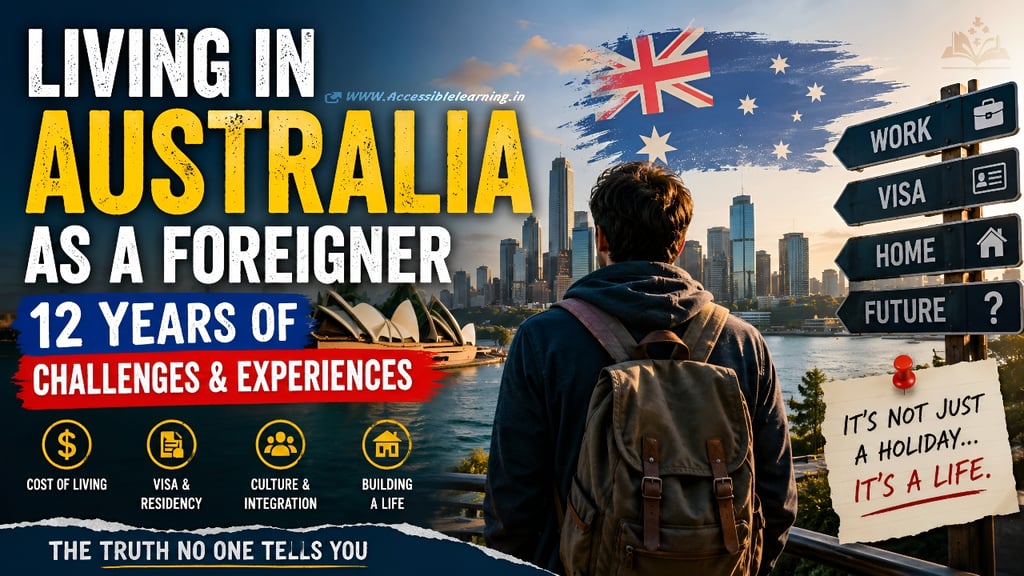

Australia has a remarkable talent for making newcomers believe they have found the perfect balance. The beaches are clean, salaries often look attractive, public services function better than in many countries, and cities like Sydney, Melbourne, Brisbane, and Perth consistently rank among the world's most livable places.
Spend twelve years here, however, and a different Australia gradually appears.
Not a worse Australia.
A more honest one.
Long-term expat life in Australia is less about beaches and barbecues than about navigating institutions, understanding unwritten social rules, and accepting that permanent residency and genuine belonging are two very different milestones.
Here is the unvarnished truth.
The Illusion of Arrival
The first few years feel remarkably smooth.
Public transport works. Streets feel safe. Supermarkets are predictable. Government services are digital. Weekend trips to the Blue Mountains National Park or along the Great Ocean Road become normal rather than exceptional.
Eventually you stop checking maps.
You know which platform to stand on at Flinders Street railway station during rush hour. You understand why commuters avoid the packed T1 line in Sydney. You instinctively book tradespeople weeks in advance because nothing happens overnight.
You begin speaking the local rhythm.
Not because your accent has changed dramatically, but because you understand what people actually mean when they say, "No worries."
Ironically, this is where many foreigners mistake familiarity for integration.
You can own a home.
Pay Australian taxes.
Raise Australian-born children.
Vote after becoming a citizen.
Yet there remains a subtle awareness that many lifelong Australians share references, friendships, sporting rivalries, and family histories stretching back generations. Those invisible networks cannot be replicated through paperwork.
Australia rewards participation.
It rarely rushes acceptance.
The Cold Shower
The hardest part is rarely discrimination. It is distance. Australia is geographically isolated in ways few countries are. Family emergencies suddenly involve fifteen-hour flights, expensive tickets, complicated leave approvals, and significant emotional calculations.
Parents' age. Children grow. Friends back home move on. Meanwhile, your life continues in Australia, often separated by thousands of kilometers and incompatible time zones.
The psychological tax accumulates slowly.
Many long-term migrants eventually experience an unusual identity split.
You no longer fully belong where you came from.
But complete acceptance in Australia remains conditional upon years of trust, shared experiences, and social continuity that locals built since childhood.
Professional life carries its own invisible barriers. Australian workplaces often value cultural fit as much as technical competence. Networking happens quietly. Recommendations matter.
Promotion pathways frequently depend upon relationships developed over years rather than solely measurable performance.
Nobody announces these rules. You simply notice who advances. What no one tells you before you pack your bags is that loneliness becomes more sophisticated after a decade. The excitement disappears. Routine replaces novelty.
The emotional challenge becomes maintaining meaningful relationships while living on one of the world's most geographically distant continents.

The Bureaucratic Reality (Legal Anchoring)
Every long-term foreign resident eventually learns that Australia's immigration system is built upon legislation, points, compliance, and constant policy adjustment rather than sentiment.
Everything begins with the Department of Home Affairs. This department administers immigration policy, visa compliance, citizenship processing, and border management.
For skilled migrants, the pathway often starts through visas such as the Subclass 482 Skills in Demand visa, which replaced much of the earlier Temporary Skill Shortage framework, or permanent options including the Subclass 189 Skilled Independent visa, the Subclass 190 Skilled Nominated visa, and the Subclass 491 Skilled Work Regional visa.
Each operates under different eligibility rules. Each carries different obligations.
Many migrants spend years navigating Australia's points-tested migration program, where age, English proficiency, qualifications, skilled employment, and state nominations collectively determine invitation prospects.
Even after receiving permanent residency, the bureaucracy does not disappear.
Citizenship eligibility generally depends upon satisfying lawful residence requirements, permanent residency periods, character assessments, and physical presence rules before an application is approved.
Recent migration reforms have also shifted the landscape.
Australia has restructured parts of its skilled migration system to better address labor shortages, introducing the Skills in Demand visa framework while tightening integrity measures around international education, employer sponsorship, and temporary migration compliance.
Employers themselves must meet sponsorship obligations under Australian migration law. Lose sponsorship under certain temporary visas without securing another lawful pathway, and the countdown begins.
Taxation introduces another layer. The Australian Taxation Office determines tax residency separately from immigration status.
Becoming an Australian tax resident changes worldwide income reporting obligations, superannuation considerations, capital gains treatment, and numerous financial responsibilities.
Healthcare is equally structured. Eligibility for Medicare depends on visa category, reciprocal healthcare agreements, or permanent residency status.
Many temporary residents continue paying substantial private health insurance premiums because public coverage remains limited. Housing presents another regulatory reality.
Foreign buyers frequently encounter restrictions administered through the Foreign Investment Review Board before purchasing residential property.
These are not bureaucratic inconveniences. They shape every major life decision.
Marriage.
Career moves.
Home ownership.
Children's education.
Retirement.
The hidden realities of living in Australia often begin inside government policy documents rather than neighborhood cafés.
The Cultural 'Why'
Australia's social architecture did not emerge accidentally. It developed from geography, economics, and historical necessity. A relatively small population occupies an enormous continent.
Skilled migration fuels economic growth. At the same time, successive governments prioritize social stability through controlled migration planning. This explains why immigration policy frequently changes according to labor market demand rather than emotional narratives.
Australians also tend to value independence. There is generally less expectation of extensive social obligations outside close family or long-established friendship circles.
To newcomers, this reserve can appear distant. In reality, it often reflects a culture that respects personal space and avoids unnecessary intrusion. Trust develops gradually.
Once established, however, friendships are usually dependable and enduring. Work-life balance also reflects national priorities. Many Australians genuinely protect weekends, annual leave, and family time.
Professional ambition exists, but endless overtime often earns less admiration than competence paired with reliability. Understanding this cultural rhythm matters more than memorizing local slang.
Cost of Living vs Quality of Life in Australia
Every conversation eventually returns to money.
Australia offers comparatively strong wages.
It also demands extraordinary living costs.
Housing in Sydney and Melbourne consumes a substantial share of household income. Electricity, childcare, insurance, groceries, and transportation continue climbing. The cost of living vs quality of life in Australia becomes a deeply personal calculation rather than a universal answer.
Some decide the lifestyle justifies every expense. Others quietly conclude that financial comfort elsewhere provides greater long-term security. Neither conclusion is objectively correct. Both are common among long-term migrants.


The Reality of Permanent Integration
After twelve years, Australia no longer feels foreign. It simply feels different.
You know the election cycles.
You understand cricket conversations without pretending.
You instinctively avoid peak-hour congestion on Sydney Trains.
You complain about housing prices like everyone else.
Yet permanent integration is not achieved through duration alone.
It happens when your emotional investment matches your legal status.
When your community extends beyond people from your home country.
When Australia's successes matter to you because they directly shape your family's future.
At the end of the day, Australia does not ask newcomers to abandon their identity.
It asks something far more demanding. Patience.
Because belonging here is rarely granted in dramatic moments.
It accumulates quietly through thousands of ordinary days, years of consistency, respect for the country's institutions, and genuine participation in the communities that make this vast continent function.
That is the reality behind long-term expat life in Australia.
It is rewarding.
It is demanding.
And after twelve years, you finally understand that calling Australia home is less about what is written on your visa and more about the life you have slowly, deliberately, and permanently built.
FAQ's
Q: Is Australia a good country for long-term expats?
Yes. Australia offers a high quality of life, strong healthcare, stable infrastructure, and excellent career opportunities. However, long-term expats often face challenges such as a high cost of living, housing affordability, immigration policy changes, and the gradual process of social integration.
Q: What are the biggest Australia residency challenges for foreigners?
The biggest challenges include meeting visa and permanent residency requirements, adapting to changing immigration policies, finding affordable housing, managing the high cost of living, and building lasting social and professional networks within Australian society.
Q: What is the cost of living vs quality of life in Australia?
Australia provides excellent public services, safety, and work-life balance, but these benefits come with high living costs. Housing, childcare, transportation, insurance, and groceries can consume a significant portion of household income, particularly in major cities like Sydney and Melbourne.
Q: How difficult is it to become a permanent resident in Australia?
Obtaining permanent residency depends on factors such as age, occupation, English language proficiency, work experience, qualifications, and eligibility under Australia's skilled migration programs. Requirements and visa pathways are regularly updated, making it important to stay informed about current immigration policies.
Q: Can foreigners easily integrate into Australian society?
Most foreigners find Australians friendly and welcoming, but genuine integration takes time. Building close friendships, understanding workplace culture, participating in local communities, and respecting Australian social norms are often more important than simply living in the country for many years.
Q: What are the hidden realities of living in Australia?
Beyond the attractive lifestyle, many long-term residents experience homesickness, geographic isolation from family, rising housing costs, evolving immigration rules, and the challenge of balancing career growth with Australia's relatively relaxed work-life culture.
Q: Is Australian citizenship worth pursuing after permanent residency?
For many long-term residents, Australian citizenship offers valuable benefits, including voting rights, an Australian passport, greater security, and unrestricted access to government services. Whether it is worthwhile depends on individual career goals, family circumstances, and long-term plans to remain in Australia.
Subscribe to Frontier Intelligence
All © Copyright reserved by Accessible-Learning Hub
| Terms & Conditions
Accessible Learning Hub — Actionable clarity for high-agency minds.
Weekly breakdowns on AI breakthroughs, capital flow, and human performance systems. Zero fluff.