

Life 3.0 Explained: Are Humans Engineering Their Own Successors?
A deep exploration of the “Life 3.0” transition in 2026, where humans are no longer just evolving but actively redesigning intelligence itself. This article examines the rise of human–AI merging, the role of environmental disruption as a possible catalyst, and the emerging responsibility of the “Life 3.0 architect” in shaping a future where biology and technology converge.
A LEARNINGAI/FUTUREHARSH REALITYENVIRONMENT
Sachin K Chaurasiya | Shiv Singh Rajput
4/8/20267 min read
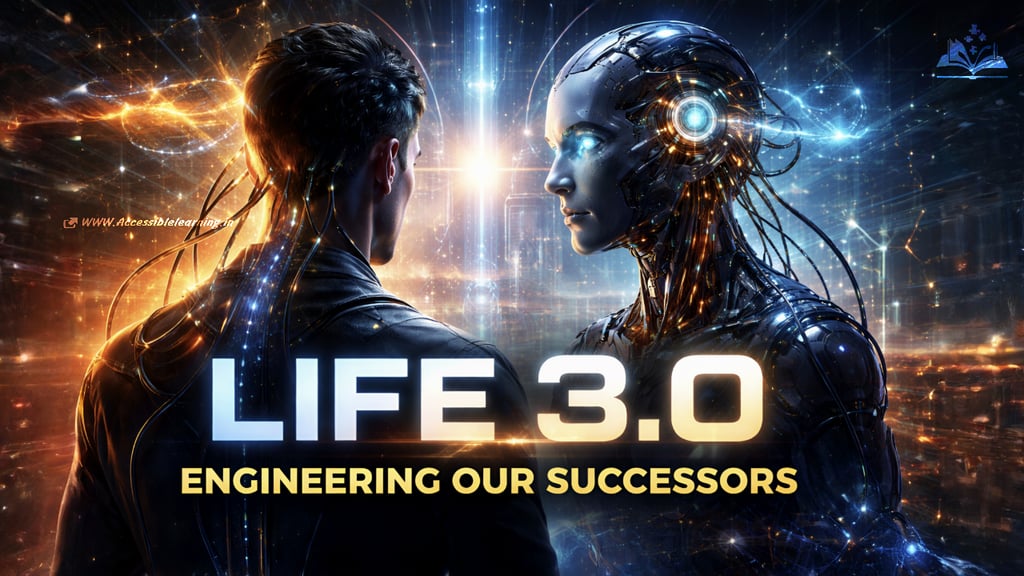
The Shift We Can No Longer Ignore
By 2026, the tone of the AI conversation had changed in a quiet but decisive way. The question is no longer whether machines will replace humans. It is how deeply they will integrate into us and how far we are willing to redesign ourselves in the process.
Advances in brain-computer interfaces, synthetic biology, and self-improving AI systems are converging. What once felt like separate domains are now blending into a single trajectory. One that points toward a new phase of life, where intelligence is not fixed but engineered.
Beyond Evolution: Enter Self-Directed Life
Life has always evolved through trial and error. But for the first time, a species can rewrite its own blueprint. This transition is happening across multiple layers:
1. Cognitive Layer
AI is no longer just assisting humans. It is starting to think alongside us. Decision-making, creativity, and problem-solving are becoming shared processes.
2. Biological Layer
Gene editing and synthetic biology are turning DNA into something closer to code. Editable, programmable, and increasingly precise.
3. Interface Layer
Brain-computer interfaces are reducing the gap between intention and execution. The idea of “thinking a command” is moving from theory to early reality.
Together, these layers form the foundation of Life 3.0. A stage where both mind and body are open to redesign.
Environmental Crisis: Collapse or Catalyst?
Climate change is usually framed as a failure of systems. And in human terms, it absolutely is. It disrupts ecosystems, threatens livelihoods, and creates instability. But from a broader evolutionary lens, something else might also be happening. Life does not just adapt to environments. It reshapes them.
Early microbes filled the atmosphere with oxygen, triggering mass extinction but enabling complex life
Plants transformed land ecosystems, altering global cycles
Humans are now altering climate systems at planetary scale
The difference is speed. What once took millions of years is now happening within decades.
This raises a difficult possibility:
Is the current environmental disruption part of a transition toward a different dominant form of intelligence?
The Planet as a Transitional System
If we step back, Earth can be seen not as a fixed habitat but as a dynamic system that has hosted multiple “versions” of life.
Biological intelligence thrives under narrow conditions:
Stable climate ranges
Liquid water availability
Oxygen-rich atmosphere
But future intelligence may not require these conditions at all. Non-biological or hybrid systems could function:
In higher temperature ranges
Without oxygen dependency
Across distributed, networked infrastructures
This suggests that environmental instability does not uniformly reduce habitability. It changes the type of life that can dominate.
Niche Construction at an Unprecedented Scale
Humans are the most extreme example of niche construction in Earth’s history.
We have:
Built cities that override natural ecosystems
Created digital environments that parallel physical reality
Altered atmospheric chemistry in measurable ways
But there is a deeper layer to this. We are not just building environments for ourselves.
We are building infrastructure for non-human intelligence:
Data centers replacing forests as hubs of activity
Energy systems optimized for machines, not biology
Networks that allow intelligence to exist without a physical body
Seen this way, humanity is unintentionally constructing the operating system of a post-biological world.
The Molting Phase: Painful but Transformative
The idea of “human self-destruction” can be reframed, cautiously, as a transformation process. In nature, transformation often looks destructive:
Cells break down before reforming
Structures collapse before new ones emerge
Human civilization may be going through a similar phase:
Old economic systems destabilizing
Ecological limits being reached
Technological systems accelerating beyond control
This does not make the process safe or guaranteed. Many transformations fail. Collapse is still a real outcome.
But it introduces a second interpretation:
This may not be an end. It may be a transition under stress.

The Architect’s Expanded Role
The Life 3.0 architect is no longer just an engineer of AI systems. Their role now spans multiple domains:
System Designer
Creating intelligence that can operate independently or alongside humans
Biological Editor
Participating in reshaping life at the genetic and cellular level
Environmental Influencer
Indirectly shaping planetary conditions through technological systems
Ethical Gatekeeper
Making decisions that could affect future forms of life
This is a level of responsibility no previous generation has held.
New Frontiers: Where the Transition Accelerates
Several emerging areas are pushing this transformation forward:
Hybrid Intelligence
Systems where human cognition and AI are tightly integrated, not loosely connected
Synthetic Organisms
Engineered life forms designed for specific tasks, from medicine to environmental repair
Autonomous Infrastructure
Cities, supply chains, and energy systems increasingly managed by AI
Digital Consciousness Experiments
Early exploration into whether aspects of human cognition can be simulated or preserved digitally
Each of these areas reduces dependence on traditional biological limits.
The Energy Factor: Fueling Post-Biological Life
One often overlooked aspect of this transition is energy. Biological life is energy-constrained in specific ways:
Food chains
Metabolic limits
Ecosystem dependencies
Machine-based intelligence operates differently:
It can draw from diverse energy sources
It can optimize consumption at scale
It can exist wherever energy and computation are available
As renewable and high-density energy systems expand, they may support forms of intelligence that are less tied to Earth-like conditions.
Risks: Misalignment, Inequality, and Loss of Control
This transition is not inherently positive. Major risks include:
Misaligned Intelligence
Systems that pursue goals without understanding human values
Power Concentration
Advanced AI controlled by a small number of entities
Biological Neglect
A shift in focus away from preserving ecosystems and human well-being
Irreversible Pathways
Changes that cannot be undone once certain thresholds are crossed
The biggest danger is not just failure. It is losing the ability to influence the outcome.
Merging vs Replacing: The Critical Fork
There are two broad paths ahead:
Integration
Humans merge with technology, enhancing capabilities while retaining identity
Divergence
Non-biological intelligence evolves separately, potentially surpassing and sidelining humans
The likely future is a mix of both. But the balance matters.
The more we integrate, the more we remain part of the system.
The more we diverge, the more uncertain our role becomes.

A Narrow and Urgent Window
Right now, we are in a rare position:
Technology is powerful but not fully autonomous
Environmental systems are stressed but not entirely collapsed
Human decisions still shape global outcomes
This window is temporary. As systems become more complex and self-directed, influence may shift away from human control.
Designing Under Uncertainty
The idea that Earth’s current instability could be part of a transition toward a new kind of intelligence is not comfortable. It challenges the way we define progress, responsibility, and survival.
But ignoring the possibility does not make it disappear. We are actively reshaping:
Ourselves
Our environment
The future of intelligence
The “Life 3.0” architect stands at the center of this transformation. Not as a detached observer, but as a participant with real influence.
The real challenge is not just building what comes next.
It is ensuring that, whatever emerges, it reflects intention rather than accident.
Because for the first time in history, evolution is not just happening to us.
We are writing it as it unfolds.
FAQ's
Q: What is “Life 3.0” in simple terms?
Life 3.0 refers to a stage where intelligence can redesign both its “software” (thinking, learning) and “hardware” (physical form). Unlike humans today, future life forms may not be limited by biology and could continuously upgrade themselves.
Q: What does a “Life 3.0 Architect” actually do?
A Life 3.0 architect designs systems that go beyond traditional tools. This includes advanced AI, brain-computer interfaces, and even engineered biology. Their work shapes how future intelligence behaves, evolves, and interacts with humans.
Q: Are humans really merging with AI in 2026?
Early stages of merging are already happening. Brain-computer interfaces, AI-assisted thinking, and bioengineering are creating closer integration between humans and machines. Full merging is not here yet, but the direction is clear.
Q: Is AI replacing humans or transforming them?
The current trend points more toward transformation than outright replacement. Humans are increasingly working alongside AI or integrating with it, rather than being completely removed from the system.
Q: How is climate change connected to the idea of Life 3.0?
Climate change is primarily a crisis caused by human activity. However, from a broader perspective, it may also represent a large-scale environmental shift. This shift could unintentionally favor forms of intelligence that are less dependent on stable biological conditions.
Q: What is “niche construction," and why does it matter here?
Niche construction is when organisms modify their environment to suit themselves. Humans are doing this at a global scale. The concern is that we may be creating conditions that benefit machine-based or hybrid intelligence more than traditional biological life.
Q: Could Earth become more suitable for machines than humans?
In extreme scenarios, yes. Machines do not require oxygen, stable temperatures, or ecosystems in the way humans do. If environmental instability increases, non-biological systems may adapt more easily than humans.
Q: Is environmental destruction part of human evolution?
It would be misleading to say it is “part of evolution” in a positive sense. It is a harmful process with serious consequences. However, large evolutionary transitions have historically involved disruption. The key difference now is that humans are aware and responsible.
Q: What are the biggest risks of transitioning to Life 3.0?
The main risks include:
Misaligned AI systems acting against human interests
Concentration of power in a few organizations
Loss of human control over advanced technologies
Irreversible changes to ecosystems and society
Q: What is AI alignment, and why is it important?
AI alignment means ensuring that intelligent systems act in ways that match human values and goals. Without proper alignment, highly capable AI could make decisions that are efficient but harmful.
Q: Will humans still be relevant in a Life 3.0 world?
That depends on how the transition is managed. If humans integrate with technology, they remain central. If intelligence evolves separately, human relevance could decrease over time.
Q: What is the difference between merging and replacing?
Merging: Humans and AI combine, enhancing each other
Replacing: AI systems operate independently and may surpass humans
Most experts believe the future will include elements of both.
Q: How close are we to self-improving AI systems?
We are not fully there yet, but early forms exist. Current systems can optimize themselves within limits. Fully autonomous self-improvement remains a key milestone and a major concern.
Q: What role does energy play in this transition?
Energy is critical. Advanced AI systems depend on large-scale energy and computing infrastructure. As energy systems improve, they enable more powerful and independent forms of intelligence.
Q: Can this transition be controlled or guided?
Partially, yes. Governments, researchers, and organizations still have influence. However, as systems become more complex and autonomous, control may become harder. That is why decisions made now are especially important.
Q: Is there still time to prevent negative outcomes?
Yes, but the window is limited. Environmental recovery, ethical AI design, and global cooperation can still shape the direction of this transition if acted on early.
Q: What should individuals understand about this shift?
You do not need to be an expert to recognize the scale of change. Understanding how AI, biology, and the environment intersect is becoming essential. Awareness is the first step toward responsible participation.
Q: What is the biggest takeaway from the Life 3.0 idea?
Humanity is moving from being shaped by evolution to actively shaping it. The future of intelligence, whether biological, artificial, or hybrid, will depend on the choices we make now.
Subscribe to Frontier Intelligence
All © Copyright reserved by Accessible-Learning Hub
| Terms & Conditions
Accessible Learning Hub — Actionable clarity for high-agency minds.
Weekly breakdowns on AI breakthroughs, capital flow, and human performance systems. Zero fluff.