

LevelFields AI vs AI Signals: Which AI Trading Tool Actually Works Better?
Compare LevelFields AI vs AI Signals in this in-depth guide. Learn how each AI trading tool works, their key differences, pros and cons, and which platform is better for beginners, day traders, or long-term investors.
ARTIFICIAL INTELLIGENCE & FUTURE TECH
Sachin K Chaurasiya | Vishwajeet Chaurasiya
4/15/20265 min read
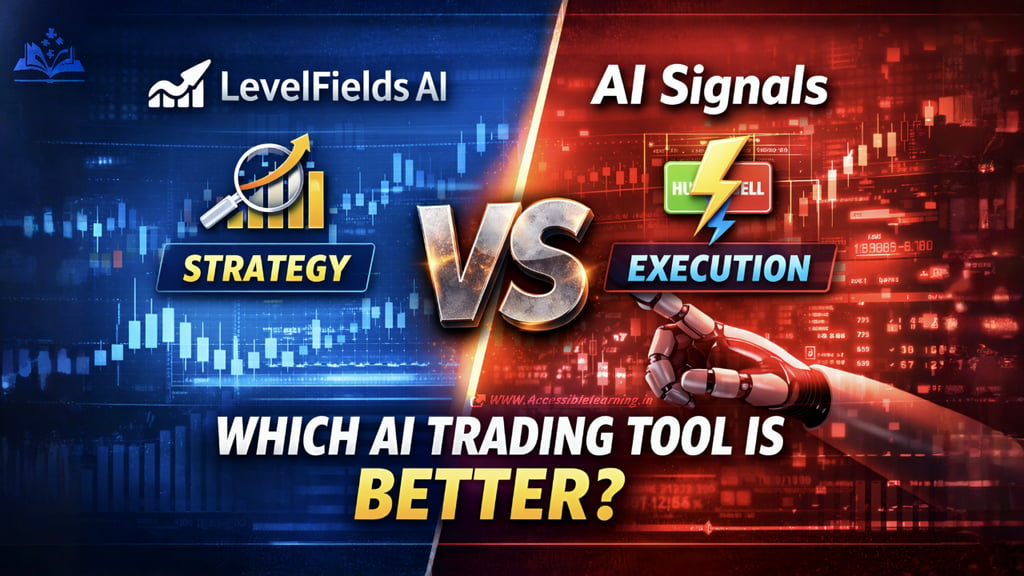
Artificial intelligence is no longer a “nice-to-have” in trading. It’s quickly becoming the backbone of how modern traders analyze markets, find opportunities, and make decisions. But not all AI tools work the same way.
Two platforms that often get compared are LevelFields AI and AI Signals. While both use AI, they approach trading from completely different angles. This guide goes beyond surface-level features and breaks down how each tool actually performs in real-world use.
What is LevelFields AI?
LevelFields AI focuses on event-driven trading, which means it tracks real-world events that historically move stock prices. Instead of asking, “What does the chart say?”, it asks:
“What just happened, and how did similar events affect stocks in the past?”
Key Features
Real-time detection of market-moving events
Historical analysis of similar past events
Probability-based insights (win rate, expected returns, duration)
Custom event alerts (earnings, insider buying, layoffs, etc.)
Backtesting on event-driven strategies
Clean dashboard focused on decision clarity
Deeper Strengths
Context over noise: You’re not flooded with signals. You see fewer, but more meaningful, setups.
Pattern + cause alignment: It connects price movement with real-world triggers
Better for patience-driven strategies: Works well for traders who don’t want to rush
Limitations
Limited to stocks and ETFs
No built-in execution or automation
Can feel “slow” if you prefer fast-paced trading
Requires interpretation, not just action
What are AI Signals?
AI Signals is built around real-time trading signals and automation. It processes large amounts of technical data and sentiment signals to generate immediate buy/sell recommendations. Instead of explaining why, it focuses on what to do next.
Key Features
Instant AI-generated trading signals
Combines technical indicators with sentiment analysis
Multi-asset support (stocks, crypto, forex, commodities)
Integration with brokers for automated trading
Built-in risk management (stop-loss, take-profit)
High-frequency signal generation
Deeper Strengths
Speed-first approach: Ideal when timing matters more than explanation
Automation-ready: You can reduce manual effort significantly
Flexible across markets: Not limited to just stocks
Limitations
Signal overload can lead to decision fatigue
Less transparency behind why trades are suggested
Requires strict discipline to avoid overtrading
Can be overwhelming for beginners
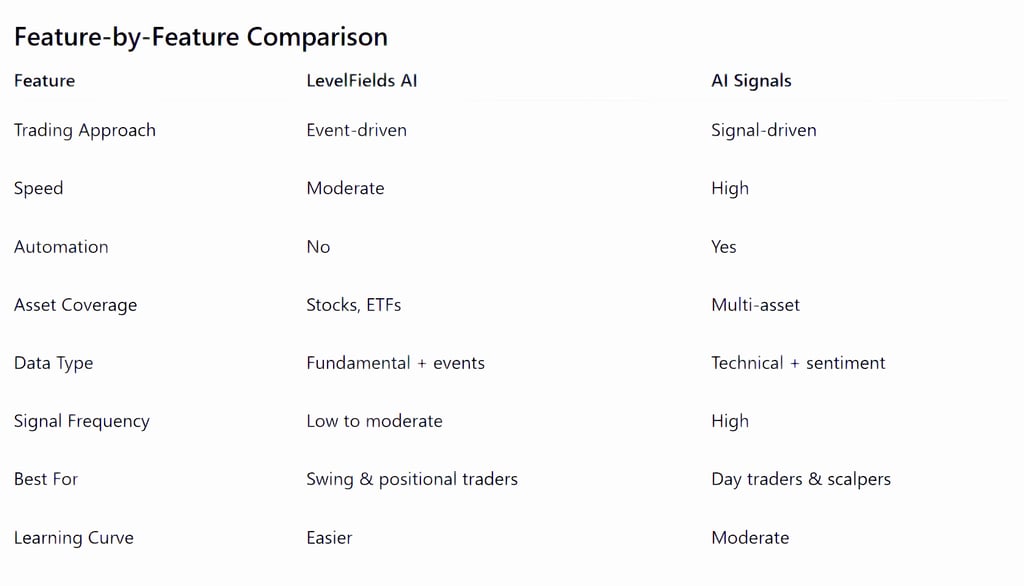
Core Difference: Thinking vs Acting
This is the real separation point.
LevelFields AI = Thinking tool
AI Signals = Acting tool
LevelFields AI helps you understand opportunities. AI Signals pushes you toward execution. Neither is better universally. It depends on how you naturally make decisions.

Hidden Differences Most People Miss
1. Quality vs Quantity of Trades
LevelFields focuses on fewer, higher-quality setups
AI Signals provides more frequent opportunities
If you prefer precision, LevelFields feels cleaner.
If you prefer constant action, AI Signals fits better.
2. Mental Load on the Trader
LevelFields reduces stress by simplifying decisions
AI Signals can increase stress due to constant updates
Many traders underestimate how important this is over time.
3. Dependency Level
LevelFields builds your independent thinking
AI Signals can make you dependent on signals
Over-reliance on signals can become risky if you stop understanding the market.
4. Market Adaptability
Event-based strategies tend to work better in volatile or news-driven markets
Signal-based systems can struggle when markets become choppy or unpredictable
5. Skill Development
LevelFields helps you improve as a trader
AI Signals helps you execute faster, but not necessarily learn faster
Real-World Trading Scenarios
Scenario 1: Earnings Announcement
LevelFields: Shows how similar earnings surprises impacted stock price historically
AI Signals: Gives a quick buy/sell signal based on technical reaction
Better choice: LevelFields for planning, AI Signals for timing
Scenario 2: Intraday Trading
LevelFields: Too slow for rapid decision-making
AI Signals: Designed for this exact purpose
Better choice: AI Signals
Scenario 3: Long-Term Position
LevelFields: Strong edge due to event-based insights
AI Signals: Less useful for long holding periods
Better choice: LevelFields
Scenario 4: Beginner Trader
LevelFields: Easier to understand and learn from
AI Signals: Can feel overwhelming without experience
Better choice: LevelFields initially
Risk Management Perspective
This is where the difference becomes practical.
LevelFields AI
Encourages planned entries and exits
Relies on historical probabilities
Lower trading frequency = lower emotional mistakes
AI Signals
Requires strict stop-loss discipline
High activity increases risk of impulsive trades
Automation can help, but also amplify mistakes if misconfigured

Cost vs Value Mindset
When evaluating these tools, think beyond pricing.
LevelFields delivers value through insight quality
AI Signals delivers value through speed and volume
The better ROI depends on how you use the tool, not just what it offers.
A Smarter Combined Strategy
Instead of choosing one, many traders combine both:
Use LevelFields AI to identify strong setups based on real events
Use AI Signals to fine-tune entries and exits
This creates a workflow where:
You think with data
Then act with precision
Both tools are powerful, but they serve different types of traders.
LevelFields AI is better for clarity, strategy, and controlled decision-making
AI Signals is better for speed, automation, and high-frequency execution
If you like to understand before acting, LevelFields will feel more natural.
If you prefer quick decisions with system support, AI Signals will feel more efficient.
In the end, the real advantage doesn’t come from the tool itself.
It comes from how well the tool matches your mindset and trading behavior.
FAQ's
Q: What is the main difference between LevelFields AI and AI Signals?
The main difference lies in their approach. LevelFields AI focuses on event-driven insights to help traders understand why a stock may move, while AI Signals provides real-time buy and sell signals for quick execution.
Q: Which is better for beginners: LevelFields AI or AI Signals?
LevelFields AI is generally better for beginners because it offers clear, data-backed insights with less noise. AI Signals can feel overwhelming due to frequent signals and faster decision-making requirements.
Q: Can AI Signals be used for automated trading?
Yes, AI Signals supports automation by integrating with brokers. Traders can set rules for entry, exit, stop-loss, and take-profit, allowing trades to execute automatically.
Q: Is LevelFields AI suitable for long-term investing?
Yes, LevelFields AI is more suitable for swing trading and long-term investing because it analyzes real-world events and their historical impact on stock prices.
Q: Do AI trading tools guarantee profits?
No, neither LevelFields AI nor AI Signals guarantees profits. Both rely on historical data and probability, and market conditions can change unpredictably.
Q: Which platform is better for day trading?
AI Signals is better suited for day trading because it delivers fast, real-time signals and supports quick decision-making and automation.
Q: Can I use LevelFields AI and AI Signals together?
Yes, many traders combine both tools. LevelFields AI can be used to identify high-quality opportunities, while AI Signals helps with timing entries and exits.
Q: What type of trader should use LevelFields AI?
LevelFields AI is ideal for traders who prefer structured analysis, event-based strategies, and fewer but more meaningful trade setups.
Q: What type of trader benefits most from AI Signals?
AI Signals works best for active traders, scalpers, and those who want frequent trade opportunities with automation support.
Q: Are AI Signals risky for new traders?
It can be. The high frequency of signals may lead to overtrading if not managed properly. Beginners should use strict risk management and avoid blindly following every signal.
Q: Does LevelFields AI provide real-time alerts?
Yes, LevelFields AI provides alerts based on specific events. However, it focuses more on meaningful triggers rather than constant signal updates.
Q: Which tool is more accurate: LevelFields AI or AI Signals?
Accuracy depends on usage. LevelFields AI offers higher clarity and context, while AI Signals focuses on timing. Neither is universally more accurate, as market behavior varies.
Q: Are AI trading tools worth it in 2026?
AI trading tools can be valuable if used correctly. They save time, improve analysis, and reduce emotional decisions, but they still require human judgment and discipline.
Q: What are the risks of relying on AI trading tools?
The biggest risks include over-reliance, lack of understanding, poor risk management, and blindly following signals without context.
Q: How do I choose between LevelFields AI and AI Signals?
Choose LevelFields AI if you prefer understanding and strategy. Choose AI Signals if you prefer speed and execution. The best choice depends on your trading style and risk tolerance.
Subscribe to Frontier Intelligence
All © Copyright reserved by Accessible-Learning Hub
Accessible Learning Hub — Actionable clarity for high-agency minds.
Weekly breakdowns on AI breakthroughs, capital flow, and human performance systems. Zero fluff.