

LevelFields AI vs. AI Signals Comparison: Features, Accuracy, and Performance
Compare LevelFields AI vs. AI Signals in 2026 with this in-depth guide. Explore features, accuracy, pricing, and trading strategies to find the best AI trading platform for your needs.
AI/FUTUREEDITOR/TOOLSBANKING/CASH-FLOWSTOCK MARKET
Sachin K Chaurasiya | Vishwajeet Chaurasiya
3/29/20265 min read
Artificial intelligence is rapidly reshaping how traders and investors interact with financial markets. Instead of manually analyzing charts, news, and earnings reports, modern platforms now use AI to surface high-probability opportunities in real time.
Two platforms gaining attention in this space are LevelFields AI and AI Signals. While both aim to simplify trading decisions using data-driven insights, they approach the problem very differently. This guide breaks down everything you need to know so you can decide which platform fits your trading style.
What Is LevelFields AI?
LevelFields AI is an event-driven trading platform that focuses on identifying market-moving catalysts rather than traditional technical indicators. The core idea is simple: most news does not impact stock prices, but certain events do. LevelFields filters out the noise and highlights only those events likely to trigger significant price movement.
Key Features
Event-Based Trade Discovery
Detects catalysts like earnings surprises, insider trading, buybacks, and mergers.AI Trade Ideas with Clear Execution Plans
Provides entry points, stop-loss levels, and profit targets.Real-Time Scanners
Tracks markets continuously to identify opportunities as they emerge.Backtesting Engine
Lets users validate strategies using historical event data.Automation Support
Integration with brokers for semi-automated or automated trading.
What Are AI Signals?
AI Signals is a broader AI-powered trading assistant that focuses on real-time alerts, technical analysis, and pattern recognition. Rather than focusing only on events, it continuously analyzes price action, indicators, and market sentiment to generate actionable signals.
Key Features
Real-Time Trading Alerts
Instant buy/sell signals based on AI analysis.Technical Indicator Analysis
Uses patterns, momentum, and price behavior.Multi-Asset Coverage
Includes stocks, forex, crypto, and commodities.User-Friendly Interface
Designed for both beginners and active traders.Fast Decision Support
Helps traders react quickly to market movements.
How Their AI Actually Works
Understanding how each platform processes data helps clarify why their outputs feel so different.
LevelFields AI Approach
Uses event classification models to detect impactful financial events
Applies historical pattern matching to similar past events
Calculates expected price movement probabilities
Prioritizes signals with statistically proven outcomes
This makes it closer to a research-driven AI system rather than a simple alert tool.
AI Signals Approach
Uses machine learning models on price data
Tracks indicators like RSI, MACD, volume, and trend strength
Detects chart patterns and momentum shifts
Generates signals instantly based on market conditions
This approach behaves more like a real-time trading assistant.
Signal Quality vs Signal Quantity
This is one of the most practical differences for traders.
LevelFields AI
Produces fewer signals but with stronger reasoning behind each trade. Ideal if you prefer patience and confirmation.AI Signals
Produces a higher volume of alerts. Ideal if you want constant opportunities but are comfortable filtering.
In real trading scenarios, this often translates to:
LevelFields → Higher confidence, lower frequency
AI Signals → Lower confidence, higher frequency

Risk Management and Trade Discipline
LevelFields AI
Provides structured trade setups
Encourages predefined risk (stop-loss, targets)
Suitable for rule-based trading systems
AI Signals
Leaves more decisions to the trader
Requires manual risk management discipline
Better for experienced traders who can filter signals
Learning Curve and User Experience
LevelFields AI
Takes time to understand event-driven logic
Better suited for traders willing to learn deeper strategies
Interface is data-rich and analytical
AI Signals
Easier onboarding
Minimal learning required
More intuitive for beginners
Performance Perspective (Real-World Use)
While no AI tool guarantees profits, performance depends on how you use it.
LevelFields AI performs best when
Markets react strongly to news or events
You follow structured strategies consistently
AI Signals performs best when
Markets are trending or volatile
You actively monitor and react quickly
Hidden Advantage: Time Efficiency
A major benefit often overlooked is how much time each platform saves.
LevelFields AI
Reduces research time by filtering only meaningful eventsAI Signals
Reduces chart analysis time by providing instant signals
Both tools act as time multipliers, but in different ways.
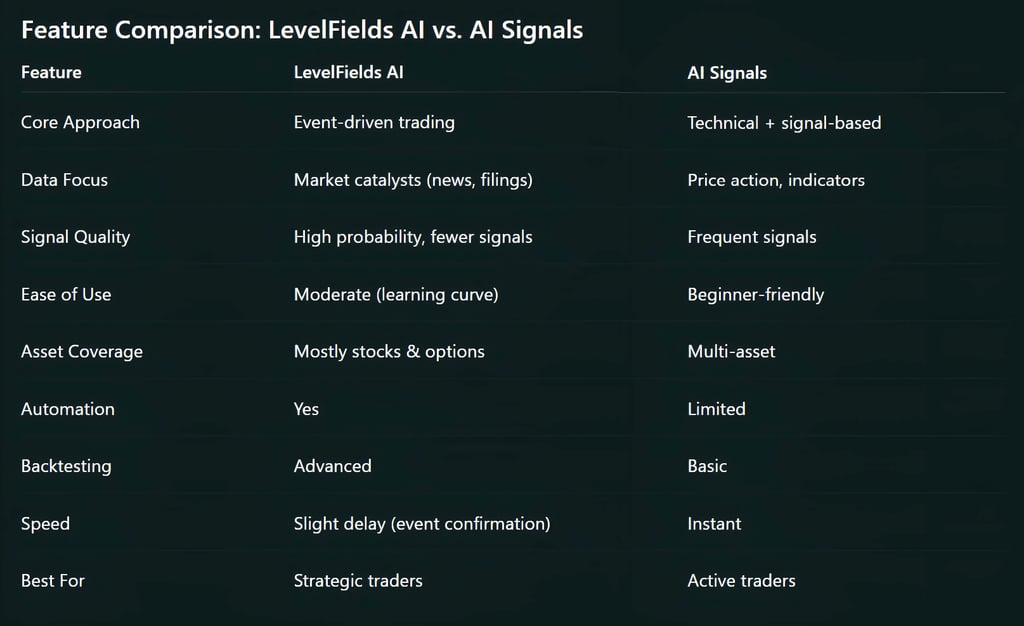
Use Case Breakdown: Which One Should You Choose?
Choose LevelFields AI if:
You prefer quality over quantity
You want structured trade setups
You trade based on news and catalysts
You focus on options or swing trading
Choose AI Signals if:
You want constant opportunities
You rely on technical analysis
You trade across multiple markets
You prefer fast-paced trading
Pros and Cons Summary
LevelFields AI
Pros
High-quality signals
Event-based accuracy
Structured trading approach
Cons
Higher cost
Learning curve
Limited signal frequency
AI Signals
Pros
Easy to use
High signal frequency
Flexible across markets
Cons
Signal overload risk
Requires filtering
Less strategic depth
Pricing Value Perspective
Instead of just cost, think in terms of value:
LevelFields AI: Better for traders who want fewer but more calculated trades
AI Signals: Better for traders who want constant engagement with markets
There is no universal winner because both platforms solve different problems.
Choose LevelFields AI if you want precision, structured trades, and event-driven insights
Choose AI Signals if you want speed, flexibility, and continuous opportunities
In simple terms:
LevelFields AI = Strategic trading
AI Signals = Reactive trading

FAQ's
Q: What is the main difference between LevelFields AI and AI Signals?
The main difference lies in their approach to trading. LevelFields AI focuses on event-driven opportunities like earnings, insider activity, and news catalysts, while AI Signals focuses on technical indicators and real-time market patterns to generate frequent trading alerts.
Q: Which platform is better for beginners: LevelFields AI or AI Signals?
AI Signals is generally better for beginners due to its simple interface and real-time alerts. It requires less understanding of complex strategies, whereas LevelFields AI may require learning event-driven trading concepts.
Q: Is LevelFields AI more accurate than AISignals?
LevelFields AI often provides higher-quality but fewer signals, as it filters trades based on statistically significant events. AI Signals provides more frequent alerts, but accuracy can vary depending on market conditions and user filtering.
Q: Can I use AI Signals for crypto and forex trading?
Yes, AI Signals typically supports multiple asset classes, including crypto, forex, stocks, and commodities. LevelFields AI is more focused on stocks and options trading.
Q: Does LevelFields AI support automated trading?
LevelFields AI offers automation features and broker integrations, allowing users to execute trades with minimal manual input. AI Signals may offer limited automation depending on the platform or provider.
Q: Which platform is better for day trading?
AI Signals is generally better suited for day trading because it provides fast, real-time alerts and continuous opportunities. LevelFields AI is more suitable for swing trading or event-based strategies.
Q: Are AI trading tools like LevelFields AI and AI Signals reliable?
Both platforms can be reliable when used correctly, but they are decision-support tools, not guaranteed profit systems. Success depends on risk management, strategy, and how well the user interprets signals.
Q: Do I need trading experience to use LevelFields AI?
Yes, some level of trading knowledge is helpful. LevelFields AI involves understanding market events, probabilities, and structured trade setups, which may not be ideal for complete beginners.
Q: How do AI trading signals actually work?
AI trading signals are generated using machine learning models and data analysis. These systems process market data, identify patterns or events, and suggest potential buy or sell opportunities based on historical probabilities or technical indicators.
Q: Which is better for long-term investing?
Neither platform is specifically designed for long-term investing. However, LevelFields AI can be more useful for medium-term or swing trades based on fundamental events, while AI Signals is more focused on short-term trading activity.
Q: Can I rely completely on AI Signals for trading decisions?
No. AI Signals should be used as a support tool, not a replacement for decision-making. Traders should always apply their own analysis and risk management before executing trades.
Q: Why do some traders prefer LevelFields AI over traditional signal tools?
Many traders prefer LevelFields AI because it focuses on why a stock moves, not just how it moves. This provides deeper context and can lead to more informed trading decisions.
Subscribe to Frontier Intelligence
All © Copyright reserved by Accessible-Learning Hub
| Terms & Conditions
Accessible Learning Hub — Actionable clarity for high-agency minds.
Weekly breakdowns on AI breakthroughs, capital flow, and human performance systems. Zero fluff.