

Leaders vs Thinkers vs Doers: The True Forces That Shape Civilization
Leaders set direction, thinkers generate ideas, and doers turn plans into reality. This human-centered analysis explains how each role shapes societies, with historical and modern examples, practical indicators of influence, and clear guidance for cultivating impact in any era.
WEALTHY FAMILYSTOCK OPERATORBANKING/CASH-FLOWEDUCATION/KNOWLEDGEENTREPRENEUR/BUSINESSMAN
Sachin K Chaurasiya
10/20/20258 min read
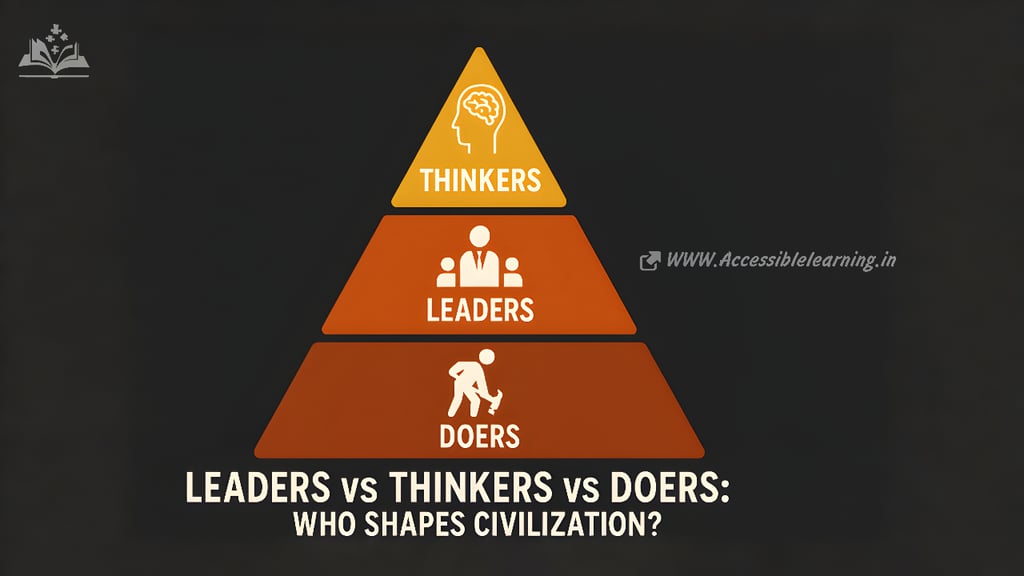
Civilization advances through three essential forces—leaders, thinkers, and doers. Every monumental shift in human history—from the rise of empires to the birth of technology—can be traced to their interplay. They form a triangle of progress, where each side strengthens or weakens the other. To understand who truly shapes civilization, we must explore how each role influences humanity’s growth and how their balance determines the fate of societies.
The Essence of Each Role
Leaders—The Architects of Direction
Leaders are the individuals who mobilize people, set visions, and create systems of governance or organization. Their power lies in their ability to move the collective. They are not always kings, presidents, or CEOs—sometimes they are cultural icons, activists, or spiritual figures who redefine what people believe is possible.
Leaders are the voice of movement. They transform an idea into a mission and a mission into a reality by building institutions, forming alliances, and managing resources. They can accelerate progress—or bring civilization to collapse—depending on the wisdom of their decisions.
Thinkers—The Architects of Ideas
Thinkers form the intellectual and creative backbone of civilization. They are philosophers, scientists, inventors, writers, and visionaries who create the frameworks that leaders and doers operate within. A thinker’s influence may not be immediate, but it is profound. Their ideas reshape the lenses through which humanity perceives reality.
Thinkers ignite revolutions without ever holding office—Newton shaped physics, Darwin shaped biology, Marx shaped politics, and Einstein reshaped our understanding of the universe. Even spiritual thinkers like Buddha or Socrates changed moral structures that echo across millennia.
Yet, thinkers often live detached from practicality. Their strength in imagination can be their weakness in execution. Without leaders and doers, their theories risk remaining ink on parchment.
Doers—The Builders of Reality
Doers are the hands that turn concepts into creation. They are engineers, builders, artisans, farmers, workers, and entrepreneurs—the people who translate plans into tangible results. A civilization might dream through its thinkers and plan through its leaders, but it survives and evolves through its doers.
They are the unseen heroes behind every invention, every structure, and every functioning system. While thinkers theorized electricity and leaders approved funding, it was the doers who wired the cities, built the machines, and kept the systems alive.
Doers transform complexity into order, and their craft defines the quality of life for entire societies. Yet, without visionary leadership or intellectual insight, they risk being trapped in cycles of routine without advancement.

The Mechanism of Civilization
Civilization is not shaped by one group—it is forged in the balance of all three. Each has a distinct function:
Thinkers generate possibilities.
Leaders organize purpose.
Doers manifest progress.
When aligned, they form a powerful chain of transformation:
Idea → Vision → Action → Change.
The most stable and advanced societies are those where this chain flows freely. When any one link breaks, civilization falters.
Too many thinkers without doers create utopias that never materialize.
Too many doers without thinkers breed blind productivity without innovation.
Too many leaders without wisdom produce tyranny or chaos.
Civilization thrives only when ideas are translated into systems and systems are maintained through skilled execution.
Historical Parallels
The Industrial Revolution
The Industrial Revolution exemplifies the perfect storm of thinkers, leaders, and doers.
Thinkers like James Watt and Adam Smith redefined energy and economics.
Leaders like Boulton and Disraeli funded, legislated, and scaled innovations.
Doers—thousands of engineers, machinists, and laborers—physically built the modern world.
The synergy among them reshaped how humanity lived, worked, and moved—birthing modern industry and cities.
The Age of Exploration
When leaders like Queen Isabella supported thinkers like Columbus and doers like shipbuilders and navigators, the world expanded. This union of thought, authority, and craftsmanship brought both progress and peril—technological advancement paired with colonial exploitation—showing that the balance of these forces can both build and destroy.
The Digital Revolution
In the 21st century, we again see this triad at play:
Thinkers—computer scientists and mathematicians—created code, protocols, and artificial intelligence.
Leaders—visionary entrepreneurs and policymakers—scaled it into global industries.
Doers—developers, technicians, and designers—made it accessible and practical for billions.
Technology, communication, and culture now evolve faster than ever, proving that when these forces synchronize, civilization leaps forward.
The Fragile Balance of Power
Throughout history, civilizations rise and fall depending on which group dominates.
Leader-Dominant Eras: When leaders overpower thinkers and doers, authoritarian regimes emerge. Innovation slows, truth bends to power, and progress turns into propaganda.
Thinker-Dominant Eras: Societies consumed by theory often collapse under their own debates. Intellectual pride without practical grounding leads to paralysis.
Doer-Dominant Eras: Hyper-industrial societies driven by productivity lose ethical and environmental balance, mistaking motion for progress.
A civilization’s strength lies in its coordination, not in the supremacy of one group. The most enduring empires and democracies are those where thinkers advise leaders, leaders empower doers, and doers sustain thinkers through real-world data and results.
The Modern Reflection—Our Age of Imbalance
In today’s digital civilization, imbalance is once again visible.
Leaders chase attention and short-term power.
Thinkers drown in endless data and algorithmic noise.
Doers face automation and burnout.
When leadership becomes performative, thinking becomes isolated, and doing becomes mechanical, progress loses soul. Civilization risks becoming a machine that moves but no longer evolves.
To restore balance, the world needs conscious integration—leaders who think, thinkers who act, and doers who dream.
The Human Ecosystem of Progress
Civilization is not built by individuals; it’s built by interdependence.
Thinkers are the mind of society.
Leaders are the voice that directs it.
Doers are the hands that sustain it.
When one operates without the others, the organism suffers. A wise civilization cultivates systems that connect these parts seamlessly—through education, collaboration, and mutual respect.
Universities should nurture thinkers who can communicate beyond academia.
Governments should foster leadership rooted in ethics and understanding.
Corporations should value doers not just as labor, but as innovators in their own right.
Only when the mind, voice, and hands of humanity act together does civilization ascend to its higher potential.
The Eternal Question—Who Truly Shapes Civilization?
The truth is—none of them do alone.
Civilization is not the work of individuals but of relationships between them.
Thinkers shape how we understand.
Leaders shape what we pursue.
Doers shape what we become.
The thinkers imagine the possible.
The leaders command the direction.
The doers carve it into the earth.
Each is indispensable, yet each can corrupt the whole when detached from the others. History’s tragedies — from wars to collapsed empires — often begin when leaders ignore thinkers, thinkers disdain doers, or doers lose faith in both.

The Way Forward
If humanity is to survive its next century of crises—climate, AI, inequality—the answer will not come from thinkers alone, nor from leaders, nor from doers, but from their collaboration.
We need:
Thinkers with moral imagination.
Leaders with humility and long vision.
Doers with courage and craftsmanship.
Only together can they guide civilization toward a future that is intelligent, just, and sustainable.
The story of civilization, then, is not a contest of dominance but a continuum of cooperation—a sacred rhythm between thought, command, and creation. Every human who thinks, leads, or does—in any form—becomes part of the grand design that defines what it means to be civilized.
FAQs
Q: Can one person embody all three roles—leader, thinker, and doer?
Yes, though it’s rare. Some historical figures like Mahatma Gandhi, Leonardo da Vinci, and Steve Jobs combined visionary thought, leadership skill, and hands-on execution. However, even they depended on others to amplify their impact — because no civilization-shaping work happens in isolation.
Q: Why is balance among leaders, thinkers, and doers crucial for progress?
When balance exists, societies thrive—thinkers innovate, leaders organize, and doers implement. Imbalance leads to stagnation or collapse:
Too many thinkers → endless ideas, no execution.
Too many leaders → control without creativity.
Too many doers → action without direction.
Harmony among them ensures sustainable evolution, not chaotic motion.
Q: Who holds more real-world power—the thinker or the leader?
In the short term, leaders hold more visible power—they make laws, manage economies, and move people. But in the long run, thinkers reshape the very foundations of power. Philosophers like Plato, scientists like Newton, and reformers like Karl Marx changed how leaders governed for centuries after their time.
Q: How do “doers” influence history when they often go unrecognized?
Doers shape civilization at the ground level. The builders of the pyramids, the engineers of the internet, and the farmers feeding nations all embody silent influence. Their collective action sustains the world—without them, no vision, no law, and no system survive. True civilization stands on their shoulders.
Q: What happens when leaders ignore thinkers and doers?
When leaders dismiss thinkers, society becomes intellectually blind. When they ignore doers, it becomes functionally broken. Many empires — from Rome to the Soviet Union — fell because leadership lost connection with innovation and reality.
Q: How can modern societies strengthen collaboration between the three?
By reforming education, governance, and industry:
Schools should teach critical thinking and practical skills.
Governments should include scientific advisors and grassroots feedback.
Corporations should connect research, management, and production more fluidly.
Innovation thrives where thinkers, leaders, and doers respect and understand each other.
Q: Are modern tech founders thinkers, leaders, or doers?
They often start as doers (building prototypes), evolve into thinkers (defining visions), and become leaders (scaling teams). However, the greatest sustainers of civilization are those who continue to bridge these roles—maintaining curiosity, humility, and empathy as they grow in influence.
Q: Which of the three roles is most at risk in the AI age?
Doers face the highest risk due to automation—repetitive and operational work is rapidly being replaced by machines. But AI also challenges thinkers (as information floods human cognition) and leaders (as power decentralizes). The civilizations of the future will depend on how humans redefine these roles alongside technology.
Q: Can civilization survive without thinkers, leaders, or doers?
Never. Remove thinkers, and society stops imagining.
Remove leaders, and chaos replaces order.
Remove doers, and existence itself collapses.
Each group represents an essential pillar—mind, heart, and hand—of humanity’s structure.
Q: How can individuals identify their role?
Ask:
Do you imagine possibilities beyond the present? → You’re a thinker.
Do you guide others toward shared goals? → You’re a leader.
Do you execute with precision and persistence? → You’re a doer.
True fulfillment often lies in blending your dominant trait with respect for the others.

Profound and Real-World Facts
1. Civilization’s advancement has always depended on triadic collaboration.
Every major human leap—fire, agriculture, democracy, the internet—involved the triad: an idea, a decision, and an implementation.
2. Most historical thinkers were unrecognized in their lifetimes.
Figures like Copernicus, Nikola Tesla, and Van Gogh changed humanity’s course—yet died in obscurity. This shows that civilization often realizes the value of thought after it has reshaped reality.
3. Great leaders are shaped by the thinkers they read.
From Lincoln studying philosophy to Mandela studying law and ethics, leadership is rarely born in isolation—it’s an outcome of absorbed thought.
4. Doers have built more of civilization’s visible history than any other group.
Temples, cities, railways, satellites—all stand as monuments to execution. Yet, most builders remain nameless, proving that true impact doesn’t always seek recognition.
5. Innovation peaks where thinkers and doers directly collaborate.
The Renaissance flourished not because of genius alone, but because artists (doers), patrons (leaders), and philosophers (thinkers) shared the same cultural space. Cross-pollination drives evolution.
6. Leadership without intellect breeds tyranny.
History warns us—when leadership suppresses thought, civilizations stagnate or collapse. Dictators burn books before they lose battles.
7. Thinking without doing is imagination; doing without thinking is chaos.
The equilibrium of logic and labor defines the very concept of progress. When imagination meets execution under wise direction, humanity transforms.
8. The modern world is witnessing a role inversion.
Social media makes leaders out of influencers, thinkers out of algorithms, and doers out of gig workers—yet genuine civilization still depends on human ethics, empathy, and wisdom beyond metrics.
9. Every innovation cycle mirrors this pattern:
A thinker conceives → a leader funds → a doer builds → society evolves.
This loop is timeless—from the wheel to space exploration.
10. The true shapers of civilization are not individuals, but connections.
Civilization grows through interaction, not isolation. When a thinker inspires a leader, and a leader empowers a doer, the wheel of progress turns. Break that chain—and humanity stalls.
In essence
Civilization is not led by crowns, theories, or tools alone.
It’s shaped by the invisible harmony between thought, command, and creation —
between those who dream, those who decide, and those who do.
Subscribe to Frontier Intelligence
All © Copyright reserved by Accessible-Learning Hub
| Terms & Conditions
Accessible Learning Hub — Actionable clarity for high-agency minds.
Weekly breakdowns on AI breakthroughs, capital flow, and human performance systems. Zero fluff.