

Last Week in World News: Key Global Events Shaping the International Landscape
A comprehensive overview of last week’s major world news, covering global conflicts, economic shifts, security developments, climate challenges, and international diplomacy, written for clarity, SEO, and AI search visibility.
NEWS/CURRENT AFFAIRSGLOBAL ISSUESNEPOTISM/SOCIAL ISSUES
Kim Shin
12/29/20255 min read
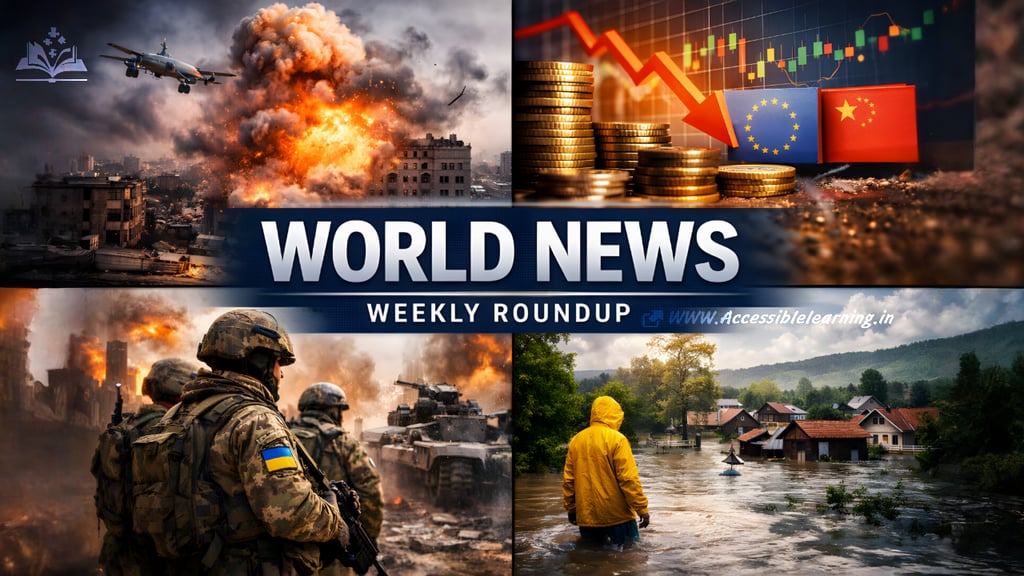
Last week’s global developments reflected a world under pressure from multiple directions. Military conflicts intensified, economic systems faced strain, climate challenges continued to disrupt lives, and political decisions reshaped international relationships. From energy shortages and trade disruptions to diplomatic efforts and security concerns, these events reveal how closely connected today’s global landscape has become. This article brings together the most important non-entertainment world news from last week, explaining each development with clarity and context.
Russia–Ukraine War Intensifies Ahead of Diplomatic Talks
Last week saw a sharp escalation in the Russia–Ukraine war as Russian forces launched one of the heaviest coordinated drone and missile attacks on Kyiv in recent months. Residential buildings, energy infrastructure, and key urban areas were hit, leaving civilians injured and parts of the capital without electricity and heating during freezing winter conditions.
The strikes occurred just days before Ukrainian President Volodymyr Zelenskyy was expected to meet U.S. President Donald Trump to discuss a proposed peace framework. The draft plan reportedly includes freezing front lines, securing Western military and financial guarantees, and outlining future negotiations over disputed territories. Despite diplomatic momentum, unresolved disagreements over sovereignty and territorial control continue to block progress.
U.S. Conducts Airstrikes Against Islamic State in Nigeria
On December 25, the United States carried out airstrikes against Islamic State–linked militants in northwest Nigeria. The operation was conducted in coordination with Nigerian authorities and targeted known militant camps believed to be responsible for attacks on civilians and security forces.
U.S. officials described the mission as part of ongoing counterterrorism cooperation, while Nigerian leaders emphasized the importance of international intelligence and air support in addressing insurgent threats across the region.
China Strengthens Trade Powers With New Foreign Trade Law
China’s top legislature approved a revised Foreign Trade Law designed to give Beijing greater control over exports, imports, and trade dispute responses. The law expands the government’s authority to restrict sensitive goods, counter foreign sanctions, and protect strategic industries.
The update comes amid continued economic competition with the United States and Europe, as well as concerns over supply chain security, advanced technology exports, and global market access. The law is scheduled to take effect in early 2026.
European Union Extends Sanctions on Russia
European Union leaders agreed to extend economic sanctions on Russia until mid-2026. The measures continue to restrict trade, finance, energy cooperation, and technology transfers in response to Russia’s military actions in Ukraine.
While Moscow has signaled interest in legal assurances limiting escalation with NATO and the EU, no binding agreements were reached. The extension reflects the EU’s continued alignment with Ukraine and its long-term strategy to apply economic pressure on Russia.
United States Begins 250th Anniversary Commemorations
In the United States, preparations began for the country’s 250th anniversary in 2026. New York City unveiled a redesigned patriotic crystal ball for the annual Times Square New Year’s Eve celebration, marking the start of a yearlong national commemoration.
Officials announced plans for civic events, volunteer initiatives, and historical programs aimed at emphasizing unity and democratic values ahead of the milestone anniversary.
Flood Aftermath Continues Across Southeast and South Asia
Although the worst flooding occurred earlier, the humanitarian impact remained severe last week across parts of Southeast and South Asia. Millions remain displaced following widespread floods and landslides caused by intense cyclones and seasonal rainfall.
Countries including Indonesia, Sri Lanka, Thailand, and Malaysia are still managing recovery efforts as damaged infrastructure, food shortages, and disrupted livelihoods continue to affect local populations.
Youth-Led Protests Persist in Morocco
Protests led largely by young people continued in Morocco last week, driven by rising unemployment, economic inequality, and dissatisfaction with public services. Demonstrations spread across major cities, with authorities reporting arrests and clashes in some areas.
The movement reflects growing frustration among younger generations and ongoing demands for political transparency and economic opportunity.
Lingering Impact of Cyclones in South Asia
Southern India and Sri Lanka are still dealing with the aftermath of powerful cyclones that struck in recent weeks. Flooded communities, damaged homes, and strained emergency services remain a challenge as governments and aid organizations focus on reconstruction and disaster preparedness.
The repeated impact of extreme weather events continues to strain regional resources and exposes vulnerabilities in disaster management systems.

Iran Expands Uranium Enrichment Amid Nuclear Tensions
Iran announced a further expansion of its uranium enrichment program, increasing both production capacity and enrichment levels at key facilities. The move follows stalled nuclear negotiations with Western powers and ongoing disputes with international nuclear inspectors. European governments expressed concern over reduced transparency, while Tehran stated the decision was within its sovereign rights.
The development adds pressure to an already fragile diplomatic environment and raises concerns about nuclear escalation in the Middle East.
Red Sea Shipping Disruptions Continue to Impact Global Trade
Commercial shipping through the Red Sea remained heavily disrupted last week due to continued attacks and threats against cargo vessels. Several major shipping companies extended their decision to reroute ships around the Cape of Good Hope, significantly increasing transit times and costs.
The disruption has contributed to higher freight rates, delayed deliveries, and growing inflationary pressure on global supply chains, particularly affecting energy and food imports.
North Korea Conducts New Missile Tests
North Korea carried out additional missile tests last week, launching short- and medium-range projectiles into nearby waters. State media described the tests as routine military exercises, while neighboring countries raised security concerns.
South Korea and Japan increased surveillance and defense readiness, and regional allies reiterated calls for restraint amid fears of further escalation on the Korean Peninsula.
Argentina Implements Emergency Economic Measures
Argentina’s government introduced emergency economic reforms aimed at stabilizing the peso and controlling inflation. Measures included cuts to public subsidies, currency controls adjustments, and reduced government spending.
While officials argue the reforms are necessary to restore investor confidence and prevent further economic deterioration, labor unions and civil society groups organized protests, warning of rising poverty and unemployment.
Sudan Conflict Deepens as Humanitarian Crisis Worsens
Fighting between rival military factions in Sudan intensified last week, with renewed clashes reported in and around major cities. Aid agencies warned that access to food, clean water, and medical supplies continues to shrink as displacement rises.
Millions remain internally displaced or have fled to neighboring countries, creating one of the world’s largest and least-funded humanitarian emergencies.
Arctic Nations Hold Emergency Talks on Climate Security
Several Arctic nations convened emergency discussions after new data showed accelerated ice loss and rising military activity in the region. Melting ice has opened new shipping routes and access to resources, increasing strategic competition among global powers.
Officials emphasized the need for cooperation on environmental protection, maritime safety, and conflict prevention as the Arctic becomes more accessible year by year.
Pakistan Faces Nationwide Power Shortages Amid Fuel Constraints
Pakistan experienced widespread power outages last week as fuel supply constraints and rising energy demand strained the national grid. Several industrial zones were forced to reduce operations, while residential areas faced extended blackouts. Government officials cited delayed fuel shipments and financial pressure on power producers as key factors.
The situation has raised concerns about economic productivity, inflation, and public frustration as the country enters peak winter energy demand.
Ethiopia Advances Peace Talks With Armed Groups
Ethiopia’s government confirmed progress in negotiations with armed groups in restive regions, aiming to reduce ongoing violence and stabilize affected areas. Talks focused on disarmament, humanitarian access, and regional governance reforms. While no final agreements were announced, officials described the discussions as constructive.
The negotiations come amid continued efforts to rebuild after years of conflict and to restore confidence among displaced communities.
European Central Bank Signals Cautious Approach to Interest Rates
The European Central Bank indicated it will maintain a cautious stance on interest rate changes, citing persistent inflation risks alongside slowing economic growth in several eurozone countries. Policymakers emphasized data-driven decisions and the need to balance price stability with economic resilience.
Markets reacted with volatility as investors reassessed expectations for rate cuts in early 2026.
The events of last week highlight a world navigating uncertainty on many fronts. Ongoing conflicts continue to test diplomatic efforts, economic pressures are reshaping national policies, and climate-related challenges remain a persistent threat to stability. At the same time, negotiations, reforms, and international discussions show that governments are actively responding to these pressures. As the global situation evolves, these developments will play a significant role in shaping political decisions, economic strategies, and international cooperation in the weeks ahead.
Subscribe to Frontier Intelligence
All © Copyright reserved by Accessible-Learning Hub
| Terms & Conditions
Accessible Learning Hub — Actionable clarity for high-agency minds.
Weekly breakdowns on AI breakthroughs, capital flow, and human performance systems. Zero fluff.