

Kharchi Puja: The Seven-Day Festival That Reveals the Real Soul of Tripura
Discover the history, rituals, significance, and cultural impact of Kharchi Puja, Tripura's iconic seven-day festival dedicated to the worship of the fourteen Chaturdasha Devata deities.
CULTURE/TRADITIONINDIA/BHARAT
Jagdish Nishad
7/10/20264 min read
Kharchi Puja is not a colorful side attraction. It is one of the most important religious and cultural events in Tripura, and every year it exposes a truth that many outsiders miss: the state's identity still rests on a powerful blend of indigenous traditions, royal history, and living faith.
Held annually in July at the Chaturdasha Devata Temple near Agartala, Kharchi Puja revolves around the worship of fourteen deities known collectively as the Chaturdasha Devata. The festival lasts seven days, draws massive crowds, and transforms a religious ceremony into one of the largest social gatherings in the state.
Kharchi Puja Is Built Around Fourteen Gods, Not One
Most major Indian festivals focus on a single deity or a small group of divine figures. Kharchi Puja breaks that pattern.
The entire festival centers on fourteen deities worshipped by the former royal family of Tripura. These gods represent a unique fusion of tribal belief systems and Hindu traditions. Their names include Shiva, Durga, Vishnu, Lakshmi, Saraswati, Kartikeya, Ganesha, and several local divine forms rooted in Tripura's indigenous culture.
The word "Kharchi" itself carries multiple interpretations. Many historians connect it to rituals of purification. Others trace it to ancient tribal traditions associated with cleansing the earth after periods considered ritually impure. Regardless of interpretation, purification remains the festival's core theme.
The Festival Begins With a Public Ritual Few Outsiders Ever Understand
The most dramatic moment arrives on the opening day.
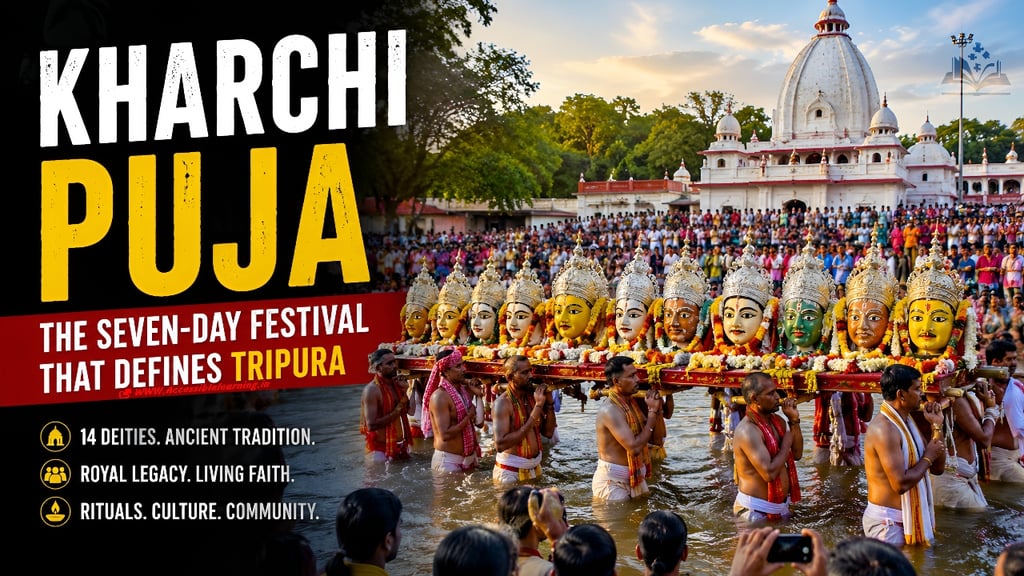
Priests carry the fourteen deity heads from the temple and take them to the banks of the Haora River for a ceremonial bath. Thousands gather to witness the procession. Drums thunder. Traditional musicians fill the air with sound. Security personnel struggle to manage the crowds.
Tourism brochures often romanticize this scene. They rarely mention the logistical challenge behind it.
Roads become congested. Local businesses adjust schedules. Authorities deploy extensive crowd-control measures. Vendors, transport operators, and temporary workers prepare weeks in advance because the festival creates a sudden surge in demand.
Kharchi Puja is not merely a religious event. It is a massive operational exercise.
The Royal Legacy Still Shapes Everything
You cannot understand Kharchi Puja without understanding Tripura's monarchy.
For centuries, the Manikya kings used the worship of the Chaturdasha Devata as a symbol of political authority and cultural unity. The royal court institutionalized these rituals and helped preserve them through major social and political changes.
Even after the monarchy disappeared, the festival remained. That survival matters.
Many royal traditions across South Asia faded into museum pieces. Kharchi Puja refused to become a historical artifact. Local communities continued the rituals, ensuring that the festival remained a living institution rather than a ceremonial performance for visitors.
The Economic Impact Is Bigger Than Most People Realize
Every year, Kharchi Puja pumps significant economic activity into the surrounding region.
Temporary markets emerge around the temple grounds. Food stalls multiply. Artisans sell traditional goods. Transport services experience higher demand. Small businesses often earn a substantial share of their seasonal income during the festival period.
This reality rarely appears in cultural discussions. People talk about devotion. They talk about heritage. They talk about tradition. Money moves just as fast.
A festival that attracts thousands of visitors inevitably becomes an economic engine. Local livelihoods depend on that annual influx of people.
Kharchi Puja Reveals Tripura's Complex Cultural Identity
The most fascinating aspect of Kharchi Puja is not the ritual itself. It is what the ritual represents.
Tripura sits at a cultural crossroads where tribal traditions, Bengali influences, Hindu practices, and regional histories constantly interact. Kharchi Puja embodies that intersection more clearly than almost any other event in the state.
The festival refuses simplistic labels.
Calling it purely tribal ignores centuries of Hindu influence.
Calling it purely Hindu ignores its indigenous foundations.
That tension is exactly what makes Kharchi Puja culturally significant.
It demonstrates how traditions evolve without completely abandoning their origins.

Modernization Has Not Killed the Festival
Many traditional festivals struggle against urbanization, digital entertainment, and changing lifestyles.
Kharchi Puja continues to attract large crowds.
Younger generations still participate. Local governments still support the event. Religious institutions still maintain the rituals. Vendors still invest in temporary businesses around the celebration.
The festival survives because it offers something social media cannot replicate: physical participation in a shared cultural experience.
People do not attend Kharchi Puja merely to observe. They attend to belonging.
Kharchi Puja is far more than a regional religious festival. It is a living demonstration of Tripura's history, identity, economy, and social structure.
The ceremonial bathing of fourteen deities may dominate the headlines, but the real story lies beneath the spectacle.
Kharchi Puja preserves ancient traditions, sustains local commerce, reinforces community bonds, and keeps a unique cultural heritage alive in an era that constantly pushes toward uniformity.
That is why the festival continues to matter. And that is why it remains one of the most revealing cultural events in Tripura.
FAQ's
Q: What is Kharchi Puja?
Kharchi Puja is a seven-day Hindu and indigenous tribal festival celebrated in the Indian state of Tripura. The festival centers on the worship of the fourteen deities known as the Chaturdasha Devata and is considered one of Tripura's most important cultural and religious events.
Q: Why is Kharchi Puja celebrated?
Kharchi Puja is traditionally associated with purification rituals and the worship of the Earth and fourteen guardian deities. The festival symbolizes cleansing, renewal, and spiritual well-being for the community.
Q: Where is Kharchi Puja celebrated?
The main celebrations take place at the Chaturdasha Devata Temple near Agartala, although devotees from across Tripura and neighboring regions participate in the festival.
Q: Who are the fourteen gods worshipped during Kharchi Puja?
The fourteen deities, known as the Chaturdasha Devata, include a blend of Hindu gods and indigenous tribal divine figures. They have been worshipped for centuries as the traditional guardian deities of Tripura.
Q: When is Kharchi Puja celebrated?
Kharchi Puja is usually celebrated in July during the Hindu month of Ashadha. The exact dates vary each year according to the traditional lunar calendar.
Q: What are the main rituals of Kharchi Puja?
The most significant ritual is the ceremonial procession and bathing of the fourteen deity heads in the Haora River. This is followed by prayers, offerings, cultural performances, fairs, and community gatherings over seven days.
Q: Why is Kharchi Puja important for Tripura's culture?
Kharchi Puja preserves Tripura's unique blend of tribal heritage, royal traditions, and Hindu religious practices. It also supports local businesses, attracts visitors, and strengthens cultural identity across generations.
Subscribe To Our Newsletter
All © Copyright reserved by Accessible-Learning Hub
| Terms & Conditions
Knowledge is power. Learn with Us. 📚

