

Karka Sankranti: The Day India Quietly Changes Seasons While Most People Miss the Real Story
Discover the real meaning of Karka Sankranti, the solar transition that marks Dakshinayana, seasonal change, agricultural planning, and ancient traditions. Explore its hidden cultural impact, rituals, and significance across India.
CULTURE/TRADITIONINDIA/BHARAT
Jagdish Nishad
7/4/20264 min read
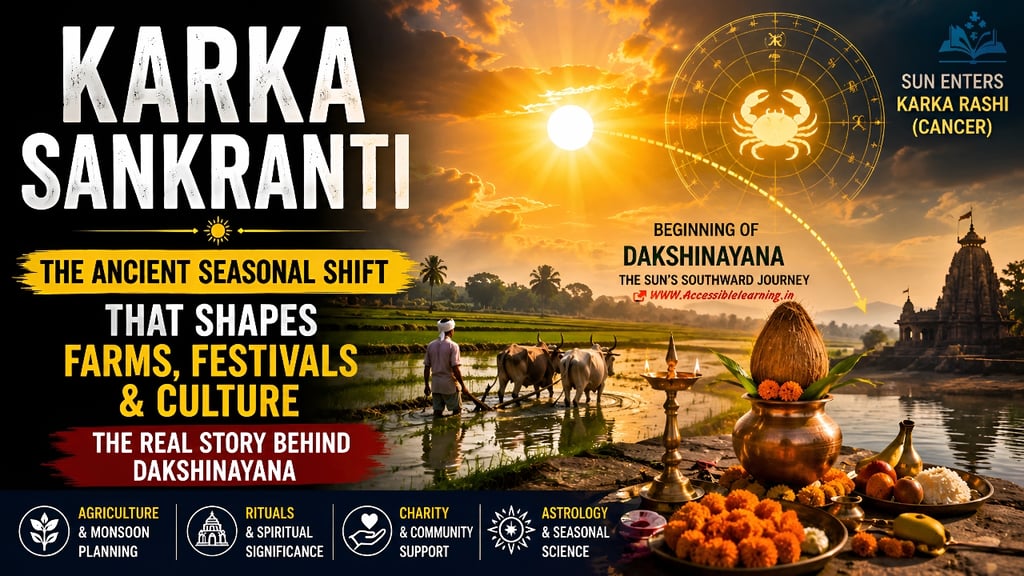
Karka Sankranti marks the Sun's transition into the zodiac sign of Cancer (Karka Rashi). That sounds like a harmless astrological event until you realize it signals one of the most important seasonal shifts in the Indian calendar. This day traditionally marks the beginning of Dakshinayana, the Sun's southward journey, a period many Hindu traditions associate with introspection, spiritual discipline, and preparation for major festivals ahead.
Karka Sankranti Is Not Just a Festival. It Is a Seasonal Warning Signal.
Most people treat Karka Sankranti as another date on the religious calendar. Historically, communities treated it as something far more practical.
This transition arrives during the peak monsoon season across much of India. Farmers closely observed this period because rainfall patterns, soil conditions, and crop planning directly affected survival. Before weather apps and satellite forecasts existed, seasonal markers like Karka Sankranti helped communities organize agricultural life.
The religious rituals often overshadow this reality. The festival emerged from a society that depended on reading nature correctly. Miss the season, and you risked losing an entire harvest.
The Real Meaning Behind Dakshinayana
Karka Sankranti traditionally marks the start of Dakshinayana, the six-month period when the Sun appears to move southward relative to Earth.
Ancient Hindu texts describe this phase as a quieter, more reflective period compared to Uttarayana. Many communities believe spiritual practices performed during Dakshinayana carry deeper significance because nature itself begins shifting toward conservation and inward focus.
This belief shaped everything from temple rituals to pilgrimage schedules.
The modern obsession with festival selfies rarely captures this larger philosophical idea: Karka Sankranti was designed to remind people that growth requires cycles of withdrawal, reflection, and preparation.
Why Farmers Still Take This Day Seriously
Urban India often ignores Karka Sankranti. Rural India largely does not.
Across agricultural regions, the timing aligns with critical stages of monsoon farming. Farmers monitor rainfall intensity, field conditions, and crop development during this period.
For centuries, Karka Sankranti acted as a natural checkpoint. Communities evaluated whether monsoon patterns matched expectations and adjusted agricultural decisions accordingly.
The cultural ceremony may last a day. The agricultural consequences can influence an entire season.
That reality explains why the event continues to hold relevance despite rapid modernization.
Charity and Rituals: More Than Religious Formalities
Many devotees perform holy baths, offer prayers to the Sun God, donate food, clothing, grains, and money, and visit temples.
Critics often dismiss these activities as ritualistic repetition.
They miss the historical function.
Monsoon seasons traditionally created economic uncertainty. Donations during Karka Sankranti helped redistribute resources within communities when vulnerable households faced seasonal challenges.
What appears to be a simple religious act often served as an informal social welfare mechanism long before government assistance programs existed.
The Regional Traditions Most Outsiders Never Hear About
Karka Sankranti does not command the national attention enjoyed by festivals like Diwali or Holi. Yet regional observances remain deeply rooted.
In parts of Odisha, Karnataka, Kerala, Maharashtra, and other regions, local customs blend solar worship, temple ceremonies, community gatherings, and seasonal food traditions.
Some communities emphasize agricultural blessings. Others focus on ancestor remembrance, charity, or spiritual discipline.
This diversity reveals a larger truth about Indian culture: there is no single version of Karka Sankranti. Every region adapts the observance to its environment, economy, and history.

The Commercial World Ignores Karka Sankranti for a Reason
Karka Sankranti lacks the massive consumer spending associated with India's biggest festivals.
No nationwide shopping frenzy drives headlines.
No billion-rupee advertising campaigns dominate television screens.
As a result, mainstream coverage often overlooks it.
Ironically, that makes Karka Sankranti one of the more authentic seasonal observances still surviving in modern India. It remains connected to agriculture, astronomy, charity, and community rather than pure consumerism.
The Cultural Impact Nobody Talks About
Karka Sankranti preserves something increasingly rare: a direct connection between celestial observation and daily life. Ancient societies watched the sky because their survival depended on it. Modern society watches screens instead.
Yet every year, Karka Sankranti quietly reminds millions that human life still operates within larger natural cycles. Monsoons still matter. Seasons still matter. Food production still matters. The festival survives because those realities never disappeared.
Karka Sankranti is not a flashy celebration. It does not dominate social media trends or generate massive tourism campaigns. What it does represent is far more important.
It marks a turning point in the seasonal calendar, reinforces agricultural awareness, encourages community support through charity, and preserves one of India's oldest relationships with the natural world.
Ignore the astrology if you want.
Ignore the rituals if you choose.
But ignore the seasonal wisdom behind Karka Sankranti, and you miss the entire reason this observance survived for centuries in the first place.
FAQ's
Q: What is Karka Sankranti?
Karka Sankranti is a Hindu solar event that marks the Sun's transition into Cancer (Karka Rashi). It traditionally signals the beginning of Dakshinayana, the Sun's southward journey in the Hindu calendar.
Q: Why is Karka Sankranti important in Hindu tradition?
The day holds religious, seasonal, and agricultural significance. Many Hindus perform prayers, charitable acts, and sacred rituals, while farming communities view it as an important marker during the monsoon season.
Q: What is Dakshinayana, and how is it connected to Karka Sankranti?
Dakshinayana begins on Karka Sankranti. According to Hindu beliefs, it represents a six-month period dedicated to spiritual reflection, discipline, and preparation for major festivals and religious observances.
Q: How is Karka Sankranti celebrated across India?
Celebrations vary by region but commonly include temple visits, Surya (Sun God) worship, holy river baths, donations to the needy, community gatherings, and special seasonal food offerings.
Q: What is the agricultural significance of Karka Sankranti?
Historically, Karka Sankranti served as a seasonal checkpoint for farmers during the monsoon. It helped agricultural communities assess rainfall patterns, crop growth, and farming strategies for the months ahead.
Q: Is Karka Sankranti the same as Makar Sankranti?
No. Karka Sankranti marks the Sun's entry into Cancer (Karka), while Makar Sankranti marks its entry into Capricorn (Makara). Both are important solar transitions but occur at different times of the year and carry different cultural meanings.
Q: What charitable activities are performed on Karka Sankranti?
Many devotees donate food, grains, clothing, and money to the poor. These traditions reflect the festival's long-standing emphasis on community welfare and social responsibility.
Q: When is Karka Sankranti celebrated?
Karka Sankranti is usually observed in mid-July each year, though the exact date can vary slightly depending on astronomical calculations and regional calendars.
Subscribe To Our Newsletter
All © Copyright reserved by Accessible-Learning Hub
| Terms & Conditions
Knowledge is power. Learn with Us. 📚

