

JAXA's MMX Mission Explained: Why Phobos Is the Most Dangerous Moon to Land On
Discover how JAXA's MMX mission will collect samples from Mars' doomed moon Phobos, overcome near-zero gravity, and return them to Earth by 2031.
SPACE & EXPLORATION
Sachin K Chaurasiya
7/25/20268 min read
The Start: One Wrong Push and the Entire Mission Floats Away
Imagine spending more than a decade designing a spacecraft, launching it across hundreds of millions of kilometers, and arriving at one of the strangest worlds in the Solar System.
Now imagine that after all of that, the biggest danger isn't crashing.
It's pushing too hard.
That's the terrifying reality facing Japan's Martian Moons eXploration (MMX) mission. Scheduled to launch in late 2026, the spacecraft will spend years traveling to Mars before attempting something humanity has never accomplished: landing on the tiny moon Phobos, deploying a rover, collecting samples, and returning them safely to Earth by 2031.
But "landing" isn't really the right word.
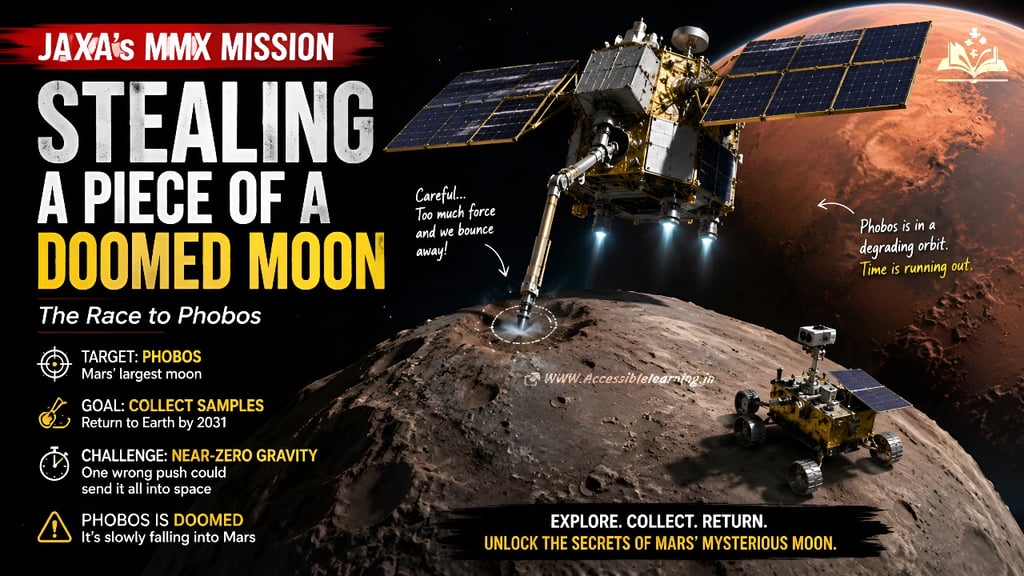
Phobos has such weak gravity that a heavy spacecraft cannot simply touch down the way a lunar lander lands on the Moon. Engineers must instead perform something closer to an ultra-gentle docking maneuver. Even the force created by a robotic arm digging into the surface could produce enough recoil to send the spacecraft drifting away.
It's the cosmic equivalent of trying to stand on a balloon without bouncing off.
And that's only the beginning.
The destination itself is dying.
Every orbit, Phobos moves slightly closer to Mars. Scientists know it is slowly spiraling inward, trapped in a gravitational countdown that will eventually tear the moon apart before its remains crash into the Red Planet.
That makes this mission feel less like ordinary exploration and more like a rescue operation across time.
Japan isn't just visiting another moon.
It is trying to steal a piece of a doomed world before that world disappears forever.
"The greatest danger isn't crashing into Phobos. It's accidentally pushing yourself away from it."
The Big Problem: How Do You Land Where Gravity Barely Exists?
Most people assume landing on another world means slowing down and touching the ground.
That works on Earth.
It works on the Moon.
It even works on Mars.
Phobos plays by completely different rules.
The moon is only about 27 kilometers (17 miles) across. Because it is so small, its gravity is incredibly weak. A person weighing 70 kilograms on Earth would effectively weigh only a few dozen grams there.
Walking normally would be impossible.
Jumping would launch you into space.
A careless movement could send you floating away forever.
For engineers, this creates an impossible balancing act.
The MMX spacecraft cannot simply fire powerful landing engines because they could kick up debris or destabilize the vehicle. It cannot slam a robotic scoop into the ground because Newton's Third Law always wins. Every action produces an equal and opposite reaction.
If the scoop pushes down...
The spacecraft gets pushed upward.
Even a tiny recoil matters when gravity barely exists.
That forced JAXA engineers to rethink nearly every rule of planetary exploration.
Instead of brute force, the spacecraft must rely on precision measured in centimeters and fractions of a second.
Some of the engineering challenges include:
Matching Phobos' motion while orbiting Mars
Touching the surface gently enough to avoid bouncing away
Collecting material without destabilizing the spacecraft
Keeping dust from damaging sensitive instruments
Escaping safely after sample collection
Each step sounds manageable.
Together, they become one of the most delicate space operations ever attempted.
The Strange World Called Phobos
At first glance, Phobos looks like a giant potato floating above Mars. Its irregular shape is covered with ancient craters, giant grooves, and loose dust called regolith.
Unlike Earth's Moon, Phobos never became a perfect sphere because it simply wasn't massive enough. The moon circles Mars at astonishing speed. It completes one orbit in just 7 hours and 39 minutes, making it one of the fastest-orbiting moons in the Solar System.
Even stranger, it rises in the west and sets in the east for anyone standing on Mars. Yet scientists still argue over one huge mystery.
Where did Phobos come from?
There are two leading ideas. The first suggests it was once an asteroid captured by Mars.
The second argues it formed from debris blasted into space after a gigantic impact on Mars billions of years ago. The MMX mission could finally settle that debate.
If returned samples resemble Martian rocks, the impact theory gains support.
If they resemble primitive asteroids, the capture theory becomes much stronger.
The answer could rewrite what we know about how planetary systems evolve.
"Phobos isn't just orbiting Mars. It is slowly falling toward its own destruction."


The Main Event: Japan's Most Ambitious Deep-Space Adventure
The MMX mission represents one of Japan's boldest scientific projects. The spacecraft will journey to Mars, enter orbit, repeatedly approach Phobos, and carefully select the safest location for sampling.
Instead of rushing, scientists plan months of detailed mapping.
High-resolution cameras, laser altimeters, and scientific instruments will study:
Surface composition
Internal structure
Temperature variations
Dust behavior
Gravitational properties
Only after understanding the landscape will the spacecraft begin its historic sampling attempt.
The process is incredibly delicate.
The spacecraft slowly approaches.
Navigation systems constantly correct their position.
Touchdown occurs for only a brief period.
A sampling mechanism gathers material.
Then the spacecraft immediately backs away.
It sounds simple.
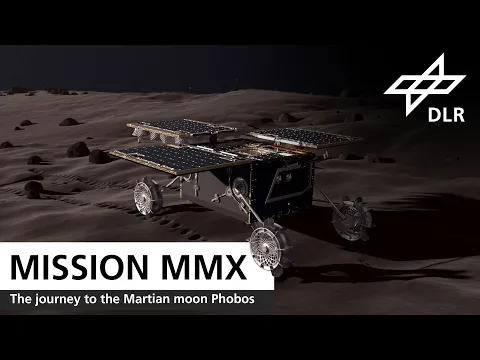
In reality, it combines orbital mechanics, robotics, artificial intelligence, and extreme precision under conditions never experienced on Earth. Meanwhile, a small rover developed through international collaboration will also descend onto Phobos.
Because gravity is almost nonexistent, even driving becomes unusual. Traditional wheels provide little traction. Instead of rolling like cars on Earth, the rover may hop, tumble, or carefully reposition itself while investigating the surface.
Everything about this mission requires engineers to abandon assumptions formed by decades of exploration on planets and larger moons.
The Physics Nightmare Nobody Can Practice on Earth
Testing equipment for Phobos presents another enormous problem.
Earth's gravity is too strong.
Mars' gravity is still far too strong.
Even airplanes flying parabolic "zero-g" flights only provide a few seconds of weightlessness.
Nothing on Earth perfectly recreates Phobos.
That means engineers depend heavily on the following:
Computer simulations
Suspension systems
Drop towers
Robotic laboratories
Mathematical modeling
Even then, uncertainty remains.
Tiny forces that seem insignificant on Earth become mission-critical on Phobos.
Imagine balancing a feather on another feather during a hurricane.
That is roughly the level of precision required.
This is why MMX is often described as one of the most technically demanding sample-return missions ever designed.
A Moon Living on Borrowed Time
Perhaps the most fascinating part of this story isn't the spacecraft.
It's the destination.
Phobos is doomed.
Unlike Earth's Moon, which slowly moves away from us every year, Phobos is spiraling inward toward Mars. The enormous gravitational forces acting on the moon continue pulling it closer.
Scientists estimate that within tens of millions of years, Phobos will cross a critical boundary where Mars' gravity overwhelms the moon's structural strength.
At that point, one of two things may happen.
Either:
Phobos breaks apart into a spectacular ring around Mars.
Or:
Large fragments eventually crash onto the Martian surface.
From a human perspective, tens of millions of years sounds unimaginably distant. Astronomically, it is surprisingly soon. In planetary history, Phobos is already approaching its final chapter.
That makes every scientific measurement taken today a glimpse into a world that future civilizations may never see.
What Scientists Hope to Bring Home
Returning samples from Phobos is about much more than collecting unusual rocks. Inside those grains could be billions of years of Solar System history.
Scientists hope to discover:
Whether Phobos originated from Mars or an asteroid
Evidence of ancient impacts on Mars
Minerals never studied directly before
Organic molecules from the early Solar System
Clues about how moons evolve around planets
There is another exciting possibility.
For millions of years, powerful asteroid impacts on Mars have blasted Martian rocks into space.
Some of that debris may have landed on Phobos.
If so, tiny pieces of Mars itself could be hiding within the returned samples.
Instead of drilling into Mars, scientists may receive ancient Martian material delivered naturally to Phobos over billions of years. It would be one of nature's greatest sample-delivery systems.
The International Team Behind the Mission
Although MMX is led by Japan, it represents international cooperation. Researchers and engineers from multiple countries contribute scientific instruments, technology, and mission planning.
This collaboration reflects a growing trend in space exploration. Modern missions increasingly combine expertise from agencies around the world rather than relying on a single nation.
The knowledge gained will support future missions to:
Mars
Asteroids
Small moons
Comets
Other low-gravity destinations
Every lesson learned on Phobos makes future exploration safer and more efficient.
Why It Matters: The Future of Space Mining May Begin on a Tiny Moon
The phrase "How Japan Plans to Steal a Piece of a Doomed Moon" sounds like science fiction. Yet it captures something much bigger than one ambitious mission.
Humanity's future in space will depend on learning how to work on tiny worlds where gravity barely exists. Many asteroids contain metals, water ice, and other valuable resources.
Mining them won't resemble mining on Earth.
The biggest challenge won't be digging.
It will be staying attached to the surface while doing it.
MMX serves as a rehearsal for that future.
Every successful maneuver teaches engineers how spacecraft can safely interact with small celestial bodies without drifting into space.
At the same time, the mission may solve one of Mars' oldest mysteries while preserving material from a moon that is slowly disappearing.
If everything goes according to plan, samples collected from Phobos will arrive on Earth around 2031.
Inside a sealed container no larger than a small capsule could be answers to questions scientists have debated for generations.
Where did Mars' moons come from?
How do small worlds evolve?
Can humans safely operate on almost weightless objects?
And perhaps most importantly, can we master the strange physics that will define humanity's future beyond Earth?
Long before astronauts build cities on Mars or mine distant asteroids, one quiet Japanese spacecraft may prove that the impossible is simply a matter of learning how gently to touch another world.
FAQ's
Q: What is JAXA's MMX mission?
JAXA's Martian Moons eXploration (MMX) mission is a Japanese space mission scheduled to launch in late 2026. Its primary goal is to explore Mars' moons, especially Phobos, collect surface samples, deploy a small rover, and return the samples to Earth by 2031.
Q: Why is Phobos considered a "doomed moon"?
Phobos is slowly spiraling toward Mars due to the planet's gravitational pull. Scientists believe that in tens of millions of years, it will either break apart into a ring around Mars or crash into the planet, making it a unique target for scientific study before its eventual destruction.
Q: Why is landing on Phobos so difficult?
Phobos has extremely weak gravity, making a traditional landing impossible. The MMX spacecraft must perform a controlled docking-like maneuver because even the force from collecting a sample could push the spacecraft away from the moon's surface.
Q: What will the MMX mission collect from Phobos?
The mission aims to collect at least 10 grams of surface material, including dust and rocks. Scientists will analyze these samples to determine whether Phobos originated from a captured asteroid or formed from debris created by a massive impact on Mars.
Q: How could MMX help scientists understand Mars?
Over billions of years, asteroid impacts may have blasted Martian rocks onto Phobos. If those fragments are found in the returned samples, researchers could study ancient Martian material without needing to retrieve it directly from Mars.
Q: What rover will explore Phobos during the MMX mission?
MMX will deploy a small rover designed to operate in Phobos' ultra-low gravity. It will capture close-up images, measure surface properties, and study how the moon's loose regolith behaves in near-weightless conditions.
Q: When will the MMX samples return to Earth?
If the mission proceeds as planned, the spacecraft will return its sample capsule to Earth in 2031, allowing scientists worldwide to analyze some of the first-ever pristine samples collected from a Martian moon.
Q: Why is the MMX mission important for future space exploration?
MMX will demonstrate how spacecraft can safely land, collect samples, and operate on extremely low-gravity worlds. These technologies are expected to play a crucial role in future asteroid mining, Mars exploration, and deep-space resource missions.
Subscribe to Frontier Intelligence
All © Copyright reserved by Accessible-Learning Hub
Accessible Learning Hub — Actionable clarity for high-agency minds.
Weekly breakdowns on AI breakthroughs, capital flow, and human performance systems. Zero fluff.