

Jagannath Rath Yatra Odisha: History, Rituals, Significance & Hidden Facts
Jagannath Rath Yatra in Odisha is one of the world's largest religious festivals. Discover its history, rituals, cultural significance, economic impact, and the massive logistics behind Puri's iconic chariot procession.
CULTURE/TRADITIONINDIA/BHARATEVENT/SPECIAL
Jagdish Nishad
7/5/20264 min read
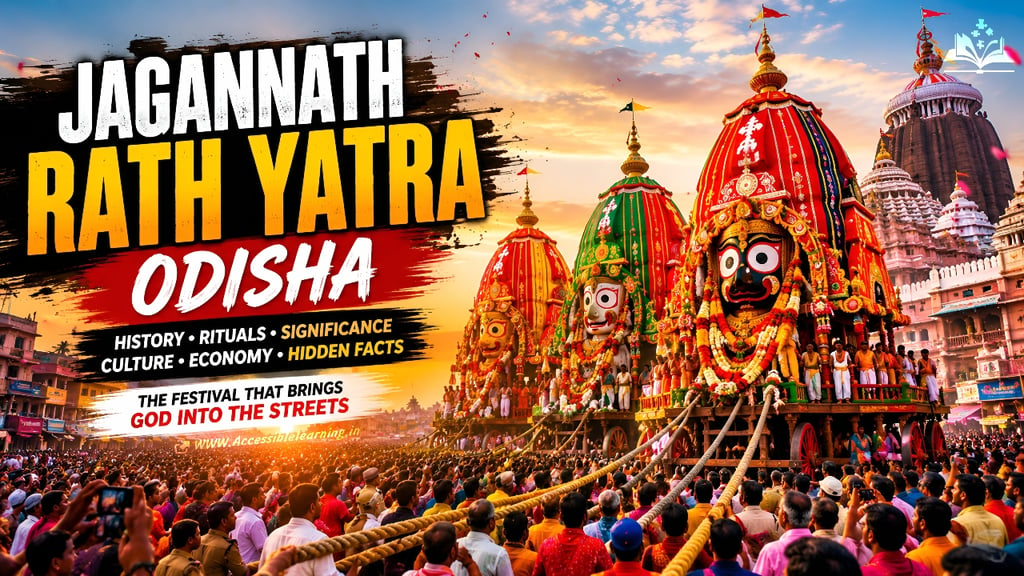
Every year, millions gather in Puri for one reason: they believe God leaves his temple and joins ordinary people. No VIP pass. No royal gate. No exclusive access. The Jagannath Rath Yatra is one of the largest religious gatherings on Earth, and it turns a coastal city in Odisha into a massive human tide driven by faith, tradition, logistics, and economic power.
The Brutal Scale Most People Never Understand
Forget the colorful photographs.
The Jagannath Rath Yatra moves three gigantic wooden chariots through the streets of Puri. These are not symbolic floats. Workers construct them from scratch every year using thousands of pieces of wood sourced through a centuries-old process.
The three chariots represent the following:
Jagannath Ji
Balabhadra Ji
Maa Subhadra
Each structure rises several stories high and weighs tons. Thousands of devotees pull the ropes simultaneously. The movement looks spiritual from a distance, but it also demands military-level crowd management.
One mistake can trigger chaos.
That reality explains why authorities deploy extensive security forces, medical teams, surveillance systems, and emergency response units every year.
This Festival Breaks the Traditional Temple Barrier
Many Hindu temples restrict entry based on specific religious rules. The Jagannath Temple in Puri maintains its own long-standing entry regulations. The Rath Yatra flips that dynamic.
Jagannath Ji comes out of the temple and enters public space. Anyone standing on the route can witness the procession. That single act explains why the festival carries enormous emotional power across social classes.
The message remains blunt: if people cannot enter the sanctum, the deity will come to them.
Few religious events demonstrate accessibility with such dramatic symbolism.
The Hidden Machine Behind the Celebration
Most visitors see devotion. Few notice the industrial operation running underneath.
Months before the procession begins, carpenters, temple servitors, administrators, police officers, sanitation workers, transportation agencies, vendors, and local businesses start preparing.
The annual rebuilding of the chariots creates jobs and preserves traditional craftsmanship. Hotels fill. Restaurants overflow. Transportation networks strain under pressure. Temporary markets emerge almost overnight.
For Odisha, Rath Yatra functions as both a spiritual event and a major economic engine.
Faith drives the gathering.
Money keeps the ecosystem running.
Why Jagannath Matters Far Beyond Odisha
The influence of Lord Jagannath extends well beyond Puri.
The festival inspired global celebrations in cities across Europe, North America, Australia, and Southeast Asia. Hindu communities worldwide organize their own Rath Yatras, carrying forward a tradition that originated on Odisha's coastline centuries ago.
This international expansion transformed Jagannath from a regional deity into a global cultural symbol.
Yet many copies miss the original context.
Puri's Rath Yatra carries centuries of ritual complexity, hereditary service traditions, local history, and cultural memory that cannot be replicated by simply building a decorated cart.
The Environmental and Infrastructure Challenge Nobody Likes to Discuss
Millions of visitors create enormous pressure on a relatively small city.
Waste management becomes a constant battle. Traffic systems reach their limits. Public services face extreme demand. Water, sanitation, and healthcare infrastructure must perform under extraordinary conditions.
Religious enthusiasm does not eliminate logistical reality.
Every successful Rath Yatra depends on thousands of workers solving practical problems that rarely appear in devotional narratives.
The crowd sees divine movement.
Administrators see a city operating at maximum capacity.
Both perspectives remain true.

The Cultural Impact Is Larger Than Religion
Reducing Rath Yatra to a religious procession misses the bigger picture.
The event shapes Odisha's identity, tourism industry, traditional arts, woodcraft, music, cuisine, and local economy. It reinforces community bonds while projecting Odia culture onto a global stage.
For many families, participation connects generations through shared memory. Grandparents, parents, and children often experience the festival together, creating a cultural continuity that modern entertainment struggles to match.
That enduring relevance explains why the festival survives political shifts, technological change, and social transformation.
The Real Reason Rath Yatra Endures
Many festivals attract crowds.
Few convince millions that a deity physically journeys into public life.
That idea sits at the heart of Jagannath Rath Yatra.
The massive chariots, the roaring crowds, the economic activity, and the logistical complexity all orbit one central belief: divinity should not remain locked behind walls.
Whether viewed through faith, history, culture, or sociology, Rath Yatra remains one of India's most powerful public rituals. And that is the uncomfortable truth many travel brochures avoid.
This is not merely a festival.
It is a yearly demonstration of how belief can mobilize an entire city, reshape an economy, and command the attention of millions across the world.
FAQs
Q: What is the Jagannath Rath Yatra?
Jagannath Rath Yatra is an annual Hindu festival held in Puri, Odisha, where Lord Jagannath, Lord Balabhadra, and Goddess Subhadra are taken out of the Jagannath Temple on massive wooden chariots and pulled through the city by devotees.
Q: When is Jagannath Rath Yatra celebrated?
The festival takes place every year during the Hindu month of Ashadha (June–July). The exact date changes annually according to the lunar calendar.
Q: Why is Jagannath Rath Yatra important?
The festival symbolizes Lord Jagannath leaving the temple to meet all devotees, regardless of social status, caste, or background. It represents accessibility, equality, and devotion on a massive public scale.
Q: Where does the Jagannath Rath Yatra take place?
The main Rath Yatra is held in the city of Puri, Odisha, between the Jagannath Temple and the Gundicha Temple. It attracts millions of pilgrims and tourists from around the world.
Q: How many chariots are used in the Rath Yatra?
Three chariots are used:
Nandighosa for Lord Jagannath
Taladhwaja for Lord Balabhadra
Darpadalana for Goddess Subhadra
Each chariot is newly constructed every year using traditional methods and sacred rituals.
Q: Can non-Hindus attend Jagannath Rath Yatra?
Yes. While entry to the main Jagannath Temple follows specific religious rules, anyone can watch and participate in the Rath Yatra procession on the streets of Puri.
Q: How many people attend Jagannath Rath Yatra every year?
The festival typically attracts hundreds of thousands to several million devotees and visitors, making it one of the largest religious gatherings in India and the world.
Q: What is the economic impact of Jagannath Rath Yatra on Odisha?
The festival generates significant revenue through tourism, hospitality, transportation, local businesses, handicrafts, and religious services, making it one of Odisha's most important cultural and economic events.
Subscribe To Our Newsletter
All © Copyright reserved by Accessible-Learning Hub
| Terms & Conditions
Knowledge is power. Learn with Us. 📚

