

Isra Miraj (Laylat al-Mi’raj): The Divine Journey That Redefined Faith, Prayer, and Purpose
Isra Miraj, also known as Laylat al-Mi’raj, is the miraculous night journey of Prophet Muhammad (peace be upon him) from Makkah to Jerusalem and through the heavens. This article explores its historical background, spiritual meaning, Qur’anic references, and lasting impact on Islamic faith, prayer, and daily life.
CULTURE/TRADITIONEVENT/SPECIALCELEBRATION/FESTIVALS
---
1/6/20265 min read
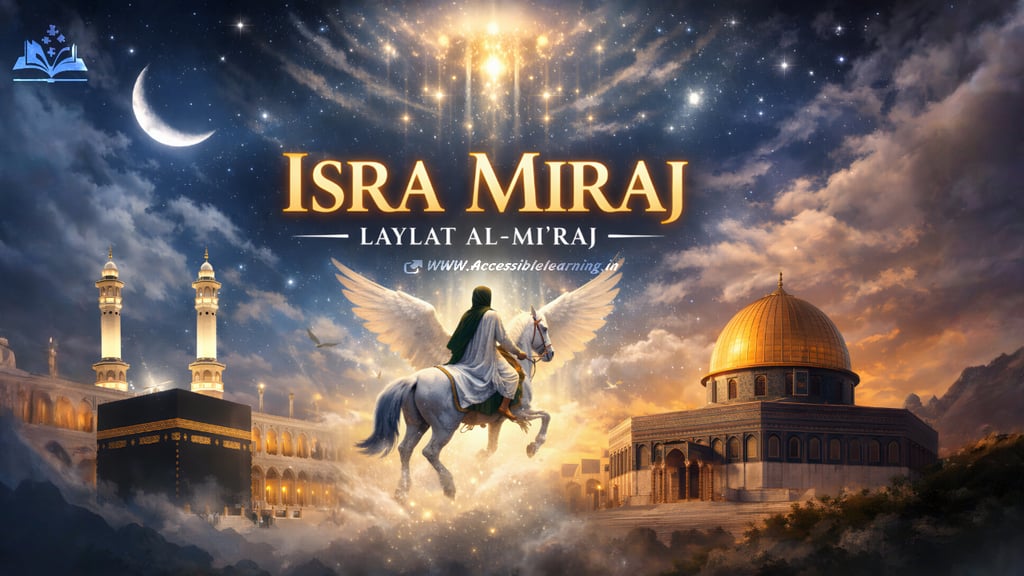
Isra Miraj, also called Laylat al-Mi’raj, is among the most extraordinary events in Islamic belief. It is not only a miracle of travel beyond time and space but also a spiritual framework that explains why prayer matters, how faith is tested, and how closeness to Allah is achieved.
This night journey stands at the intersection of history, theology, and personal transformation. It speaks to believers across centuries because its lessons are timeless.
Meaning and Linguistic Roots of Isra Miraj
Understanding the words themselves adds depth to the event.
"Isra" comes from the Arabic root meaning "to travel by night." It refers specifically to the horizontal journey from Makkah to Jerusalem.
Mi’raj comes from a root meaning “ladder” or “means of ascent.” It represents spiritual and physical elevation beyond the earthly realm.
Together, they describe a journey that moves both across the world and beyond it.
Exact Time and Scholarly Views
Most Islamic scholars agree the event occurred around 621 CE, about one year before the Hijrah to Madinah. However, scholars differ on:
The exact date (some cite 27th of Rajab; others remain cautious)
Whether the journey was physical, spiritual, or both (majority view supports both)
This diversity of scholarly thought shows that Islam values reflection and interpretation, not blind uniformity.
The Role of Buraq: Beyond a Simple Mount
Buraq is often described briefly, but its symbolism is significant.
Described as a creature larger than a donkey and smaller than a mule
Able to cover vast distances instantly
Its name comes from "barq," meaning "lightning."
Buraq represents the idea that divine power is not limited by human physics. It also symbolizes that when Allah commands something, distance and limitation disappear.
Masjid al-Aqsa: A Sacred Link Between Prophets
The stop at Masjid al-Aqsa was not incidental.
Key meanings include
Establishing Jerusalem as Islam’s third holiest site
Confirming continuity between Islamic and earlier prophetic traditions
Declaring Islam as a completion, not a replacement, of previous monotheistic faiths
The Prophet leading all prophets in prayer symbolizes spiritual leadership and unity of the divine message.
Detailed Stages of the Heavenly Ascension
The Mi’raj was not a sudden leap but a structured ascent.
Each heaven reflected a lesson:
Adam (AS): Humanity’s beginning and responsibility
Yusuf (AS): Beauty paired with patience
Idris (AS): Knowledge and elevated status
Harun (AS): Leadership with compassion
Musa (AS): Struggle, law, and perseverance
Ibrahim (AS): Pure monotheism and legacy
These encounters reflect different dimensions of faith that every believer must balance.
Sidrat al-Muntaha: The Boundary of Creation
Sidrat al-Muntaha is described as a point where:
Human knowledge ends
Angels cannot proceed
Only the Prophet Muhammad (PBUH) was granted access
This moment highlights the unique honor given to the Prophet and shows that some truths exist beyond explanation. Islam accepts mystery without denying reason.
Salah as a Direct Divine Appointment
Prayer is central because of how it was given.
Unlike fasting, charity, or pilgrimage:
Salah was not revealed gradually
It was commanded directly, without intermediary
It links daily life to the Mi’raj experience
Each prayer becomes a personal ascension, reminding believers that they do not need to leave Earth to reach Allah spiritually.
The Test of Belief and Abu Bakr’s Title
When the Prophet described the journey, many mocked him. Some even abandoned Islam.
Abu Bakr (RA) responded with unwavering trust:
“If he said it, then it is true.”
Because of this, he was given the title As-Siddiq (the Truthful). Isra Miraj thus became a test that separated faith based on conviction from faith based on convenience.
Isra Miraj and the Concept of Divine Mercy
The reduction of prayers from fifty to five teaches:
Allah’s mercy exceeds human weakness
Dialogue and humility matter
Reward is based on intention, not burden
This moment reflects Islam’s balance between discipline and compassion.
Psychological and Emotional Lessons
Isra Miraj also addresses human emotion.
Grief does not mean abandonment by Allah
Silence from the world does not mean silence from Heaven
Elevation often follows isolation
For anyone facing rejection or burnout, the story offers quiet reassurance.
Observance Across Cultures
Different Muslim cultures observe Laylat al-Mi’raj in unique ways:
Storytelling sessions
Community prayers
Poetry and nasheed focused on the journey
Educational programs for children
Despite variations, the core remains remembrance and reflection.
Misconceptions About Isra Miraj
Common misunderstandings include:
Treating it as a festival rather than a reflective night
Focusing only on the miracle, not the message
Ignoring Salah while celebrating the event that established it
True remembrance lies in practice, not performance.
Relevance in Today’s World
In an age of distraction and anxiety, Isra Miraj teaches:
Stillness is powerful
Connection matters more than speed
Faith is not outdated; it is grounding
The journey reminds believers to rise above noise, ego, and despair.
Isra Miraj is not merely a story to be told once a year. It is a spiritual map. It explains why prayer anchors a Muslim’s day, why faith demands trust, and why hardship is often followed by elevation.
The Prophet’s journey was unique, but its message is shared. Every sincere prayer is a small Mi’raj. Every act of faith is a step upward. And that is what makes Laylat al-Mi’raj eternally relevant.
FAQ's
Q: What is Isra Miraj in Islam?
Isra Miraj is the miraculous night journey of Prophet Muhammad (peace be upon him) from Masjid al-Haram in Makkah to Masjid al-Aqsa in Jerusalem, followed by his ascension through the heavens by Allah’s command.
Q: When did Isra Miraj take place?
Most Islamic scholars agree that Isra Miraj occurred around 621 CE, about one year before the Hijrah. While many Muslims observe it on the 27th night of Rajab, the exact date is not definitively established.
Q: Was Isra Miraj a physical or spiritual journey?
The majority of scholars believe Isra Miraj was both physical and spiritual, as it demonstrates Allah’s unlimited power. Some scholars held alternative views, but all agree it was a true and divinely guided experience.
Q: Why is Masjid al-Aqsa important in Isra Miraj?
Masjid al-Aqsa is where the Prophet led all previous prophets in prayer. This moment symbolizes the unity of all prophetic messages and establishes Jerusalem as Islam’s third holiest site.
Q: What was the greatest gift given during Mi’raj?
The greatest gift of Mi’raj was Salah (five daily prayers). It was commanded directly by Allah and serves as a daily spiritual connection between believers and their Creator.
Q: How many prayers were originally prescribed?
Initially, 50 daily prayers were prescribed. Through Allah’s mercy, this number was reduced to five, while the reward remained equivalent to fifty prayers.
Q: Is Isra Miraj mentioned in the Qur’an?
Yes. The Night Journey (Isra) is mentioned in Surah Al-Isra (17:1), and parts of the ascension are referenced in Surah An-Najm (53:1–18).
Q: How do Muslims observe Laylat al-Mi’raj today?
Muslims observe the night through extra prayers, supplication, Qur’an recitation, reflection, and learning about the event. There is no obligatory ritual specifically prescribed for this night.
Q: What lesson does Isra Miraj teach believers?
Isra Miraj teaches faith beyond logic, patience during hardship, the importance of prayer, and the certainty that Allah’s help comes even in the darkest moments.
Q: Why is Salah connected to Isra Miraj?
Salah was established during Mi’raj, making it a spiritual ascent for every believer. Each prayer is seen as a reminder of the Prophet’s journey and a direct meeting with Allah.
Subscribe to Frontier Intelligence
All © Copyright reserved by Accessible-Learning Hub
| Terms & Conditions
Accessible Learning Hub — Actionable clarity for high-agency minds.
Weekly breakdowns on AI breakthroughs, capital flow, and human performance systems. Zero fluff.