

India's ₹1.26 Lakh Crore Semiconductor Bet vs ₹10,300 Crore AI Push: Strategic Breakdown
Explore India's ₹1.26 lakh crore semiconductor investment vs ₹10,300 crore AI funding. Compare strategic priorities, timelines, and economic impact in 2025.
NEWS/CURRENT AFFAIRSSPACE/TECHAI/FUTUREINDIA/BHARATGOVERNMENT SKIM
Keshav Jha
12/18/202512 min read
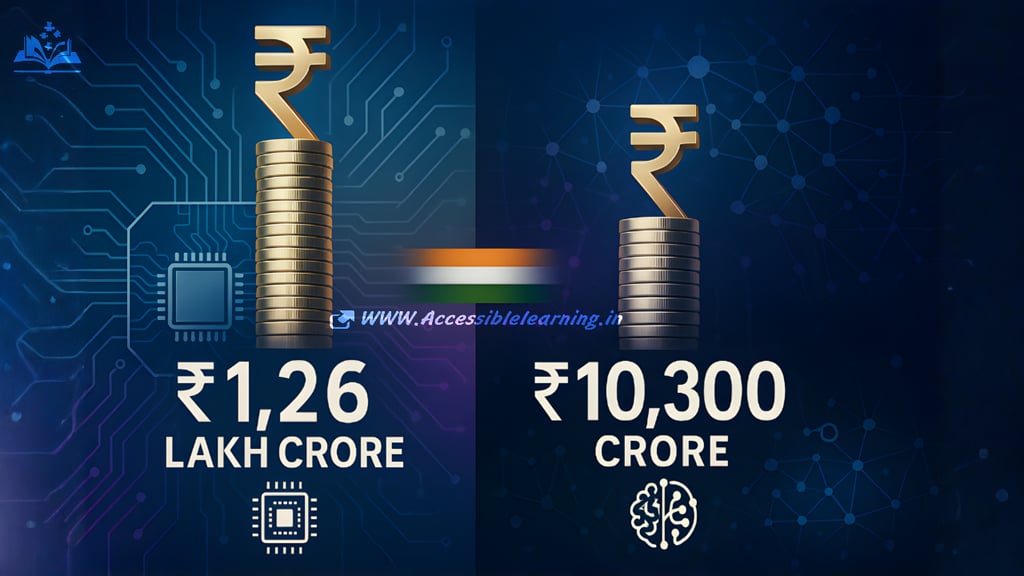

India stands at a technological crossroads, balancing two critical infrastructure investments that will define its digital future: semiconductor manufacturing and artificial intelligence infrastructure. As the world's fifth-largest economy races to become a global technology powerhouse, understanding how these two sectors compare in funding, priorities, and strategic importance has never been more crucial.
Understanding India's Technology Investment Landscape
What is semiconductor infrastructure funding?
Semiconductor infrastructure funding refers to capital allocated for establishing chip fabrication plants (fabs), assembly and testing facilities, design centers, and the complete ecosystem needed to manufacture computer chips domestically. These investments encompass everything from building specialized clean rooms to training engineers in advanced chip production techniques.
What is AI infrastructure funding?
AI infrastructure funding focuses on building the computational backbone for artificial intelligence applications. This includes GPU-based computing systems, data centers, machine learning platforms, datasets, and the software frameworks that enable businesses and researchers to develop AI solutions.
The Numbers Tell a Compelling Story
Semiconductor Funding: Building Physical Foundations
India's semiconductor sector has secured approximately ₹1.26 lakh crore (US$15.2 billion) in approved investments as of 2025, with the India Semiconductor Mission (ISM) providing ₹76,000 crore (US$9.2 billion) in government incentives. This flagship initiative, launched in December 2021, represents one of the most aggressive technology infrastructure pushes in India's history.
The scale becomes clearer when examining major projects. Tata Electronics is investing over ₹91,000 crore (US$10.44 billion) to establish a semiconductor fabrication plant in Dholera, Gujarat, with the central government providing 50 percent financial support for eligible project costs. Micron Technology's facility in Sanand, Gujarat, involves $825 million from the company, with Gujarat and the Indian federal government covering an additional $1.925 billion.
India's semiconductor market, valued at approximately US$38 billion in 2023, is projected to reach US$45-50 billion by 2025 and expand to US$100-110 billion by 2030, demonstrating explosive growth potential.
AI Infrastructure Funding: Computing for Intelligence
The AI funding landscape presents a different picture. India has surpassed US$20 billion in cumulative and new AI investment commitments as of 2025, combining government and private-sector funding. However, the government's direct allocation tells a more modest story.
The Cabinet approved an allocation of over ₹10,300 crore (approximately US$1.25 billion) for the IndiaAI Mission in March 2024, spread over five years. Interestingly, the revised estimates for the IndiaAI Mission for fiscal year 2024-2025 dropped from ₹551.75 crore to ₹173 crore, a 69 percent decrease, though the Finance Ministry allocated ₹2,000 crore for FY 2025-26, representing a 1056 percent increase.
The private sector dramatically amplifies these numbers. Microsoft announced a US$3 billion investment over two years in India for cloud and AI infrastructure, while Google committed $15 billion over five years to construct its largest AI data hub outside the United States in Visakhapatnam, Andhra Pradesh.


Comparing Investment Philosophies: Hardware vs Software-Centric Approaches
Semiconductor: The Long-Term Physical Asset Strategy
Semiconductor investments represent patient capital with decade-long horizons. Building a fab requires massive upfront capital, specialized infrastructure, and years before the first chip rolls off production lines. A modern semiconductor fabrication unit spans 14 to 28 football fields and consumes around 169 megawatt-hours of energy annually, enough to power an entire Indian city.
The government's approach emphasizes:
Capital intensity: Up to 50 percent fiscal support for approved projects
Strategic partnerships: Collaborations with Taiwan's PSMC, Japan's Renesas, and American companies
Complete value chain: From design to assembly, testing, and packaging
Job creation: Expected to generate 1 million jobs by 2026
AI Infrastructure: Agile, Cloud-First, Hybrid Model
AI funding follows a more distributed model, balancing government compute infrastructure with private cloud services. The government announced plans to invest in AI computing infrastructure equipped with at least 10,000 Graphics Processing Units (GPUs), creating a public platform for researchers and startups.
However, India accounts for just 3 percent of early-stage AI infrastructure and foundational startups, with 65 percent focusing on AI applications rather than infrastructure. This reveals a strategic choice: leveraging global cloud providers like Google, Microsoft, and AWS for infrastructure while focusing domestic innovation on applications.
Why the Funding Gap? Strategic Rationale Explained
Economic Security Through Semiconductor Self-Reliance
India's semiconductor push addresses a critical vulnerability exposed during COVID-19. The automotive sector experienced a cumulative backorder of nearly 500,000 units due to chip shortages, highlighting dangerous import dependence.
The strategic calculation is clear: semiconductors are the foundation of everything digital. Without domestic manufacturing capacity, India remains vulnerable to global supply chain disruptions, geopolitical tensions, and technological dependencies.
AI Infrastructure: Build on Existing Strengths
India's AI strategy leverages existing advantages. The country contributes 20 percent of global semiconductor design talent, fostering a thriving "fabless" ecosystem. Rather than reinventing cloud infrastructure that global giants already provide, India focuses on:
Training talent (Microsoft's goal to train 10 million by 2030)
Creating datasets and platforms
Supporting application development
Funding deep-tech AI startups
This pragmatic approach recognizes that building hyperscale data centers to compete with AWS or Azure makes less economic sense than creating the intellectual layer that sits atop this infrastructure.
Global Context: How India Compares
Semiconductor Race
The United States committed US$52 billion under the CHIPS Act, while China established a US$47.5 billion fund to achieve semiconductor self-sufficiency. India's approximately $10-15 billion commitment seems modest but aligns with its focused strategy on specific manufacturing segments rather than competing across all technology nodes.
AI Investment Landscape
In 2024, hyperscalers like Google, Amazon, and Meta invested $200 billion in AI infrastructure globally, while AI-focused companies like OpenAI and Anthropic spent approximately $13.8 billion. Against this backdrop, India's combined $20+ billion (mostly private) positions it as an emerging player rather than a leader, but with significant growth momentum.
The Interconnection: Why Both Matter for India's Future
The semiconductor-AI relationship creates a powerful synergy. Advanced technologies like GPUs and NPUs drive AI breakthroughs, and India aims to build indigenous AI infrastructure, including potentially its own GPUs within 3-5 years.
Consider the virtuous cycle:
Semiconductor fabs produce AI chips → Domestic GPU and accelerator production
AI chips power compute infrastructure → Indigenous data centers and cloud platforms
Compute infrastructure enables AI development → Indian AI models and applications
AI applications drive chip demand → Sustained semiconductor manufacturing
Indian AI startups attracted over $5.2 billion in funding as of October 2025, particularly in generative AI, creating demand that domestic semiconductor manufacturing can eventually serve.
Current State of Development: Where Do Both Sectors Stand?
Semiconductor Milestones
The Tata-PSMC fabrication plant in Dholera, initiated in March 2024, is slated to begin rolling out chips by September-October 2025, a year ahead of schedule, producing up to 50,000 wafers per month. Tata Semiconductor Assembly and Test (TSAT) is investing $3.25 billion in an ATMP unit in Morigaon, Assam, set to be operational by mid-2025, aiming to produce 48 million chips daily.
A tripartite venture between India's CG Power, Japan's Renesas, and Thailand's Stars Microelectronics launched India's first full-service Outsourced Semiconductor Assembly and Test (OSAT) pilot line facility in Sanand, Gujarat, in August 2025, with plans to produce 15 million chips daily.
AI Infrastructure Progress
The government announced in December 2024 its intention to make public sector datasets AI-ready. However, challenges persist. The AIRAWAT project experienced significant downtime, with startups relying on it for affordable, high-performance computing encountering major setbacks.
India's data center market scaled to approximately 1,255 MW in the first nine months of 2024 and is projected to reach 2,070 MW by the end of 2025, with the sector expected to grow from $3.3 billion in 2023 to $12 billion by 2030.
Challenges and Concerns in Both Sectors
Semiconductor Hurdles
Infrastructure dependencies: Reliable power, pure water, specialized supply chains
Capital intensity: Long payback periods discourage private investment without government support
Technology gap: India focuses on mature nodes (28-110nm) rather than cutting-edge 3-5nm chips
Talent shortage: While India has design talent, manufacturing expertise remains limited
Geopolitical competition: Vietnam, Malaysia, and UAE compete for semiconductor investments
AI Infrastructure Challenges
Compute allocation debate: Participants questioned whether 44 percent investment in compute capacity justifies its size, or if resources could be better directed toward datasets, skilling, or AI research
Application over infrastructure: Heavy reliance on foreign cloud providers for foundational infrastructure
Funding volatility: Dramatic budget revisions create uncertainty
Energy and environmental impact: Data centers have massive water and energy footprints
Skills at scale: Training millions requires sustained, coordinated effort


Policy Frameworks: Government Support Mechanisms
Semiconductor Policy Architecture
The India Semiconductor Mission functions under the Department of Telecommunications, governed by a steering committee of global semiconductor veterans and chaired by the Secretary of Electronics and Information Technology.
Key schemes include:
Fabrication-Linked Incentive (FLI): Capital subsidies and operating support for wafer fabs
Display Manufacturing Incentive (DMI): Grants for display fabs
Design Linked Incentive (DLI): Support for chip design companies
Production Linked Incentive (PLI): Manufacturing incentives across electronics
Under iCET (India-US Critical and Emerging Technology framework), India and the United States collaborate on joint R&D, workforce development, and supply-chain diversification in semiconductors.
AI Policy Framework
The IndiaAI Mission encompasses seven pillars: IndiaAI Compute Capacity, IndiaAI Innovation Centre (IAIC), IndiaAI Datasets Platform, IndiaAI Application Development Initiative, IndiaAI FutureSkills, IndiaAI Startup Financing, and Safe & Trusted AI.
The government partners with the private sector for infrastructure while focusing public investment on:
Public compute platforms
Dataset creation and standardization
Early-stage startup funding
Skills development and training
Ethical AI frameworks
Investment Returns: Economic Impact Analysis
Semiconductor Economic Multipliers
The Tata Electronics project is expected to create over 20,000 direct and indirect skilled jobs. Beyond employment, semiconductor manufacturing creates ecosystem effects:
Component suppliers and raw material providers
Testing and certification services
Logistics and specialized transportation
Research institutions and training centers
The import substitution effect matters significantly. Reducing chip imports improves trade balances and currency stability while ensuring supply security for critical sectors like defense, telecommunications, and automotive.
AI Infrastructure Economic Impact
India's AI market, growing at 25-35 percent annually, is expected to reach US$17 billion by 2027. As India's digital economy aims for a $1 trillion valuation by 2025, the infrastructure laid today will determine who leads tomorrow's innovation economy.
AI infrastructure enables:
Startup ecosystem growth and venture capital attraction
Productivity gains across traditional industries
New service categories and export opportunities
Research breakthroughs in healthcare, agriculture, and education
Global Partnerships and Technology Transfer
Semiconductor Collaborations
India's semiconductor strategy explicitly embraces international partnerships:
Taiwan: PSMC partnership for Tata fab, technology transfer for manufacturing
United States: iCET framework, equipment suppliers like Applied Materials and Lam Research
Japan: Renesas partnership for OSAT facilities
European Union: MoU signed between India and the European Commission on semiconductor ecosystems and supply chain cooperation
Applied Materials is investing $400 million in an engineering center, while Lam Research pledged $25 million to set up a semiconductor training lab and train 60,000 Indian engineers.
AI Partnerships
OpenAI Vice President Srinivas Narayanan announced the company's commitment to partnering with IndiaAI. Microsoft and SaaSBoomi aim to impact over 5,000 startups and 10,000 entrepreneurs over five years, upskilling 150,000 startup employees and helping attract an additional US$1.5 billion in venture capital.
Future Outlook: 2025-2030 Trajectory
Semiconductor Sector Projections
Experts predict India will be among the top five global destinations for semiconductor manufacturing by 2030, securing 10 percent of the global market. The announcement of the new Electronics Component Manufacturing Scheme in April 2025 may lead to a surge of investments in the larger electronic ecosystem, which may drive upstream semiconductor investments.
Key milestones to watch:
The first "Made in India" chips will reaching market in late 2025
Semicon India Mission 2.0 launch expanding scope
Advanced packaging capability development
Indigenous GPU design initiatives
AI Infrastructure Evolution
The AI sector's trajectory depends heavily on private investment momentum. With Microsoft's $3 billion and Google's $15 billion commitments, infrastructure capacity will grow dramatically. However, government funding consistency remains uncertain given the 69 percent budget reduction in 2024-25.
Critical factors include:
Public compute platform stability and uptime
Dataset quality and accessibility
Regulatory frameworks for AI governance
Integration of AI across government services
Which Sector Receives Priority? Understanding Strategic Choices
The funding disparity reveals clear priorities: semiconductors receive substantially higher government commitment because they address a critical manufacturing gap and import dependency. AI infrastructure leverages existing private sector capabilities, requiring less direct government intervention.
This doesn't mean AI is less important. Rather, it reflects:
Capital requirements: Fabs need billions; cloud services scale incrementally
Market dynamics: Private sector already invests heavily in AI infrastructure
Strategic vulnerability: Semiconductor import dependence poses greater security risks
Timeline to impact: Manufacturing takes decades to build; AI applications can deploy quickly


Talent Development: The Human Capital Dimension
Semiconductor Workforce Initiatives
India plans talent development programs to train 85,000 semiconductor professionals by 2027. The focus spans:
Advanced manufacturing techniques
Clean room operations
Chip design and verification
Supply chain and operations management
The industry is projected to generate 1 million jobs by 2026, creating massive demand for technical education and vocational training.
AI Skills Development
Microsoft surpassed its goal of training 2 million people in AI skills by 2025, reaching 2.4 million individuals in under a year, with 65 percent being women and 74 percent from tier II and tier III cities. The next milestone: equipping 10 million more Indians with essential AI skills by 2030.
AI training benefits from:
Online scalability (unlike manufacturing training)
Existing IT education infrastructure
Global demand for AI talent
Lower barriers to entry for application development
Environmental and Sustainability Considerations
Environmental impact assessments are recommended for AI infrastructure, considering energy consumption, carbon emissions, water usage, and waste generation associated with AI operations. A semiconductor fab consumes around 169 megawatt-hours of energy annually, raising similar concerns.
Both sectors require:
Renewable energy sources
Water recycling systems
Heat management and cooling efficiency
Carbon footprint reduction strategies
Microsoft committed to being carbon negative, water positive, and zero waste by 2030, setting standards that Indian facilities must aspire to meet.
Regional Development: Geographic Distribution of Investments
Semiconductor Manufacturing Hubs
Major facilities are concentrated in specific regions:
Gujarat: Tata fab in Dholera, Micron and Kaynes in Sanand
Assam: Tata ATMP facility in Morigaon
Odisha: Silicon Carbide fab
Uttar Pradesh: HCL-Foxconn display driver chip facility
This geographic distribution aims to create regional innovation clusters, though infrastructure challenges in these locations require significant state-level support.
AI Infrastructure Geographic Spread
Google's largest AI data hub outside the US is being constructed in Visakhapatnam, Andhra Pradesh. However, AI infrastructure remains heavily concentrated in:
Bangalore (40+ percent of AI startup funding)
Hyderabad (emerging AI hub)
National Capital Region
Mumbai and Pune
The geographic concentration reflects existing tech ecosystem presence rather than strategic geographic distribution policies.
India's approach to semiconductor and AI infrastructure funding reflects pragmatic strategic thinking rather than an either-or choice. The approximately 6-8x higher investment in semiconductors addresses a manufacturing void and supply chain vulnerability that AI infrastructure, with significant private sector engagement, does not face.
India's semiconductor and AI push can be viewed as a "transformative era," akin to its highly successful software and IT revolution. Just as that earlier period established India as a global software services leader, the current focus on indigenous manufacturing and AI hardware aims to leverage human capital to become a foundational technology player.
The semiconductor foundation enables AI advancement, while AI applications drive chip demand, creating a virtuous cycle. India's trajectory represents a pivotal moment in global technology history, transforming the nation into a critical global hub for both hardware manufacturing and advanced AI development.
Success requires sustained policy execution, continued private sector participation, workforce development at scale, and infrastructure investments addressing power, water, and specialized supply chains. Both sectors face challenges, but the strategic alignment between government vision, private capital, and talent availability creates genuine momentum toward India's goal of becoming a technology superpower by 2030 and beyond.
Frequently Asked Questions
Q: Why is India investing more in semiconductors than AI infrastructure?
India invests more heavily in semiconductors because chip manufacturing requires massive upfront capital and specialized infrastructure and addresses critical import dependency. AI infrastructure benefits from significant private sector investment and can leverage global cloud providers, requiring less government funding.
Q: How do semiconductor and AI investments complement each other?
Semiconductors provide the physical chips that power AI systems. Indigenous chip manufacturing enables domestic GPU production, which fuels local AI infrastructure, creating self-reliance across the technology stack. AI applications, in turn, drive demand for more advanced chips.
Q: What is the India Semiconductor Mission budget?
The India Semiconductor Mission has a ₹76,000 crore (US$9.2 billion) corpus providing targeted funding across semiconductor fabrication, display manufacturing, and chip design.
Q: How much has India allocated for AI infrastructure?
The Cabinet approved over ₹10,300 crore (approximately US$1.25 billion) for the IndiaAI Mission in March 2024, spread over five years. Combined with private investments, total AI funding exceeds US$20 billion.
Q: When will India start manufacturing semiconductors domestically?
The Tata-PSMC fabrication plant in Dholera is slated to begin rolling out chips by September-October 2025, marking India's entry into large-scale domestic semiconductor manufacturing.
Q: Which companies are investing in Indian semiconductor manufacturing?
Major investors include Tata Electronics, Micron Technology, Kaynes Semicon, CG Power (with Renesas), HCL-Foxconn, Applied Materials, Lam Research, and AMD, among others.
Q: What is the difference between semiconductor fabs and ATMP facilities?
Semiconductor fabs (fabrication plants) manufacture chips by creating circuits on silicon wafers. ATMP facilities (Assembly, Testing, Marking, and Packaging) handle post-fabrication processes: assembling chips, testing functionality, marking products, and packaging for distribution.
Q: How does India's AI funding compare with global leaders?
India's combined government and private AI investment of US $20+ billion is modest compared to the US and China but represents rapid growth. US had 1,073 newly funded AI companies in 2024, with substantially higher capital deployment.
Q: What role do foreign companies play in India's technology infrastructure?
Foreign companies provide critical technology transfer, manufacturing partnerships, training programs, and capital. Taiwan's PSMC, Japan's Renesas, US companies like Micron and AMD, and tech giants like Microsoft and Google are essential partners in India's technology infrastructure buildout.
Q: Can India become self-sufficient in semiconductors and AI?
Complete self-sufficiency is unrealistic given the global nature of technology supply chains. However, India aims for strategic self-reliance: manufacturing critical chips domestically, controlling essential AI infrastructure, and reducing dangerous dependencies while remaining integrated with global innovation networks.
Subscribe to Frontier Intelligence
All © Copyright reserved by Accessible-Learning Hub
| Terms & Conditions
Accessible Learning Hub — Actionable clarity for high-agency minds.
Weekly breakdowns on AI breakthroughs, capital flow, and human performance systems. Zero fluff.