

Independence Movement Day: The Day a Nation Chose Courage Over Silence
On March 1, 1919, thirty-three ordinary people walked into a restaurant, read a declaration aloud, and called the police on themselves. What followed was one of history's most powerful acts of nonviolent resistance and a movement that quietly shaped democracy, inspired Gandhi, and still echoes across Korea every single year. This is the story of Independence Movement Day: what really happened, why it matters, and what the world has never quite given it credit for.
EVENT/SPECIALCELEBRATION/FESTIVALSSOUTH KOREA
Kim Shin
2/22/202613 min read
What Is Independence Movement Day?
Imagine waking up one morning knowing you're about to do something that will get you arrested. You dress calmly. You gather with friends and colleagues. You share a meal. You read a document aloud. And then you pick up the phone and call the police yourself.
That's exactly what happened on March 1, 1919. And that's exactly why it still matters.
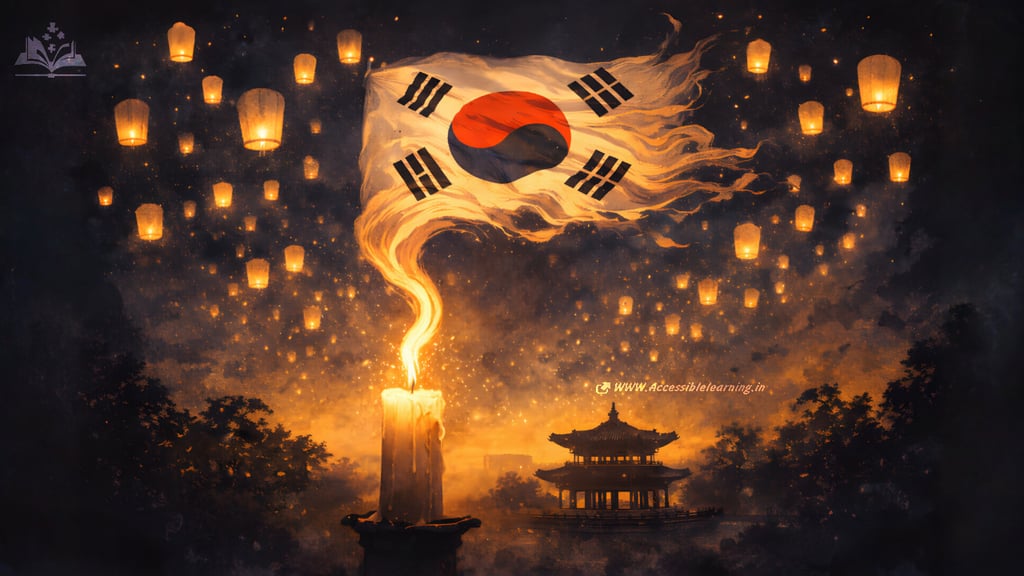
Every year on March 1st, South Korea pauses. Flags rise. Streets fill. At Tapgol Park in Seoul, voices read aloud from a document that first echoed across that very spot over a century ago: the Korean Declaration of Independence.
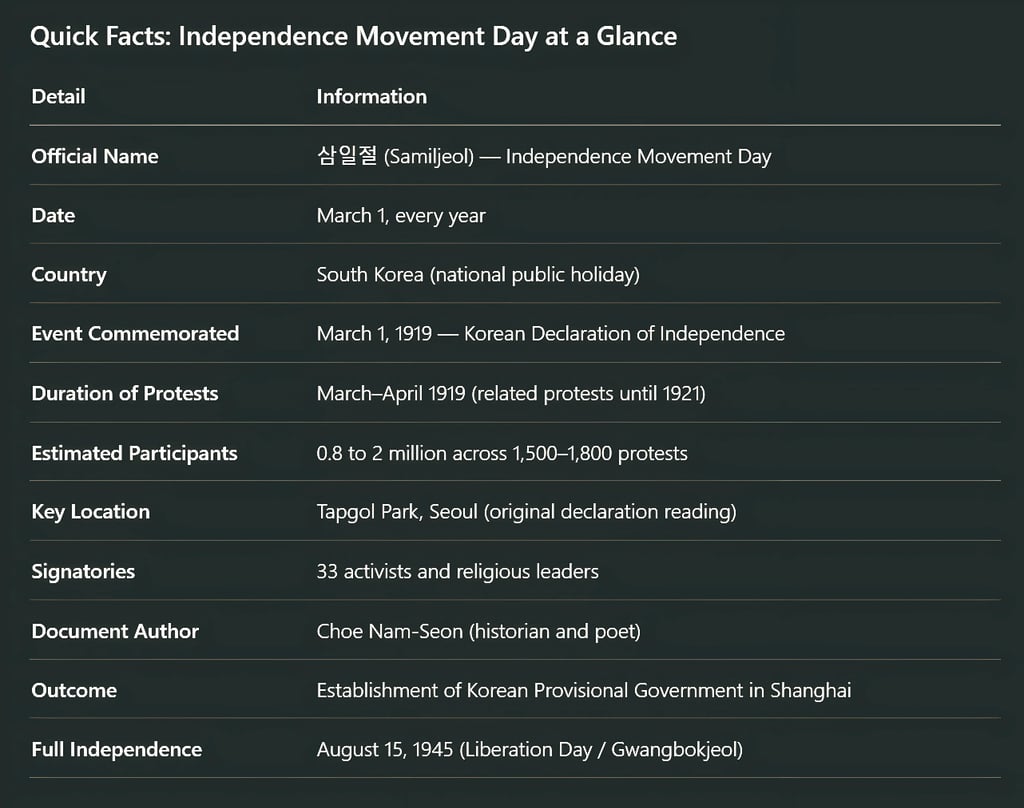
This is Independence Movement Day, known in Korean as 삼일절 (Samiljeol), "Sam" (3) for the third month, "Il" (1) for the first day, and "Jeol" (절) meaning festival or holiday. It is one of South Korea's five national public holidays and arguably the one carrying the deepest emotional weight.
But to call it merely a holiday would be to misread it entirely. Samiljeol is a living memory, a reckoning with colonization, a celebration of nonviolent courage, and a mirror that a nation holds up to ask: where have we been, and what do we still owe the future?"
The World That Made March 1st Necessary
To truly understand why March 1, 1919 happened, you have to feel what Korea had lost and how brutally, how recently, it had lost it.
In 1905, Japan forced Korea into the Eulsa Treaty, stripping the peninsula of its diplomatic rights. By 1910, Korea was formally annexed, absorbed into the Japanese Empire as a colonial territory. Within a matter of years, the Korean language was suppressed in schools. Korean culture was systematically dismantled. Korean land was redistributed to Japanese settlers.
A people with over four thousand years of continuous civilization suddenly found themselves living as subjects of a foreign empire watched, controlled, and silenced.
Resistance never disappeared. It went underground, into the hearts of students, priests, teachers, and farmers who kept a quiet ember burning.
Then, in January 1918, U.S. President Woodrow Wilson delivered his Fourteen Points speech, explicitly calling for the right of national self-determination. The phrase landed like a spark in dry timber among colonized peoples across the globe. Korean students studying in Tokyo were among the first to act, publishing a declaration of their own demanding freedom.
The fire grew hotter when former Emperor Gojong died on January 21, 1919, under circumstances that many Koreans believed with very good reason were deeply suspicious. His death became the emotional catalyst that turned quiet grief into public action.
The moment was ready. The people were ready. And so, on the morning of March 1st, everything changed.
March 1, 1919: The Moment Itself
At 2:00 PM on March 1, 1919, thirty-three activists gathered not in a grand palace or a government hall, but in an ordinary Seoul restaurant called Taehwagwan.
They sat together. They read aloud from the Korean Declaration of Independence, a document carefully crafted by historian and poet Choe Nam-Seon. It was not a document of hatred or revenge. It was a document of dignity affirming the Korean people's natural right to exist as a sovereign nation and calling for a peaceful new world order built on justice rather than force.
After reading it, they did something that still leaves historians speechless: they called the police themselves. They forwarded a copy of the declaration directly to the Japanese Governor-General. They announced what they had done and waited to be arrested.
It wasn't recklessness. It was a profound statement. We are not hiding. We are not fleeing. We are not ashamed. They were standing as plainly and openly as a person can stand.
Meanwhile, just down the street at Tapgol Park (Pagoda Park), a student named Chung Jae-Yong read the same declaration aloud to a gathered crowd. The crowd did not disperse. It grew.
Within hours, demonstrations had swept across Seoul. Within days, they had spread across the entire peninsula. Estimates suggest around 0.8 to 2 million participants across 1,500 to 1,800 separate protests, a staggering number given that Korea's total population at the time was only around 16 to 17 million people.
The protests were overwhelmingly nonviolent. Koreans marched, sang, waved flags, and read the declaration aloud. But the Japanese colonial response was anything but peaceful. Military forces were deployed. Protestors were beaten, imprisoned, and killed. Independence activists were jailed and martyred in places like Seodaemun Prison, a building that still stands today as a museum of conscience, every cell and corridor a witness to what they endured.


Why the Movement "Failed" And Why That's the Wrong Word
Let's be honest about something that often gets glossed over: the March First Movement did not immediately win Korean independence. Japan's grip did not loosen until the empire's defeat in World War II, in August 1945 twenty-six years later.
By the simple, transactional measure of "did it achieve its stated goal immediately," March 1st fell short. But that framing misses something essential, and honestly, it misses the point of what movements like this really do.
While the March First Independence Movement did not directly lead to independence, it accelerated the establishment of the Korean Provisional Government in Shanghai. And in that government's constitution, Korea was declared a democratic republic with sovereignty residing in the people, a principle enshrined in Article 1.
Think about the weight of that moment. For the first time, Koreans formally and constitutionally articulated that power belongs to the people, not to a monarch, not to a colonial occupier. After centuries of dynastic rule and decades of imperial subjugation, the Samil Movement planted the philosophical seed of modern Korean democracy.
It also rippled outward into the world.
Mahatma Gandhi's Indian independence movement drew direct inspiration from Korea's example. Rabindranath Tagore, the first Asian Nobel Prize laureate and a close friend of Gandhi, called Korea "the lamp of the East" in recognition of what it had contributed to the global language of peaceful resistance.
Some movements change laws. Some movements change minds. The March First Movement, quietly but permanently, changed both.
The Document That Started It All: The Korean Declaration of Independence
Most declarations of independence throughout history are angry documents listing grievances, accusations, and demands. The Korean Declaration of Independence is something different and worth understanding on its own terms.
It opens not with anger but with the announcement, "We herewith proclaim the independence of Korea." No apology. No lengthy justification. Just a plain, clear statement of fact. It does not call for war or revenge. It calls for a new world order grounded in the principle that all nations deserve to live freely and coexist as equals.
What's remarkable is that the declaration explicitly frames Korean independence not as a Korean issue alone, but as a global issue. It positions the movement as part of a universal human tide flowing toward freedom and justice. In 1919, that argument was considered radical. Today, it reads remarkably like the preamble to the United Nations Charter.
The thirty-three signatories were also a coalition unlike any other in Korean history: Buddhist leaders, Christian ministers, and members of the Cheondogyo religious movement, all standing together and signing the same document. In a society with deep religious distinctions, that unity was itself a revolutionary act.
The Global Ripple Effect: How Samil Shaped the World
Here's something that doesn't get nearly enough attention in world history classrooms: the March First Movement was one of the earliest large-scale nonviolent independence movements of the entire 20th century, and its influence traveled far beyond Korea.
In India, Gandhi and his circle were watching carefully. The mass nonviolent civil disobedience demonstrated in Korea in March 1919 helped reinforce the very philosophy Gandhi would use to move a continent. The Salt March of 1930 carries clear echoes of what happened in Korea eleven years earlier.
At the Paris Peace Conference, Korean diaspora activists in Shanghai and the United States worked urgently to get news of the protests out to the international press. The first communication about the protests to leave the Japanese empire was in English, sent to Shanghai, where the first international article on the movement appeared on March 4th. News reached the United States on March 10th via cablegram, a remarkably fast journey for 1919.
For colonized peoples everywhere, the March First Movement demonstrated something quietly electrifying: that organized, nonviolent resistance was not naive idealism. It was a real, viable, morally powerful force even when directed against an industrialized military empire.
How Koreans Celebrate Independence Movement Day Today
If you've never experienced a Korean national holiday in person, Samiljeol might surprise you. It isn't a quiet, somber observance, but it isn't a party, either. It sits somewhere more interesting: a day of proud, collective remembrance that feels both solemn and alive.
The Tapgol Park Ceremony is the emotional heart of the day. Each year, the Korean Declaration of Independence is read aloud at the very park where it was first proclaimed to the public in 1919. This annual reading isn't ceremonial filler; it's a deliberate act of transmission, passing the words from one generation's mouths into the next generation's ears.
The Taegukgi (Korean national flag) appears everywhere on homes, businesses, government buildings, buses, and lapels. That sea of flags isn't merely decorative. It's a visual statement of continuity: we are still here, and we remember who made it possible.
Seodaemun Prison History Hall draws thousands of visitors every March 1st. The prison where independence activists were interrogated, tortured, and executed now stands preserved as a museum, its cells intact, its photographs unflinching. It is one of the rare places on Earth where a nation has chosen to keep the evidence of its own suffering visible rather than tear it down and move on. That choice says a great deal about Korean identity.
Independence Hall of Korea in Cheonan is another pilgrimage site a sprawling campus of monuments, artifacts, and galleries that walk visitors through the full arc of Korea's colonial experience and its long journey toward freedom.
And for families with children, the day carries one more layer of meaning: the Korean school year begins on March 2nd, the day after Samiljeol. For many kids, the holiday is inseparable from the flutter of a new beginning—backpacks packed, new classrooms waiting giving the commemoration an unexpected intimacy that connects national history to personal life.

The Thirty-Three Who Signed: A Closer Look at Courage
History has a tendency to flatten human beings into monuments. The thirty-three signatories of the Korean Declaration of Independence are often presented as a unified, almost mythological bloc—brave, resolute, and certain. But they were people. They had families, doubts, and fears. They knew exactly what was coming when they made that phone call to the police.
Among them was Son Byong-hui, the leader of the Cheondogyo movement, who had spent years quietly planning and organizing what would become one of the most significant acts of resistance in Korean history. There was Yi Seung-hun, a Christian educator whose networks helped spread the movement to schools and churches across the country.
And then there was Yu Gwan-sun, not herself a signatory, but perhaps the face most associated with March First today. A teenage student at the time, she was arrested after organizing protests in her hometown following the initial demonstrations in Seoul. She was tortured in Seodaemun Prison. She was dead at eighteen.
Her name is spoken with the same quiet reverence in Korea that Rosa Parks' name carries in the United States: a young woman who, at the moment history required something, simply refused to look away.
What unites all of them is not the absence of fear. It's the decision to act despite it openly, peacefully, trusting that the moral weight of their declaration would outlast any weapon pointed at them. It did.
Independence Movement Day and the Reunification Question
There's a dimension to Samiljeol that doesn't always make international news, but Koreans carry it quietly into every celebration: the peninsula is still divided.
The March First Movement was not a southern movement or a northern movement. It was a Korean movement spanning the entire peninsula, drawing participation from farmers and students and clergy from Busan to Pyongyang. The Provisional Government established in its aftermath was conceived for all Koreans.
Modern Samiljeol ceremonies often include sentiments of reunification alongside the historical commemorations. The Korean Constitution itself explicitly cites the March First Movement as the founding spirit of the republic, a reminder that the movement's original dream was always bigger than the borders that currently divide the peninsula.
For many Koreans, then, Independence Movement Day is not only a commemoration of 1919. It is an annual, quiet restatement of an aspiration that hasn't been fully realized yet. The conversation that began in Taehwagwan restaurant is still, in some sense, ongoing.
What the World Can Learn from Samiljeol
Independence movements throughout history have taken every imaginable form: armed revolutions, diplomatic negotiations, guerrilla campaigns, and constitutional maneuvers. The March First Movement chose a different path: organized, public, radical nonviolence. It didn't succeed on its own timeline. Its leaders were arrested within hours. Its participants were beaten and killed. The occupying power did not pack up and leave.
And yet the movement accomplished something that no army could: it forced the world to look at Korea, to hear Korea, and to ask uncomfortable questions about what "civilization" really meant when it was built on the suppression of other civilizations.
The premise of the March First Independence Movement was a pro-democratic dream, one that asserted the sovereignty of the people and upheld universal values like freedom, equality, human rights, and peace.
Those values did not expire in 1919. They remain the contested terrain of global politics today. And that is exactly why Samiljeol continues to matter not just to Koreans, but to anyone who has ever believed that how you fight for something is just as important as what you're fighting for.
The Act of Remembering Is Itself Political
There is a reason authoritarian regimes, in every era and every corner of the world, work so hard to rewrite history. Memory is dangerous. Collective memory is revolutionary.
Every March 1st, when Koreans gather at Tapgol Park and a voice reads aloud the words "We herewith proclaim the independence of Korea," they are not merely honoring the dead. They are performing an act of conscious continuity, drawing a line from 1919 to the present and saying: we know who we are, we know what we came from, and we know what we still owe the future."
That is what Independence Movement Day really is. Not just a holiday. A conversation with the past, with each other, and with the world. A conversation that, over a hundred years later, is still very much alive.
Frequently Asked Questions
Q: What is Independence Movement Day, and why is it important?
Independence Movement Day, or Samiljeol (삼일절), is a South Korean national holiday observed every March 1st. It commemorates the massive nonviolent protests of March 1, 1919, when millions of Koreans publicly declared their resistance to Japanese colonial rule. Its importance goes beyond the historical event itself: it marks the moment Koreans formally articulated democracy, people's sovereignty, and national self-determination the same values that underpin modern South Korea's constitution and identity.
Q: Why did the 33 signatories call the police on themselves?
This is one of the most striking and most misunderstood details of the day. The thirty-three signatories called the authorities on themselves to make a deliberate moral statement: we are not criminals hiding from justice. We are citizens asserting our rights openly. Their voluntary arrest was an act of radical transparency, designed to demonstrate the legitimacy and dignity of their cause to the public, the press, and the colonial government itself. It was courage dressed as calmness, and it worked exactly as intended.
Q: Did the March First Movement actually succeed?
In the short term, no, Japan maintained colonial control until 1945. But measuring the movement by that single outcome is like judging a river by one moment in its flow. The movement directly led to the establishment of the Korean Provisional Government in Shanghai, which drafted the first democratic constitution in Korean history. It inspired independence movements in India and across the colonial world. And it embedded the ideas of popular sovereignty and democratic governance into the Korean national consciousness in ways that shaped the nation for generations. By any meaningful long-term measure, the movement succeeded profoundly.
Q: Who was Yu Gwan-sun, and why is she so important to Samiljeol?
Yu Gwan-sun was a teenage student activist who organized protests in her hometown of Cheonan after the initial demonstrations in Seoul. She was arrested, imprisoned in Seodaemun Prison, and subjected to severe torture by colonial authorities. She died in prison at the age of eighteen. She never signed the declaration and never held political office, but her youth, her refusal to break under unimaginable pressure, and her death have made her the human face of March First for generations of Koreans. She is often called Korea's Joan of Arc, though her story is equally her own.
Q: Is Independence Movement Day observed in North Korea as well?
Yes, March First is commemorated in North Korea too, though the framing and political emphasis differ significantly from South Korean observances. Both Koreas claim the movement as part of their shared historical heritage, even as their official narratives diverge. This shared claim is one of the reasons the holiday carries extra resonance in discussions about Korean reunification; it is one of the few historical touchstones that both halves of the peninsula hold in common.
Q: How is Samiljeol different from Gwangbokjeol (Liberation Day)?
These two holidays often get confused, so it's worth a clear distinction. Samiljeol (March 1st) commemorates the 1919 declaration and the nonviolent resistance movement; it's about the struggle for independence. Gwangbokjeol (August 15th) commemorates Korea's actual liberation from Japanese rule in 1945, following Japan's surrender in World War II it's about achieving independence. Together, they bookend twenty-six years of one of the most defining chapters in Korean history, and both are national holidays in South Korea.
Q: What makes the Korean Declaration of Independence unusual compared to other independence documents?
Most declarations of independence are charged with anger; they list grievances and demand justice through confrontation. The Korean Declaration of Independence takes a different tone entirely. It is remarkably calm, philosophical, and forward-looking. Rather than framing independence as revenge against Japan, it argues that independence is a universal human right and that a world order built on the free coexistence of equal nations would benefit everyone, including Japan. In 1919, that argument was radical and visionary. Today, it reads almost like a founding document of the United Nations. That is what makes it genuinely worth reading, not just remembering.
Q: Can foreigners participate in Samiljeol celebrations?
Absolutely, and many do. Tapgol Park, Seodaemun Prison History Hall, and the Independence Hall of Korea in Cheonan all welcome international visitors on March 1st and throughout the year. The ceremonies are deeply moving even for those without a personal connection to Korean history. The reading of the declaration, the sea of flags, and the preserved prison cells all speak a universal language about what human dignity costs and what it's worth. If you find yourself in Korea on March 1st, going is worth every minute of your time.
Q: How long did the March First protests last?
While the main wave of demonstrations took place from March through April 1919, related protests and independence activities continued until around 1921. The March First Movement was not a single day's event; it was a sustained national awakening that took months to gradually suppress, and whose spirit, as Samiljeol proves each year, was never suppressed at all.
Subscribe to Frontier Intelligence
All © Copyright reserved by Accessible-Learning Hub
| Terms & Conditions
Accessible Learning Hub — Actionable clarity for high-agency minds.
Weekly breakdowns on AI breakthroughs, capital flow, and human performance systems. Zero fluff.