

Immersive Spatial Learning: The End of the 2D Textbook
Immersive Spatial Learning is transforming education through AR, VR, and spatial computing. Discover how interactive 3D experiences help students understand anatomy, history, engineering, and complex subjects faster than traditional textbooks.
AI/FUTURECOMPANY/INDUSTRYEDUCATION/KNOWLEDGE
Sachin K Chaurasiya | Shiv Singh Rajput
6/16/20267 min read
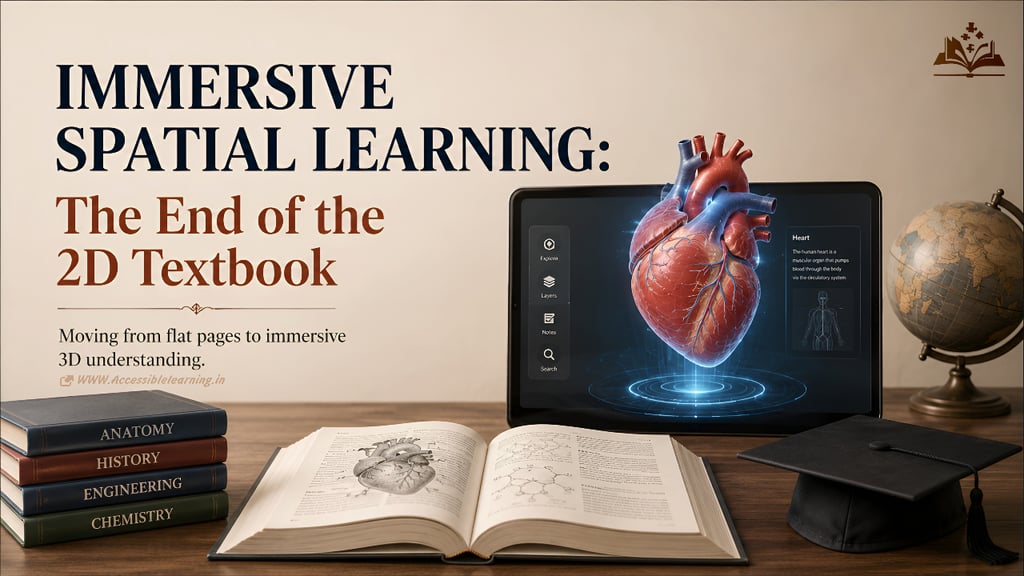
Don't Read About the Human Heart. Walk Inside It.
For centuries, education has relied on the same basic formula: place information on a flat surface and ask students to absorb it.
Clay tablets became books. Books became PDFs. Chalkboards became digital whiteboards. Yet despite all the technological upgrades, one thing remained unchanged: learning stayed trapped inside two dimensions.
Now that is beginning to change.
A student studying anatomy no longer needs to stare at a diagram of the human heart. They can step inside a life-sized beating heart, observe blood flow in real time, and interact with every chamber and valve from any angle.
A history student can walk through ancient Rome instead of reading about it.
An engineering student can assemble a virtual engine with their own hands before touching a real machine.
This shift is called Spatial Learning, and it may become one of the most significant educational transformations since the invention of the textbook itself.
As augmented reality (AR), virtual reality (VR), and spatial computing technologies become more affordable and accessible, education is moving beyond screens and entering physical space. The result is a learning experience that aligns more closely with how the human brain naturally understands the world.
The future of education is not about reading information. It is about experiencing it.
What Is Spatial Learning?
Spatial learning is an educational approach that places information within a three-dimensional environment where learners can interact with concepts as if they were physical objects.
Instead of viewing information on a flat page or screen, students engage with content through immersive experiences powered by:
Augmented Reality (AR)
Virtual Reality (VR)
Mixed Reality (MR)
Spatial Computing Systems
Interactive 3D Simulations
In traditional learning, students must mentally convert a two-dimensional diagram into a three-dimensional understanding. Spatial learning removes that translation step.
The concept becomes the environment. The learner enters the lesson rather than merely observing it.
Why Traditional Textbooks Are Reaching Their Limits
Textbooks have served humanity remarkably well.
However, they were designed for a world where immersive technology did not exist.
Complex subjects often suffer when compressed into static images and paragraphs.
Consider these examples:
Anatomy
Students memorize diagrams of muscles, organs, and systems while attempting to visualize their spatial relationships.
Mechanical Engineering
Machine assemblies are presented through flat illustrations that often fail to communicate movement and interaction.
Architecture
Blueprints require learners to mentally construct entire buildings from abstract drawings.
Chemistry
Molecular structures are displayed as symbols rather than interactive objects.
History
Ancient civilizations are reduced to photographs and written descriptions.
The challenge is not a lack of information.
The challenge is visualization.
Many students struggle because they cannot mentally construct accurate models from static content.
Spatial learning solves this problem by presenting information in its natural form.
The Science Behind Why Spatial Learning Works
The human brain evolved to navigate physical environments long before it learned to read. For most of human history, survival depended on understanding:
Distance
Motion
Objects
Navigation
Physical interaction
As a result, the brain possesses highly developed visual-spatial and kinesthetic processing systems. Spatial learning activates these systems simultaneously.
Instead of merely reading about a concept, learners:
Observe it
Manipulate it
Navigate through it
Interact with it
Experiment with it
This creates multiple memory pathways. Educational research consistently shows that active engagement improves comprehension and retention compared to passive information consumption.
When learners physically interact with concepts, understanding often develops faster because the brain is connecting visual, spatial, and motor information at the same time. Learning becomes an experience rather than an observation.
Walk Inside the Human Body
One of the clearest examples of spatial learning can be found in medical education. Traditionally, anatomy requires extensive memorization. Students spend countless hours studying:
Organ systems
Skeletal structures
Muscular networks
Circulatory pathways
With immersive spatial environments, students can enter a full-scale virtual body. They can:
Walk through arteries
Examine organs from every angle
Observe physiological processes in motion
Disassemble and reassemble body systems
Explore microscopic structures at massive scale
Complex relationships become obvious because learners can literally see them. Instead of memorizing anatomy, students experience anatomy. This dramatically reduces cognitive friction and accelerates understanding.

History Becomes Time Travel
History education often suffers from a lack of context. Students memorize dates, names, and events without truly understanding the environments where those events occurred. Spatial learning changes that.
Imagine exploring:
Ancient Rome at its peak
Medieval castles
Egyptian temples
World War battlefields
Renaissance cities
Rather than reading descriptions, students can move through reconstructed environments. They gain an intuitive understanding of:
Geography
Architecture
Scale
Culture
Social structures
Historical events become easier to understand because learners can experience the spaces where they unfolded. History transforms from memorization into exploration.
Engineering Without Expensive Mistakes
Engineering education benefits enormously from immersive simulation.
Physical prototypes cost money.
Mistakes cost money.
Equipment costs money.
Spatial learning creates realistic practice environments where students can:
Build systems
Test designs
Diagnose failures
Simulate operations
Learn safety procedures
All without real-world risk. Students gain practical understanding before entering laboratories or workplaces. This shortens learning curves and increases confidence. The result is faster skill acquisition and better preparation for real-world challenges.
Why Reading Alone Is No Longer Enough
Reading remains valuable.
It always will.
However, reading is only one way the brain learns.
Traditional education often overemphasizes linguistic intelligence while underutilizing other cognitive strengths.
Spatial learning engages:
Visual Intelligence
Understanding through observation.
Kinesthetic Intelligence
Understanding through interaction.
Spatial Intelligence
Understanding through relationships in space.
Experiential Learning
Understanding through direct experience.
The more systems involved in learning, the more robust comprehension tends to become. This is why students often understand concepts faster after performing a task than after reading about it.
The Rise of Spatial Computing
The driving force behind this educational transformation is spatial computing. Spatial computing refers to technologies that blend digital information with physical space. Instead of interacting through keyboards and touchscreens, users interact naturally with digital content positioned around them.
Major technology companies are investing billions into:
Mixed-reality headsets
AR glasses
3D visualization tools
Immersive collaboration platforms
Digital twin technologies
As hardware prices continue to decline, educational institutions gain access to tools that were previously too expensive for widespread adoption.
What was once experimental is becoming practical.
What was once futuristic is becoming affordable.
The Economic Advantage of Immersive Education
Spatial learning is not only about better experiences. It also offers significant economic benefits. Educational institutions can reduce costs associated with:
Physical training equipment
Laboratory resources
Field trips
Safety training
Specialized facilities
Organizations can train employees faster while reducing operational risk. Students gain access to experiences that would otherwise be impossible due to cost, geography, or safety constraints. In many cases, immersive learning democratizes access to high-quality education.
Challenges That Still Need Solving
Despite its promise, spatial learning faces several obstacles.
Hardware Costs
Although prices are decreasing, some immersive devices remain expensive.
Content Creation
Building accurate and engaging 3D educational experiences requires time and expertise.
Accessibility
Not all learners have access to AR and VR equipment.
Teacher Training
Educators need support and training to effectively integrate immersive technologies.
Motion Sickness and Comfort
Some users still experience discomfort during extended VR sessions.
These challenges are real, but they are technological problems rather than conceptual ones.
Historically, technology costs decline while capability increases.
The same pattern is already visible in spatial computing.

What the Classroom of 2030 May Look Like
The classroom of the future may contain fewer textbooks and more experiences. Students could:
Explore virtual ecosystems
Conduct simulated surgeries
Visit historical civilizations
Build engineering projects
Collaborate inside shared digital environments
Lessons may become increasingly adaptive and interactive. Instead of consuming information, students will inhabit it. The distinction between learning and experience will begin to disappear. Education will feel less like studying and more like discovery.
The Bigger Shift: From Information Consumption to Understanding
The most important aspect of spatial learning is not the technology.
It is the change in how knowledge is delivered.
For decades, education has focused on transferring information.
The problem is that information alone does not guarantee understanding.
Understanding emerges when learners can connect ideas, observe relationships, and apply concepts in meaningful contexts.
Spatial learning creates those contexts naturally.
It transforms abstract concepts into tangible experiences.
And when learning becomes experiential, comprehension often arrives faster and lasts longer.
The 2D textbook is not disappearing overnight. Books, articles, and written materials will remain essential tools for learning. But their monopoly on education is ending.
As AR, VR, and spatial computing become mainstream, a new educational model is emerging, one built around immersion, interaction, and experience.
The future student may not read about the human heart first.
They may walk through it.
They may not memorize the layout of ancient Rome.
They may explore it.
They may not imagine how an engine works.
They may build one in a virtual environment before touching the real machine.
The next revolution in education is not about delivering more information.
It is about making understanding feel real.
And in that future, the flat textbook becomes only the starting point, not the destination.
FAQ's
Q: What is Spatial Learning?
Spatial Learning is an educational approach that uses three-dimensional environments, augmented reality (AR), virtual reality (VR), and interactive simulations to help learners understand concepts through exploration and hands-on interaction rather than relying solely on text and images.
Q: How does Spatial Learning differ from traditional textbook learning?
Traditional textbooks present information in a flat, two-dimensional format. Spatial Learning places students inside immersive 3D environments where they can interact with concepts, objects, and systems, making complex subjects easier to understand and remember.
Q: Why is Spatial Learning considered more effective for complex subjects?
Spatial Learning engages visual, spatial, and kinesthetic learning systems simultaneously. This helps learners build stronger mental models of complex topics such as anatomy, engineering, chemistry, and architecture, often reducing the time required to achieve understanding.
Q: What technologies power Spatial Learning?
Spatial Learning is primarily powered by the following:
Augmented Reality (AR)
Virtual Reality (VR)
Mixed Reality (MR)
Spatial Computing
Interactive 3D Simulations
Digital Twin Technologies
Q: Can Spatial Learning improve knowledge retention?
Yes. Research suggests that active participation and immersive experiences can improve comprehension and long-term memory retention compared to passive reading alone because learners engage with information through multiple cognitive pathways.
Q: Which subjects benefit the most from Spatial Learning?
Spatial Learning is especially effective for:
Human Anatomy and Medicine
Mechanical and Civil Engineering
Architecture and Design
Chemistry and Physics
Geography and Earth Sciences
History and Archaeology
Technical and Vocational Training
Q: What is Spatial Computing in education?
Spatial Computing refers to technology that blends digital content with physical space, allowing students to interact naturally with virtual objects and environments. It serves as the foundation for many modern immersive learning experiences.
Q: Will AR and VR replace textbooks completely?
No. Textbooks will continue to play an important role in education. However, AR and VR are expected to complement and enhance traditional learning methods by providing interactive experiences that improve understanding and engagement.
Q: What are the advantages of using VR for education?
Key benefits include the following:
Better visualization of complex concepts
Increased student engagement
Safe simulation of real-world scenarios
Faster skill development
Improved knowledge retention
Access to experiences that may be expensive or impossible in real life
Q: What challenges are slowing the adoption of Spatial Learning?
Some current challenges include:
Hardware costs
Content development expenses
Limited access to devices
Teacher training requirements
User comfort and motion sickness concerns
Q: How can Spatial Learning help medical students?
Medical students can explore full-scale virtual organs, study body systems in motion, practice procedures in simulated environments, and gain a deeper understanding of anatomy without relying solely on diagrams or cadavers.
Q: Is Spatial Learning the future of education?
Many educators and technology experts believe Spatial Learning will become a major component of future education. As AR, VR, and spatial computing technologies become more affordable and accessible, immersive learning experiences are expected to become increasingly common in schools, universities, and workplace training programs.
Subscribe To Our Newsletter
All © Copyright reserved by Accessible-Learning Hub
| Terms & Conditions
Knowledge is power. Learn with Us. 📚

