

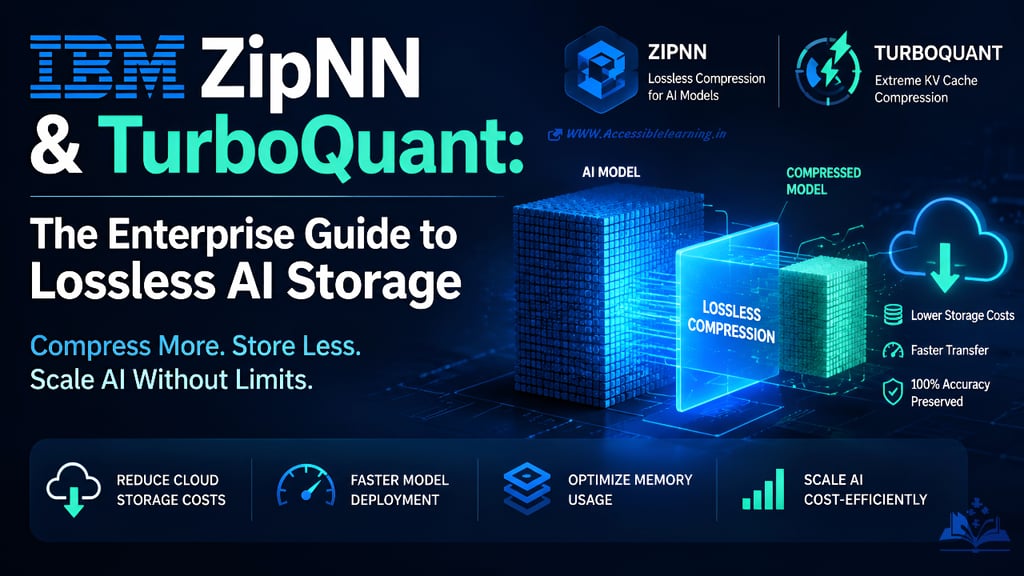
IBM ZipNN and TurboQuant: The Enterprise Guide to Lossless AI Storage
Discover how IBM ZipNN and TurboQuant are transforming AI infrastructure in 2026. Learn how lossless AI compression reduces model storage, cuts cloud costs, improves inference efficiency, and makes large-scale AI deployments more affordable for enterprises.
COMPANY/INDUSTRYAI/FUTURE
Sachin K Chaurasiya
6/24/20268 min read
How Massive Tech Companies Are Finally Making AI Storage Mathematically Affordable
Artificial intelligence has a storage problem.
For years, the industry has focused on making models smarter, larger, and more capable. The result is an explosion in model sizes, checkpoint files, embeddings, vector databases, and inference caches. A single enterprise AI deployment can now generate petabytes of data annually.
Most organizations assumed this was simply the cost of doing business in the AI era.
That assumption is now being challenged.
A new generation of mathematically driven compression technologies is changing the economics of AI infrastructure. Among the most significant developments are IBM's ZipNN and Google's TurboQuant, two advanced compression systems designed specifically for neural networks and AI workloads.
Unlike traditional compression tools, these technologies exploit hidden statistical patterns inside AI data itself. The goal is simple but powerful: dramatically reduce storage and network costs without sacrificing model quality.
For enterprise organizations facing soaring cloud bills and infrastructure bottlenecks, these technologies may represent one of the most important AI infrastructure breakthroughs of 2026.
The AI Storage Crisis Nobody Wanted to Talk About
The AI industry has spent years discussing GPUs, training costs, and model capabilities. Storage rarely made headlines. Yet storage has quietly become one of the largest operational expenses in modern AI systems.
Consider a typical enterprise AI environment:
Foundation models ranging from 10GB to several terabytes
Multiple model versions for governance and rollback
Fine-tuned variants for departments and business units
Vector databases containing billions of embeddings
Massive inference logs
Growing key-value (KV) caches for long-context AI applications
Every deployment creates another layer of storage overhead. As organizations scale AI across departments, cloud storage bills often increase faster than compute costs.
This problem becomes even worse when models must be replicated across regions, transferred between clouds, or deployed to edge environments.
The result is a hidden tax on AI adoption.
The industry has spent years optimizing computation while largely ignoring storage efficiency.
ZipNN and TurboQuant are changing that equation.
Why Traditional Compression Struggles With AI Models
Conventional compression tools such as ZIP, GZIP, or Zstandard were never designed for neural networks. They work well on text documents, source code, databases, and repetitive files because those formats contain obvious redundancy.
AI models appear different.
At first glance, billions of floating-point weights look almost random.
A language model may contain tens or hundreds of billions of numerical parameters represented in formats such as FP32, FP16, BF16, FP8, or emerging low-precision variants.
Historically, engineers assumed these values offered little opportunity for lossless compression. That assumption turned out to be wrong.
Researchers discovered that neural network weights contain subtle mathematical structures that traditional compression algorithms fail to recognize. These hidden structures create opportunities for dramatically better compression.

What Is IBM ZipNN?
IBM's ZipNN is an open-source lossless compression library specifically designed for AI models and neural network data. Researchers found that model weights contain predictable patterns that can be exploited for compression while preserving every bit of information.
Unlike quantization, pruning, or distillation, ZipNN does not modify the model. When decompressed, the model is mathematically identical to the original.
No accuracy loss.
No retraining.
No inference degradation.
No quality trade-offs.
That distinction is critical for enterprises operating under strict governance, compliance, and reproducibility requirements.
How ZipNN Works
To understand ZipNN, it helps to understand floating-point numbers. Neural networks store weights using formats such as the following:
FP32
FP16
BF16
FP8
These formats consist of multiple components:
Sign bits
Exponents
Mantissas
Researchers discovered that these components often contain non-random distributions and repeating patterns. ZipNN reorganizes and processes these numerical structures in ways that expose hidden redundancy.
Instead of treating model files as generic binary data, ZipNN understands the statistical behavior of neural network parameters. This AI-aware approach allows significantly higher compression ratios than general-purpose compression systems.
The Numbers That Matter
The most impressive aspect of ZipNN is not merely compression. It is compression combined with speed.
According to IBM's published research:
Common AI models often achieve approximately 33% storage reduction.
Some models exceed 50% reduction.
Compression performance exceeds traditional approaches by more than 17%.
Compression and decompression speeds improve by roughly 62%.
Multi-threaded decompression can reach up to 80 GB/s.
Those numbers translate directly into lower infrastructure costs.
For organizations moving large models across regions or repeatedly downloading checkpoints, the savings compound quickly.
IBM researchers estimate that AI-focused compression at scale could eliminate more than an exabyte of annual network traffic from major model repositories.
An exabyte equals one billion gigabytes.
That is not an optimization.
That is infrastructure transformation.
Why ZipNN Matters for Enterprises
Most enterprise AI budgets focus on GPUs.
Storage is often treated as an unavoidable expense.
ZipNN challenges that assumption.
Potential enterprise benefits include:
Reduced Cloud Storage Costs
Every compressed model occupies less storage space.
Organizations maintaining hundreds or thousands of models see immediate savings.
Faster Model Distribution
Smaller files move faster across networks.
Deployment pipelines become more efficient.
Lower Backup Costs
AI checkpoints frequently dominate backup storage requirements.
Compression reduces this burden substantially.
Improved Disaster Recovery
Model restoration becomes faster due to reduced transfer volumes.
Better Multi-Cloud Portability
Moving large AI assets between providers becomes less expensive.
For organizations managing AI at scale, these savings can become significant enough to affect annual infrastructure planning.

Enter TurboQuant: Google's Different Approach
While ZipNN focuses on lossless compression of model data, TurboQuant attacks another rapidly growing problem. Memory consumption during AI inference.
Modern large language models rely heavily on a structure called the Key-Value Cache, commonly known as the KV Cache.
This cache stores contextual information that allows models to remember previous tokens during conversations.
The longer the conversation becomes, the larger the cache grows.
For long-context AI systems, KV cache memory often becomes a major bottleneck.
TurboQuant was developed specifically to address this challenge.
What Makes TurboQuant Different?
Traditional quantization methods reduce precision but introduce overhead.
Many require:
Calibration datasets
Retraining
Extra metadata
Additional quantization parameters
TurboQuant takes a more mathematically elegant approach. The system uses advanced geometric transformations to compress vectors while preserving their essential structure.
Its architecture combines two major innovations:
PolarQuant
Vectors are rotated and transformed into polar representations.
This allows efficient compression while maintaining semantic relationships.
Quantized Johnson-Lindenstrauss (QJL)
A residual correction mechanism compensates for quantization errors and helps preserve accuracy.
The result is extremely aggressive compression with minimal or no measurable performance degradation across many workloads.
Why TurboQuant Matters
Enterprise AI systems increasingly struggle with memory pressure rather than storage pressure.
Long-context agents.
RAG systems.
Multi-agent workflows.
Reasoning models.
All of these consume substantial KV cache resources.
TurboQuant's research suggests:
More than 4× compression in many KV cache scenarios.
Significant reductions in memory requirements.
Improved throughput for AI inference systems.
Better scalability for long-context workloads.
This directly affects infrastructure utilization. Less memory per request means more concurrent users per GPU. More users per GPU means lower operational costs.
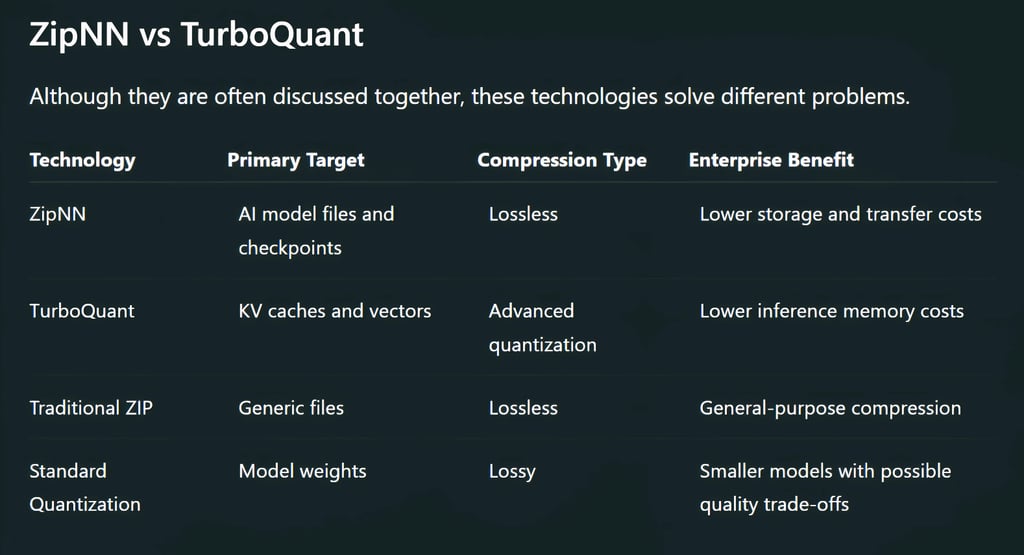
The most forward-looking AI infrastructure teams will likely deploy both approaches.
One reduces stored data.
The other reduces active memory consumption.
Together they attack the two largest hidden costs in AI infrastructure.
The Bigger Trend: AI-Aware Infrastructure
ZipNN and TurboQuant reveal a broader industry shift. For decades, infrastructure technologies were designed for general-purpose computing.
AI is changing that paradigm.
Storage systems are becoming AI-aware.
Networking is becoming AI-aware.
Databases are becoming AI-aware.
Compression is becoming AI-aware.
Instead of treating neural networks as generic files, modern infrastructure increasingly understands the mathematical structure of AI workloads.
This shift creates efficiencies that were impossible with traditional computing assumptions.
The result is a new generation of infrastructure optimized not for applications in general, but specifically for artificial intelligence.
What Enterprise Leaders Should Watch Next
The next phase of AI infrastructure competition will not be about model size. It will be about model efficiency. Organizations that can store, transfer, and serve AI systems more efficiently will gain meaningful cost advantages.
Expect continued innovation in:
AI-native compression
KV cache optimization
Vector database compression
Checkpoint deduplication
Memory-aware inference
AI storage architectures
The companies that master these technologies will spend less on infrastructure while delivering the same or better AI capabilities. That is a strategic advantage that scales with every model deployed.

The AI industry's obsession with bigger models has created a hidden infrastructure crisis.
Storage costs are exploding.
Network traffic is growing.
Memory requirements are becoming unsustainable.
IBM's ZipNN and Google's TurboQuant demonstrate that the solution may not require more hardware.
It may require better mathematics.
By exploiting previously overlooked patterns inside neural networks, these technologies transform compression from a generic IT function into a specialized AI optimization discipline.
For enterprise architects, data scientists, and infrastructure leaders, the message is clear:
The next major breakthrough in AI economics is not necessarily a faster GPU or a larger model.
It may be the ability to store the same intelligence in dramatically less space.
FAQ's
Q: What is IBM ZipNN?
IBM ZipNN is a lossless AI compression technology designed specifically for neural network models. It reduces the storage size of AI models by identifying and compressing mathematical redundancies in model weights while preserving every bit of the original data. This means models can be compressed without affecting accuracy, performance, or reproducibility.
Q: How does ZipNN differ from traditional compression tools like ZIP or GZIP?
Traditional compression tools treat AI models as generic files. ZipNN understands the structure of neural network data, including floating-point representations such as FP16, BF16, and FP32. This AI-aware approach enables significantly better compression ratios and faster decompression speeds for machine learning models.
Q: Is ZipNN lossless or lossy?
ZipNN is completely lossless. After decompression, the AI model is mathematically identical to the original version. Unlike quantization or pruning techniques, there is no reduction in model quality, accuracy, or inference performance.
Q: What is TurboQuant?
TurboQuant is an advanced AI compression technique developed to reduce memory usage during AI inference. It focuses on compressing key-value (KV) caches and vector data used by large language models, enabling more efficient memory utilization and improved inference scalability.
Q: How does TurboQuant improve AI inference efficiency?
TurboQuant uses advanced mathematical transformations and quantization methods to compress KV caches while preserving model performance. This allows organizations to serve more AI requests per GPU, reduce memory bottlenecks, and lower infrastructure costs.
Q: What are the business benefits of AI model compression?
AI model compression can help organizations:
Reduce cloud storage costs
Lower network transfer expenses
Accelerate model deployment times
Improve backup and disaster recovery processes
Increase infrastructure efficiency
Scale AI workloads more cost-effectively
Q: Can ZipNN and TurboQuant be used together?
Yes. ZipNN and TurboQuant address different parts of the AI infrastructure stack. ZipNN focuses on reducing stored model sizes, while TurboQuant focuses on reducing active memory consumption during inference. Using both technologies can maximize overall AI infrastructure efficiency.
Q: Why is AI storage becoming a major challenge for enterprises?
Modern AI systems generate massive amounts of data, including model checkpoints, embeddings, vector databases, training artifacts, and inference logs. As organizations deploy more AI applications, storage requirements grow rapidly, often leading to significant cloud and infrastructure costs.
Q: Will AI-native compression become a standard part of enterprise AI infrastructure?
Industry trends suggest that AI-native compression technologies will become increasingly important as AI models continue to grow in size and complexity. Organizations are actively seeking ways to reduce storage, networking, and memory costs without sacrificing model performance.
Q: What industries can benefit most from ZipNN and TurboQuant?
Industries with large-scale AI deployments are likely to see the greatest benefits, including:
Financial services
Healthcare and life sciences
Telecommunications
Manufacturing
Cloud service providers
Enterprise software companies
Research and high-performance computing organizations
Q: How do AI compression technologies reduce cloud costs?
By shrinking model files and reducing memory requirements, AI compression technologies decrease the amount of storage, bandwidth, and compute resources needed to train, deploy, and operate AI systems. This can significantly reduce overall cloud infrastructure spending.
Q: Are lossless AI compression technologies important for regulated industries?
Yes. Regulated industries often require exact model reproducibility for compliance, auditing, and governance purposes. Because lossless compression preserves the original model without modification, it is particularly attractive for sectors with strict regulatory requirements.
Subscribe To Our Newsletter
All © Copyright reserved by Accessible-Learning Hub
| Terms & Conditions
Knowledge is power. Learn with Us. 📚

