

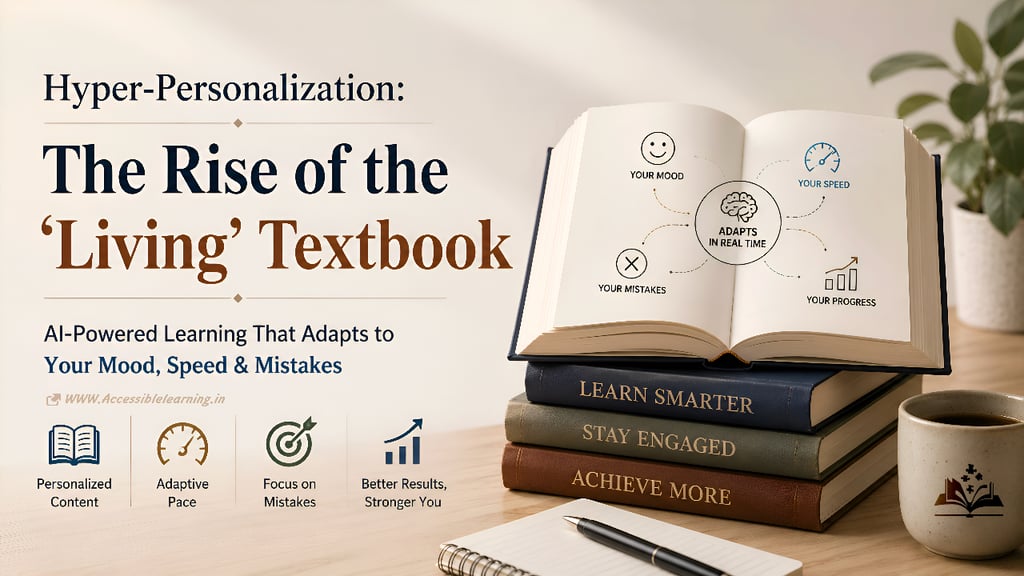
Hyper-Personalization: The Rise of the "Living" Textbook!
Discover how AI-powered Living Textbooks are transforming education through hyper-personalized learning. Learn how adaptive courses adjust to student pace, mistakes, engagement, and learning styles in real time.
ACCESSIBLE LEARNING
Shiv Singh Rajput | Sachin K Chaurasiya
6/11/20267 min read
Why Your Next Course Will Adapt to Your Mood, Speed, and Mistakes in Real Time
For decades, education followed a simple formula: every student received the same textbook, the same lessons, and the same assessments. Whether a learner struggled with a concept or mastered it instantly, the content remained unchanged.
Online learning improved accessibility, but most digital courses still followed the same static model. Everyone watched the same videos, completed the same modules, and moved through the same curriculum regardless of their learning style or pace.
That model is rapidly becoming outdated.
In 2026, a new generation of AI-powered educational systems is transforming how people learn. Instead of presenting identical content to every learner, modern platforms can analyze performance, identify weaknesses, measure engagement, and adapt lessons in real time.
The result is what many experts are calling the "Living Textbook": a dynamic learning environment that evolves continuously based on the individual learner.
For educators, course creators, and self-directed learners, this shift represents one of the most important developments in the future of education.
What Is a Living Textbook?
A Living Textbook is an AI-driven educational resource that changes itself according to the learner's needs. Unlike traditional textbooks or static online courses, a Living Textbook continuously collects data about how a student learns and uses that information to personalize the learning experience.
The system may adapt:
Lesson difficulty
Learning pace
Content format
Practice exercises
Revision schedules
Assessment methods
Learning pathways
Feedback mechanisms
Instead of forcing students to adapt to the course, the course adapts to the student. Imagine learning mathematics.
If a learner struggles with algebraic equations, the system automatically slows down, introduces simpler examples, provides visual explanations, and generates additional practice exercises.
Meanwhile, another student who demonstrates mastery can skip introductory material and move directly into advanced applications. Both students are studying the same subject, but their learning journeys become entirely different.
Why Traditional Online Courses Are Losing Effectiveness
The explosion of online education created unprecedented access to knowledge. However, course completion rates remain surprisingly low.
Many learners face challenges such as the following:
Information overload
Lack of motivation
Generic content
Poor retention
Learning fatigue
One-size-fits-all instruction
Most online courses assume every student learns in the same way. Reality tells a different story. Some learners absorb information visually. Others prefer reading. Some require repetition.
Others learn through projects and experimentation. When educational content fails to adapt, students disengage. The Living Textbook solves this problem by creating individualized learning experiences that remain relevant at every stage of the learning journey.

How AI Makes Hyper-Personalized Learning Possible
The rise of hyper-personalized education is powered by several AI technologies working together.
1. Learning Analytics
Modern AI systems monitor the following:
Time spent on lessons
Quiz performance
Completion rates
Error patterns
Repeated mistakes
Revision behavior
This data creates a detailed learning profile for every student. The platform learns how the learner thinks, where they struggle, and what teaching methods produce the best results.
2. Adaptive Learning Engines
Adaptive learning systems make real-time decisions about what content should appear next. For example:
If a learner scores 95% on a topic:
The system advances faster.
Reduces repetitive practice.
Introduces advanced material.
If a learner scores 50%:
The system revisits foundational concepts.
Provides extra examples.
Generates personalized exercises.
Every decision is optimized to maximize learning efficiency.
3. Generative AI Tutors
AI tutors are becoming a central component of modern education. Instead of waiting for an instructor to answer questions, learners can interact with intelligent tutoring systems 24/7.
These AI tutors can:
Explain concepts differently
Generate examples instantly
Create quizzes
Simplify difficult topics
Translate content into multiple languages
Simulate one-on-one coaching
The educational experience becomes significantly more interactive and personalized.
4. Emotional and Engagement Detection
One of the most fascinating developments in 2026 is engagement-aware learning. AI systems increasingly measure indicators such as the following:
Response speed
Participation patterns
Attention levels
Learning consistency
Frustration signals
When engagement drops, the system can respond immediately. Examples include:
Switching content formats
Introducing interactive exercises
Offering shorter lessons
Providing motivational feedback
Recommending breaks
The goal is not just teaching information but maintaining optimal learning conditions.
The Three Levels of Hyper-Personalization
Level 1: Personalized Content
The system changes what students learn. Examples include:
Customized reading materials
Personalized examples
Industry-specific case studies
Dynamic assignments
A marketing professional and a software developer may receive different examples while learning the same business concept.
Level 2: Personalized Learning Paths
The system changes the order of learning. Rather than following a fixed curriculum, learners take unique pathways based on their:
Existing knowledge
Goals
Strengths
Weaknesses
This significantly reduces wasted learning time.
Level 3: Personalized Learning Experience
The system changes how learning is delivered. Examples include:
Video-first instruction
Text-based learning
Interactive simulations
Audio lessons
Visual explanations
Project-based learning
Every learner receives a format optimized for retention.

Why Learners Retain More Information
One of the biggest promises of adaptive learning is improved knowledge retention. Traditional learning often suffers from:
Passive consumption
Cognitive overload
Poor revision timing
Irrelevant examples
Living Textbooks solve these issues through continuous optimization. The system can:
Schedule review sessions before forgetting occurs
Reinforce weak concepts
Increase challenge gradually
Connect new information to existing knowledge
As a result, learners spend less time studying while retaining more information.
The Rise of AI Learning Companions
Future educational platforms will not simply provide content. They will provide intelligent learning companions.
These companions will:
Track progress
Recommend next steps
Explain difficult concepts
Monitor learning goals
Generate personalized study plans
Identify skill gaps
Instead of acting as digital textbooks, they become educational partners. This shift fundamentally changes how people approach self-education.
What This Means for Course Creators
The rise of Living Textbooks creates both opportunities and challenges. Course creators who continue building static content may struggle to compete against adaptive learning platforms.
The future belongs to educational experiences that can evolve continuously. Successful course creators will focus on the following:
Modular Content Design
Lessons should be built in smaller units that AI systems can rearrange dynamically.
Multi-Format Learning Resources
Provide:
Videos
Articles
Worksheets
Interactive activities
Assessments
This gives adaptive systems more personalization options.
Data-Driven Course Improvement
AI analytics reveal:
Drop-off points
Difficult topics
Engagement bottlenecks
Learning outcomes
Creators can continuously improve their content based on real user behavior.
How Schools and Universities Are Adapting
Educational institutions are increasingly adopting adaptive learning technologies. Benefits include:
Higher student engagement
Better completion rates
Improved academic performance
Personalized support at scale
Instead of replacing educators, AI enables teachers to focus on mentorship, critical thinking, and deeper learning experiences. The teacher becomes more valuable, not less. AI handles routine personalization while educators provide human guidance and expertise.
Potential Challenges and Ethical Concerns
Despite its benefits, hyper-personalized education introduces important challenges.
Data Privacy
Adaptive systems require extensive learner data. Educational organizations must ensure:
Transparency
Consent
Secure storage
Responsible AI practices
Algorithmic Bias
AI systems must avoid creating unfair learning experiences.
Developers need rigorous testing to ensure personalization benefits all learners equally.
Over-Reliance on Automation
Education is more than information transfer.
Critical thinking, creativity, collaboration, and human mentorship remain essential.
The best future combines AI personalization with human instruction.


Tools Driving the Living Textbook Revolution
Several categories of tools are accelerating this transformation:
AI tutoring platforms
Adaptive learning systems
Intelligent assessment tools
Learning analytics software
Personalized study planners
Generative content engines
Skill-based credentialing platforms
As these technologies mature, adaptive learning will become the default expectation rather than a premium feature.
The Future: Every Learner Gets Their Own Curriculum
The traditional classroom was designed for efficiency. The Living Textbook is designed for effectiveness. In the coming years, learners will increasingly expect educational experiences that:
Adapt instantly
Understand their strengths
Identify their weaknesses
Personalize learning paths
Optimize retention
Evolve continuously
The concept of a single textbook for millions of students may eventually feel as outdated as a one-size-fits-all website. Education is moving toward a future where every learner receives a unique curriculum, delivered at the right pace, in the right format, at the right moment.
Hyper-personalization is no longer a futuristic concept. It is quickly becoming the foundation of modern education. The rise of the Living Textbook signals a major shift away from static courses and standardized learning experiences toward intelligent systems that adapt continuously to individual needs.
For learners, this means faster skill development, better retention, and more engaging educational journeys. For educators and course creators, it presents an opportunity to build learning experiences that are smarter, more responsive, and significantly more effective.
The question is no longer whether adaptive learning will become mainstream. The real question is how quickly educational organizations can evolve before the Living Textbook becomes the new standard.
FAQ's
Q: What is a Living Textbook in education?
A Living Textbook is an AI-powered learning system that continuously adapts educational content based on a student's progress, learning speed, mistakes, engagement level, and knowledge gaps. Unlike traditional textbooks or static online courses, it evolves in real time to create a personalized learning experience.
Q: How does AI personalize learning for each student?
AI analyzes learning behavior such as quiz scores, completion rates, time spent on lessons, repeated mistakes, and study habits. Based on this data, it adjusts lesson difficulty, recommends targeted practice, changes content formats, and creates customized learning paths to improve outcomes.
Q: What is hyper-personalized learning?
Hyper-personalized learning is an advanced educational approach where AI tailors every aspect of the learning experience to an individual's needs. This includes personalized content, pacing, assessments, feedback, revision schedules, and learning methods to maximize retention and engagement.
Q: How are Living Textbooks different from traditional online courses?
Traditional online courses provide the same content to every learner. Living Textbooks adapt dynamically, offering different lessons, exercises, explanations, and learning pathways based on each student's strengths, weaknesses, and learning preferences.
Q: Can AI-powered learning improve knowledge retention?
Yes. AI-powered adaptive learning systems use techniques such as spaced repetition, personalized review schedules, and targeted reinforcement of weak areas. These methods help learners retain information longer and reduce the chances of forgetting important concepts.
Q: What technologies power adaptive learning platforms?
Modern adaptive learning platforms use technologies such as artificial intelligence, machine learning, learning analytics, natural language processing (NLP), generative AI, intelligent tutoring systems, and predictive analytics to create personalized educational experiences.
Q: Are AI tutors replacing human teachers?
No. AI tutors are designed to support learning by providing instant explanations, practice exercises, and personalized guidance. Human teachers remain essential for mentorship, critical thinking development, emotional support, creativity, and collaborative learning experiences.
Q: What are the benefits of AI-driven personalized education?
Key benefits include the following:
Faster learning progress
Better engagement
Improved retention
Customized learning paths
Immediate feedback
Reduced learning frustration
More efficient skill development
Q: Which learners benefit most from adaptive learning?
Adaptive learning benefits:
Students in schools and universities
Self-taught learners
Working professionals
Corporate trainees
Exam preparation students
Lifelong learners seeking personalized education
Q: What are the challenges of hyper-personalized education?
Some challenges include data privacy concerns, algorithmic bias, ethical AI usage, implementation costs, and the need to balance automation with human interaction. Educational institutions must ensure responsible use of learner data and transparent AI practices.
Q: Will adaptive learning become the future of online education?
Industry trends suggest that adaptive learning will become a standard feature of digital education. As AI technology advances, learners will increasingly expect courses that automatically adjust to their skill level, goals, and learning behavior.
Q: How can educators and course creators prepare for the rise of Living Textbooks?
Educators should focus on creating modular content, multiple learning formats, interactive assessments, and AI-compatible learning experiences. Understanding learning analytics and adaptive technologies will also become increasingly important for future-ready course design.
Q: What are the best AI tools for personalized learning in 2026?
Popular categories include AI tutors, adaptive learning platforms, intelligent assessment tools, learning analytics software, personalized study planners, and generative AI content systems. The best tool depends on the learner's goals, subject area, and preferred learning style.
Q: Is hyper-personalized learning suitable for professional skill development?
Yes. Many organizations are adopting adaptive learning systems for employee training because they can identify skill gaps, customize learning paths, and accelerate workforce development more effectively than traditional training programs.
Q: How does AI know when a student is struggling?
AI systems detect patterns such as repeated mistakes, declining quiz scores, excessive time spent on a topic, skipped lessons, or reduced engagement. The platform then adjusts the learning experience by offering additional support, alternative explanations, or extra practice materials.
Subscribe to Frontier Intelligence
All © Copyright reserved by Accessible-Learning Hub
Accessible Learning Hub — Actionable clarity for high-agency minds.
Weekly breakdowns on AI breakthroughs, capital flow, and human performance systems. Zero fluff.