

How to Use AI to Practice Real Skills, Not Just Chat
Learn how to use AI as a practical skill-building tool, not just a chatbot. This guide shows how to practice real-world skills like language learning, design thinking, and business strategy using AI in a deliberate, human-centered way.
A LEARNINGAI/FUTUREEDUCATION/KNOWLEDGE
Sachin K Chaurasiya | Kim Shin
2/3/20265 min read
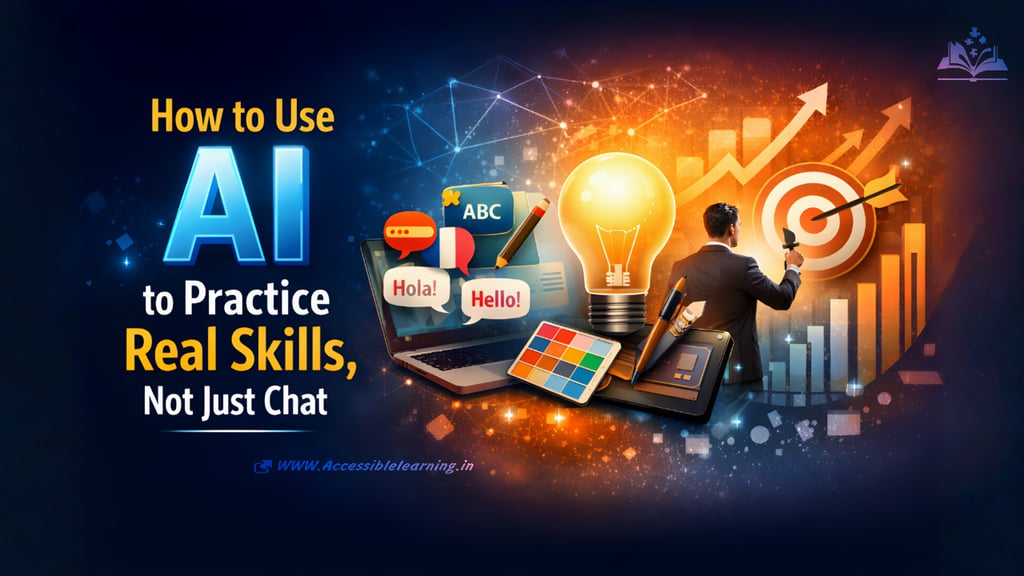
AI has become part of daily life. People use it to answer questions, write emails, generate content, or brainstorm ideas. While this is convenient, it creates a false sense of progress. Getting answers is not the same as building skills.
Real skills are developed through effort, repetition, feedback, and reflection. AI becomes genuinely valuable when it is used as a practice system, not a talking machine. When used correctly, AI can accelerate learning in ways that were never possible before.
This article breaks down how to use AI to practice real skills, with a focus on language learning, design thinking, and business strategy, while sharing frameworks that apply to any skill.
Why Most People Fail to Learn With AI
Before learning how to use AI correctly, it helps to understand what goes wrong.
Common patterns:
Asking AI to “do it for me”
Copying results without thinking
Avoiding difficult or uncomfortable practice
Treating AI responses as final answers
This turns AI into a dependency instead of a tool. Skills require friction. If AI removes all friction, learning stops.
The goal is not speed. The goal is skill transfer.
Reframing AI: From Chatbot to Skill Trainer
The moment you stop chatting and start training, AI becomes powerful.
A useful mental shift:
AI is not a teacher giving lectures
AI is not a worker replacing you
AI is a coach that reacts to your effort
That means:
You act first
AI responds second
You improve through iteration
This single shift changes everything.
Using AI for Language Learning Beyond Basics
Practice Output, Not Just Input
Most learners focus too much on reading and listening. Fluency comes from producing language.
Use AI to:
Write short paragraphs and get corrections
Speak (via voice tools) and ask for feedback
Rephrase your thoughts in multiple ways
Ask questions like
“Correct my sentence and explain why it sounds unnatural.”
“Rewrite my sentence as a native speaker would say it casually.”
This trains instinct, not memorization.
Build Thinking-in-the-Language Ability
Translation keeps your brain locked in your native language. Instead, train thinking directly in the new language.
Try:
Describing daily routines only in the target language
Asking AI questions and answering them without translating
Explaining simple concepts as if teaching someone else
This builds internal language mapping, which is the foundation of fluency.
Progressive Difficulty Is Key
Static practice leads to plateaus.
Ask AI to:
Start with simple vocabulary
Gradually introduce complex structures
Correct less overtime and only point out major issues
This mirrors how humans naturally learn and keeps progress steady.
Using AI to Develop Real Design Skills
Design Is Decision-Making, Not Decoration
AI can generate visuals instantly, but design skill lies in why something works.
Use AI to:
Analyze layout choices
Explain visual hierarchy
Identify usability problems
Examples:
“What design principle is violated here?”
“How would this layout confuse first-time users?”
This sharpens judgment, which matters more than tools.
Practice Constraint-Based Design
Real design work always has constraints: time, brand rules, users, and devices.
Ask AI to:
Limit color palettes
Design for accessibility
Optimize for mobile-first experiences
Constraints force creative thinking and simulate real-world projects.
Develop Design Critique Skills
Good designers can critique work, not just create it.
Practice by:
Sharing a concept and asking for harsh critique
Comparing two design approaches
Asking which audience each design serves best
This builds professional-level thinking instead of surface-level aesthetics.
Using AI to Strengthen Business Strategy Skills
Replace Business Plans With Strategic Thinking
Business plans look impressive but rarely build skill. Instead, use AI to:
Break ideas into assumptions
Identify risks
Explore alternative strategies
Ask:
“What assumption would kill this idea if wrong?”
“What would a competitor do to attack this business?”
This develops strategic awareness.
Train Decision-Making Under Uncertainty
Most business decisions are made with incomplete information.
Simulate this by asking AI to:
Give partial data
Change conditions unexpectedly
Challenge your decisions
Then reflect on your reasoning, not just the outcome.
Practice Clear Thinking and Communication
Strategy fails when it cannot be explained.
Use AI to:
Simplify your ideas
Identify vague thinking
Force clarity
Examples:
“Rewrite this strategy so a non-expert can understand it.”
“Point out where my thinking lacks evidence.”
This improves leadership and persuasion skills.

Skill Transfer: The Most Important Factor
Learning only matters if it transfers to real life.
To ensure transfer:
Practice with real problems, not abstract ones
Use your own ideas, not AI-generated ones
Apply learning outside AI immediately
AI should prepare you for reality, not replace it.
The Universal AI Skill Practice Loop
Use this loop for any skill:
Attempt first
Do the task without AI help.Request targeted feedback
Ask what is weak and why.Revise intentionally
Apply feedback with awareness.Increase complexity
Add constraints, speed, or realism.Reflect on improvement
Identify what changed and what didn’t.
This loop turns AI into a skill accelerator.
Advanced Ways to Use AI for Skill Growth
Ask AI to act as a strict evaluator, not a helper
Request grading rubrics before starting a task
Ask AI to hide the answer and only guide you
Use AI to track recurring mistakes
Practice explaining concepts back to AI
These methods push learning deeper.
Psychological Benefits of Practicing With AI
AI also helps with:
Reducing fear of failure
Allowing unlimited retries
Providing judgment-free feedback
Encouraging experimentation
This makes consistent practice easier, which matters more than talent.
What Not to Use AI For
Avoid using AI to:
Replace thinking
Avoid effort
Skip fundamentals
Pretend progress is mastery
AI should make learning harder in the right ways, not easier in the wrong ones.
AI does not automatically make people smarter. It amplifies intent. Those who use AI to:
Practice deliberately
Think critically
Improve continuously
will gain real skills that compound over time.
Those who only chat will stay entertained, not capable. The difference is how you choose to use the tool.
FAQ's
Q: Can AI really help build real skills, or is it just for information?
Yes, AI can help build real skills, but only if it is used actively. Skills grow through practice, feedback, and correction. When AI is used as a coach that critiques your work, simulates real situations, and challenges your thinking, it supports genuine skill development. When it is used only to give answers, learning stays shallow.
Q: How is using AI for practice different from taking online courses?
Online courses mainly deliver content. AI enables interaction. With AI, you can practice anytime, get immediate feedback, repeat exercises endlessly, and adapt difficulty to your level. This makes AI more effective for skill application, while courses are better for structured knowledge.
Q: What is the biggest mistake people make when learning with AI?
The biggest mistake is letting AI do the work instead of attempting it themselves first. When AI replaces effort, skills do not develop. The most effective approach is to try first, fail, and then ask AI for feedback and improvement guidance.
Q: Can beginners use AI for skill practice, or is it only for advanced users?
Beginners benefit the most from AI when it is used correctly. AI can explain mistakes in simple language, slow down practice, and provide safe, judgment-free repetition. The key is to start with basic tasks and gradually increase difficulty instead of jumping to advanced outputs.
Q: How do I avoid becoming dependent on AI?
Use AI after effort, not before it. Attempt the task on your own, then ask AI to critique or guide you. Also, regularly practice without AI and apply what you learn in real-world situations. Dependence forms when AI replaces thinking instead of supporting it.
Q: Is using AI for language learning better than traditional methods?
AI is not a replacement for traditional methods, but it is a powerful complement. Textbooks and courses teach structure, while AI enables conversation, correction, and contextual practice. When combined, learning becomes faster and more practical.
Q: How much time should I spend practicing with AI daily?
Even 20 to 30 minutes of focused practice is effective if done deliberately. Short, consistent sessions with feedback and reflection produce better results than long, unfocused interactions. Quality of practice matters more than duration.
Q: Does practicing with AI transfer to real-world performance?
Yes, if practice is realistic. Skill transfer happens when you simulate real situations, work on your own ideas, and reflect on feedback. If AI practice mirrors real-world conditions, confidence and competence improve outside the tool as well.
Q: Can AI help with soft skills like thinking, communication, and strategy?
Yes. AI is especially useful for practicing reasoning, decision-making, explanation, and clarity of thought. By challenging your ideas, asking follow-up questions, and exposing weak logic, AI strengthens soft skills that are hard to train elsewhere.
Q: Will AI eventually replace the need to learn skills?
No. AI increases the value of skilled humans. As tools become more powerful, people who can think clearly, make decisions, and apply judgment will stand out even more. AI rewards those who build skills, not those who avoid them.
Subscribe To Our Newsletter
All © Copyright reserved by Accessible-Learning Hub
| Terms & Conditions
Knowledge is power. Learn with Us. 📚

