

How to Build Resilience When Learning Gets Tough (In-Depth Guide)
Learning does not always feel easy. When motivation drops and concepts feel overwhelming, resilience becomes the key to progress. This guide explores practical, science-backed ways to help learners stay consistent, adapt to challenges, and grow stronger when learning gets tough.
A LEARNINGEDUCATION/KNOWLEDGE
Shiv Singh Rajput
2/15/20264 min read
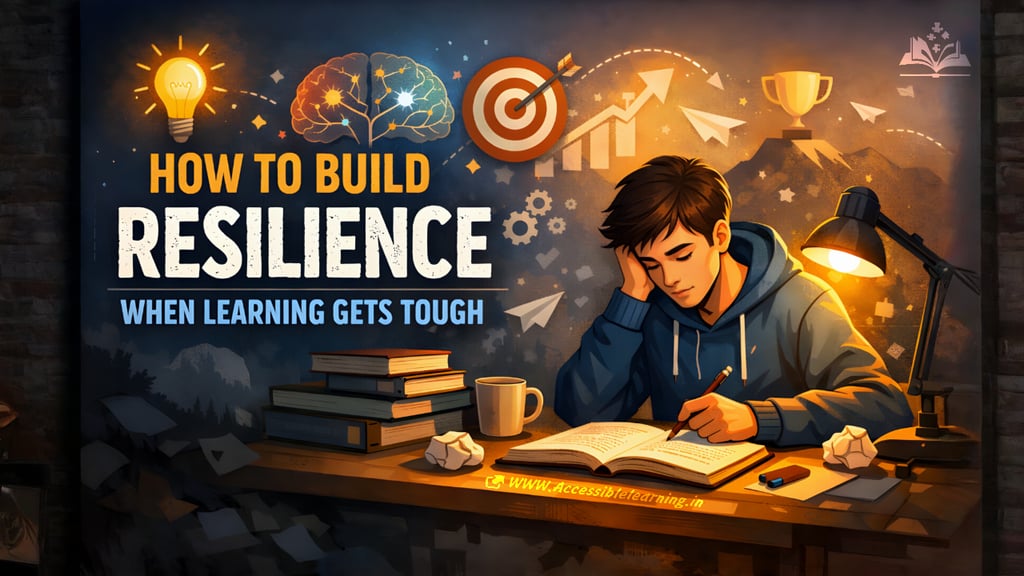
Learning is not meant to feel easy all the time. Real learning stretches your thinking, challenges your confidence, and tests your patience. When the process gets tough, resilience is what keeps you moving forward. Resilience in learning is the ability to stay engaged, adapt your approach, and continue despite frustration, slow progress, or setbacks.
This guide goes deep into practical, human-centered strategies to help you build strong learning resilience that lasts.
Understand That Struggle Is a Sign of Growth
One of the biggest mistakes learners make is assuming struggle means failure. In reality, struggle often means your brain is forming new connections. When learning feels difficult:
Your brain is working harder
You are moving beyond comfort zones
Deeper understanding is being built
Reframing struggle as progress helps you stay calm and committed instead of discouraged.
Set Realistic Expectations From the Start
Many people quit learning because they expect fast results. Unrealistic expectations:
“I should understand this immediately”
“If I’m slow, I must be bad at this”
“I should already be good by now”
Healthy expectations:
Learning takes time
Confusion is temporary
Skill builds gradually through repetition
When expectations are realistic, setbacks feel manageable instead of personal.
Define Clear, Meaningful Learning Goals
Vague goals weaken resilience. Clear goals give direction. Instead of:
“I want to study better”
Use:
“I want to understand this chapter by Friday”
“I want to solve 10 problems without help”
“I want to explain this concept in my own words”
Clear goals:
Reduce anxiety
Improve focus
Make progress visible
Design Your Learning for Focus, Not Length
Long study hours do not guarantee resilience. Focus does. Try this structure:
Short, focused sessions (25–45 minutes)
One specific task per session
Breaks to reset attention
This prevents mental fatigue and keeps motivation steady, even during difficult topics.
Learn to Pause, Not Quit
When learning gets overwhelming, many people quit entirely. Resilient learners pause instead. Pausing can mean:
Taking a short walk
Switching to a lighter task
Reviewing basics
Returning later with a fresh mind
Pauses preserve momentum. Quitting destroys it.
Use Reflection to Strengthen Learning
Reflection turns effort into improvement. After each learning session, ask:
What did I understand better today?
Where did I struggle?
What should I try differently next time?
Reflection builds awareness and prevents repeating the same mistakes.
Train Emotional Control During Learning
Frustration, anxiety, and self-doubt are common during tough learning phases. To manage emotions:
Take slow breaths when stuck
Step away briefly instead of forcing progress
Name the feeling without judging it
Learning resilience grows when emotions are managed, not ignored.
Replace Perfectionism With Progress
Perfectionism kills resilience. Signs of perfectionism:
Avoiding tasks unless conditions are perfect
Feeling discouraged by small mistakes
Overthinking instead of practicing
Progress-focused learners:
Accept imperfect understanding
Learn through trial and error
Improve through feedback
Progress keeps learning alive.
Strengthen Memory Through Repetition and Review
Difficulty often comes from forgetting, not inability. Improve retention by:
Revisiting material after one day, one week, and one month
Summarizing from memory instead of rereading
Mixing old topics with new ones
Strong memory reduces frustration and boosts confidence.
Change the Way You Study When Stuck
Resilient learners change strategies, not goals. If something isn’t working:
Switch from reading to writing
Use visuals or diagrams
Teach the concept aloud
Practice with real examples
Flexibility is a core resilience skill.
Protect Your Energy Like a Resource
Learning is energy-dependent. Low energy causes:
Reduced focus
Negative thinking
Faster frustration
Support your energy by:
Sleeping consistently
Eating balanced meals
Staying hydrated
Taking short movement breaks
A supported body supports the mind.

Build Discipline Without Waiting for Motivation
Motivation comes and goes. Discipline stays. Build discipline by:
Studying at the same time daily
Starting even when you don’t feel ready
Keeping sessions short but consistent
Action creates motivation, not the other way around.
Reduce Mental Noise and Distractions
Distractions weaken resilience by breaking concentration. Practical steps:
Keep phone away during study
Close unnecessary tabs
Use simple tools instead of many apps
A quieter environment helps you push through difficult material.
Learn to Ask for Help Early
Struggling alone for too long increases frustration. Ask for help when:
You are stuck repeatedly
Concepts don’t make sense after effort
You feel mentally blocked
Help can come from:
Teachers or mentors
Study partners
Online forums or communities
Asking questions is a strength, not a weakness.
Celebrate Effort, Not Just Results
Resilience grows when effort is recognized. Celebrate:
Showing up consistently
Finishing difficult tasks
Trying again after failure
This builds positive reinforcement and long-term motivation.
Develop Patience With Yourself
Learning is not linear. Progress has ups and downs. On slow days:
Lower expectations
Focus on consistency
Trust the process
Patience prevents burnout and supports long-term success.
Reconnect With Purpose During Hard Phases
When learning feels pointless, resilience fades. Reconnect by asking:
How will this skill help me later?
What opportunities does this open?
What problem will this help me solve?
Purpose gives meaning to effort.
Resilience Is Built, Not Found
Resilience in learning is not about being tough all the time. It is about being adaptable, patient, and consistent.
When learning gets tough:
Adjust instead of abandoning
Reflect instead of reacting
Continue instead of quitting
Over time, resilience transforms difficulty into confidence and effort into mastery.

FAQ's
Q: What does resilience in learning mean?
Resilience in learning is the ability to keep going even when learning feels difficult, slow, or frustrating. It means adapting your approach, managing emotions, and continuing to make progress instead of giving up after setbacks.
Q: Why do I feel stuck or frustrated while learning new things?
Feeling stuck usually happens because your brain is processing unfamiliar information. It can also be caused by unrealistic expectations, mental fatigue, poor study methods, or fear of making mistakes. Struggle is often a sign that real learning is happening.
Q: How can I stay motivated when learning feels overwhelming?
Focus on small, achievable goals instead of the full workload. Short study sessions, visible progress, and reconnecting with your purpose for learning can restore motivation. Taking breaks and changing strategies also helps prevent burnout.
Q: Is struggling a sign that I am bad at learning?
No. Struggling is a normal part of learning. Everyone experiences difficulty when building new skills. What matters is how you respond to the struggle. Persistence and adjustment lead to improvement over time.
Q: What are simple ways to build learning resilience daily?
Study consistently, even for short periods. Reflect on what worked and what didn’t. Practice self-compassion, limit distractions, and treat mistakes as feedback. These small habits strengthen resilience over time.
Q: How do I avoid quitting when I fail or make mistakes?
Instead of seeing mistakes as failure, treat them as information. Ask what went wrong and what you can change next time. Pausing, adjusting your approach, and trying again builds long-term confidence.
Q: Can resilience be learned, or is it natural?
Resilience is a skill, not a personality trait. It develops through experience, repetition, and reflection. The more you face challenges and keep going, the stronger your resilience becomes.
Q: How long does it take to build resilience in learning?
There is no fixed timeline. Resilience builds gradually through consistent effort and mindset shifts. Each time you push through difficulty instead of quitting, you strengthen it.
Subscribe to Frontier Intelligence
All © Copyright reserved by Accessible-Learning Hub
| Terms & Conditions
Accessible Learning Hub — Actionable clarity for high-agency minds.
Weekly breakdowns on AI breakthroughs, capital flow, and human performance systems. Zero fluff.