

How the Parker Solar Probe Survives Hell: The Mission That Rewrote the Rules of Spaceflight
Discover how NASA's Parker Solar Probe became the fastest object ever built, survived the Sun's extreme heat, and revealed groundbreaking secrets about our closest star.
SPACE & EXPLORATION
Sachin K Chaurasiya
7/24/20267 min read
Mission Timeline
Launch Date: August 12, 2018
Launch Vehicle: Delta IV Heavy with a Star 48BV upper stage
Mission Agency: NASA
The mission is named after solar astrophysicist Eugene Parker, who first proposed the existence of the solar wind in 1958. It is the first NASA spacecraft named after a living person.
The Start: Racing Straight Into Hell
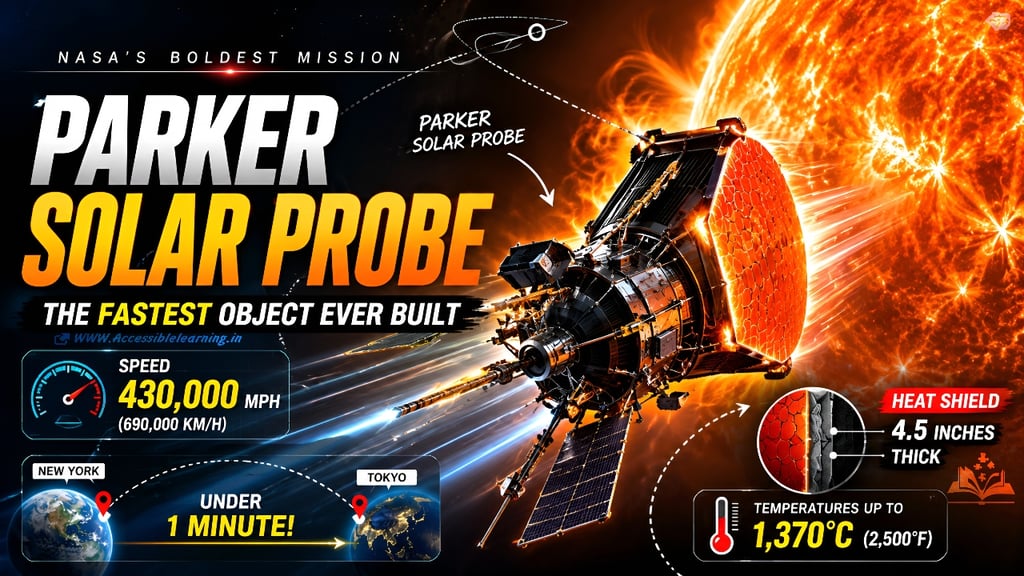
Imagine watching a spacecraft dive toward the Sun at nearly 430,000 miles per hour (690,000 km/h). It isn't slowing down. It isn't turning away. Every second, it hurtles deeper into a place where temperatures soar beyond 1,370°C (2,500°F), hot enough to melt almost any metal ever made.
For most spacecraft, this would be a death sentence.
But the Parker Solar Probe was built for exactly this mission.
Wrapped behind a carbon-composite heat shield only 4.5 inches (11.4 cm) thick, the spacecraft races through the Sun's outer atmosphere, skimming closer than any human-made object has ever dared. One mistake, one unexpected failure, and years of engineering would vanish in an instant.
This isn't just another space mission.
It's humanity's most daring game of cosmic chicken.
"At its top speed of about 430,000 mph (690,000 km/h), the Parker Solar Probe could travel from New York to Tokyo in well under one minute."
Every flyby pushes the spacecraft faster than anything humans have ever built, turning the Sun's gravity into the ultimate slingshot.
The Big Problem: How Do You Touch the Sun Without Melting?
Sending a spacecraft to Mars is difficult.
Sending one to Jupiter is even harder.
But flying toward the Sun sounds almost impossible.
The closer you get, the more brutal everything becomes.
Engineers faced challenges unlike any previous mission:
Extreme heat that can destroy electronics.
Intense solar radiation capable of damaging instruments.
Violent streams of charged particles traveling at incredible speeds.
Tiny dust particles that hit with explosive force because of the probe's enormous velocity.
The obvious question was simple:
How can a spacecraft survive where temperatures exceed those inside many industrial furnaces?
NASA's answer was surprisingly elegant. Instead of trying to make the entire spacecraft heatproof, engineers created one extraordinary shield.
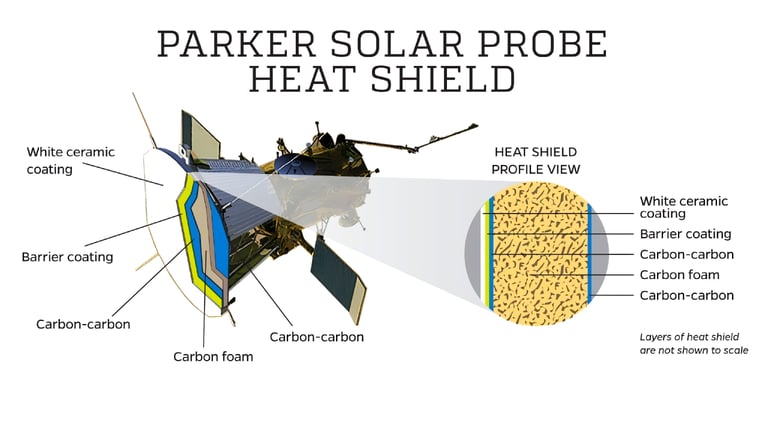
The carbon-composite heat shield is just 4.5 inches thick, yet it keeps the spacecraft's instruments at roughly room temperature while the front side faces inferno-like conditions.
Think of standing a few feet away from a roaring bonfire.
Now imagine your face is inches from the flames while your back stays comfortably cool.
That is essentially what Parker Solar Probe experiences every second near the Sun.
Even its solar panels can't remain fully exposed. Special mechanisms pull them partially behind the heat shield, leaving only enough surface area to generate electricity without overheating.
Everything about this spacecraft exists for one purpose:
Survive long enough to answer questions scientists have asked for generations.
The Main Event: Flying Through the Sun's Atmosphere
Most spacecraft observe planets from afar.
The Parker Solar Probe does the exact opposite.
It flies directly into the Sun's outer atmosphere, known as the corona.
For decades, scientists struggled to explain several mysteries:
Why is the Sun's outer atmosphere hundreds of times hotter than its visible surface?
How is the solar wind accelerated to millions of miles across the Solar System?
What causes the powerful solar storms that can disrupt satellites, GPS systems, radio communication, and even electrical grids on Earth?
Instead of looking from a distance, Parker decided to fly straight into the action.
Every close approach gathers measurements that have never been possible before.
The spacecraft has already revealed that the Sun's magnetic field twists and folds in surprisingly complex ways. It has flown through giant magnetic "switchbacks," where magnetic fields suddenly reverse direction like a snapping whip.
Scientists have also observed streams of solar wind forming much closer to the Sun than expected, helping explain how these charged particles gain incredible speed before spreading across the Solar System.
Each orbit takes Parker even closer.
Each pass produces data that reshapes decades of scientific theories.
And with every encounter, the spacecraft becomes even faster.
Gravity acts like an enormous accelerator.
Rather than fighting the Sun's pull, NASA cleverly uses repeated flybys of Venus to gradually reshape Parker's orbit, allowing it to dive closer and closer until the Sun itself flings it to record-breaking speeds.
This isn't speed for the sake of speed. It is the only way to reach regions no spacecraft has ever explored.
"The Parker Solar Probe isn't just the closest spacecraft to the Sun. It is also the fastest object ever built by humanity."
That title isn't likely to disappear anytime soon.

More Than Heat: The Hidden Dangers
Heat grabs all the headlines, but it isn't the spacecraft's only enemy. Traveling hundreds of thousands of miles per hour creates another problem. Even microscopic dust particles become dangerous.
Imagine a tiny grain of sand striking a windshield at highway speed. Now multiply that impact thousands of times.
At Parker's incredible velocity, tiny particles carry enormous energy. Instruments must survive countless high-speed impacts while continuing to collect precise scientific measurements.
Communication also becomes difficult. Signals take several minutes to travel between Earth and the spacecraft, making real-time control impossible. The probe must constantly monitor its own position.
If its heat shield ever points away from the Sun, even briefly, exposed instruments could overheat within moments. So Parker largely flies itself.
Its autonomous guidance system constantly adjusts its orientation without waiting for commands from Earth. That's like asking a race car to drive itself through a volcano while the driver watches from another continent.
What Parker Solar Probe Has Already Changed
The mission has already transformed solar science.
Researchers now understand much more about:
The origin of the solar wind.
The behavior of powerful magnetic fields.
The structure of the Sun's corona.
How energetic particles accelerate during solar storms.
Why space weather can become so unpredictable.
These discoveries help improve forecasts of solar activity.
That matters because modern civilization depends heavily on technology vulnerable to space weather.
Powerful solar storms can interfere with:
Satellites
GPS navigation
Radio communications
Astronaut safety
Airline routes near Earth's poles
Electrical infrastructure
Better predictions mean better protection.
Why It Matters: Learning to Live With Our Star
The Sun gives Earth life. It also has the power to disrupt nearly every modern technology we rely on. Understanding it isn't just an academic exercise.
It's becoming essential. The Parker Solar Probe represents something remarkable about human curiosity. Instead of avoiding the most dangerous place in our Solar System, scientists chose to fly directly into it.
Every orbit proves that engineering can overcome challenges once thought impossible.
Every measurement helps us better understand the star that makes life on Earth possible.
And every record-breaking dive reminds us that exploration isn't always about traveling farther away.
Sometimes the greatest adventure is racing toward the very thing everyone else thought you should avoid. The Parker Solar Probe isn't simply the fastest object ever built.
It is one of humanity's boldest scientific experiments, turning the impossible into reality one blisteringly fast orbit at a time.

How Close Does It Get?
At its closest approach, Parker Solar Probe comes within approximately 6.1 million km (3.8 million miles) of the Sun's visible surface.
That is about seven times closer than the orbit of Mercury, making it the closest spacecraft ever sent to the Sun.
Why Venus Is So Important
The spacecraft uses seven gravity-assist flybys of Venus to gradually shrink its orbit around the Sun.
These flybys act like carefully timed "orbital brakes," allowing Parker to get closer to the Sun without carrying enormous amounts of fuel.
What Does It Carry?
Parker Solar Probe has four primary scientific instrument suites:
FIELDS measures electric and magnetic fields.
SWEAP studies electrons, protons, and helium ions in the solar wind.
WISPR captures images of the Sun's corona and solar wind.
IS☉IS measures energetic particles produced by solar eruptions.
Together, these instruments provide the most detailed in-situ measurements of the Sun ever collected.
Designed for Extreme Autonomy
Because communication with Earth is delayed by several minutes, the spacecraft must make many decisions on its own.
An onboard fault-protection system can detect problems, point the heat shield toward the Sun, and place the spacecraft into a safe operating mode without waiting for instructions from mission control.
Mission Extensions
Parker Solar Probe was originally planned for a primary mission of about seven years.
Thanks to its healthy systems and successful operations, it continues to return valuable scientific data, and scientists expect it to keep improving our understanding of the Sun through future close encounters.
Helping Future Space Exploration
The mission's discoveries will benefit:
Future crewed missions to the Moon and Mars.
Space weather forecasting for satellites and astronauts.
Design of next-generation spacecraft capable of operating in extreme environments.
Research into other stars, since understanding our Sun helps astronomers interpret stellar behavior across the universe.
A Record-Breaking Mission
Parker Solar Probe currently holds multiple world records:
Fastest human-made object ever built.
Closest spacecraft ever to the Sun.
First spacecraft to repeatedly fly through the Sun's corona.
These milestones make Parker Solar Probe one of the most ambitious and scientifically important robotic missions in the history of space exploration.
FAQ's
Q: What is the Parker Solar Probe, and why is it important?
The Parker Solar Probe is a NASA spacecraft launched in 2018 to study the Sun closer than any mission before. It helps scientists understand the solar wind, the Sun's magnetic fields, and space weather that can affect satellites, astronauts, GPS, and power grids on Earth.
Q: How fast is the Parker Solar Probe?
The Parker Solar Probe is the fastest human-made object ever built. During its closest solar flybys, it reaches speeds of about 430,000 mph (690,000 km/h), fast enough to travel from New York to Tokyo in less than a minute.
Q: How does the Parker Solar Probe survive the Sun's extreme heat?
The spacecraft is protected by a 4.5-inch (11.4 cm) carbon-composite heat shield that withstands temperatures exceeding 1,370°C (2,500°F) while keeping its scientific instruments near room temperature.
Q: How close does the Parker Solar Probe get to the Sun?
At its closest approach, the Parker Solar Probe comes within 6.1 million kilometers (3.8 million miles) of the Sun's visible surface, making it the closest spacecraft ever to study our star.
Q: What has the Parker Solar Probe discovered so far?
The mission has revealed new details about the solar wind, magnetic switchbacks, the Sun's corona, and energetic particles, helping scientists better understand why the Sun's outer atmosphere is so hot and how solar storms develop.
Q: Why does the Parker Solar Probe use Venus instead of flying directly to the Sun?
The spacecraft performs seven gravity-assist flybys of Venus to gradually reduce its orbit around the Sun. These maneuvers allow it to get closer to the Sun without carrying an impractical amount of fuel.
Q: Why do Parker Solar Probe's discoveries matter for Earth?
The mission improves space weather forecasting, helping scientists predict solar storms that can disrupt satellites, communications, GPS navigation, aviation, and electrical power systems. It also provides critical knowledge for future missions to the Moon, Mars, and beyond.
Subscribe to Frontier Intelligence
All © Copyright reserved by Accessible-Learning Hub
Accessible Learning Hub — Actionable clarity for high-agency minds.
Weekly breakdowns on AI breakthroughs, capital flow, and human performance systems. Zero fluff.