

How Social Media Affects Student Mental Focus
Social media plays a powerful role in student life, influencing attention span, concentration, sleep, and learning habits. This article explores how social media affects student mental focus, the science behind digital distraction, and practical strategies to improve concentration in a connected world.
A LEARNINGEDUCATION/KNOWLEDGE
Shiv Singh Rajput
12/26/20255 min read
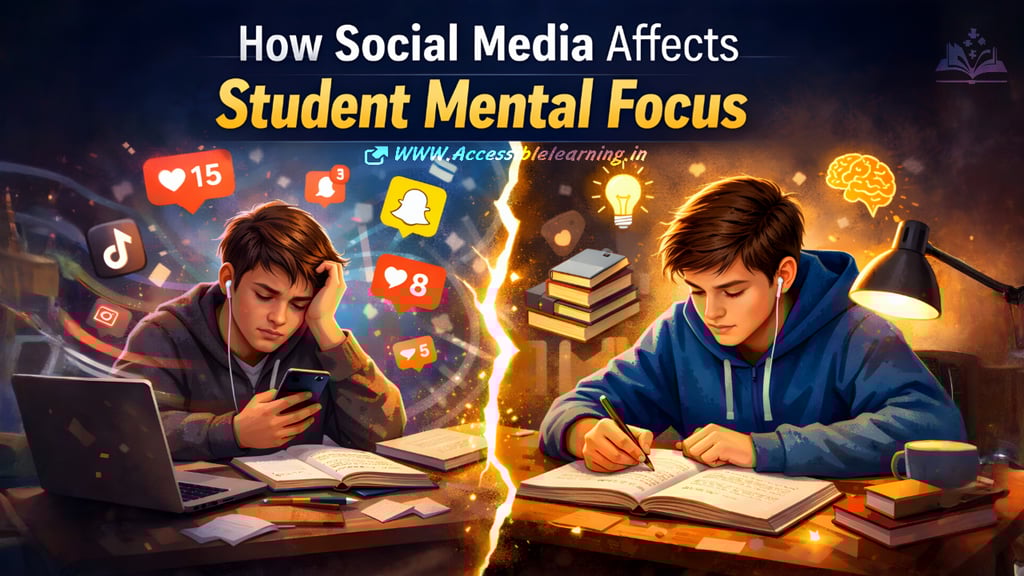
Social media has become a constant presence in students’ daily lives. From online classes and study groups to entertainment and social interaction, platforms like Instagram, YouTube, Snapchat, and TikTok shape how students spend their time and attention. While these platforms offer benefits, their influence on mental focus is significant and often underestimated.
Understanding how social media affects student concentration, attention span, and cognitive performance is essential for students, parents, and educators navigating a digitally connected world.
What Mental Focus Means for Students
Mental focus is the brain’s ability to stay attentive to a single task for an extended period without being distracted. For students, strong focus supports:
Deep understanding of academic concepts
Better memory retention
Faster problem-solving skills
Emotional regulation during stress
Higher academic confidence
When mental focus weakens, students may study longer but learn less.
The Attention Economy and Student Brains
Social media platforms operate within what is known as the attention economy. Their primary goal is to keep users engaged for as long as possible. Algorithms prioritize content that triggers emotional reactions, curiosity, or instant gratification.
For developing student brains, this constant stimulation can interfere with natural attention development. Instead of sustained focus, the brain adapts to rapid content switching and quick rewards.
Key Ways Social Media Impacts Student Mental Focus
Fragmented Attention and Multitasking
Many students believe they can study while checking social media. In reality, the brain does not truly multitask. It switches rapidly between tasks, which reduces efficiency and comprehension.
Effects include:
Slower reading and understanding
More errors in assignments
Difficulty completing complex tasks
Over time, this habit weakens the brain’s ability to focus deeply.
Reduced Deep Thinking Ability
Deep thinking requires time, silence, and mental patience. Constant social media use interrupts this process. When students consume short, fast-paced content, the brain becomes less comfortable with slow, effort-based thinking such as solving math problems or writing essays.
This can affect creativity, critical thinking, and analytical skills.
Increased Mental Restlessness
Excessive scrolling can create a feeling of mental restlessness. Students may feel bored quickly, even during important activities. This leads to:
Frequent breaks without productivity
Inability to sit through lectures
Impatience with long-term goals
Mental restlessness directly reduces academic focus.
Emotional Distraction and Cognitive Load
Social media exposes students to emotional content, including news, conflicts, trends, and peer opinions. Emotional reactions consume cognitive resources, leaving less mental energy for learning.
Even passive scrolling can mentally drain students before they begin studying.
Impact of Social Media on Memory and Learning
Short-Term Memory Interference
Learning depends heavily on working memory. Constant interruptions from social media prevent information from being properly processed and stored. Students may read content but struggle to recall it later.
Reduced Long-Term Knowledge Retention
When learning happens in distracted environments, information remains shallow. Students may recognize answers temporarily but fail to apply knowledge in exams or real-life situations.
Social Media, Sleep, and Focus Connection
Sleep is critical for attention and memory consolidation. Social media negatively affects sleep through:
Late-night screen exposure
Emotional engagement before bed
Disrupted circadian rhythm
Students who lack quality sleep often experience brain fog, reduced focus, and slower learning the next day.
Mental Health Factors That Influence Focus
Anxiety, Stress, and Overthinking
Comparison culture on social media can increase anxiety and stress, especially among students. A stressed mind struggles to concentrate and often seeks distraction as a coping mechanism.
Fear of Missing Out and Constant Checking
The fear of missing out encourages frequent checking of apps. This habit prevents the brain from entering a calm, focused state necessary for learning.
Positive and Productive Uses of Social Media for Students
Despite the challenges, social media can support mental focus when used intentionally.
Learning Communities and Educational Content
Platforms host high-quality educational resources, including:
Concept explainers
Skill-based tutorials
Exam preparation strategies
Career guidance
When aligned with academic goals, this content can improve understanding and motivation.
Collaborative Learning and Peer Interaction
Students can discuss doubts, share notes, and collaborate on projects through social platforms. This social learning can enhance engagement and accountability.
Motivation and Goal Reinforcement
Following positive role models, educators, or productivity creators can inspire better habits and focus when consumption is limited and purposeful.

Long-Term Effects on Academic and Cognitive Development
If unmanaged, excessive social media use can lead to:
Chronic distraction
Lower academic performance
Reduced self-discipline
Difficulty with sustained effort
However, students who learn to regulate their digital habits often regain strong focus and cognitive control.
Practical Strategies to Improve Student Focus in a Social Media World
Build Digital Awareness
Students should understand how algorithms influence behavior. Awareness reduces unconscious scrolling and improves self-control.
Create a Focus-Friendly Study Environment
Keep phones out of reach
Use website blockers during study time
Study in quiet, clutter-free spaces
Develop Attention Training Habits
Activities like reading, writing, meditation, and problem-solving help rebuild attention span over time.
Balance Online and Offline Life
Encouraging offline hobbies, physical activity, and real-world interactions helps reset mental focus and reduce screen dependency.
Role of Parents, Schools, and Institutions
Educational systems must adapt by:
Teaching digital discipline
Encouraging mindful technology use
Designing engaging, focused learning experiences
Supportive guidance is more effective than strict restrictions.
Social media has a powerful influence on student mental focus. While it can distract, overstimulate, and fragment attention, it can also educate and connect when used with intention.
Mental focus is not lost permanently. With awareness, discipline, and balanced digital habits, students can protect their concentration, improve learning outcomes, and thrive academically in the digital age.
FAQ's
Q: Does social media really reduce student focus?
Yes. Frequent social media use can reduce focus by encouraging constant task-switching, short attention spans, and mental overstimulation. When students regularly check apps during study time, their ability to concentrate deeply on academic tasks decreases.
Q: How much social media use is considered harmful for students?
There is no fixed number that applies to everyone, but problems usually appear when social media interferes with sleep, study time, or mental well-being. Using social media for several hours daily without boundaries often leads to reduced focus and academic performance.
Q: Can students use social media without harming their mental focus?
Yes. When used intentionally and in limited time blocks, social media can be beneficial. Following educational content, avoiding distractions during study hours, and turning off unnecessary notifications help protect mental focus.
Q: How does social media affect concentration during studying?
Social media interrupts the brain’s focus cycle. Even brief checks can break concentration and increase the time needed to return to full focus, making studying less effective and more tiring.
Q: Does social media affect memory and learning ability?
Yes. Studying while distracted by social media reduces working memory efficiency, leading to poor information retention and weaker understanding of concepts over time.
Q: What is the relationship between social media, sleep, and focus?
Late-night social media use disrupts sleep quality, which directly affects focus, attention span, and memory the next day. Poor sleep often leads to brain fog and reduced learning capacity.
Q: Are there any positive effects of social media on student focus?
When used correctly, social media can support learning through educational videos, study communities, and peer collaboration. The key is controlled and purposeful use rather than constant scrolling.
Q: How can students improve focus while still using social media?
Students can improve focus by setting fixed usage times, keeping phones away during study sessions, using focus techniques like the Pomodoro method, and prioritizing sleep and offline activities.
Q: Should parents completely ban social media for students?
Complete bans are often ineffective. Teaching self-regulation, digital awareness, and balanced usage is more helpful for long-term focus and healthy habits.
Q: Is reduced focus from social media permanent?
No. Mental focus is a trainable skill. With reduced screen time, structured study habits, and mindful technology use, students can rebuild strong concentration and attention over time.
Subscribe to Frontier Intelligence
All © Copyright reserved by Accessible-Learning Hub
| Terms & Conditions
Accessible Learning Hub — Actionable clarity for high-agency minds.
Weekly breakdowns on AI breakthroughs, capital flow, and human performance systems. Zero fluff.