

How NASA Fixed Voyager 1's Dead Computer 15 Billion Miles Away
Discover how NASA rescued Voyager 1 by remotely repairing a failing 1970s computer over 15 billion miles away in one of the greatest engineering feats in space history.
SPACE & EXPLORATION
Sachin K Chaurasiya
7/26/20269 min read
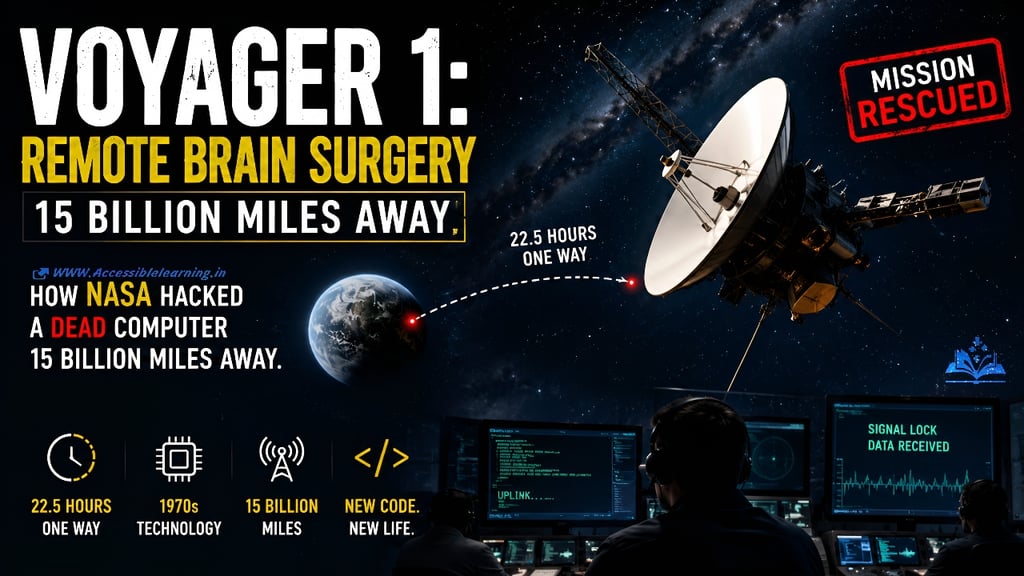
The Start: The Day Voyager 1 Started Speaking Gibberish
Imagine receiving a desperate phone call from a computer that left Earth before the first personal computer existed. Now imagine that computer is over 15 billion miles away, floating alone in interstellar space, where no human has ever traveled. That was NASA's reality in late 2023.
For nearly half a century, Voyager 1 had faithfully whispered scientific discoveries back to Earth. Every signal it sent crossed billions of miles of empty darkness before reaching giant radio antennas. Engineers trusted those signals. They knew the spacecraft almost like an old friend.
Then, without warning, the messages stopped making sense. The spacecraft was still alive. It was still pointing its antenna toward Earth.
It was still transmitting. But instead of meaningful engineering data, Voyager 1 began sending endless streams of meaningless numbers.
It was like calling your grandparents and hearing only random keyboard smashing.
Nobody could walk over and reboot it.
Nobody could replace a broken part.
Nobody could even know if their next command had worked for almost 23 hours.
NASA suddenly faced perhaps the greatest remote IT support challenge ever attempted.
This wasn't just fixing an old computer.
This was like performing brain surgery on a machine built in the 1970s, from 15 billion miles away.
The Big Problem: Fixing a Computer That Shouldn't Still Exist
Most electronics struggle to survive for ten years. Voyager 1 had already survived more than 46 years.
It had endured:
Launch in 1977
Jupiter flyby
Saturn flyby
Decades of cosmic radiation
Extreme cold
Constant exposure to space
Every year it kept working was already remarkable. But age eventually catches everything. The problem wasn't the spacecraft's antenna.
It wasn't the radio.
It wasn't its power supply.
The real culprit was far stranger.
A portion of memory inside one of Voyager's onboard computers had failed. Think of memory as shelves inside a library. If one shelf suddenly collapses, every book stored there becomes impossible to read correctly.
Voyager's Flight Data System depended on that damaged memory. Instead of packaging useful engineering information, it kept reading corrupted data and transmitting complete nonsense.
Normally, fixing a failed memory chip means replacing it. Except Voyager is farther away than any spacecraft humanity has ever built.
No repair mission.
No replacement hardware.
No restart button.
Just radio waves traveling at the speed of light. Even worse, every command required extraordinary patience.
A single instruction needed roughly the following:
22.5 hours to reach Voyager.
Another 22.5 hours before engineers could see the result.
Every attempt consumed almost two full days.
One mistake could permanently silence humanity's most distant explorer.
"By the time NASA knew whether a command had succeeded, nearly two days had already passed."
That completely changes how engineers think.
There are no quick experiments.
No rapid debugging.
Every decision must be nearly perfect before pressing Send.
The Main Event: NASA Hacked a 1970s Computer Across Interstellar Space
When modern software crashes, developers usually have documentation online, source code repositories, simulators, and powerful debugging tools.
Voyager offered none of those luxuries. Instead, NASA engineers went searching through decades-old archives. They dug out original engineering documents.
Some were paper manuals dating back to the spacecraft's design in the early 1970s. Imagine trying to repair your great-grandfather's radio using handwritten notes stored in a filing cabinet.
That was essentially the challenge. The engineering team reconstructed exactly how Voyager's aging computers organized memory.
Eventually they located the damaged region.
The failed memory couldn't be repaired.
So they came up with something far more creative.
They would simply stop using it.
Instead of fixing the broken chip, engineers rewrote portions of Voyager's software so critical information would be stored elsewhere inside the spacecraft's remaining healthy memory.
That sounds easy. It wasn't.
Voyager's computers have less computing power than almost anything around us today.
The onboard memory is tiny by modern standards.
There wasn't enough empty space to simply copy everything into one location.
The software itself had to be carefully reorganized.
Imagine taking an encyclopedia whose pages are falling apart.
Instead of replacing the damaged pages, you cut chapters into smaller pieces and hide them throughout different shelves while leaving instructions telling readers where every section now lives.
That's effectively what NASA did. Because of communication limits, they couldn't upload one giant software update. They sliced the new instructions into extremely small pieces.
Each piece traveled billions of miles through empty space before reaching Voyager. Every upload demanded incredible precision.
A single mistake could overwrite critical instructions and permanently cripple the spacecraft. It was one of the most delicate software deployments ever attempted.
Then came the hardest part.
Waiting.
For nearly two days.
No progress bar.
No confirmation message.
Nothing.
Finally, Earth received another transmission.
This time, something had changed.
Instead of meaningless garbage, Voyager once again returned understandable engineering information. The spacecraft had accepted the software modifications.
NASA had successfully taught a 46-year-old computer to work around its own damaged brain.
It wasn't magic.
It wasn't luck.
It was brilliant engineering.
"Voyager 1 has less computer memory than many modern car key fobs, yet NASA successfully rewrote its software from over 15 billion miles away."
The rescue wasn't finished in a single command.
Over the following weeks and months, engineers continued relocating additional code and data, gradually restoring more of Voyager's scientific capabilities while carefully protecting its remaining systems.
The achievement became one of the greatest examples of creative problem-solving in spaceflight history.
It also highlighted the extraordinary care NASA continues to take as the spacecraft ages. As Voyager's available electrical power slowly decreases, engineers have periodically made difficult decisions involving nasa voyager 1 instrument shutdown procedures, turning off selected scientific instruments to conserve energy and extend the mission for as long as possible. Each shutdown is carefully planned so the spacecraft can continue returning unique measurements from interstellar space.


Why This Rescue Was So Incredible
The story isn't just about fixing old hardware. It's about changing how we think about distance. The farther Voyager travels, the harder every repair becomes. Unlike satellites orbiting Earth, Voyager has no backup crew.
No servicing mission.
No replacement parts.
Everything depends on software, planning, and patience.
The rescue also proved several remarkable lessons:
Clever software can sometimes overcome permanent hardware failures.
Good engineering documentation can remain valuable for decades.
Systems designed with flexibility can survive far beyond their intended lifespan.
Human creativity often matters more than raw computing power.
Perhaps the most surprising lesson is that reliability isn't always about using the newest technology.
Voyager's computers are unimaginably primitive compared to modern smartphones. Yet they were designed with extraordinary care. That careful engineering has allowed them to continue operating for nearly half a century.
Why It Matters for the Future of Space Exploration
Voyager 1 is doing something no other spacecraft has accomplished. It is exploring interstellar space, the region beyond the Sun's protective bubble.
Every bit of information it sends helps scientists better understand the environment future spacecraft may someday cross. More importantly, its rescue offers a blueprint for future deep-space missions.
Tomorrow's explorers may travel to the following:
The outer planets
The Kuiper Belt
Interstellar space
Nearby star systems
Those missions will face the same reality.
If something breaks, nobody will be there to fix it. Engineers on Earth will have to solve impossible problems using only radio signals and ingenuity.
Voyager proved that this is possible. It also reminds us that software can become one of the most powerful repair tools ever invented.
A spacecraft built before desktop computers, before the internet, before mobile phones, and before GPS is still teaching humanity new lessons.
Not because it is flawless. Because humans refused to give up on it. In an age obsessed with replacing old technology, Voyager 1 tells a different story.
Sometimes the greatest innovation isn't building something new.
Sometimes it's keeping something extraordinary alive against impossible odds.
Forty-six years after launch, humanity's oldest explorer continues whispering from the darkness between the stars, carrying a message far more inspiring than its scientific data alone:
Distance is enormous.
Time is relentless.
Hardware eventually fails.
But ingenuity can travel even farther.
Mission Snapshot
Before diving into the rescue, here are the numbers that make Voyager 1 extraordinary:
Launch Date: September 5, 1977
Current Distance: More than 15 billion miles (24+ billion km) from Earth
Signal Travel Time: About 22.5 hours one way
Round Trip Communication: Nearly 45 hours
Mission Status: Exploring interstellar space
Power Source: Radioisotope Thermoelectric Generator (RTG)
Computer Age: Built using 1970s technology
Why This Was Unlike Any Normal Computer Repair
Imagine trying to fix your laptop under these conditions:
You can only send one message every two days.
You cannot physically inspect the hardware.
Pressing the wrong button could permanently destroy the system.
Replacement parts are impossible.
The computer is older than most IT engineers working today.
Now replace "laptop" with a spacecraft farther away than any human-made object has ever traveled. That's the challenge NASA faced.
What Actually Failed?
The culprit wasn't the entire computer. Instead, engineers traced the problem to a failed section of memory inside Voyager's Flight Data System (FDS).
Its job is to:
Collect engineering information.
Organize scientific measurements.
Prepare data for radio transmission.
Send readable telemetry back to Earth.
When part of its memory stopped working, the spacecraft continued operating, but the information reaching Earth became corrupted. Think of it as writing a letter using a typewriter with several broken keys.
How NASA Solved the Problem
The repair wasn't a single software update. It involved weeks of careful planning.
NASA engineers had to:
Study decades-old engineering manuals.
Map every working section of onboard memory.
Rewrite software routines.
Move critical code into healthy memory locations.
Split commands into tiny transmissions.
Test every change with nearly two-day communication delays.
Every upload had to be perfect.
Challenges That Made the Rescue Even Harder
The engineering team had to work around several major obstacles:
No Restart Button: A bad command could permanently disable the spacecraft.
Tiny Memory: Voyager has only a fraction of the computing power found in modern electronics.
Limited Electricity: Every year the spacecraft produces less power.
Extreme Distance: Engineers cannot verify changes immediately.
Cosmic Radiation: Decades of radiation continue aging the electronics.
Each factor increased the risk of failure.
Lessons Every Engineer Can Learn from Voyager
Voyager's rescue wasn't just a victory for space exploration.
It also demonstrates timeless engineering principles.
Design systems that can adapt to unexpected failures.
Keep excellent documentation.
Build software that can be modified years later.
Never assume hardware will last forever.
Creativity often solves problems that hardware cannot.
Did You Know?
Mind-Blowing Facts
Voyager 1 is the most distant human-made object ever built.
The spacecraft carries the famous Golden Record, a collection of sounds, music, greetings, and images from Earth intended for any intelligent civilization that may one day discover it.
Engineers still communicate using the Deep Space Network, one of the most sensitive radio communication systems on Earth.
Voyager's computers were designed when floppy disks were considered cutting-edge technology.
Why the Mission Is Still Continuing
Although Voyager 1 is aging, NASA continues to extend its life through careful power management.
To keep the spacecraft alive for as long as possible, engineers have gradually done the following:
Turned off heaters.
Reduced non-essential systems.
Planned nasa voyager 1 instrument shutdown operations to conserve electricity.
Prioritized the instruments that provide the most valuable scientific data.
These decisions could allow Voyager to continue sending information from interstellar space for several more years before its power supply is finally exhausted.


FAQ's
Q: Why did Voyager 1 start sending gibberish instead of scientific data?
Voyager 1 began transmitting unreadable data after a portion of memory in its Flight Data System (FDS) failed. Although the spacecraft itself was still operating normally, the damaged memory corrupted the engineering data before it was sent back to Earth.
Q: How did NASA fix Voyager 1 from 15 billion miles away?
NASA engineers analyzed decades-old documentation, identified the failed memory section, rewrote portions of the spacecraft's software, and uploaded the new code in small segments. The update redirected critical data away from the damaged memory, successfully restoring communications.
Q: How long does it take for a signal to travel between Earth and Voyager 1?
A radio signal takes approximately 22.5 hours to reach Voyager 1, and another 22.5 hours for the response to return. Every command therefore requires nearly 45 hours before engineers know whether it worked.
Q: How old is Voyager 1, and why is it still operating?
Launched on September 5, 1977, Voyager 1 has been operating for more than four decades thanks to robust engineering, careful power management, and regular software updates that help overcome aging hardware.
Q: What is the Flight Data System (FDS) on Voyager 1?
The Flight Data System is one of Voyager 1's onboard computers. It collects scientific and engineering information, formats the data, and prepares it for transmission back to Earth through the spacecraft's communication system.
Q: What is NASA's Voyager 1 instrument shutdown plan?
As Voyager 1's power supply slowly decreases, NASA periodically performs Voyager 1 instrument shutdown procedures by turning off selected scientific instruments. This conserves electricity and extends the spacecraft's mission for as many years as possible.
Q: Where is Voyager 1 now, and what is it studying?
Voyager 1 is currently traveling through interstellar space, beyond the Sun's heliosphere. It studies cosmic rays, magnetic fields, and charged particles, helping scientists better understand the environment between the stars.
Q: Why is Voyager 1's repair considered one of NASA's greatest engineering achievements?
The repair required engineers to troubleshoot and reprogram a 1970s spacecraft over 15 billion miles away, with a communication delay of nearly two days and no possibility of a physical repair. It remains one of the most remarkable examples of remote spacecraft engineering in history.
Subscribe to Frontier Intelligence
All © Copyright reserved by Accessible-Learning Hub
Accessible Learning Hub — Actionable clarity for high-agency minds.
Weekly breakdowns on AI breakthroughs, capital flow, and human performance systems. Zero fluff.