

How Does Media Literacy Combat Misinformation in the Digital Age?
Discover how media literacy combats misinformation in the digital age. Learn essential fact-checking skills, spot deepfakes, and navigate information safely.
A LEARNINGAWARE/VIGILANTGLOBAL ISSUES
Jagdish Nishad
2/5/202612 min read
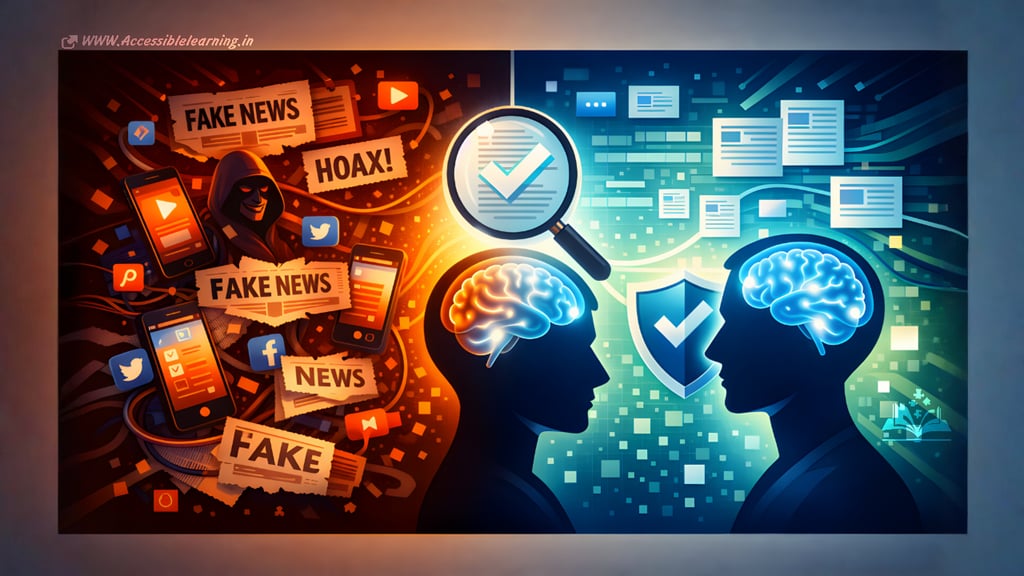
In an era where information travels faster than truth, media literacy has become the most essential skill for navigating our digital world.
Understanding the Misinformation Crisis
We live in an unprecedented information ecosystem. Every minute, millions of pieces of content flood our screens—news articles, social media posts, videos, podcasts, and advertisements. Within this deluge exists a dangerous mixture: factual reporting alongside manipulated images, credible analysis next to conspiracy theories, and genuine expertise competing with manufactured authority.
The numbers tell a sobering story. Studies show that false information spreads six times faster than truth on social media platforms. Deepfake videos now fool viewers 70% of the time. Americans encounter an average of 200 pieces of misinformation weekly, yet most cannot identify basic hallmarks of unreliable sources.
This isn't simply about "fake news"—a term that has itself become weaponized. The misinformation landscape encompasses deliberate disinformation campaigns, unintentional sharing of false content, sophisticated AI-generated fabrications, context-stripped imagery, and algorithmically amplified half-truths that prey on our cognitive biases.
What Media Literacy Really Means
Media literacy transcends the ability to read or consume content. It represents a comprehensive framework of critical thinking skills that enable individuals to analyze, evaluate, and create media across various platforms and formats.
At its core, media literacy involves understanding how media messages are constructed, recognizing the techniques used to attract attention and shape perception, identifying underlying commercial or ideological motivations, distinguishing between news reporting and opinion, evaluating source credibility and evidence quality, understanding how algorithms curate our information environment, and recognizing our own cognitive biases and emotional triggers.
A media-literate person doesn't simply reject all information as potentially false—that leads to dangerous cynicism. Instead, they develop nuanced evaluation skills that allow them to navigate uncertainty while maintaining healthy skepticism.
The Psychology Behind Why We Fall for Misinformation
Understanding why misinformation spreads requires examining human psychology. Our brains evolved to make rapid decisions based on limited information—a survival mechanism that now makes us vulnerable to manipulation.
Confirmation bias leads us to accept information that aligns with existing beliefs while dismissing contradictory evidence. The availability heuristic causes us to overestimate the importance of information that's easily recalled or emotionally memorable. Social proof makes us more likely to believe claims when others around us accept them. The illusory truth effect means repeated exposure to false claims increases perceived truthfulness.
Emotional content bypasses rational analysis. Stories that trigger fear, anger, or moral outrage spread faster than neutral information because they demand immediate sharing. Misinformation architects exploit these tendencies deliberately, crafting content designed to hijack our psychological vulnerabilities.


Core Skills for Media Literacy
Source Evaluation
The foundation of media literacy lies in evaluating sources systematically. This means investigating who created the content and what their expertise or agenda might be, checking whether other credible sources report similar information, examining the evidence provided and whether it's verifiable, looking for transparency about methodology and funding, and being especially cautious with sources that only confirm what we want to hear.
Professional fact-checkers use the SIFT method: Stop before sharing, Investigate the source, Find better coverage, and Trace claims to original context. This approach takes seconds but dramatically improves information quality.
Recognizing Manipulation Techniques
Modern misinformation employs sophisticated techniques. Out-of-context imagery takes real photos from different times or places and presents them as current events. Misleading headlines contradict or oversimplify article content. Cherry-picked statistics highlight data supporting a narrative while omitting contradictory evidence. False equivalence presents fringe views as equally valid as expert consensus. Emotional manipulation uses loaded language to bypass critical thinking.
Deep learning algorithms now generate photorealistic fake images, convincing synthetic voices, and fabricated video footage. Media literacy increasingly requires technical awareness of these emerging technologies.
Understanding Algorithmic Curation
Social media platforms use algorithms that prioritize engagement over accuracy. Content that generates strong reactions—especially outrage—receives preferential distribution. This creates filter bubbles where users primarily encounter information reinforcing existing worldviews.
Media-literate individuals recognize that their feed is curated, not comprehensive. They actively seek diverse perspectives, follow sources that challenge their assumptions, and understand that virality doesn't indicate truthfulness.
The Stakes: Why Media Literacy Matters
The consequences of widespread media illiteracy extend far beyond individual deception. Misinformation undermines public health responses, leading to vaccine hesitancy and dangerous medical practices. It erodes democratic institutions by spreading false claims about election integrity. Environmental misinformation delays action on climate change. Financial scams proliferate as people fall for fraudulent investment schemes.
Perhaps most insidiously, persistent exposure to misinformation creates epistemic chaos—a state where people lose confidence in their ability to know what's true. This breeds cynicism, polarization, and vulnerability to authoritarian narratives that promise certainty in an uncertain world.
Teaching Media Literacy Across Generations
Effective media literacy education must begin early and continue throughout life. For children and adolescents, age-appropriate lessons should cover understanding that online content can be false or misleading, questioning who created content and why, recognizing advertising and sponsored content, understanding privacy implications of sharing personal information, and developing empathy to resist cyberbullying and hate speech.
Adults need ongoing education addressing sophisticated manipulation tactics, evaluating scientific and medical claims, recognizing financial and political disinformation, understanding AI-generated content, and modeling critical media consumption for younger generations.
Educational institutions increasingly integrate media literacy across curricula rather than treating it as a standalone subject. Analyzing propaganda techniques in history class, evaluating scientific sources in biology, identifying bias in news reports during social studies, and examining visual manipulation in art classes all contribute to comprehensive media literacy.
Practical Strategies for Daily Life
Building media literacy requires consistent practice. Before sharing content, pause and ask whether you've verified the information through credible sources, considered whether the emotional reaction might cloud judgment, checked whether the headline accurately reflects the content, and thought about whether sharing serves informational value or simply signals identity.
Diversify information sources beyond those confirming existing beliefs. Follow journalists and experts from different perspectives. Use fact-checking sites like Snopes, PolitiFact, or FactCheck.org. Enable settings that slow down sharing on social media platforms.
Develop healthy skepticism without descending into cynicism. Recognize that uncertainty is normal and trustworthy sources acknowledge limitations. Be willing to update beliefs when presented with new evidence.

The Role of Technology and Platforms
Social media companies bear responsibility for the misinformation ecosystems they've created. While some platforms have implemented fact-checking programs, content moderation policies, and transparency tools, these efforts remain inadequate relative to the scale of the problem.
Emerging technologies offer both threats and opportunities. AI can detect deepfakes and identify coordinated disinformation campaigns, but it can also generate increasingly convincing synthetic media. Blockchain technology promises content authentication but raises privacy concerns.
Media-literate individuals advocate for platform accountability while recognizing that technological solutions alone cannot solve fundamentally human problems rooted in psychology and social dynamics.
Building a Media-Literate Society
Creating a culture of media literacy requires collective action. Policymakers must fund media literacy education in schools and public awareness campaigns. Technology platforms must prioritize truth over engagement metrics. Journalists must maintain rigorous standards and transparently correct errors. Educators must integrate critical thinking across all subjects. Parents must model healthy media consumption habits. Individuals must commit to verification before amplification.
This isn't about creating a population of expert fact-checkers—it's about establishing baseline critical thinking skills and cultivating a culture where asking questions is normalized rather than dismissed as cynicism.
The Future of Information Integrity
As artificial intelligence becomes more sophisticated, the line between authentic and fabricated content will blur further. Synthetic media will become indistinguishable from reality. Personalized misinformation will target individual psychological profiles with unprecedented precision.
Yet the fundamental principles of media literacy remain constant: question sources, demand evidence, resist emotional manipulation, seek diverse perspectives, acknowledge uncertainty, and maintain epistemic humility.
The battle against misinformation cannot be won through individual heroics or technological fixes alone. It requires systematic investment in education, platform accountability, and cultural change that values truth over tribal loyalty.
Taking Action: Your Role in the Information Ecosystem
Every individual participates in the information ecosystem. When you share content, you become a publisher. When you like or comment, you amplify messages. When you scroll past falsehoods without challenging them, you allow misinformation to spread.
Media literacy empowers you to break this cycle. Start small: fact-check one suspicious claim today. Ask questions about sources. Share corrections when you discover you've spread misinformation. Model intellectual humility by saying "I don't know" or "I was wrong."
These individual actions accumulate into cultural transformation. A media-literate society isn't one where everyone agrees—it's one where disagreements occur on the basis of shared reality rather than competing fabrications.
Truth as a Collective Responsibility
In the misinformation age, media literacy isn't optional—it's essential infrastructure for democracy, public health, and social cohesion. Like literacy itself once transformed humanity's potential, media literacy now determines whether we master digital tools or become enslaved by them.
The challenge ahead is formidable. Misinformation will evolve faster than our defenses. Bad actors will exploit new technologies and human vulnerabilities. The information landscape will grow more complex, not simpler.
But history offers perspective. Humanity has navigated previous information revolutions—from the printing press to radio to television. Each disrupted existing power structures and created periods of chaos before new norms emerged.
We stand at a similar inflection point. The question isn't whether misinformation will disappear—it won't. The question is whether we'll develop the collective immune system of critical thinking skills necessary to thrive despite it.
Media literacy is that immune system. And like biological immunity, it requires constant maintenance, adaptation to new threats, and transmission across generations.
The work begins with you. Question, verify, think critically, and help others do the same. The truth is worth fighting for—and media literacy is how we fight.


Frequently Asked Questions
Q: What is media literacy and why is it important?
Media literacy is the ability to access, analyze, evaluate, create, and act using all forms of communication. It's important because it empowers individuals to critically assess information sources, recognize manipulation tactics, and make informed decisions in an era where misinformation spreads rapidly across digital platforms. Without media literacy skills, people become vulnerable to propaganda, scams, and false narratives that can harm public health, democracy, and personal wellbeing.
Q: How can I tell if a news source is credible?
To determine source credibility, check if the outlet has professional editorial standards and corrections policies, verify the author's credentials and expertise in the topic, look for transparency about funding and ownership, cross-reference claims with multiple reputable sources, examine whether evidence is cited and verifiable, and assess if the tone is balanced or heavily sensationalized. Credible sources acknowledge uncertainty, provide context, and distinguish clearly between news reporting and opinion pieces.
Q: What is the SIFT method for fact-checking?
SIFT is a four-step fact-checking framework: Stop before sharing content to avoid emotional reactions driving decisions; Investigate the source by researching who created the content and their credibility; Find better coverage by checking if reputable news outlets report the same information; Trace claims to original context to verify quotes, statistics, and images haven't been manipulated or misrepresented. This method takes only minutes but dramatically improves information accuracy.
Q: How do social media algorithms contribute to misinformation?
Social media algorithms prioritize engagement over accuracy, meaning content that triggers strong emotional responses—especially outrage, fear, or anger—receives preferential distribution. This creates filter bubbles where users primarily see information confirming existing beliefs. The algorithms don't evaluate truthfulness; they amplify what keeps people clicking, sharing, and scrolling, which often means sensational misinformation spreads faster than nuanced, accurate reporting.
Q: What are deepfakes and how can I identify them?
Deepfakes are AI-generated synthetic media—videos, images, or audio—that convincingly depict people saying or doing things they never did. To identify them, watch for unnatural facial movements or blinking patterns, check for inconsistent lighting or shadows, listen for audio that doesn't sync perfectly with lip movements, examine backgrounds for distortions or glitches, verify the source and whether reputable outlets confirm the content, and use reverse image search to trace the media's origin. As technology improves, detection becomes harder, making source verification increasingly critical.
Q: How can I teach media literacy to children?
Start age-appropriate conversations early by helping children understand that not everything online is true or real, encouraging them to question who created content and why, teaching them to recognize advertising and sponsored content, discussing privacy and the dangers of sharing personal information, modeling critical thinking by fact-checking together, and creating open dialogue where children feel comfortable asking questions about confusing or disturbing content. Make it interactive through games that identify real versus fake images or news stories.
Q: What's the difference between misinformation and disinformation?
Misinformation is false or inaccurate information shared without malicious intent—someone genuinely believes it's true and shares it unknowingly. Disinformation is deliberately fabricated or manipulated information created and spread to deceive, manipulate public opinion, or cause harm. Both are dangerous, but disinformation represents coordinated campaigns often backed by financial or political motives, while misinformation often spreads through well-meaning people who haven't verified their sources.
Q: Can fact-checking websites be trusted?
Reputable fact-checking organizations like Snopes, PolitiFact, FactCheck.org, and AP Fact Check follow rigorous methodological standards, cite original sources and evidence, operate with transparent funding disclosure, employ professional journalists and subject experts, issue corrections when they make mistakes, and have established credibility over years of operation. However, no source is infallible. Media-literate individuals consult multiple fact-checkers and understand the reasoning behind their conclusions rather than accepting verdicts blindly.
Q: How do I avoid confirmation bias when consuming news?
Combat confirmation bias by deliberately seeking sources that challenge your perspectives, following journalists and experts across the political spectrum, reading full articles instead of just headlines that confirm beliefs, examining your emotional reactions to information (strong feelings often indicate bias activation), asking yourself what evidence would change your mind on an issue, and practicing intellectual humility by acknowledging when you lack expertise. Recognize that discomfort with information doesn't make it false, nor does agreement make it true.
Q: What role does emotional manipulation play in misinformation?
Emotional manipulation bypasses rational thinking by triggering fear, anger, disgust, or moral outrage—emotions that demand immediate action and sharing. Misinformation creators deliberately craft content to exploit these responses because emotionally charged material spreads faster and is remembered longer than neutral information. Media literacy involves recognizing when content is designed to provoke rather than inform, pausing before reacting emotionally, and seeking verification before amplifying emotionally loaded claims.
Q: How has AI changed the misinformation landscape?
AI has dramatically escalated misinformation threats through sophisticated text generation that mimics authoritative writing, photorealistic fake images and videos, synthetic voices replicating real people, automated bot networks spreading coordinated disinformation, personalized manipulation targeting individual psychological profiles, and scale that allows mass production of customized false content. However, AI also aids detection through pattern recognition identifying fake content, automated fact-checking systems, and tools that authenticate original media.
Q: What are filter bubbles and echo chambers?
Filter bubbles occur when algorithms selectively present information matching your previous behavior, creating a personalized information environment that excludes contradictory perspectives. Echo chambers are social environments—online or offline—where similar-minded people reinforce shared beliefs without encountering dissent. Both phenomena limit exposure to diverse viewpoints, strengthen existing biases, make misinformation harder to correct, and contribute to political and social polarization by creating separate realities for different groups.
Q: How can schools integrate media literacy education?
Effective integration occurs across curricula rather than isolated lessons: analyzing primary sources and propaganda in history classes, evaluating scientific studies and health claims in science courses, identifying bias and rhetorical techniques in language arts, examining statistical manipulation in mathematics, critiquing visual manipulation in art and media classes, and discussing digital citizenship and online safety in technology courses. Schools should also train teachers in media literacy, provide age-appropriate resources, and engage parents in reinforcing skills at home.
Q: What's the connection between media literacy and democracy?
Democracy requires an informed electorate capable of evaluating candidate claims, understanding policy implications, recognizing manipulation attempts, and making decisions based on factual information rather than propaganda. Media literacy strengthens democratic institutions by reducing vulnerability to disinformation campaigns, promoting civil discourse based on shared reality, enabling citizens to hold leaders accountable, protecting election integrity, and fostering critical engagement rather than passive consumption or cynical disengagement.
Q: How do I verify information during breaking news events?
During rapidly developing situations, wait for confirmation from multiple credible news sources before accepting claims, be skeptical of dramatic or shocking reports without verification, check timestamps on images and videos to ensure they're current, understand that early reports often contain errors later corrected, avoid sharing unconfirmed information even if tagged with disclaimers, follow established news organizations with verification protocols, and recognize that saying "I don't know yet" is appropriate when information is unclear.
Q: What are common red flags for fake news?
Warning signs include sensational headlines that don't match article content, lack of author attribution or credentials, absence of dates or outdated information presented as current, URLs mimicking legitimate news sites with slight variations, numerous grammatical errors or awkward phrasing, no citations or links to original sources, requests to share widely before "it's taken down," appeals to extreme emotions without factual grounding, and claims of exclusive information not reported elsewhere.
Q: How can I improve my media literacy skills daily?
Build habits like reading beyond headlines before sharing, diversifying your news sources across ideological perspectives, following journalists and subject experts rather than just outlets, using fact-checking sites for suspicious claims, questioning your emotional reactions to content, practicing the SIFT method on social media posts, engaging with long-form journalism for deeper context, discussing media messages with others to gain different perspectives, and regularly reflecting on your information diet and adjusting accordingly.
Q: What's the relationship between media literacy and critical thinking?
Media literacy applies critical thinking specifically to information and communication contexts. It requires analyzing arguments and evidence, evaluating source credibility and bias, questioning assumptions and motives, recognizing logical fallacies, distinguishing correlation from causation, understanding how context affects meaning, and synthesizing information from multiple sources. Media literacy is critical thinking plus understanding of how media systems work, including production techniques, economic incentives, and distribution mechanisms.
Q: How do conspiracy theories spread and how can media literacy help?
Conspiracy theories spread by offering simple explanations for complex events, providing community and identity for believers, exploiting legitimate distrust of institutions, using confirmation bias to interpret all evidence as supporting the theory, and leveraging algorithmic amplification on social platforms. Media literacy helps by teaching source evaluation, demanding extraordinary evidence for extraordinary claims, understanding how cognitive biases work, recognizing rhetorical manipulation tactics, and maintaining epistemic humility while distinguishing reasonable skepticism from unfounded paranoia.
Q: What tools are available for detecting misinformation?
Useful tools include reverse image search engines (Google Images, TinEye) to find original image sources, browser extensions like NewsGuard rating site credibility, InVID for video verification, fact-checking sites with searchable databases, media bias charts showing outlet positioning, lateral reading techniques comparing multiple sources, WHOIS lookup for investigating website ownership, and AI detection tools for synthetic media. However, tools supplement rather than replace critical thinking and media literacy skills.
Subscribe to Frontier Intelligence
All © Copyright reserved by Accessible-Learning Hub
| Terms & Conditions
Accessible Learning Hub — Actionable clarity for high-agency minds.
Weekly breakdowns on AI breakthroughs, capital flow, and human performance systems. Zero fluff.