

How Data Science Is Reshaping Careers in the Modern Workforce
Discover how data science is reshaping modern careers across industries. Learn about emerging roles, essential skills, industry impact, and why data-driven professionals are becoming critical in the future workforce.
A LEARNINGCOMPANY/INDUSTRYEDUCATION/KNOWLEDGE
Sachin K Chaurasiya
3/29/20268 min read
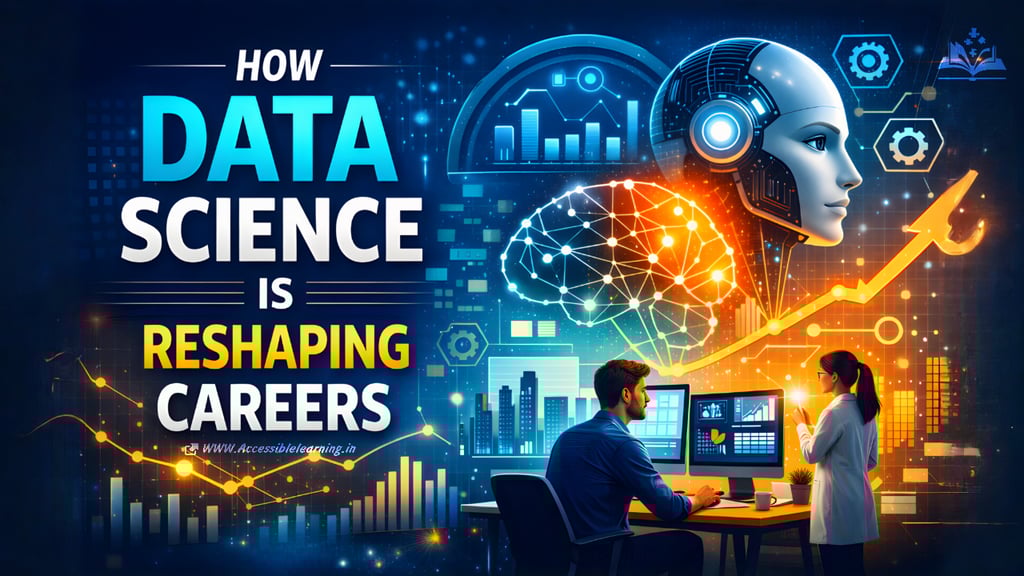
Over the past decade, the world has experienced an explosion of data. Every online search, purchase, social media interaction, mobile app usage, and digital transaction produces information. Businesses now collect and store enormous amounts of this data every day. But raw data alone has little value unless it can be analyzed and turned into meaningful insights.
This is where data science plays a critical role.
Data science combines statistics, programming, artificial intelligence, and domain knowledge to analyze complex datasets and uncover patterns. These insights help organizations make better decisions, optimize operations, understand customer behavior, and predict future trends.
As companies increasingly rely on data-driven strategies, the impact of data science is extending far beyond the technology sector. It is transforming how organizations operate and fundamentally reshaping career opportunities across industries.
The Data Revolution in the Modern Economy
Data has become one of the most valuable assets in the digital economy. Organizations today generate data from multiple sources, such as:
Websites and mobile applications
Social media platforms
Smart devices and IoT sensors
Financial transactions
Customer relationship systems
Supply chain operations
The ability to analyze these massive datasets allows companies to uncover insights that were impossible to detect just a few years ago.
Instead of relying only on intuition or past experience, organizations now use predictive analytics and machine learning models to guide decisions.
For example, businesses can now:
Predict customer demand before it happens
Detect fraud in real time
Optimize pricing strategies
Improve product recommendations
Forecast market trends
This shift toward data-driven decision-making has dramatically increased the demand for professionals who understand data.
New Career Paths Created by Data Science
Data science has introduced a wide range of new job roles that focus on analyzing, managing, and interpreting data. Some of the most important roles include:
Data Scientist
Data scientists design algorithms, build predictive models, and analyze complex datasets to uncover insights that help businesses make strategic decisions.
Data Analyst
Data analysts focus on interpreting structured data, creating reports, and visualizing trends using dashboards and analytics tools.
Machine Learning Engineer
Machine learning engineers develop systems that allow computers to learn from data and make automated predictions.
Data Engineer
Data engineers design and maintain data pipelines that collect, process, and store large volumes of data efficiently.
Business Intelligence Specialist
These professionals translate business data into strategic insights that help executives understand performance and opportunities.
AI Engineer
AI engineers develop artificial intelligence applications that rely heavily on large datasets and machine learning models.
These roles are now essential in organizations that rely on data to drive growth and innovation.

Data Science Is Changing Traditional Jobs
One of the most interesting effects of data science is that it is not only creating new careers but also transforming existing ones. Many professionals who were not traditionally involved with data are now using analytics tools in their daily work.
For example:
Marketing professionals now analyze customer behavior, campaign performance, and engagement metrics to design better strategies.
Human resource teams use workforce analytics to improve recruitment, track employee satisfaction, and predict staff turnover.
Journalists and media analysts use data to identify trends, analyze public opinion, and produce investigative reports.
Product managers rely on user behavior data to improve digital products and user experiences.
This means data science is gradually becoming a core skill layer that enhances almost every profession.
The Growing Importance of Data Literacy
As data becomes central to decision-making, the concept of data literacy is becoming increasingly important. Data literacy refers to the ability to read, interpret, and communicate insights from data.
Professionals who can understand data trends and interpret analytics reports often have a competitive advantage in the workplace.
Organizations are now encouraging employees to develop skills such as:
Understanding basic statistics
Interpreting data visualizations
Using analytics dashboards
Making decisions based on evidence
In many companies, data literacy is becoming just as important as digital literacy.
The Rise of Remote and Global Data Careers
Another major change driven by data science is the growth of remote and global work opportunities. Many data-related jobs can be performed entirely online because professionals work primarily with digital tools and datasets. This has created a global talent marketplace where companies can hire data professionals from anywhere in the world.
For example:
Analysts can work remotely using cloud-based analytics platforms
Data engineers can manage infrastructure through cloud systems
Machine learning engineers can deploy models on global cloud networks
This shift allows professionals to collaborate across countries and industries without being physically present in the same office.
Data Science and the Startup Ecosystem
Startups have embraced data science as a key competitive advantage. Young companies often rely on data analytics to understand their users, optimize growth strategies, and make rapid decisions.
Data-driven startups frequently use analytics to:
Identify profitable customer segments
Track user engagement patterns
Improve digital products through experimentation
Predict market demand
Because startups operate in highly competitive environments, data insights often determine whether a company succeeds or fails.
The Role of Data Science in Artificial Intelligence
Artificial intelligence depends heavily on data science. Machine learning algorithms require large datasets to train models and improve their predictions. Data scientists play a central role in AI development by:
Preparing and cleaning datasets
Selecting relevant features
Designing machine learning models
Evaluating model performance
Improving algorithm accuracy
As AI adoption grows across industries, professionals who understand both data science and machine learning will be in particularly high demand.

Industries Where Data Science Is Making a Major Impact
Healthcare
Healthcare organizations use data science to analyze patient records, medical imaging, and genomic data.
Applications include:
Early disease detection
Personalized treatment plans
Drug discovery research
Hospital resource optimization
Predictive models can help identify potential health risks before symptoms appear.
Finance
The financial sector relies heavily on data analysis for risk management and investment decisions. Applications include:
Fraud detection systems
Credit scoring models
Automated trading algorithms
Financial forecasting
Banks analyze large transaction datasets to detect unusual behavior and prevent financial crimes.
Retail and E-Commerce
Retailers use data science to improve customer experiences and increase sales. Common applications include:
Personalized product recommendations
Demand forecasting
Inventory management
Customer segmentation
Recommendation algorithms help online platforms suggest products that customers are most likely to purchase.
Transportation and Logistics
Data science helps transportation companies improve efficiency and reduce costs.
Analytics tools can optimize delivery routes, predict shipping delays, and improve fleet management.
Ride-sharing and navigation platforms rely heavily on real-time data analysis to function effectively.
Agriculture
Modern agriculture is becoming increasingly data-driven.
Farmers now use data from satellites, drones, and soil sensors to monitor crop health and improve farming practices.
Predictive models help determine the best planting times, irrigation schedules, and fertilizer usage.
Key Tools and Technologies in Data Science
Data professionals rely on a wide range of tools to analyze and manage data. Common tools include:
Python for machine learning and data analysis
R for statistical modeling
SQL for managing databases
Tableau and Power BI for data visualization
Apache Spark and Hadoop for big data processing
Cloud platforms such as AWS, Google Cloud, and Azure
These technologies allow organizations to process and analyze massive datasets efficiently.
The Role of Automation in Data Careers
Automation is changing how data professionals work.
Modern analytics tools can automatically clean data, build machine learning models, and generate insights.
This allows data professionals to focus more on strategic thinking rather than repetitive tasks.
However, automation does not eliminate the need for data experts. Instead, it increases the importance of professionals who can interpret results and apply insights to real-world problems.
Ethical Challenges in Data Science
As the influence of data science grows, ethical considerations are becoming increasingly important.
Data Privacy
Organizations must ensure that personal data is handled responsibly and protected from misuse.
Algorithmic Bias
Machine learning models can sometimes reflect biases present in training data. Addressing bias is essential to ensure fairness and transparency.
Responsible AI Development
As automated systems influence important decisions, organizations must ensure that data-driven technologies are used responsibly.


The Future of Data Science Careers
The influence of data science will continue expanding as organizations generate more data and rely more heavily on analytics.
Several trends are likely to shape the future of careers in this field:
Greater integration between data science and artificial intelligence
Expansion of real-time analytics systems
Increased demand for data privacy and ethical AI specialists
Growth of automated analytics tools
Wider adoption of data-driven decision-making across industries
Professionals who combine technical expertise with business understanding and communication skills will be particularly valuable in the coming years.
Data science is no longer just a technical specialty. It has become a foundational part of the modern economy. By transforming how organizations analyze information and make decisions, data science is reshaping careers across nearly every industry.
New job roles are emerging, traditional professions are evolving, and data literacy is becoming a core professional skill. As the world becomes increasingly data-driven, professionals who understand how to work with data will play a critical role in shaping the future of business, technology, and society.
FAQ's
Q: What is data science, and why is it important for modern careers?
Data science is the process of analyzing large datasets using statistics, programming, and machine learning to uncover insights and patterns. It has become important for modern careers because businesses now rely heavily on data to guide decisions, improve products, and predict market trends. Professionals who understand data can help organizations solve problems and make smarter strategic choices.
Q: How is data science changing traditional job roles?
Data science is adding a new layer of analytical thinking to many traditional professions. Marketing teams use data to understand customer behavior, finance professionals analyze risk through predictive models, and HR teams use workforce analytics for hiring and retention. Instead of replacing these roles, data science is enhancing them by enabling better decision-making through data insights.
Q: What skills are needed to start a career in data science?
A strong data science foundation usually includes programming skills (such as Python or R), statistics, data visualization, and knowledge of databases like SQL. In addition to technical abilities, skills such as problem-solving, communication, and business understanding are equally important because data scientists must translate complex insights into practical decisions.
Q: Is a degree required to become a data scientist?
A formal degree can be helpful, but it is not always required. Many professionals enter the field through online courses, certifications, coding bootcamps, and hands-on projects. Employers increasingly focus on practical skills, portfolio work, and real-world experience rather than academic credentials alone.
Q: Which industries offer the most opportunities for data science careers?
Data science opportunities exist in almost every industry. Some of the fastest-growing sectors include healthcare, finance, e-commerce, technology, transportation, and marketing. Even industries like agriculture, manufacturing, and entertainment are now using analytics to improve efficiency and innovation.
Q: How does artificial intelligence relate to data science careers?
Artificial intelligence relies heavily on data science. Machine learning models require large datasets to learn patterns and make predictions. Data scientists prepare the data, build models, and evaluate their performance. Because of this close relationship, professionals who understand both AI and data science often have strong career opportunities.
Q: Is data science a good career for the future?
Yes, data science is widely considered one of the most promising careers of the digital age. As organizations continue generating more data, the need for professionals who can analyze and interpret that data will continue to grow. Careers in analytics, artificial intelligence, and machine learning are expected to expand significantly in the coming years.
Q: What tools are commonly used in data science jobs?
Data professionals typically work with tools such as Python, R, SQL, Tableau, Power BI, and machine learning frameworks. Cloud platforms and big data technologies are also widely used to manage and analyze large datasets. These tools allow analysts and scientists to process complex information and generate insights efficiently.
Q: Can beginners learn data science without a technical background?
Yes, beginners from non-technical backgrounds can learn data science. Many successful data professionals started in fields like economics, business, mathematics, or social sciences. With structured learning, practical projects, and consistent practice, it is possible to transition into data-related careers even without a traditional technology background.
Q: How will data science influence future workplaces?
Future workplaces will rely more heavily on analytics, automation, and artificial intelligence. Data-driven decision-making will become standard across industries. Professionals who can understand data trends, build predictive models, and communicate insights will play a key role in shaping how organizations operate and compete in the digital economy.
Subscribe to Frontier Intelligence
All © Copyright reserved by Accessible-Learning Hub
| Terms & Conditions
Accessible Learning Hub — Actionable clarity for high-agency minds.
Weekly breakdowns on AI breakthroughs, capital flow, and human performance systems. Zero fluff.