

How AI Prompt Engineering Saves 10 Hours of Design Work Every Week
A practical guide explaining how AI prompt engineering cuts nearly 10 hours of manual design work. This header highlights the real workflow improvements, time savings, and creative advantages designers and businesses gain by using structured, intentional AI prompts.
AI ASSISTANTA LEARNINGPROGRAMMING
Sachin K Chaurasiya
12/4/20256 min read
AI isn’t replacing designers. It’s removing the slow, mechanical parts of the job. The real breakthrough comes from prompt engineering, which helps AI understand creative intent and produce usable results in minutes. When done right, it cuts a full day of work from the design cycle without lowering quality.
This expanded guide explains exactly how those hours are saved, why prompt engineering matters, and how designers, marketers, and agencies can use it to speed up projects and deliver stronger creative work.
The Real Reason Prompt Engineering Saves Time
AI models can generate images, layouts, typography ideas, animations, and even website sections. But they only work well when the instructions are clear. Prompt engineering eliminates guesswork and gives AI a structured path to follow.
This saves time in four areas:
Decision-making
Manual experimentation
Revision cycles
Cross-format production
The results are more consistent and closer to the client’s expectations.
Where Designers Lose the Most Time (And How AI Fixes It)
Below is a deeper breakdown of the hours typically lost in manual design and how prompt engineering solves each bottleneck.
Slow Creative Direction Building
Before any design begins, teams explore ideas. That process alone can burn hours.
AI compresses this by generating:
Brand mood concepts
Color guides
Visual metaphors
Style explorations
Photography directions
You don’t have to wait for inspiration. You review the AI’s outputs and choose a direction instantly.
Time saved: 2–3 hours
Faster Concept Development
AI can produce multiple versions of a concept with a single command.
You can instantly test:
Different layouts
Alternate color blends
Theme variations
Typography systems
Illustration styles
This replaces manual sketching, wireframing, and rough drafts.
Time saved: 1–2 hours
Accurate Brand Alignment Through Prompt Structures
Brand consistency usually requires checking:
Fonts
Spacing
Visual tone
Brand personality
Color psychology
A structured brand prompt embeds these rules so AI follows them automatically.
It’s like having a full brand guidelines document inside the prompt.
Time saved: 1 hour
Automated Correction and Refinement
Instead of manually editing early designs, you can fix issues through iterative prompts such as:
“Increase contrast.”
“Add more breathing room.”
“Make the typography cleaner.”
“Align with minimal, premium style.”
This replaces manual corrections and Photoshop back-and-forth.
Time saved: 1–1.5 hours
Smart Scaling Across Platforms and Formats
Prompt engineering helps AI generate content directly in platform-specific ratios:
Instagram square
YouTube thumbnail
Website hero banner
Mobile-first layout
Print poster sizes
You skip resizing and avoid losing composition quality.
Time saved: 1 hour
Faster Collaboration and Approval
Clients understand visuals faster than long explanations. With AI-generated options, you can present:
Mood boards
Draft layouts
Style variations
Mockups
Before/after transformation sets
This speeds up approvals and reduces communication delays.
Time saved: 1–2 hours
Automated Production Tasks
AI handles tasks designers usually consider boring:
Removing backgrounds
Cleaning images
Retouching
Adjusting color balance
Extending backgrounds
Vectorizing shapes
These are normally done manually, but prompts can automate them.
Time saved: 45 minutes

How Prompt Engineering Improves the Designer’s Workflow
This isn't just about speed. Prompt engineering changes how designers think and work.
More exploration without cost
Designers can test bold, unusual ideas without wasting production hours.
Better presentations and storytelling
Prompt-based mockups help communicate ideas more clearly to clients.
Less burnout and decision fatigue
AI takes over the repetitive parts, leaving designers to focus on creative strategy.
Higher output capacity
A single designer can handle work previously done by a small team.
Real-time experimentation
Instead of waiting for feedback or new inspiration, designers can create multiple design paths instantly.
Advanced Prompt Techniques That Save Even More Time
Here are additional systems that speed up work even further:
Layered Prompting
You build the output in steps:
Visual base
Style polish
Brand alignment
Final fixes
This improves quality while keeping iterations short.
Reverse Prompting
Upload a reference and ask AI to generate the prompt for it.
This helps maintain style consistency across different projects.
Prompt Templates
Teams can create reusable templates, such as
“High-conversion ad banner”
“Minimal modern UI dashboard”
“Premium lifestyle brand look”
Anyone can plug in project details and get consistent results.
Negative Prompting
Telling AI what to avoid removes errors like
Over-saturated colors
Unbalanced layouts
Typography distortion
This reduces revision cycles.
The Business Impact: Why Companies Care About This Shift
AI prompt engineering isn’t just a designer’s trick. It affects the bottom line.
Faster project delivery
Agencies can take more clients without increasing staff.
Lower production cost
Less manual labor means smaller budgets spent on repetitive tasks.
Higher design consistency
AI helps keep brand visuals uniform across teams.
Competitive advantage
Clients prefer teams that deliver faster without losing quality.
Better creativity at scale
Companies can explore more ideas before choosing the final direction.

The Future of Design: A Hybrid Creative Workflow
In the coming years:
Designers will focus more on concept thinking.
AI will handle the execution layers.
Prompt engineering will be a standard skill like using Photoshop or Figma.
Creative speed will become a competitive metric.
Brands will build their own prompt libraries as internal assets.
This blend of human creativity and AI precision will reshape the entire design landscape.
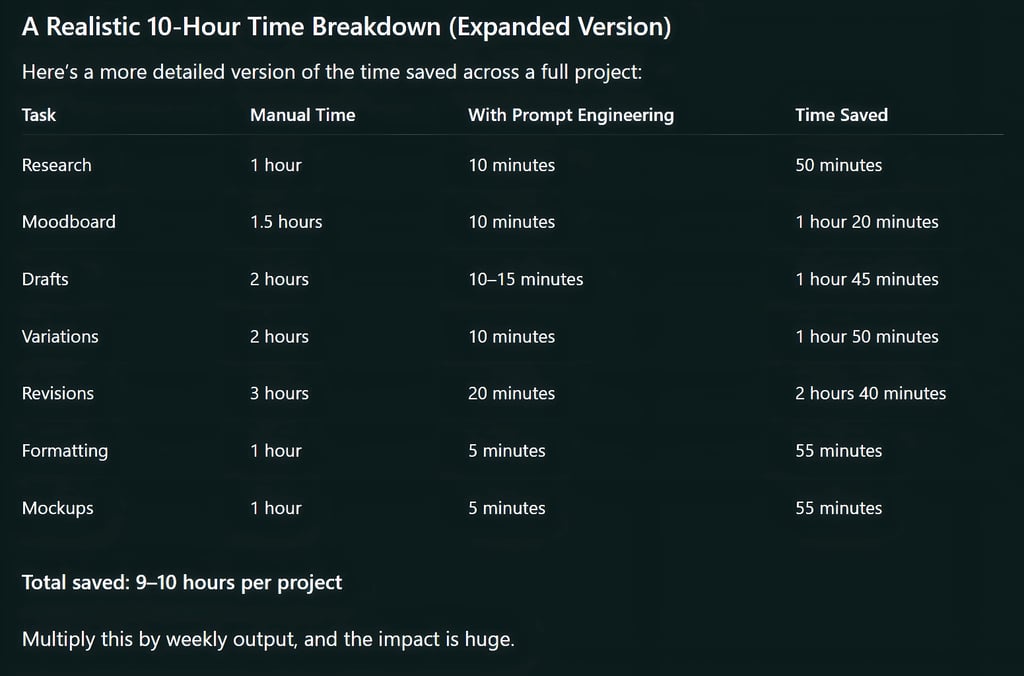
AI prompt engineering isn’t just a productivity hack. It’s redefining how creative work gets done. Designers who embrace it will work faster, explore more ideas, and deliver more polished results. Saving 10 hours per project isn’t an exaggeration anymore. It’s already happening across the industry.
FAQ's
Q: What exactly is prompt engineering in design?
Prompt engineering is the skill of giving AI clear, structured instructions that guide it to generate accurate layouts, visuals, styles, and creative ideas. It improves quality and cuts down hours of manual work.
Q: Does prompt engineering replace designers?
No. It replaces repetitive tasks, not creativity. Designers still make decisions, refine output, and add the human touch that AI can’t replicate.
Q: What tools benefit most from prompt engineering?
Design-focused AI models such as Midjourney, Adobe Firefly, Figma AI, Canva AI, Photoshop Generative Fill, and ChatGPT image tools all rely heavily on good prompting.
Q: How much time can a designer realistically save?
On average, around 8–10 hours per project. This depends on project complexity, but most of the time is saved in drafts, revisions, and formatting.
Q: Do I need technical knowledge to write good prompts?
Not necessarily. It’s more about clarity, creativity, and understanding how to describe visual ideas. Anyone can improve quickly with practice.
Q: Can prompt engineering help with client presentations?
Yes. You can generate ready-to-present mockups, slides, before/after comparisons, and variations without manually building everything.
Q: What are the biggest mistakes beginners make?
The most common issues include:
Writing vague prompts
Ignoring aspect ratios
Forgetting brand tone
Not using iterative refinement
Overloading prompts with unnecessary details
Q: Is prompt engineering important for agencies and freelancers?
Absolutely. It helps deliver more work in less time, improves consistency, and gives a competitive advantage in fast-paced creative industries.
Q: Does AI reduce originality in design?
No. It actually increases originality by allowing designers to explore more ideas and variations without spending days on manual drafts.
Q: Will AI-generated designs affect copyright?
Most major tools now allow commercial use, but designers should still verify model policies and avoid recreating recognizable copyrighted styles.
How Prompt Engineering Is Changing the Future of Design
AI is not slowing down. Prompt engineering is becoming a foundational skill that will reshape creative industries in several ways:
Designers Will Act More Like Creative Directors
The designer’s role will shift from manual creation to guiding AI, choosing directions, refining results, and shaping the overall vision. Concept thinking will matter more than execution skills.
Brand Identity Will Become Prompt-Based
Companies will build internal “prompt guidelines” alongside visual guidelines.
Instead of telling designers what colors or fonts to use, brands will include:
Style prompts
Tone prompts
Visual identity prompts
Negative prompts
Consistency presets
The brand voice will become a set of repeatable instructions.
Creative Speed Will Become a Market Advantage
The fastest teams will win. Agencies and freelancers using prompt engineering will deliver days’ worth of work in a few hours. This will reshape pricing, service packages, and turnaround expectations.
AI-First Design Tools Will Replace Traditional Workflows
Future tools will blend design and prompting together. We’ll see:
Real-time design refinement
Adaptive layouts based on brand rules
Multi-ratio design generation
Instant animation from static images
Live-editing through conversational instructions
Design software will feel more like a conversation than a workspace.
New Job Roles Will Emerge
As AI grows, new specialties will appear, such as:
AI Design Strategist
Creative Prompt Engineer
Brand AI Consistency Manager
AI Workflow Architect
Visual Automation Specialist
These roles will guide how companies scale their creative output.
Global Collaboration Will Become Faster and Easier
With prompt libraries and AI-generated variations, teams in different countries can stay aligned without long feedback loops or miscommunication.
Creativity Will Become More Inclusive
People who aren’t trained designers will have access to powerful AI tools. This expands creativity across:
Small businesses
Students
Solopreneurs
New creators
Non-design teams
Prompt engineering becomes the “new English for design,” a universal creative language.
Hyper-Personalized Design Will Become the Norm
AI will adapt visuals to:
Audience behavior
Platform performance
Regional trends
Brand sentiment
Demographics
Design won’t be generic anymore. It will be dynamically tailored and constantly optimized.
Large-Scale Design Systems Will Automate Themselves
Enterprises will generate full design systems through AI:
Component libraries
Color systems
Typography rules
UI kits
Teams will adjust them with simple high-level prompts.
Designers With AI Skills Will Lead the Industry
The next generation of creative leaders will be people who can use AI strategically. Understanding how to communicate ideas to machines will be just as important as understanding color theory or composition.
Subscribe to Frontier Intelligence
All © Copyright reserved by Accessible-Learning Hub
| Terms & Conditions
Accessible Learning Hub — Actionable clarity for high-agency minds.
Weekly breakdowns on AI breakthroughs, capital flow, and human performance systems. Zero fluff.