

How AI-Powered Search Is Redefining Online Learning
AI-powered search is transforming online learning by moving beyond simple keyword results to guided understanding, personalized exploration, and faster knowledge discovery. This article explains how intelligent search systems are reshaping the way learners find, process, and apply information in the digital age.
A LEARNINGAI/FUTUREEDUCATION/KNOWLEDGE
Shiv Singh Rajput
1/23/20265 min read
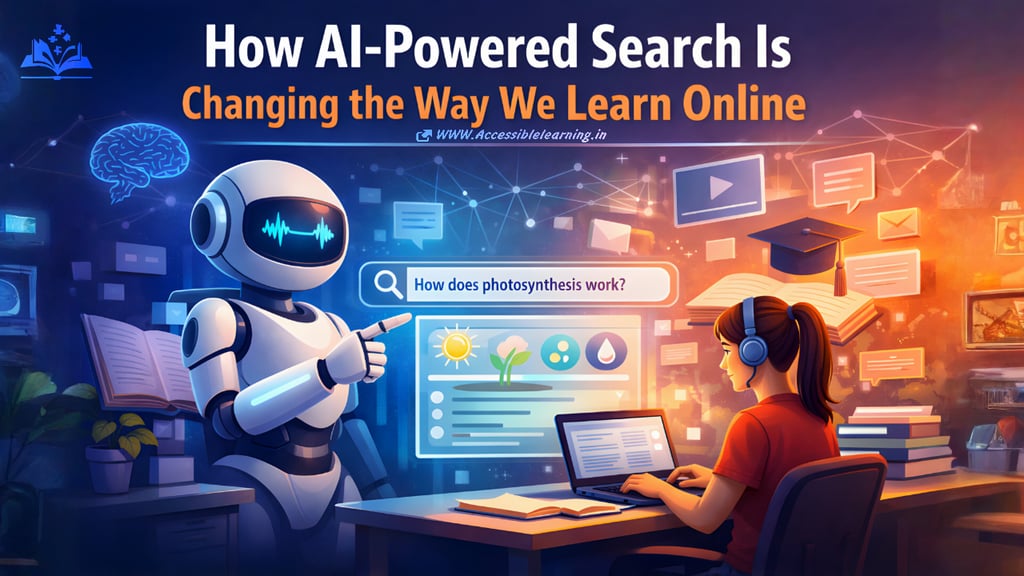

Online learning has always depended on search. What has changed is how search behaves. AI-powered search systems are no longer passive directories of links. They actively interpret questions, synthesize information, and guide learners through complex topics. This shift is reshaping how knowledge is discovered, understood, and applied in digital environments.
Evolution from information retrieval to knowledge guidance
Traditional search engines focus on matching keywords. AI-powered search focuses on intent. It tries to understand why a learner is asking something and what level of explanation is needed.
This changes learning in a fundamental way:
Learners no longer need perfect keywords
Confusion and vague questions are acceptable
Understanding is built progressively, not instantly
Search becomes a guided learning process rather than a scavenger hunt.
Natural language interaction lowers learning barriers
AI-powered search allows learners to ask questions the same way they think. This is especially valuable for:
Students struggling with technical or academic language
Self-learners exploring new fields
Non-native English speakers
By removing the need for “search-optimized” phrasing, AI makes learning more accessible and less intimidating.
Concept mapping and topic relationships
Modern AI search systems do more than answer a single question. They reveal relationships between ideas by:
Showing prerequisite concepts
Explaining cause-and-effect links
Highlighting how subtopics connect to the main topic
This helps learners build structured knowledge instead of memorizing isolated facts.
Faster synthesis of complex subjects
AI-powered search excels at summarizing large volumes of information. For complex topics such as science, technology, economics, or history, it can:
Condense long explanations into clear summaries
Highlight essential points
Remove unnecessary noise
This is especially helpful when learners need to grasp an overview before going deeper.
Adaptive depth and learning pace
Different learners need different levels of detail. AI-powered search adapts by:
Simplifying explanations for beginners
Providing advanced technical depth on request
Allowing learners to control the pace of learning
This flexibility supports lifelong learning and self-directed education.
Supporting skill-based and practical learning
Beyond theory, AI-powered search can assist with:
Step-by-step problem solving
Code explanations and debugging
Real-world examples and use cases
Practice questions and exercises
This bridges the gap between knowing about something and knowing how to use it.
Enhanced discovery of learning resources
AI-powered search can recommend:
Articles and tutorials
Videos and courses
Tools and software
Books and research papers
Instead of overwhelming learners with options, it filters resources based on relevance and learning intent.
Impact on critical thinking and learning habits
AI-powered search changes what learners must focus on. Since information is easier to obtain, the key skills shift to:
Evaluating accuracy
Understanding context
Recognizing bias or limitations
Connecting ideas across domains
Learning becomes less about recall and more about reasoning.
Risks of over-dependence and surface learning
Easy access to answers can reduce deep thinking if used carelessly. Learners may:
Accept explanations without verification
Skip foundational understanding
Rely on summaries instead of original sources
Effective learning still requires effort, reflection, and practice.
Changing expectations for educational content
As AI search becomes common, educational content must offer more value than basic explanations. High-quality learning content now emphasizes:
Clear reasoning
Real-life applications
Interactive learning
Perspective and interpretation
This raises the overall standard of online education.

AI-powered search and multimodal learning
Modern AI-powered search is expanding beyond text. Learners can now search using images, voice, diagrams, and even screenshots. This allows:
Visual learners understand concepts through charts and images
Faster clarification of diagrams, equations, or code snippets
More inclusive learning for users with different learning preferences
This multimodal approach helps bridge gaps where text alone is insufficient.
Real-time learning and up-to-date knowledge
AI-powered search can integrate live or frequently updated data. This is especially valuable for:
Technology and software learning
Market trends and business knowledge
Current events and policy understanding
Learners are no longer limited to static articles that may be outdated, improving relevance and accuracy in fast-moving fields.
Language translation and cross-cultural learning
AI search tools increasingly support instant translation and localized explanations. This enables:
Access to global educational content
Learning across languages without losing context
Cultural comparisons in subjects like history, sociology, and literature
This reduces language barriers and broadens learning opportunities worldwide.
Learning analytics and feedback loops
AI-powered search can observe patterns in how learners ask questions and where they struggle. Over time, this allows:
Better follow-up explanations
Identification of knowledge gaps
Suggestions for review or revision topics
This feedback-driven learning makes self-study more effective.
Influence on search engine optimization for education
AI-powered search changes how educational content is discovered. Content that performs well now:
Answers specific learner questions clearly
Uses structured explanations
Demonstrates real understanding, not just keywords
This encourages higher-quality educational content across the web.
Ethical considerations in AI-driven learning
AI-powered search raises ethical questions, including:
Bias in training data
Unequal access to advanced AI tools
Transparency in how answers are generated
Understanding these issues helps learners use AI responsibly and critically.
Reduced dependency on memorization
With AI-powered search available, learning shifts toward:
Conceptual understanding
Problem-solving ability
Application of knowledge in new contexts
Memorization becomes less central, while comprehension and reasoning become more valuable.
Role in collaborative and peer learning
AI-powered search can support group learning by:
Summarizing discussions
Clarifying disagreements
Providing neutral explanations during debates
This makes collaborative learning more efficient and focused.
Preparing learners for an AI-driven future
Using AI-powered search teaches learners how to:
Ask better questions
Refine prompts and queries
Think critically about AI-generated information
These skills are increasingly important in modern education and professional environments.
Long-term knowledge retention and reinforcement
AI-powered search can reinforce learning by:
Revisiting earlier topics
Providing spaced reminders
Offering quick refreshers when concepts resurface
This supports long-term retention rather than one-time exposure.


FAQ's
Q: What is AI-powered search in online learning?
AI-powered search uses artificial intelligence to understand learner intent, generate explanations, and guide users through topics instead of only showing a list of links.
Q: How is AI-powered search different from traditional search engines?
Traditional search focuses on keyword matching and link ranking, while AI-powered search focuses on understanding questions, summarizing information, and supporting learning through conversation.
Q: Does AI-powered search replace online courses or teachers?
No. It supports learning by providing explanations and guidance, but structured courses and educators are still essential for deep understanding, assessment, and mentorship.
Q: Can AI-powered search help beginners learn complex subjects?
Yes. It can simplify explanations, introduce foundational concepts, and guide learners step by step, making complex subjects more approachable.
Q: Is information from AI-powered search always accurate?
Not always. AI-generated responses should be verified using reliable sources, especially for technical, academic, or critical topics.
Q: How does AI-powered search improve self-learning?
It enables learners to ask follow-up questions, explore topics at their own pace, and receive explanations tailored to their level of understanding.
Q: What skills do learners need when using AI-powered search?
Critical thinking, source evaluation, and the ability to apply knowledge are essential to avoid surface-level learning.
Q: How does AI-powered search affect student research habits?
It speeds up early research and topic exploration, allowing students to focus more on analysis, reasoning, and original thinking.
Q: Can AI-powered search support lifelong learning?
Yes. Professionals and independent learners can quickly update skills, explore new fields, and solve real-world problems using AI-guided search.
Q: What is the future role of AI-powered search in education?
AI-powered search is likely to become a standard learning companion, helping learners navigate information more efficiently while shifting education toward understanding and application rather than memorization.
Subscribe to Frontier Intelligence
All © Copyright reserved by Accessible-Learning Hub
| Terms & Conditions
Accessible Learning Hub — Actionable clarity for high-agency minds.
Weekly breakdowns on AI breakthroughs, capital flow, and human performance systems. Zero fluff.