

How AI Helps Doctors and Medical Students: Real Impact, Benefits, and Risks
Discover how Artificial Intelligence is transforming healthcare for doctors and medical students. From faster diagnosis and personalized treatment to smarter learning and reduced workload, explore the real-world impact, benefits, and limitations of AI in modern medicine.
AI/FUTUREHEALTH/DISEASEEDUCATION/KNOWLEDGE
Sachin K Chaurasiya | Kim Shin
4/23/20267 min read
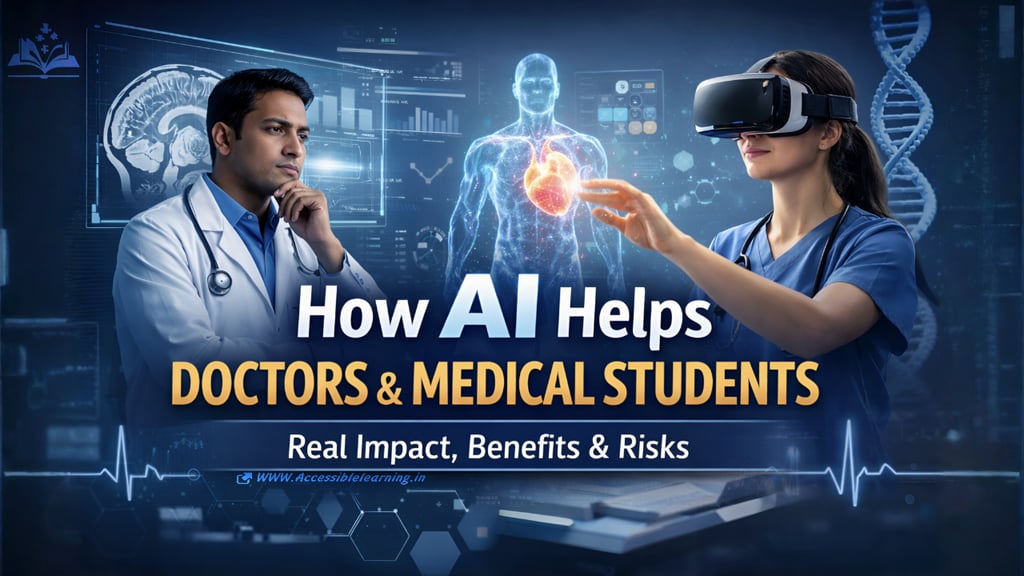
Artificial Intelligence is steadily becoming part of everyday healthcare. It is not replacing doctors or medical students, but it is changing how they work, learn, and make decisions. The biggest shift is not automation. It is augmentation. AI extends human capability, but it also introduces new risks if used blindly.
Let’s go deeper into how AI actually impacts medicine beyond the basics.
How AI Helps Doctors (Expanded View)
Early Disease Detection at Scale
AI is especially useful when dealing with large populations. Screening thousands of patients manually is slow and error-prone.
Where AI shines:
Diabetic retinopathy screening using eye scans
Tuberculosis detection in chest X-rays in rural areas
Skin cancer detection via image recognition
What matters:
AI helps scale healthcare in countries with limited specialists, including parts of India. But it still needs validation from trained doctors.
Real-Time Assistance During Procedures
AI is now entering operating rooms and procedure suites.
Examples:
Assisting surgeons with precision during robotic surgeries
Highlighting critical structures during operations
Real-time guidance in endoscopy (detecting polyps or abnormalities)
Reality:
This improves accuracy, but surgeons are still in control. AI does not “perform” surgery independently.
Drug Discovery and Development
Developing a new drug traditionally takes years. AI speeds up this process.
How it helps:
Identifying potential drug molecules
Predicting how drugs interact with the human body
Repurposing existing drugs for new diseases
Example:
During the COVID-19 pandemic, AI helped researchers analyze massive datasets quickly.
Reality:
AI accelerates research, but clinical trials and approvals still take time.
Remote Monitoring and Telemedicine
AI enables continuous monitoring of patients outside hospitals.
Use cases:
Wearables tracking heart rate, oxygen levels, sleep
Alerts for abnormal patterns (like arrhythmias)
Remote care for elderly or chronic patients
Impact:
Reduces hospital visits and allows early intervention.
Reality:
Data overload can happen, and false alarms are common.
Improving Hospital Operations
AI is not just clinical. It improves backend systems.
Applications:
Predicting patient flow in hospitals
Optimizing bed allocation
Managing staff schedules
Reducing waiting times
Reality:
Efficiency improves, but implementation costs can be high.
Mental Health Support
AI is increasingly used in mental health screening and support.
Examples:
Chat-based therapy tools
Mood tracking apps
Early detection of depression through speech or behavior patterns
Reality:
AI can support, but it cannot replace human therapists, especially in severe cases.

How AI Helps Medical Students (Expanded Learning Impact)
Instant Access to Structured Knowledge
Medical education involves massive volumes of information. AI helps organize it.
What students can do:
Convert textbooks into summaries
Break down complex topics like pharmacology or pathology
Get quick explanations during revision
Reality:
Quick answers can create shallow understanding if not studied properly.
Clinical Reasoning Practice
AI can simulate patient cases with evolving symptoms.
Benefits:
Practice differential diagnosis
Learn decision-making under pressure
Improve pattern recognition
Reality:
Real patients are unpredictable. Simulations are controlled environments.
Language and Communication Skills
Medical students often struggle with patient communication.
AI helps by:
Simulating doctor-patient conversations
Training in empathy and tone
Improving medical English or regional language explanations
Reality:
Human interaction cannot be fully replicated by AI.
Coding and Tech Integration for Modern Medicine
A growing number of students are using AI to:
Analyze datasets
Build small healthcare tools
Understand bioinformatics
Impact:
Creates a new generation of tech-aware doctors.
Global Learning Without Borders
AI removes geographical limitations. Students can:
Access global research instantly
Learn from international case studies
Stay updated with latest guidelines
Reality:
Not all AI-generated summaries are accurate or up to date.
New Emerging Areas Where AI is Making a Difference
Radiology and Pathology Automation
AI is already transforming fields like radiology.
Automated scan analysis
Faster report generation
Highlighting abnormal regions
Some fear job loss, but the reality is shifting roles, not eliminating them.
Precision Surgery and Robotics
Systems like da Vinci Surgical System assist surgeons with:
Smaller incisions
Better precision
Faster recovery times
Still, human expertise drives every decision.
Public Health and Epidemic Prediction
AI helps governments and organizations:
Track disease spread
Predict outbreaks
Allocate resources efficiently
This is especially useful in densely populated regions.
Medical Imaging Beyond Human Limits
AI can analyze patterns invisible to the human eye.
Example:
Predicting disease progression from subtle imaging changes
Detecting early-stage abnormalities


AI in Medical Ethics Training
AI is starting to play a role in teaching ethical decision-making, which is one of the hardest parts of medicine.
How it helps:
Simulates morally complex scenarios (end-of-life care, consent issues)
Allows students to explore consequences of decisions
Encourages structured ethical reasoning
Reality:
AI can present scenarios, but it cannot define what is “right.” Ethics still depends on human values, culture, and judgment.
AI for Second Opinions and Error Reduction
Even experienced doctors make mistakes. AI can act as a silent second reviewer.
Use cases:
Double-checking radiology reports
Flagging unusual lab results
Identifying inconsistencies in diagnosis
Why it matters:
This reduces human error, especially in high-pressure environments.
Reality:
AI can also introduce its own errors, so it’s not a replacement for peer review.
AI in Emergency and Critical Care
Time is everything in emergency medicine, and AI is helping prioritize care.
Applications:
Triage systems that rank patients based on severity
Predicting cardiac arrest or sepsis earlier than traditional methods
Assisting ambulance routing for faster response
Reality:
Speed improves, but wrong prioritization can have serious consequences.
Voice AI and Doctor–Patient Interaction
Voice-based AI tools are changing how consultations happen.
What’s changing:
Real-time transcription during consultations
Automated summaries of patient visits
Reduced need for manual note-taking
Impact:
Doctors can maintain better eye contact and focus more on the patient.
Reality:
Privacy concerns and occasional misinterpretation of speech remain issues.
AI and Continuous Medical Education (CME)
Medicine evolves fast, and AI helps professionals stay updated without overload.
How:
Personalized updates based on specialty
Summaries of latest research papers
Alerts for new treatment guidelines
Reality:
Doctors still need to verify sources and not rely only on summarized content.
AI in Rare Disease Identification
Rare diseases are often misdiagnosed because doctors may never encounter them frequently.
AI advantage:
Matches symptoms with global datasets
Suggests rare conditions that might otherwise be overlooked
Impact:
Faster diagnosis for patients who might otherwise spend years without answers.
AI in Multilingual Healthcare Environments
In countries like India, language diversity is a real challenge.
AI helps by:
Translating patient symptoms in real time
Assisting doctors in communicating across languages
Generating reports in multiple languages
Reality:
Medical accuracy in translation is still not perfect and must be reviewed.
AI for Burnout Detection in Doctors
AI is now being used to monitor the well-being of healthcare professionals.
How:
Analyzing work patterns and fatigue levels
Identifying signs of burnout or stress
Suggesting workload adjustments
Why it matters:
Burnout directly affects patient care quality.
AI in Medical Documentation Standardization
Different doctors document differently, which creates inconsistency.
AI contribution:
Standardizing clinical notes
Ensuring compliance with hospital protocols
Improving data quality for future use
AI and Legal Protection
AI can indirectly support doctors in medico-legal situations.
Examples:
Maintaining accurate digital records
Providing decision logs
Supporting evidence-based choices
Reality:
AI can support documentation, but legal responsibility still lies with the doctor.

The Risks That Are Often Ignored
Overconfidence in AI Outputs
Doctors and students may trust AI too quickly without verification.
Skill Degradation
Heavy reliance on AI can weaken diagnostic and analytical skills over time.
Data Privacy Issues
Patient data used in AI systems raises serious privacy concerns.
Cost and Accessibility Gap
Advanced AI tools are expensive, widening the gap between top hospitals and smaller clinics.
Ethical Dilemmas
Decisions involving life and death cannot be handed to algorithms alone.
What Smart Doctors and Students Do Differently
Instead of blindly using AI, effective professionals:
Cross-check AI outputs with clinical knowledge
Use AI for speed, not final judgment
Focus on patient interaction and empathy
Keep updating their knowledge beyond AI tools
The Reality of the Future
AI will not make medicine easier. It will make it faster and more demanding. Doctors will need to:
Interpret AI outputs correctly
Manage more data than ever
Take responsibility for decisions
Medical students will need to:
Learn how to think, not just search
Build strong fundamentals
Use AI as a tool, not a shortcut
AI is one of the most powerful tools ever introduced into healthcare. It improves diagnostics, speeds up workflows, and enhances learning. But it also introduces new challenges that cannot be ignored.
The difference between a good and a great doctor in the future will not be who uses AI, but how they use it. Used wisely, AI can elevate healthcare. Used carelessly, it can amplify mistakes. The balance is everything.
FAQ's
Q: What is the role of AI in modern healthcare?
AI helps doctors analyze medical data, improve diagnostic accuracy, automate routine tasks, and support clinical decisions. It acts as an assistant that enhances efficiency, not a replacement for medical professionals.
Q: Can AI replace doctors in the future?
No, AI cannot replace doctors. It lacks human judgment, empathy, and ethical reasoning. It can support decision-making, but final responsibility and patient care will always require a human doctor.
Q: How does AI improve diagnosis accuracy?
AI analyzes large datasets like medical images, lab reports, and patient histories to identify patterns. This helps detect diseases earlier and reduces the chances of missing critical conditions, especially in high-volume environments.
Q: How is AI useful for medical students?
AI helps medical students by simplifying complex topics, generating study materials, providing practice cases, and offering personalized learning paths. It acts like a smart study assistant available anytime.
Q: What are the risks of using AI in healthcare?
Some key risks include:
Incorrect or biased recommendations
Over-reliance by doctors or students
Data privacy concerns
Misinterpretation of AI-generated insights
Human oversight is always necessary.
Q: How does AI help in medical research?
AI speeds up research by analyzing large volumes of data, identifying patterns, summarizing studies, and even suggesting potential drug candidates. This reduces the time needed for discoveries.
Q: Is AI useful in rural or low-resource healthcare settings?
Yes, AI can be highly valuable in areas with limited access to specialists. It can assist in early diagnosis, screening, and remote monitoring, helping bridge the healthcare gap.
Q: How does AI support personalized treatment?
AI analyzes individual patient data, including medical history and genetics, to suggest treatments tailored to the patient. This improves effectiveness compared to generic treatment approaches.
Q: Do doctors need to learn AI skills?
Doctors do not need to become programmers, but understanding how AI works, its limitations, and how to interpret its outputs is becoming increasingly important in modern healthcare.
Q: What is the future of AI in medical education?
AI will make learning more personalized, interactive, and efficient. However, core medical knowledge, clinical skills, and real-world experience will remain essential for becoming a competent doctor.
Q: How does AI reduce doctor burnout?
AI reduces workload by handling repetitive tasks like documentation, scheduling, and data analysis. This allows doctors to spend more time on patient care and less on administrative work.
Q: Can AI make mistakes in healthcare?
Yes, AI can make mistakes due to poor data, bias, or incorrect interpretation. That’s why it should always be used as a support tool, not a final decision-maker.
Subscribe to Frontier Intelligence
All © Copyright reserved by Accessible-Learning Hub
| Terms & Conditions
Accessible Learning Hub — Actionable clarity for high-agency minds.
Weekly breakdowns on AI breakthroughs, capital flow, and human performance systems. Zero fluff.