

Haiper AI vs Sora AI: A Detailed Comparison of Modern AI Video Generation
A detailed comparison of Haiper AI and Sora AI that explains how each video generation tool works, where they perform best, and which use cases they are designed for. This article breaks down technical depth, creative control, workflow impact, and real-world applications to help creators and professionals choose the right AI video solution.
AI ART TOOLSAI/FUTURECOMPANY/INDUSTRY
Sachin K Chaurasiya
1/8/20267 min read
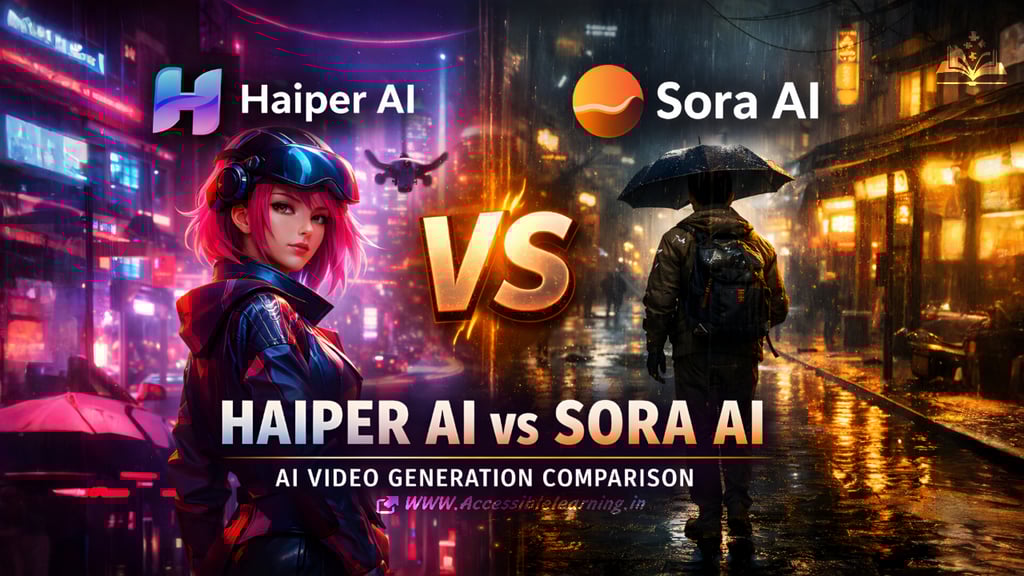
AI video generation is evolving into two clear directions: high-speed content creation and high-fidelity world simulation. Haiper AI and Sora AI represent these directions very clearly. While both generate video from text or visual prompts, their underlying goals, technical depth, and ideal users are fundamentally different.
This article expands on technical, practical, and strategic aspects to help you understand where each tool fits in real-world usage.
Model Architecture and Technical Approach
Haiper AI is optimized for rapid inference and creative stylization. Its architecture prioritizes:
fast generation cycles
visually strong single-shot outputs
reduced computational complexity
This allows Haiper to deliver results quickly but limits its ability to maintain strict physical rules across longer timelines.
Sora AI, developed by OpenAI, is built as a large-scale generative video model that treats video as a continuous simulation of space and time. Rather than generating frames independently, Sora models how objects, environments, and characters evolve across frames. This architectural choice enables:
consistent motion
better object permanence
improved cause-and-effect behavior
Video Length and Structural Stability
Haiper AI is most stable with short clips. As video length increases:
character details may drift
background elements can shift
motion may lose continuity
This is acceptable for reels, ads, and transitions but problematic for narrative sequences.
Sora AI is designed to handle longer continuous shots. Its stability improves when:
scenes are clearly defined
constraints are explicitly stated
camera movement is intentional
This makes Sora more suitable for structured storytelling and multi-shot concepts.
Visual Style Range
HyperAI leans toward:
stylized visuals
high-contrast lighting
anime, cyberpunk, and graphic looks
content-ready aesthetics
These styles perform well on social platforms where immediate visual impact matters.
Sora AI leans toward:
natural lighting
realistic textures
cinematic camera behavior
believable environments
While Sora can be stylized, it is strongest when aiming for realism or grounded visuals.
Camera Behavior and Cinematic Logic
Haiper AI supports basic camera concepts such as zoom, pan, or rotation, but these are often interpreted loosely. The camera may behave more like a visual effect than a physical camera.
Sora AI understands camera behavior more realistically:
focal length implications
depth of field changes
handheld vs stabilized motion
cinematic framing logic
This allows creators to think in terms of filmmaking rather than visual effects alone.
Character and Identity Consistency
Haiper AI struggles with long-term identity consistency. Facial features, clothing details, and proportions may subtly change across frames or generations. This limits its use for recurring characters.
Sora AI performs better at maintaining identity, especially when prompts include:
explicit character descriptions
continuity rules
environmental constraints
While not perfect, Sora is more reliable for character-driven scenes.
Audio and Multimodal Capabilities
Haiper AI is primarily a visual generation system. Audio workflows are external:
music added in editing software
voiceovers generated separately
sound effects layered post-production
Sora AI integrates audio more deeply into the generation process. Its newer capabilities include:
dialogue synchronized with lip movement
environmental sound design
scene-aware audio timing
This positions Sora closer to full-scene generation rather than silent visuals.
Editing and Post-Production Compatibility
Haiper AI outputs are well-suited for heavy post-production:
short clips drop easily into timelines
effects and transitions are commonly added later
works well with mobile and desktop editors
Sora AI outputs require less visual fixing but more planning upfront:
fewer clips, higher intent
less reliance on aggressive editing
more focus on narrative flow
Prompt Sensitivity and Error Handling
HyperAI is forgiving. Even vague prompts often produce usable visuals. However, this flexibility can lead to:
unpredictable interpretations
inconsistent results across generations
Sora AI is more sensitive to prompt structure. Poorly defined prompts may produce:
logical inconsistencies
unintended objects or actions
Clear constraints significantly improve Sora’s reliability.
Performance, Speed, and Scalability
Haiper AI excels in speed:
faster generation times
suitable for bulk content creation
practical for daily posting schedules
Sora AI is computationally heavy:
slower generation
stricter limits
not ideal for mass production
This makes Sora more suitable for quality-focused projects rather than volume.

Commercial and Professional Use Considerations
Haiper AI typically requires paid plans for:
watermark-free exports
commercial usage
higher generation limits
This makes it accessible for freelancers and small creators.
Sora AI access depends on OpenAI’s subscription tiers and platform availability. Usage policies may change, making it less predictable for client-heavy workflows.
Ethical and Safety Controls
Sora AI includes more advanced safety mechanisms:
restrictions on realistic misuse
identity protection safeguards
controlled generation of sensitive scenarios
Haiper AI’s safeguards are lighter, reflecting its focus on stylized and short-form content.
Industry Positioning and Future Direction
Haiper AI is positioned as a creator productivity tool. Its evolution is likely to focus on:
faster rendering
more styles
social-platform optimization
Sora AI is positioned as a foundational video model. Its future likely includes:
longer scenes
improved world simulation
deeper integration with multimodal AI systems
Data Training Scope and Generalization
Haiper AI appears optimized around creative datasets that emphasize visual styles, motion trends, and social-media-friendly aesthetics. This allows it to generalize well across popular visual themes but limits its understanding of complex real-world interactions.
Sora AI is trained with a broader objective: learning how the world behaves over time. This wider training scope enables stronger generalization across unfamiliar scenes, uncommon environments, and complex physical interactions.
Narrative Reliability Over Multiple Generations
When generating multiple clips intended to form a sequence, Haiper AI treats each generation largely as an independent task. This can introduce narrative discontinuity when stitching clips together.
Sora AI is better suited for sequential generation, where each output builds upon the previous context. This makes it more reliable for concept trailers, scene continuity testing, and story visualization.
Use in Pre-Production and Ideation
HyperAI is effective during early creative brainstorming where speed matters more than accuracy. Designers and marketers can quickly visualize ideas without committing to realism.
Sora AI is better aligned with pre-production workflows such as:
visualizing scripts
testing camera angles
previewing scene blocking
validating creative direction before filming
Impact on Traditional Production Roles
Haiper AI primarily complements editors, motion designers, and content creators. It reduces time spent on creating base visuals but does not replace structured production planning.
Sora AI begins to overlap with roles traditionally associated with:
previsualization artists
storyboard designers
concept cinematographers
This shifts its relevance toward studios, agencies, and advanced creative teams.
Adaptability to Non-Entertainment Use Cases
Haiper AI is mostly aligned with entertainment, marketing, and personal content creation. Its strengths are less transferable to technical or instructional domains.
Sora AI has potential applications beyond entertainment, including:
educational simulations
training scenarios
architectural visualization
scientific or environmental modeling
Its stronger logic and temporal understanding enable these uses.
Long-Term Content Maintenance
Content generated with Haiper AI often has a short lifespan. It is designed for trend-driven platforms where relevance fades quickly.
Sora AI outputs are more suitable for long-term assets such as:
evergreen brand visuals
educational materials
portfolio-grade concept videos
This affects how creators archive and reuse content.
Dependency on External Tools
Haiper AI assumes reliance on external tools for:
advanced editing
color grading
sound design
narrative assembly
Sora AI reduces dependency by consolidating multiple steps into a single generation pipeline, especially where audio and motion alignment are required.
Learning Investment vs Return
Haiper AI offers a low learning investment with immediate creative payoff. Users can become productive quickly with minimal experimentation.
Sora AI requires a higher learning investment in:
prompt structure
scene logic
cinematic language
However, the return increases as users gain mastery, leading to higher-quality outputs.
Creative Risk and Predictability
Haiper AI often produces visually surprising results, which can be creatively inspiring but inconsistent.
Sora AI prioritizes predictability over surprise. Once constraints are defined, outputs tend to align more closely with expectations, which is valuable for professional work.

Scalability for Teams
HyperAI is well suited for solo creators or small teams where rapid output is prioritized.
Sora AI aligns better with collaborative environments where:
prompts are shared
creative intent is documented
outputs are reviewed across departments
Its structure supports repeatable, team-based workflows.
Strategic Position in the AI Ecosystem
Haiper AI functions as a specialized creative tool within a larger editing ecosystem.
Sora AI functions as a foundational model that can integrate with broader AI systems involving text, audio, reasoning, and multimodal workflows.
Haiper AI and Sora AI serve different creative priorities.
Haiper AI is built for speed, iteration, and visually engaging short content. It fits creators who publish frequently and rely on editing to finalize results.
Sora AI is built for realism, coherence, and cinematic intent. It fits creators who value storytelling, physical accuracy, and scene-level control.
Understanding these differences allows creators, studios, and businesses to choose the right tool based on output quality, production scale, and creative intent, rather than hype or feature lists.
FAQ's
Q: Are Haiper AI and Sora AI built for the same type of users?
No. Haiper AI is mainly built for individual creators, marketers, and social media editors who need fast visual output. Sora AI is aimed more toward advanced creators, studios, researchers, and teams working on cinematic or narrative-driven video concepts.
Q: Can both tools generate long videos?
Haiper AI performs best with short clips and loses consistency as duration increases. Sora AI is designed to handle longer continuous scenes more reliably, although length and usage may still depend on platform limits.
Q: Which tool handles real-world physics better?
Sora AI handles real-world physics significantly better. Object motion, gravity, collisions, and environmental behavior tend to follow more realistic patterns compared to Haiper AI, which prioritizes visual appeal over physical accuracy.
Q: Is either tool suitable for professional filmmaking?
Sora AI is more suitable for professional pre-visualization, concept films, and cinematic experimentation. Haiper AI is better positioned as a supporting tool for marketing visuals, social content, and creative experimentation rather than full filmmaking.
Q: Do these tools replace traditional video editing?
No. Haiper AI relies heavily on external editing for final polish. Sora AI reduces some editing needs but still benefits from traditional post-production for refinement, pacing, and distribution-ready output.
Q: How do the tools handle repeated characters or branding?
Haiper AI struggles with consistent characters or brand elements across multiple generations. Sora AI performs better when continuity rules are clearly defined, but it still requires careful prompting to maintain identity.
Q: Can these tools be used for client or commercial projects?
Haiper AI typically requires a paid plan for watermark-free and commercial use. Sora AI’s commercial usage depends on OpenAI’s current terms and subscription level, which may evolve over time.
Q: Which tool is better for beginners?
Haiper AI is more beginner-friendly due to simpler prompts and faster results. Sora AI has a steeper learning curve and rewards users who understand cinematic language and structured prompting.
Q: Do both tools support multiple visual styles?
Yes, but differently. Haiper AI is stronger in trendy, stylized, and graphic-heavy looks. Sora AI supports style variation but excels most when aiming for realism or grounded cinematic visuals.
Q: How predictable are the results?
Haiper AI can be visually surprising but inconsistent. Sora AI is more predictable once constraints are defined, making it more suitable for professional and repeatable workflows.
Q: Can these tools generate educational or training content?
Haiper AI is limited in this area due to weaker scene logic. Sora AI has stronger potential for educational simulations, training visuals, and instructional scenarios because of better temporal and spatial understanding.
Q: Are these tools suitable for high-volume content production?
Haiper AI is well suited for high-volume, daily content creation. Sora AI is not optimized for bulk generation due to higher computational cost and stricter usage limits.
Q: How much creative control do users actually have?
Haiper AI offers broad control but less precision. Sora AI offers deeper control over scenes, motion, and continuity, provided prompts are detailed and structured.
Q: What are the biggest limitations of both tools?
Common limitations include imperfect text rendering, occasional visual artifacts, and challenges with complex motion. Sora AI also faces access and usage constraints, while Haiper AI faces consistency limitations.
Q: Will one tool replace the other in the future?
Unlikely. Haiper AI and Sora AI are evolving in different directions. One focuses on speed and creator productivity, while the other focuses on realism and simulation. They are more complementary than competitive.
Subscribe to Frontier Intelligence
All © Copyright reserved by Accessible-Learning Hub
| Terms & Conditions
Accessible Learning Hub — Actionable clarity for high-agency minds.
Weekly breakdowns on AI breakthroughs, capital flow, and human performance systems. Zero fluff.