

Guru Purnima: The Day India Worships Teachers While Ignoring Their Real Struggles
Guru Purnima celebrates the timeless bond between teachers and students. Discover its history, cultural significance, spiritual roots, modern relevance, and the real impact of honoring gurus in India.
CULTURE/TRADITIONINDIA/BHARATCELEBRATION/FESTIVALS
Shiv Singh Rajput
7/18/20265 min read
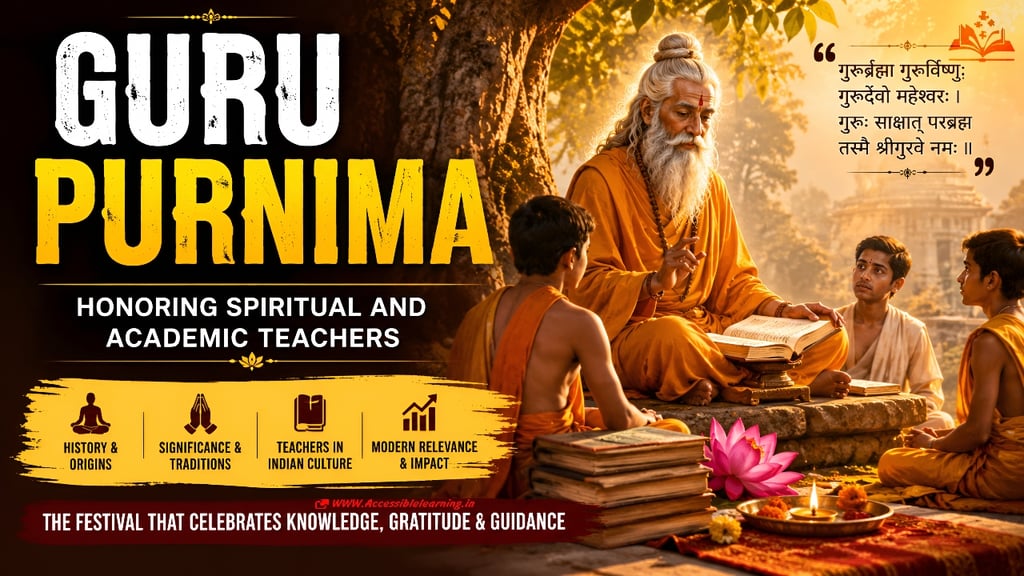
Guru Purnima Is Not About Rituals. It Is About Power, Knowledge, and Influence.
Every year, millions of Indians bow before teachers, spiritual masters, mentors, and scholars during Guru Purnima. Yet the uncomfortable truth remains: society celebrates gurus for a day while often neglecting educators and knowledge systems for the rest of the year.
Guru Purnima stands as one of the oldest surviving traditions in India. The festival honors teachers who shape minds, preserve knowledge, and influence generations. Unlike many religious celebrations centered on gods, this observance places human guidance at the center of cultural life.
That fact alone makes Guru Purnima unique.
The Origins Trace Back to Sage Vyasa
Guru Purnima falls on the full moon day (Purnima) in the Hindu month of Ashadha, usually during June or July.
The festival primarily commemorates Vyasa, the legendary scholar credited with compiling the Vedas and composing the Mahabharata. Many traditions refer to the day as Vyasa Purnima.
Without Vyasa's contributions, much of India's ancient knowledge would likely have remained scattered and inaccessible. His work transformed oral traditions into organized systems of learning.
That historical role explains why Guru Purnima evolved into a celebration of every teacher, not just one ancient sage.
The Guru Was Never Just a Teacher
Modern education often reduces teaching to exams, grades, and certificates. Ancient Indian traditions viewed the guru differently.
A guru did not simply transfer information. A guru shaped character, discipline, ethics, and worldview. The relationship extended far beyond classrooms.
The Sanskrit word "guru" literally implies someone who removes darkness and ignorance. Whether spiritual, philosophical, artistic, or academic, the guru carried enormous influence over students.
That influence created both opportunity and risk.
A wise guru could transform lives.
A corrupt guru could exploit followers.
History contains examples of both.
The Spiritual Industry Surrounding Guru Purnima
Many people imagine Guru Purnima as a peaceful cultural observance. Reality looks far more complicated.
Across India, thousands of ashrams, spiritual organizations, and religious institutions organize massive gatherings. Devotees travel long distances, offer donations, attend lectures, and seek blessings from spiritual leaders.
For major organizations, Guru Purnima often becomes one of the largest annual events on their calendar.
This creates a significant economic ecosystem involving:
Travel and transportation
Hospitality services
Religious merchandise
Event management
Donations and fundraising
Digital broadcasts and livestreams
While genuine spiritual learning remains central for many participants, commercial interests frequently enter the picture.
The modern guru economy generates substantial influence, money, and visibility.
Ignoring that reality means misunderstanding the festival entirely.
Why Academic Teachers Rarely Receive Equal Attention
Guru Purnima officially honors both spiritual and academic teachers.
In practice, spiritual figures often dominate public attention.
School teachers, university professors, researchers, and mentors rarely receive the same visibility despite contributing directly to social progress.
This imbalance reveals a larger cultural contradiction.
Society praises knowledge but often underfunds education.
People celebrate wisdom yet frequently overlook the professionals who dedicate their lives to teaching.
Guru Purnima exposes that contradiction every year.
If knowledge truly matters, recognition should not stop at ceremonial respect.

Buddhism and Jainism Also Claim the Day
Many assume Guru Purnima belongs exclusively to Hindu traditions. That assumption misses the broader picture.
For Buddhists, the day carries special significance because it marks the occasion when Gautama Buddha delivered his first sermon after attaining enlightenment.
Jain traditions also connect the day with important teacher-disciple relationships and spiritual guidance. This shared observance demonstrates how deeply the concept of mentorship runs across Indian religious and philosophical traditions.
The festival survives not because of one religion but because every knowledge tradition depends on teachers.
The Digital Age Has Changed the Meaning of Guru
The internet has completely disrupted the traditional guru model. Today, people learn from YouTube creators, online instructors, podcast hosts, AI tools, business mentors, and social media educators.
Knowledge no longer flows through a single authority figure.
That shift creates a fascinating question:
Who qualifies as a guru in the twenty-first century?
The answer keeps expanding.
A coding instructor may influence more lives than a traditional spiritual teacher.
A researcher may contribute more practical value than a celebrity guru.
A mentor on a digital platform may shape careers across continents.
Guru Purnima increasingly reflects this transformation.
The Cultural Impact Remains Massive
Despite modernization, Guru Purnima continues to hold extraordinary relevance. The festival reinforces several cultural values:
Respect for knowledge
Gratitude toward mentors
Preservation of intellectual traditions
Intergenerational learning
Community identity
These values helped sustain Indian civilization for centuries.
While technologies change and institutions evolve, societies still require trusted guides who help individuals navigate complexity. That need explains why Guru Purnima survives while countless other traditions fade.
The Real Lesson of Guru Purnima
The most important lesson of Guru Purnima has nothing to do with rituals, flowers, or ceremonial speeches.
It asks a difficult question:
Do we genuinely value knowledge, or do we merely perform respect for it?
A society that honors teachers for one day but neglects education for the remaining 364 days misses the entire point. Guru Purnima matters because it reminds people that civilizations rise through learning, mentorship, and disciplined thinking.
The festival's enduring power does not come from mythology alone.
It comes from a simple truth that remains impossible to escape:
Every successful person stands on knowledge received from someone else.
That reality makes Guru Purnima far more than a religious observance.
It makes it a cultural audit of how seriously society treats wisdom itself.
FAQ's
Q: What is Guru Purnima, and why is it celebrated?
Guru Purnima is a traditional Indian festival dedicated to honoring spiritual gurus, teachers, mentors, and academic guides. It commemorates the contributions of Sage Vyasa and celebrates the importance of knowledge, learning, and guidance.
Q: When is Guru Purnima celebrated?
Guru Purnima is observed on the full moon day (Purnima) of the Hindu month of Ashadha, which usually falls in June or July according to the Gregorian calendar.
Q: Who was Sage Vyasa, and what is his connection to Guru Purnima?
Sage Vyasa is revered as the compiler of the Vedas and the author of the Mahabharata. Guru Purnima is also known as Vyasa Purnima because it marks his birth anniversary and honors his immense contribution to Indian knowledge traditions.
Q: Is Guru Purnima only a Hindu festival?
No. While Guru Purnima has strong roots in Hindu traditions, it is also significant in Buddhism and Jainism. Buddhists associate the day with Buddha's first sermon, while Jains honor important teacher-disciple relationships.
Q: How do people celebrate Guru Purnima?
People celebrate Guru Purnima by offering prayers, expressing gratitude to teachers, attending spiritual discourses, participating in meditation sessions, and honoring mentors who have influenced their personal or professional growth.
Q: What is the significance of a guru in Indian culture?
In Indian culture, a guru is considered more than a teacher. A guru provides wisdom, moral guidance, discipline, and spiritual insight, helping individuals overcome ignorance and achieve personal growth.
Q: Why is Guru Purnima still relevant in the modern world?
Guru Purnima remains relevant because mentorship, education, and knowledge continue to shape careers, communities, and societies. The festival highlights the lasting value of teachers, coaches, researchers, and guides in every field.
Q: What is the difference between Guru Purnima and Teachers' Day?
Guru Purnima focuses on honoring spiritual, academic, and life mentors through an ancient cultural tradition, while Teachers' Day primarily recognizes professional educators and their contributions to formal education systems.
Subscribe To Our Newsletter
All © Copyright reserved by Accessible-Learning Hub
| Terms & Conditions
Knowledge is power. Learn with Us. 📚

