

Guangzhou Spring Festival Lantern Festival: A Living Tradition of Light and Meaning
Discover the Guangzhou Spring Festival Lantern Festival, a vibrant cultural celebration where Lingnan heritage, intricate lantern art, family traditions, food, and modern innovation come together to illuminate the Lunar New Year’s grand finale.
EVENT/SPECIALCHINATRAVEL LIFECELEBRATION/FESTIVALS
Kim Shin
1/18/20265 min read
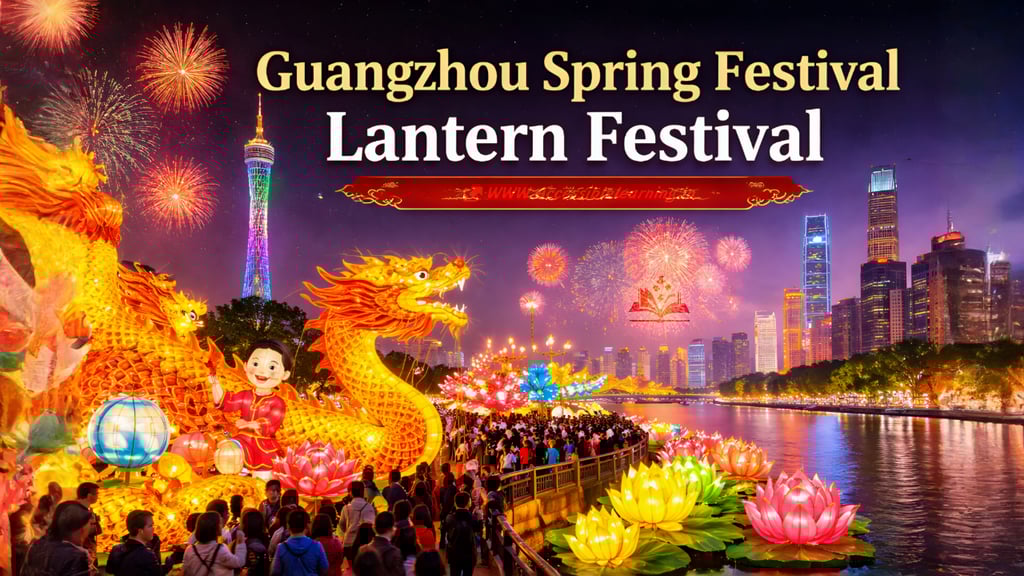
The Guangzhou Spring Festival Lantern Festival is one of southern China’s most meaningful seasonal celebrations. Taking place during the final days of the Lunar New Year and peaking on the fifteenth day of the lunar calendar, it represents closure, renewal, and collective hope. In Guangzhou, this festival is not treated as a single-night event but as a citywide cultural season that blends heritage, creativity, and everyday life.
What makes it special is not only the scale of the lantern displays but also the way the festival continues to function as a shared social ritual in a modern megacity.
Deep Historical Context in Lingnan Culture
Guangzhou’s Lantern Festival traditions are rooted in Lingnan culture, which developed independently from northern Chinese customs due to geography, climate, and trade exposure. As a historic port on the Maritime Silk Road, Guangzhou absorbed influences from Southeast Asia, the Middle East, and beyond. This openness shaped the aesthetics and symbolism of local lanterns.
Historically, lantern exhibitions in Guangzhou were also tied to:
Academic culture, where scholars used riddles to demonstrate wit and learning
Merchant culture, where families and guilds sponsored lanterns to show goodwill and prosperity
Community identity, where neighborhoods expressed pride through themed displays
This mix of intellect, commerce, and artistry remains visible today.
Evolution of Lantern Design and Technology
Traditional Craftsmanship
Classic Guangzhou lanterns rely on hand-built frames made from bamboo or wire, wrapped with silk or fine paper. Artisans paint scenes by hand, often using techniques borrowed from Chinese ink painting and Cantonese folk art.
Common traditional forms include:
Palace lanterns symbolizing dignity and harmony
Floral lanterns inspired by Lingnan’s subtropical environment
Zodiac lanterns aligned with the lunar year
Contemporary Innovation
Modern displays often integrate:
Programmable LED lighting
Mechanical movement and rotating structures
Sound, mist, and water reflections
Interactive elements activated by motion or touch
Despite these updates, many displays still follow traditional storytelling structures, ensuring innovation does not replace cultural meaning.
Symbolism Embedded in the Lanterns
Every element of a lantern carries meaning. Colors, shapes, and motifs are chosen intentionally.
Examples include:
Red for happiness, protection, and celebration
Gold for wealth and good fortune
Fish for abundance and surplus
Children figures for family continuity
Clouds and waves for smooth journeys and peace
In Guangzhou, symbolism often reflects daily life and realism rather than imperial grandeur, making the displays feel approachable and human.
Role of Public Spaces and Urban Planning
The Lantern Festival is also an exercise in urban storytelling. City planners intentionally select locations that connect history, ecology, and modern life.
Key spatial strategies include:
Using lakes and rivers to mirror lantern light
Placing displays near ancient city walls and temples
Integrating lantern paths with walking routes and public transport
Designing zones for families, photography, and quiet viewing
This approach turns the festival into a walkable cultural experience rather than a single crowded venue.
Family Traditions and Social Meaning
For many Guangzhou families, attending the Lantern Festival is a ritual passed down through generations.
Common family practices include:
Visiting lantern displays together after dinner
Teaching children to solve lantern riddles
Taking annual family photos under the same lantern areas
Sharing tangyuan at home or nearby food stalls
These small acts reinforce continuity and belonging, which is why the festival remains emotionally important even for younger residents.
Food Culture and Seasonal Flavors
Food during the Lantern Festival reflects Guangzhou’s culinary philosophy of balance and refinement.
Beyond tangyuan, the season also features:
Light herbal soups believed to restore energy
Fresh fruits arranged as symbolic offerings
Cantonese pastries shaped like lanterns or flowers
Street food areas near lantern sites often become social hubs, blending taste with celebration.
Tourism and Cultural Exchange
The Guangzhou Spring Festival Lantern Festival has become an important cultural tourism event without losing its local character.
For visitors, it offers:
A non-commercial entry point into Cantonese culture
Opportunities to witness living traditions rather than staged shows
Insight into how ancient festivals adapt to global cities
Multilingual signage and guided cultural explanations have made the festival more accessible to international audiences while still prioritizing authenticity.


Environmental Awareness and Sustainability
In recent years, Guangzhou has emphasized responsible festival management.
Key efforts include:
Reusable lantern structures
Low-energy lighting systems
Recycling programs around festival zones
Controlled crowd flow to protect parks and wetlands
These initiatives reflect a broader understanding that cultural preservation must align with environmental responsibility.
The Lantern Festival as a Reflection of Guangzhou’s Identity
At its core, the Guangzhou Spring Festival Lantern Festival mirrors the city itself. It is outward-looking but grounded, modern but respectful of tradition, and energetic yet family-centered.
The festival does not attempt to freeze history. Instead, it allows culture to evolve in public view, illuminated by thousands of lights and millions of shared moments.
Why the Festival Continues to Matter
In an era of rapid digital interaction, the Lantern Festival remains a physical, communal experience. It invites people to walk, look, talk, eat, and think together. It reminds residents that the city is not only a place of work but also a place of shared memory and hope.
The Guangzhou Spring Festival Lantern Festival is not just about light in the sky. It is about light between people, renewed every year.
Interesting Facts
Guangzhou lanterns are designed to be read, not just seen
Many lanterns are created like visual stories. A single display may depict a full folk tale, historical event, or moral lesson, moving scene by scene as visitors walk past.Lingnan lanterns favor elegance over grandeur
Compared to northern China’s bold and imperial-style lanterns, Guangzhou lanterns focus on refined details, softer lines, and themes from daily life, flowers, and family.Lantern riddles were once a public test of intelligence
In earlier times, solving difficult riddles could earn social recognition. Scholars used them to display literary skill, and merchants used clever riddles to attract crowds.The festival marks emotional closure of the Lunar New Year
For many locals, the year does not truly begin until the Lantern Festival night has passed. It is seen as the moment when celebration turns back into routine life.Some lantern frameworks are reused for decades
While the outer artwork changes yearly, many internal structures are preserved and rebuilt, blending sustainability with tradition.Guangzhou was among the first cities to modernize lantern lighting
The city began experimenting with electric and later LED lanterns earlier than many regions due to its strong manufacturing and design industries.Water reflections are part of the design plan
Lantern placement near lakes and rivers is intentional. Designers plan compositions so the reflection completes the artwork.Children play a symbolic role in lantern themes
Many displays prominently feature children's figures to represent continuity, education, and hope for the next generation.Lantern viewing is considered an act of good fortune
Traditionally, walking under lanterns and red lights is believed to invite luck, health, and harmony for the coming year.
FAQ's
Q: What is the Guangzhou Spring Festival Lantern Festival?
It is a traditional celebration held during the Lunar New Year period, culminating on the fifteenth day of the lunar calendar. It marks the symbolic end of Spring Festival celebrations with lantern displays, performances, food, and cultural activities.
Q: When does the festival usually take place?
The festival occurs during the first lunar month, with major lantern exhibitions appearing in the days leading up to the fifteenth day of the Lunar New Year.
Q: Where are the main lantern displays in Guangzhou?
Large-scale displays are commonly held in public parks, historic districts, riverfront areas, and cultural squares across the city, rather than in a single fixed location.
Q: Is the festival suitable for families and children?
Yes. The festival is strongly family-oriented, with interactive lantern riddles, open walking areas, performances, and child-friendly themes.
Q: What food is traditionally eaten during the Lantern Festival?
The most important food is tangyuan, glutinous rice balls served in sweet soup, symbolizing reunion and completeness.
Q: Are the lanterns handmade or machine-produced?
Most lanterns combine traditional handcraft techniques with modern technology. The artistic structure and painting are often done by hand, while lighting and motion may use modern systems.
Q: Why is the Lantern Festival important in Guangzhou culture?
It represents unity, renewal, and cultural continuity. In Guangzhou, it also reflects Lingnan identity, community values, and the city’s ability to blend tradition with modern life.
Subscribe to Frontier Intelligence
All © Copyright reserved by Accessible-Learning Hub
| Terms & Conditions
Accessible Learning Hub — Actionable clarity for high-agency minds.
Weekly breakdowns on AI breakthroughs, capital flow, and human performance systems. Zero fluff.