

Grammarly vs ProWritingAid vs QuillBot: Honest Comparison for Writers
A detailed comparison of ProWritingAid vs Grammarly vs QuillBot in 2026. Explore features, accuracy, pricing, AI capabilities, and the best use cases to choose the right writing tool for your workflow.
AI ASSISTANTAI/FUTUREDIGITAL MARKETING
Sachin K Chaurasiya
4/8/20264 min read
Most comparisons stop at features. But in 2026, writing tools are no longer just grammar checkers. They are AI collaborators, each shaping how your content performs across search engines, AI assistants, and human readers. This guide goes deeper. Not just what these tools do, but how they think, where they fail, and how to use them strategically.
The Evolution of Writing Tools: From Correction to Cognition
The shift is subtle but important.
Earlier tools fixed grammar
Now they influence tone, intent, and information structure
They affect how content is interpreted by AI systems (GEO: Generative Engine Optimization)
All three tools approach this differently:
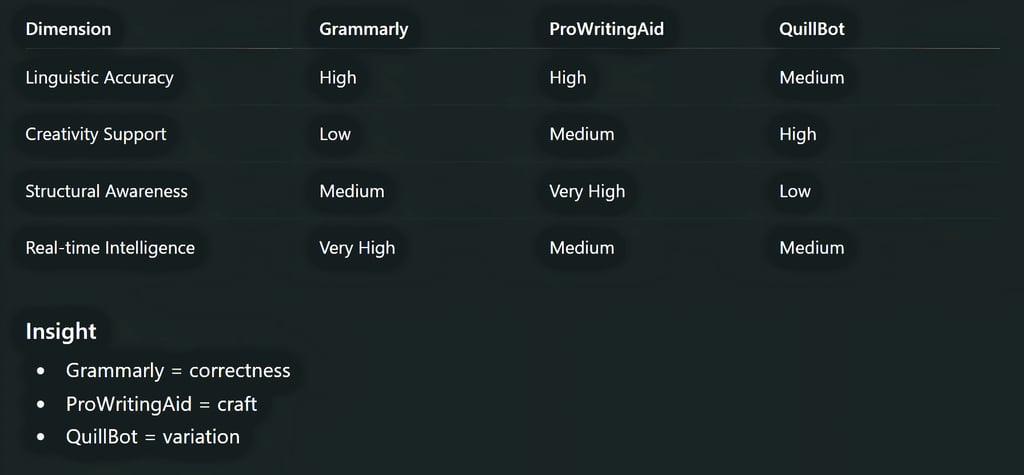
Grammarly → Context-aware writing assistant
ProWritingAid → Analytical writing intelligence
QuillBot → Semantic rewriting engine
AI Behavior and Writing Intelligence
Grammarly: Predictive Language Optimization
Grammarly doesn’t just correct errors anymore. It predicts reader expectations.
Advanced Capabilities
Context-aware tone detection (formal, confident, empathetic)
Sentence compression for clarity and speed
Domain adaptation (business, academic, casual)
Real-time intent alignment
Hidden Strength
Grammarly is very good at reducing cognitive load. It simplifies sentences in a way that improves readability scores and AI parsing.
Limitation
It often over-sanitizes writing, removing personality or nuance, especially in storytelling or opinion pieces.
ProWritingAid: Structural and Stylistic Intelligence
ProWritingAid works like a diagnostic engine for writing.
Advanced Capabilities
Narrative structure analysis (pacing, dialogue balance)
Stylistic fingerprinting (repetition, rhythm, sentence variation)
Readability heatmaps
In-depth reports (over 20 types of analysis)
Hidden Strength
It identifies patterns across long documents. For example:
Repeated sentence openings
Passive voice overuse in specific sections
Emotional flatness in narrative arcs
Limitation
It does not adapt quickly in real-time writing environments. It’s built for revision, not flow.
QuillBot: Semantic Rewriting Engine
QuillBot operates at the meaning level, not just surface grammar.
Advanced Capabilities
Multi-mode paraphrasing (fluency, creative, formal, expand, shorten)
Sentence restructuring using alternate semantic paths
Built-in summarizer for long-form content
Citation and grammar tools (secondary features)
Hidden Strength
It can break writer’s block instantly by offering alternate phrasing paths.
Limitation
It sometimes distorts intent subtly, especially in technical or precise writing.
GEO (Generative Engine Optimization) Impact
In 2026, content isn’t just ranked. It’s interpreted and reused by AI systems.
Grammarly
Produces clean, structured, AI-readable text
Strong for FAQs, professional content, and knowledge articles
Helps reduce ambiguity
Result: Better for AI extraction and summarization
ProWritingAid
Improves depth and richness of content
Enhances narrative clarity and logical flow
Result: Better for long-form authority content
QuillBot
Enables content variation and repurposing
Helps avoid duplication across platforms
Result: Useful for scaling content, but requires human review
Writing Workflow Integration (Real-World Use)
This is where most users choose wrong. Not based on features, but based on how they actually write.
Scenario A: Daily Writing (Emails, LinkedIn, Docs)
Best tool → Grammarly
Reason → Instant feedback, minimal friction
Scenario B: Blog Writing / Articles / SEO Content
Best combination → QuillBot + Grammarly
Reason → Idea reshaping + final polish
Scenario C: Books / Scripts / Long-form Content
Best tool → ProWritingAid
Reason → Structural and stylistic depth
Scenario D: Content Repurposing (YouTube → Blog → Social)
Best tool → QuillBot
Reason → Fast rewriting across formats
Risks and Misuse (Important but Rarely Discussed)
Grammarly Risk
Over-reliance leads to generic writing voice
Writers stop noticing their own mistakes
ProWritingAid Risk
Analysis paralysis from too many reports
Over-editing can kill natural flow
QuillBot Risk
Semantic drift (meaning changes slightly)
Can unintentionally create AI-detectable patterns if overused
Performance in Multilingual and Indian Contexts
Since many users write in English as a second language:
Grammarly
Strong support for non-native writers
Helps fix tone and fluency
ProWritingAid
Better for advanced users already comfortable with English
QuillBot
Very useful for rephrasing complex sentences into simpler English

The Hybrid Strategy (What Advanced Writers Actually Do)
Instead of choosing one tool, experienced writers combine them based on the writing stage:
Step-by-Step Workflow
1. Draft (Raw Thinking)
No tools or light use of QuillBot
2. Restructure
Use QuillBot to explore alternative phrasing
3. Deep Editing
Use ProWritingAid for style, pacing, and structure
4. Final Polish
Use Grammarly for correctness and clarity
This layered approach aligns with how writing actually happens:
Thinking → Refining → Structuring → Polishing
Which Tool Wins?
It depends on your intent.
If you want speed → Grammarly
If you want mastery → ProWritingAid
If you want flexibility → QuillBot
But the real advantage comes from understanding this:
No single tool replaces a writer. The best results come from using each tool at the right stage.
FAQ's
Q: Which is better: Grammarly, ProWritingAid, or QuillBot?
There isn’t a single “best” tool.
Grammarly is best for real-time grammar correction and clarity
ProWritingAid is best for deep writing improvement and long-form content
QuillBot is best for paraphrasing and rewriting
The right choice depends on your writing goal, not just features.
Q: Is Grammarly more accurate than ProWritingAid?
Yes, for real-time grammar and spelling correction, Grammarly is generally more accurate and faster.
ProWritingAid focuses more on style, structure, and detailed analysis rather than instant corrections.
Q: Can QuillBot replace Grammarly?
No, QuillBot cannot fully replace Grammarly. QuillBot is designed for rewriting and paraphrasing, while Grammarly is built for grammar accuracy and clarity. They solve different problems.
Q: Which tool is best for SEO content writing?
For SEO and AI-optimized content:
Grammarly helps ensure clarity and readability
ProWritingAid improves depth and structure
QuillBot helps generate variations and avoid duplication
A combination of tools works better than relying on just one.
Q: Are these tools safe to use for professional or academic writing?
Yes, but with caution. All three tools are safe for editing and improving writing. However:
Always review suggestions manually
Avoid blindly accepting rewrites, especially with QuillBot
Ensure originality when working on academic content
Q: Do these tools work well for non-native English writers?
Yes, especially:
Grammarly for correcting tone and fluency
QuillBot for simplifying or rephrasing sentences
ProWritingAid is better suited for users who already have a strong grasp of English.
Q: Which tool is best for long-form writing like books or essays?
ProWritingAid is the best choice for long-form writing. It provides detailed insights into pacing, repetition, and structure that are useful for authors and serious writers.
Q: Can I use all three tools together?
Yes, and that’s often the most effective approach:
Use QuillBot for rewriting ideas
Use ProWritingAid for deep editing
Use Grammarly for final proofreading
This workflow improves both quality and efficiency.
Q: Do these tools make writing sound AI-generated?
They can, if overused. Grammarly may make writing too polished, while QuillBot can create unnatural phrasing. The key is to edit with intent and keep your own voice intact.
Q: Which tool is best for beginners?
Grammarly is the easiest to start with. It offers simple, real-time suggestions and requires no learning curve.
Subscribe to Frontier Intelligence
All © Copyright reserved by Accessible-Learning Hub
| Terms & Conditions
Accessible Learning Hub — Actionable clarity for high-agency minds.
Weekly breakdowns on AI breakthroughs, capital flow, and human performance systems. Zero fluff.