

General Electric: From Industrial Conglomerate to Aerospace Innovation Leader
From Thomas Edison to aerospace leader: General Electric's transformation explained. 2025 financial results, stock analysis, and what investors need to know.
COMPANY/INDUSTRYWEALTHY FAMILYHISTORYUSA
Sachin K Chaurasiya
1/15/20268 min read
What is General Electric (GE) Today?
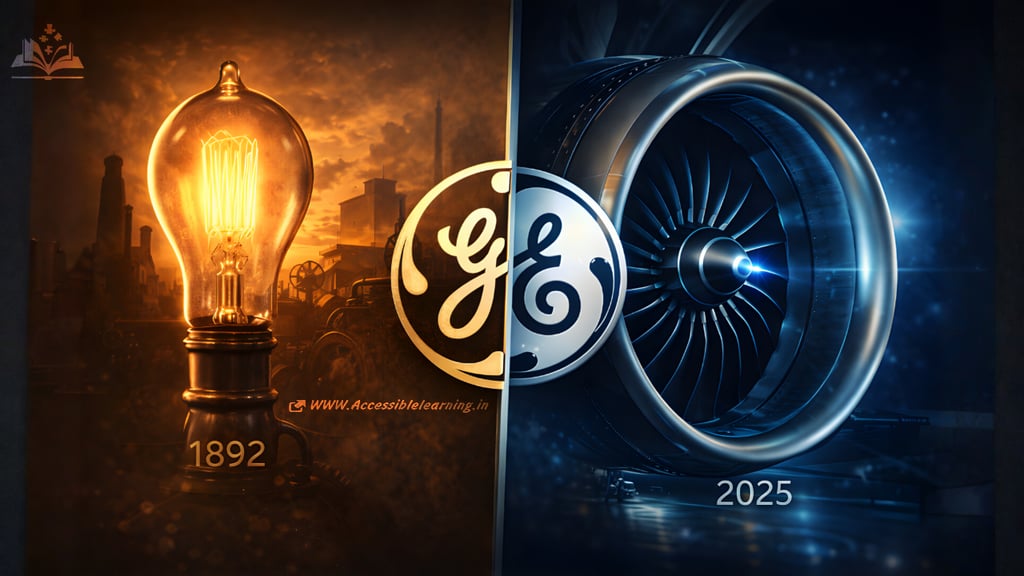
General Electric completed its historic transformation in April 2024, splitting into three independent public companies: GE Aerospace (retaining the iconic GE ticker), GE Vernova (energy and power), and GE HealthCare (medical technology). This marked the end of one of America's most storied conglomerates and the beginning of a new era for each focused business.
GE Aerospace now operates as the primary successor to the original General Electric name, concentrating on commercial and defense aircraft engines, propulsion technologies, and aerospace systems.
Understanding General Electric's Founding and Legacy
How Was General Electric Founded?
General Electric was incorporated on April 15, 1892, through a merger between Edison General Electric Company and Thomson-Houston Electric Company, facilitated by financier J.P. Morgan. The Edison General Electric Company itself had been founded in 1889, consolidating various businesses started by inventor Thomas Edison.
Edison had originally established the Edison Electric Light Company in 1878 to commercialize his incandescent lamp invention. The 1892 merger brought together two electrical industry giants, creating a company that would shape technological progress for over 130 years.
Who Founded General Electric?
While Thomas Edison is most associated with GE's origins, the company's founding involved multiple key figures:
Thomas Edison: Inventor and original business founder whose companies formed the basis for GE
Charles Coffin: President of Thomson-Houston who became GE's first president and chairman
Elihu Thomson: Chief inventor from Thomson-Houston
J.P. Morgan: Financial backer who orchestrated the merger
General Electric became one of the original 12 companies in the Dow Jones Industrial Average when it was created in 1896, and remarkably remained a Dow component for over a century.
GE's Historic Business Transformation: The 2024 Split
Why Did General Electric Split Up?
The decision to divide General Electric into three independent companies stemmed from a multi-year strategic transformation aimed at unlocking value, reducing complexity, and allowing each business to focus on its core strengths. The transformation included more than $100 billion in debt reduction since 2018 and a company-wide implementation of lean operating principles.
The Three Companies After the Split
GE Aerospace (NYSE: GE)
GE Aerospace launched as an independent company on April 2, 2024, continuing to trade under the historic GE ticker symbol on the New York Stock Exchange. The company focuses on:
Commercial aircraft engines and services
Defense and propulsion technologies
Aerospace systems and components
The company supports approximately 44,000 commercial aircraft engines and 26,000 military and defense engines globally.
GE Vernova (NYSE: GEV)
GE Vernova spun off on April 2, 2024, beginning trading under the ticker symbol GEV. This company leads in:
Power generation and grid solutions
Renewable energy (wind, hydro, solar)
Energy transition technologies
Gas, steam, and nuclear power systems
GE HealthCare (NYSE: GEHC)
GE HealthCare was the first to separate, completing its spin-off in January 2023. The company specializes in:
Medical imaging equipment
Diagnostic technologies
Healthcare IT solutions
Patient monitoring systems
How Did the GE Stock Split Work?
Shareholders holding GE common stock on March 19, 2024, received one share of GE Vernova for every four shares of GE common stock they owned. The distribution occurred before market opening on April 2, 2024, and was structured to be tax-efficient for U.S. shareholders. Investors did not need to take any action or pay consideration to receive their GE Vernova shares.

GE Aerospace Financial Performance and Outlook
2024 Financial Results
GE Aerospace delivered strong fourth quarter 2024 results with orders up 46%, earnings per share more than doubling, and free cash flow increasing over 20%. For the full year 2024, the company reported:
Revenue: $38.70 billion (up 9.49% year-over-year)
Profit growth: $1.7 billion increase
Free cash flow growth: $1.3 billion increase
The company returned more than 100% of free cash flow to shareholders, including $5 billion in share buybacks and dividends representing approximately 30% of net income.
2025 Guidance and Growth Strategy
For 2025, GE Aerospace expects double-digit revenue and earnings per share growth with greater than 100% free cash flow conversion. Specific guidance includes:
Revenue Growth: Mid-teens growth for Commercial Engines & Services segment
Earnings Per Share: $5.10 to $5.45 range (approximately 15% growth at midpoint)
Free Cash Flow: $6.3 billion to $6.8 billion
Share Buybacks: Additional $7 billion planned for 2025
The company projects achieving approximately $10 billion in operating profit by 2028, demonstrating confidence in its long-term growth trajectory.
What Does GE Aerospace Do?
GE Aerospace operates through two primary business segments:
Commercial Engines & Services:
Design and manufacturing of jet engines for commercial aircraft
Maintenance, repair, and overhaul (MRO) services
Spare parts distribution
Business aviation engines
Aeroderivative power systems
Defense & Propulsion Technologies:
Military aircraft engines
Defense systems
Marine propulsion
Industrial power generation
The company's proprietary FLIGHT DECK lean operating model guides continuous improvement initiatives and operational excellence across all business units.
GE Aerospace Stock Performance and Investment Outlook
Current Stock Price and Market Position
As of November 2025, GE Aerospace shares were trading around $310.61, reflecting strong investor confidence in the focused aerospace business model.
According to 11 analysts, the average rating for GE stock is "Strong Buy" with a 12-month price target of $311.0.
Capital Allocation and Shareholder Returns
GE Aerospace has committed to returning approximately 70-75% of available funds to shareholders while maintaining investment in growth and innovation. This balanced approach includes:
Consistent dividend payments
Substantial share repurchase programs
Strategic investments in research and development
Capital expenditures to support production increases
Key Strategic Partnerships and Industry Developments
Recent Major Contracts and Agreements
GE Aerospace has secured several significant partnerships in 2025:
Turkish Airlines reached an agreement with GE Aerospace to procure engines, spare engines, and maintenance services for 75 Boeing 787 aircraft.
Emirates and GE Aerospace signed an agreement for 130 additional GE9X engines to power the airline's growing fleet of Boeing 777-9s, including spare engines and long-term services.
flydubai signed an agreement for 60 GEnx-1B engines to power the airline's new Boeing 787-9 fleet, including spare engines and services support.
GE Aerospace and Shield AI agreed to collaborate on propulsion technologies for Shield AI's new X-BAT vehicle program.
Supply Chain and Production Improvements
From the first half to the second half of 2024, GE Aerospace achieved meaningful improvement as material inputs increased 26% across priority supplier sites. This progress supported:
Commercial Engines & Services revenue growth of 17%
Engine unit growth of 18%
LEAP engine production up 12%
Both defense and commercial engines growing double digits
The company continues using its FLIGHT DECK operating system to address supply chain constraints and improve production efficiency.
Historical Innovations That Shaped Modern Life
GE's Innovation Legacy
Throughout its 130-year history, General Electric pioneered numerous technological breakthroughs:
In 1900, GE established an industrial research laboratory where many products were developed by in-house scientists, creating one of the world's first corporate R&D facilities.
Notable innovations included
1879: Thomas Edison's commercially practical incandescent lamp
1900s: Ductile tungsten filament for light bulbs
1910: First electric stove (Hotpoint)
1917: First hermetically sealed home refrigerator
1918: Magnetron vacuum tube (later used in radar and microwaves)
1919: Co-founding Radio Corporation of America (RCA)
1928: First television broadcast demonstration
1930s: Plastics department and advanced materials research
GE's Role in American Industry
General Electric played a pivotal role in electrifying America, bringing electric lighting to homes and businesses, developing household appliances, and advancing industrial technologies. The company's innovations touched virtually every aspect of 20th-century life, from entertainment (through NBC broadcasting) to transportation, healthcare, and energy production.

Understanding GE's Business Model Today
Focus on Aerospace Excellence
As GE Aerospace, the company now concentrates exclusively on aviation and aerospace markets. This strategic focus enables:
Deeper expertise in propulsion technologies
Faster decision-making and innovation cycles
Clearer value proposition for investors
Enhanced customer focus and responsiveness
Streamlined operations and cost structure
FLIGHT DECK Operating System
GE Aerospace employs a proprietary lean methodology called FLIGHT DECK that drives operational excellence through:
Continuous improvement initiatives
Data-driven decision-making
Customer-centric problem solving
Supply chain optimization
Quality and safety enhancement
The Future of GE Aerospace
Industry Tailwinds Driving Growth
Several factors position GE Aerospace for continued success:
Recovering Air Travel Demand: Global aviation traffic continues rebounding, driving demand for services and new aircraft
Fleet Modernization: Airlines replacing older aircraft with fuel-efficient models powered by GE engines
Defense Spending: Sustained military budgets supporting defense propulsion programs
Installed Base Growth: Expanding fleet of GE-powered aircraft creates long-term service opportunities
Technological Innovation: Next-generation propulsion technologies and sustainable aviation solutions
Sustainability and Environmental Initiatives
GE Aerospace actively develops technologies to reduce aviation's environmental impact, including:
More fuel-efficient engine designs
Research into sustainable aviation fuels
Hybrid-electric propulsion concepts
Advanced materials reducing weight and emissions
Digital solutions optimizing flight operations
Investment in Innovation
GE Aerospace maintains a capital allocation framework balancing investment in growth and innovation while returning substantial capital to shareholders. The company continues developing next-generation technologies to maintain competitive advantages in propulsion systems, digital services, and aerospace solutions.
The transformation of General Electric from a diversified conglomerate to a focused aerospace leader represents one of the most significant corporate restructurings in American business history. Founded on Thomas Edison's innovations in 1892, the company that electrified America and pioneered countless technologies now concentrates its expertise on advancing aviation and aerospace.
GE Aerospace enters this new era with strong financial performance, industry-leading technology, substantial market opportunities, and a clear strategic vision. While the General Electric conglomerate no longer exists, its legacy continues through three independent companies, each positioned to lead their respective industries.
For investors, customers, and stakeholders, GE Aerospace offers exposure to the growing global aviation market with the backing of over 130 years of engineering excellence and innovation. The company's transformation demonstrates how even iconic corporations must evolve to meet changing market demands while preserving the innovative spirit that defined their success.
Frequently Asked Questions
Q: Is General Electric still in business?
Yes, but in a transformed state. The original General Electric conglomerate completed its evolution into three independent companies in April 2024. GE Aerospace continues the General Electric legacy under the GE name and ticker symbol, focusing exclusively on aerospace and aviation.
Q: What happened to the General Electric Company?
General Electric underwent a strategic transformation to unlock value and reduce complexity. The company split into three independent businesses: GE Aerospace (aviation), GE Vernova (energy), and GE HealthCare (medical technology). Each company now operates independently with its own management team and strategic focus.
Q: Who owns GE Aerospace now?
GE Aerospace is a publicly traded company listed on the New York Stock Exchange under ticker symbol GE. Ownership is distributed among institutional investors, mutual funds, and individual shareholders. The company operates independently, with H. Lawrence Culp Jr. serving as Chairman and CEO.
Q: What products does GE Aerospace make?
GE Aerospace designs and manufactures commercial and military aircraft engines, provides maintenance and repair services, produces spare parts, develops propulsion systems, and creates integrated aerospace technologies. The company supports tens of thousands of aircraft engines operating worldwide.
Q: Is GE Aerospace a good investment?
Investment decisions should be based on individual financial situations and goals. GE Aerospace demonstrates strong financial performance with double-digit growth projections, substantial free cash flow generation, and a commitment to returning capital to shareholders. The company benefits from robust aviation industry demand and long-term service agreements. Consult with financial advisors for personalized investment guidance.
Q: What is the difference between GE, GE Vernova, and GE HealthCare?
These are three independent public companies that resulted from the split of the original General Electric:
GE Aerospace (NYSE: GE): Aviation and aerospace technologies
GE Vernova (NYSE: GEV): Energy, power, and renewable technologies
GE HealthCare (NYSE: GEHC): Medical technology and diagnostics
Q: How many employees does GE Aerospace have?
While specific current employee numbers weren't disclosed in recent earnings, GE Aerospace operates as a global organization with a substantial workforce supporting manufacturing, engineering, services, and corporate functions across multiple countries.
Q: Where is GE Aerospace headquartered?
GE Aerospace maintains major operations in Cincinnati, Ohio, and Evendale, Ohio, with a global presence across manufacturing facilities, service centers, and engineering locations worldwide.
Q: What airlines use GE engines?
Major airlines worldwide use GE engines, including Emirates, Turkish Airlines, flydubai, United Airlines, Delta Air Lines, and many others. GE's engine portfolio includes the GE9X (the world's most powerful commercial jet engine), GEnx, LEAP, and various other engine families powering commercial and cargo aircraft globally.
Q: How does GE Aerospace make money?
GE Aerospace generates revenue through two primary channels: selling new engines to aircraft manufacturers and airlines and providing long-term services, including maintenance, repair, overhaul, and spare parts. The services business provides recurring revenue streams throughout an engine's 25-30 year operational life.
Subscribe to Frontier Intelligence
All © Copyright reserved by Accessible-Learning Hub
| Terms & Conditions
Accessible Learning Hub — Actionable clarity for high-agency minds.
Weekly breakdowns on AI breakthroughs, capital flow, and human performance systems. Zero fluff.