

Gemini 3.1 Pro vs. Claude 4.5 Sonnet: The Enterprise Frontier
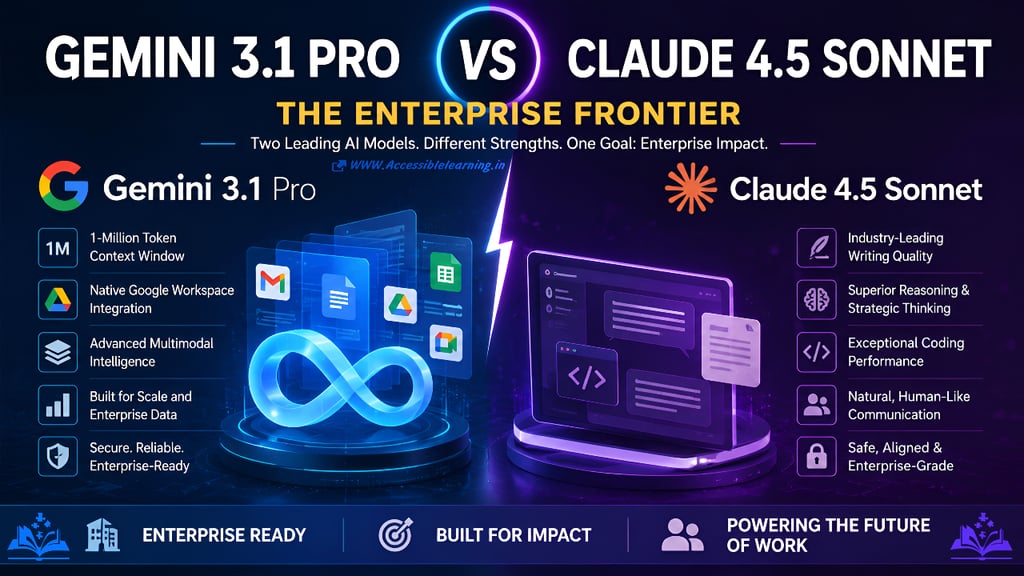
Gemini 3.1 Pro and Claude 4.5 Sonnet are leading the enterprise AI race. Compare reasoning, coding, context windows, writing quality, integrations, and business use cases to find the best AI model for your organization.
AI/FUTUREENTREPRENEUR/BUSINESSMANDIGITAL MARKETING
Sachin K Chaurasiya
6/19/20266 min read
Artificial intelligence has entered a new phase.
For nearly two years, most enterprise AI discussions revolved around a single company. That era is over. The competitive landscape has shifted into a three-way race where Google, Anthropic, and OpenAI are pushing the boundaries of reasoning, context processing, coding, and enterprise integration.
Among the most significant battles today is the showdown between Gemini 3.1 Pro and Claude 4.5 Sonnet.
Both models target businesses, researchers, developers, analysts, and power users who need more than simple chatbot functionality. These systems are increasingly becoming operating layers for knowledge work, software development, business intelligence, and strategic decision-making.
The challenge for enterprises is no longer finding a capable AI model. The challenge is selecting the right one.
This guide explores how Gemini 3.1 Pro and Claude 4.5 Sonnet compare across reasoning, context windows, coding, writing quality, integrations, enterprise deployment, and real-world business use cases.
Understanding the Strategic Difference
The easiest way to understand the competition is this:
Gemini 3.1 Pro aims to become the intelligence layer of Google's ecosystem.
Claude 4.5 Sonnet aims to become the most capable reasoning and productivity model regardless of ecosystem.
That distinction influences almost every strength and weakness of both platforms.
Organizations already operating inside Google Workspace often find Gemini naturally fits into existing workflows.
Organizations focused on knowledge work, software engineering, analysis, and content production frequently gravitate toward Claude because of its writing quality and reasoning depth.
Gemini 3.1 Pro: Google's Context Giant
Google's biggest advantage is scale. Gemini 3.1 Pro offers one of the largest commercially available context windows, supporting up to one million tokens. This fundamentally changes how organizations interact with AI.
Instead of uploading small document fragments, users can provide the following:
Entire books
Large code repositories
Multi-year financial reports
Thousands of pages of legal documentation
Massive research datasets
Enterprise knowledge bases
The model can process and reason across these datasets within a single conversation. For enterprises dealing with information overload, this capability is transformational.
Where Gemini Excels
Massive Context Understanding
Traditional AI systems often struggle when information is spread across hundreds of documents. Gemini can analyze huge collections of information simultaneously, making it valuable for:
Legal reviews
Compliance audits
Corporate research
Enterprise knowledge management
Financial analysis
Organizations that routinely work with enormous datasets gain significant advantages from Gemini's context capacity.
Google Workspace Integration
Google's ecosystem remains one of Gemini's strongest differentiators. Users can work directly across:
Gmail
Docs
Sheets
Drive
Meet
Calendar
This creates a more seamless experience than manually transferring information between applications and AI systems. For enterprises already standardized on Google Workspace, implementation friction is dramatically reduced.
Multimodal Intelligence
Gemini was built around multimodal understanding from the ground up. It handles:
Text
Images
Video
Audio
Documents
within unified workflows. This makes it especially useful for organizations dealing with varied content formats.
Gemini's Enterprise Challenges
While Gemini is exceptionally powerful, it is not universally dominant.
Some users still report inconsistencies in writing style compared to Claude.
Complex writing tasks often require more editing and refinement.
In scenarios where communication quality directly impacts business outcomes, writing performance becomes a critical consideration.

Claude 4.5 Sonnet: The Productivity Specialist
Anthropic has taken a different approach. Rather than emphasizing ecosystem dominance, Claude focuses on becoming the best possible collaborator for knowledge workers.
The result is a model that consistently performs at an elite level across writing, reasoning, coding, and strategic analysis. Many organizations now consider Claude the benchmark for professional AI-assisted work.
Where Claude Excels
Industry-Leading Writing Quality
This remains Claude's most recognized strength. Claude produces content that often feels:
More natural
More coherent
Better structured
More persuasive
More context-aware
Compared with many competing models, Claude frequently requires fewer revisions before publication.
This matters enormously for:
Marketing teams
Consultants
Executives
Researchers
Analysts
Content strategists
Time saved in editing directly translates into productivity gains.
Advanced Reasoning
Claude consistently performs well on tasks involving:
Strategic thinking
Complex decision analysis
Policy evaluation
Multi-step reasoning
Business planning
Instead of simply retrieving information, Claude often demonstrates stronger synthesis and interpretation capabilities. For executives and business strategists, this distinction is significant.
Elite Coding Capabilities
Claude has become a favorite among software developers. Its strengths include the following:
Code generation
Debugging
Refactoring
Architecture planning
Documentation creation
Repository analysis
Many development teams report that Claude handles complex engineering discussions with remarkable clarity. This has made it one of the most widely adopted AI tools among professional programmers.
Claude's Enterprise Challenges
Claude's primary limitation compared with Gemini is ecosystem leverage.
Anthropic does not own a productivity suite comparable to Google's.
Organizations may need additional integrations to achieve the same workflow convenience that Gemini provides natively.
Additionally, while Claude supports extensive context processing, Gemini's one-million-token capability remains a major differentiator for extremely large document environments.
Head-to-Head Comparison
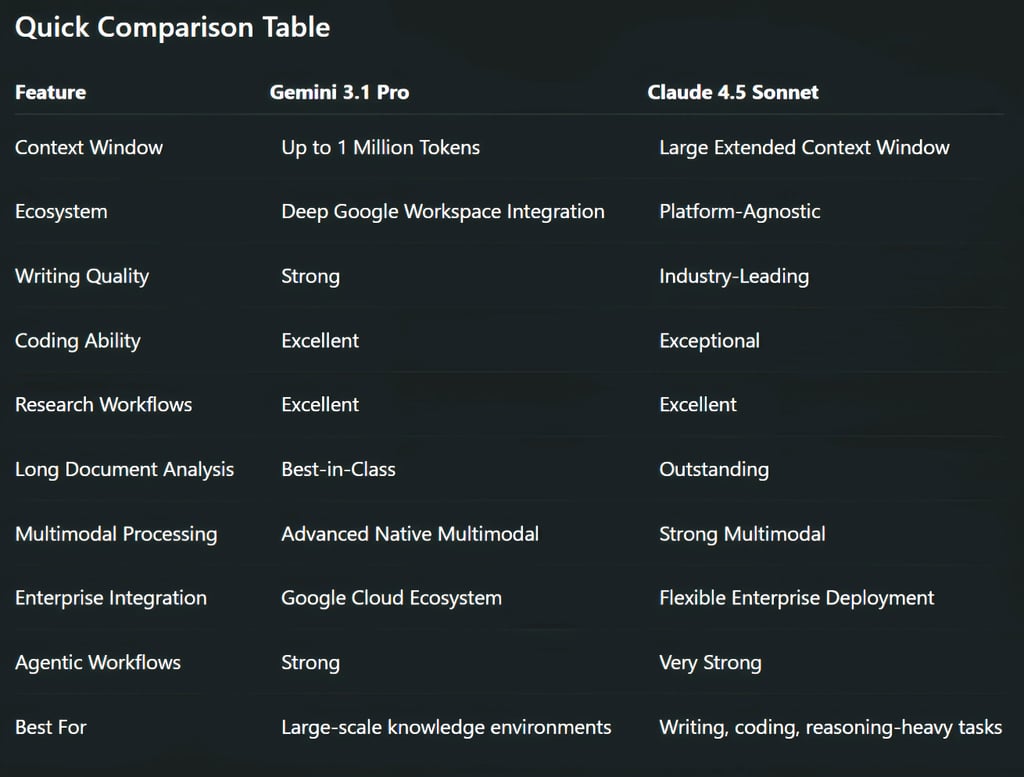
1. Reasoning
Winner: Claude 4.5 Sonnet
Claude frequently demonstrates stronger logical consistency, strategic thinking, and nuanced analysis.
For business planning and decision support, many enterprises currently favor Claude.
2. Writing and Communication
Winner: Claude 4.5 Sonnet
Claude's outputs generally feel more polished and human.
For reports, articles, executive summaries, and professional communication, Claude remains difficult to surpass.
3. Context Processing
Winner: Gemini 3.1 Pro
The one-million-token context window creates opportunities that most competing models cannot match.
Large-scale document intelligence is where Gemini shines.
4. Coding
Slight Edge: Claude 4.5 Sonnet
Both systems are highly capable.
However, many developers continue to prefer Claude for debugging, architecture discussions, and code explanation.
5. Enterprise Integration
Winner: Gemini 3.1 Pro
Native integration with Google's productivity ecosystem creates a compelling advantage for enterprises already invested in Google Workspace.
6. Multimodal Workflows
Winner: Gemini 3.1 Pro
Google's investment in multimodal AI gives Gemini a strong position for organizations handling diverse content formats.

Which Model Should Enterprises Choose?
The answer depends on organizational priorities.
Choose Gemini 3.1 Pro If:
Your company uses Google Workspace extensively
You manage massive document collections
Long-context analysis is a core requirement
Multimodal workflows are important
You want deep Google Cloud integration
Choose Claude 4.5 Sonnet If:
Writing quality matters significantly
Strategic analysis is a major use case
Your teams perform heavy knowledge work
Software engineering productivity is a priority
You want a model focused on reasoning excellence
The Bigger Picture
The most important takeaway is not which model wins. It is that enterprises now have genuine choice.
Gemini 3.1 Pro represents the future of large-scale information processing integrated into a massive productivity ecosystem.
Claude 4.5 Sonnet represents the future of AI-assisted thinking, writing, and software development.
Neither model completely dominates the other. Instead, each reflects a different vision of enterprise AI.
Google is building an intelligent operating system for organizational knowledge.
Anthropic is building a highly capable intellectual partner for professionals.
For many enterprises, the optimal strategy may not be choosing one over the other. It may be leveraging both.
If your organization's biggest challenge is managing and extracting value from enormous amounts of information, Gemini 3.1 Pro is arguably the stronger choice.
If your organization's success depends on superior reasoning, communication, strategic thinking, and software development, Claude 4.5 Sonnet currently holds the edge.
The AI race is no longer about who has the biggest model.
It is about who delivers the greatest business value.
And in that contest, Gemini 3.1 Pro and Claude 4.5 Sonnet have established themselves as two of the most influential enterprise AI platforms available today.
FAQ's
Q: What is the biggest difference between Gemini 3.1 Pro and Claude 4.5 Sonnet?
The biggest difference is focus. Gemini 3.1 Pro excels in large-context analysis, multimodal processing, and Google Workspace integration, while Claude 4.5 Sonnet is known for superior writing quality, reasoning, and coding performance.
Q: Which AI model is better for enterprise decision-making?
Claude 4.5 Sonnet is often preferred for strategic analysis, business planning, and complex reasoning tasks. However, Gemini 3.1 Pro can be more effective when decisions require analyzing massive amounts of data and documents simultaneously.
Q: Does Gemini 3.1 Pro really support a 1-million-token context window?
Yes. Gemini 3.1 Pro is designed to handle extremely large context windows, allowing users to analyze extensive datasets, lengthy reports, large codebases, and multiple documents within a single conversation.
Q: Which model is better for software development and coding?
Both models are highly capable, but many developers favor Claude 4.5 Sonnet for code generation, debugging, refactoring, and software architecture discussions due to its strong coding accuracy and explanations.
Q: Is Claude 4.5 Sonnet better for content writing?
For most professional writing tasks, Claude 4.5 Sonnet is widely regarded as one of the strongest AI models available. It produces natural, coherent, and well-structured content with minimal editing requirements.
Q: Which AI model works best with Google Workspace?
Gemini 3.1 Pro is the stronger choice for organizations using Google Workspace because it integrates directly with Gmail, Google Docs, Sheets, Drive, Meet, and other Google services.
Q: Should enterprises choose Gemini 3.1 Pro or Claude 4.5 Sonnet?
The choice depends on business needs. Organizations focused on document analysis, multimodal workflows, and Google ecosystem integration may benefit more from Gemini. Companies prioritizing writing quality, reasoning, and developer productivity may find Claude the better fit.
Q: Can businesses use both Gemini 3.1 Pro and Claude 4.5 Sonnet together?
Yes. Many enterprises adopt a multi-model strategy, using Gemini for large-scale data processing and workflow integration while relying on Claude for writing, coding, research, and strategic analysis.
Subscribe To Our Newsletter
All © Copyright reserved by Accessible-Learning Hub
| Terms & Conditions
Knowledge is power. Learn with Us. 📚

