

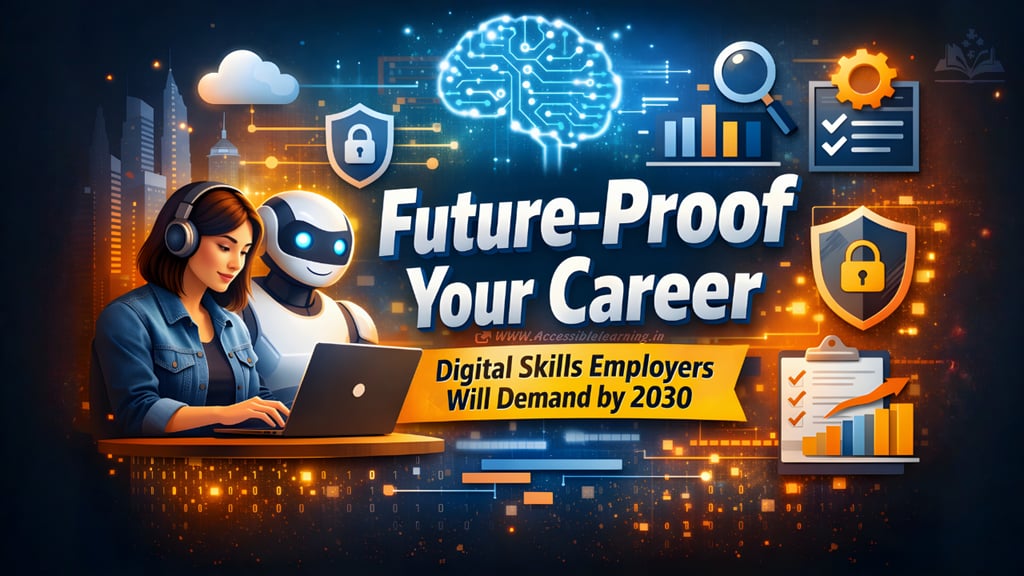
Future-Proof Your Career: Digital Skills Employers Will Demand by 2030
By 2030, digital skills will define who stays relevant and who gets left behind. This in-depth guide explains the exact skills employers will demand, why traditional learning is no longer enough, and how you can build future-ready capabilities that combine technology, human judgment, and real-world impact.
A LEARNINGEDUCATION/KNOWLEDGE
Shiv Singh Rajput
1/14/20267 min read
The world of work is changing faster than any previous decade. By 2030, most jobs will not be fully replaced by technology, but they will be deeply reshaped by it. Employers will look for people who can work with digital systems, adapt quickly, and create real outcomes, not just follow instructions.
This article breaks down the most important digital skills employers will demand by 2030 and, more importantly, how you can build them in a realistic, human way. No hype. No random tools. Just skills that compound over time.
What “employer-ready digital skills” really mean in 2030
In the past, digital skills meant knowing specific software or a programming language. By 2030, that mindset will be outdated. Employers will care less about which tool you know today and more about:
How quickly you can learn new tools
How well you combine technology with human judgment
How safely and responsibly you use digital systems
How clearly you communicate outcomes
Digital skills will sit at the intersection of technology, thinking, and execution.
Core digital skills employers will expect by 2030
AI fluency and human judgment
AI will be embedded into almost every role, from marketing and design to finance and operations. Employers will expect you to:
Use AI tools to speed up work, but do not blindly trust them
Write clear instructions and refine outputs
Detect errors, bias, and weak reasoning
Decide when human judgment matters more than automation
This is not about being an AI engineer. It is about being a responsible AI user.
How to build it
Practice using AI for real tasks like research, planning, analysis, and content
Always add a verification step
Document how AI helped and where it failed
Data literacy as a basic workplace skill
Data literacy will be as essential as email once was. Employers will expect you to:
Understand charts, dashboards, and metrics
Ask the right questions before trusting numbers
Spot misleading data or poor assumptions
Translate data into decisions, not just reports
You do not need to become a data scientist, but you must be data-aware.
How to build it
Learn spreadsheet basics, dashboards, and simple analysis
Track real data such as website traffic, sales, or productivity
Practice writing short insights based on numbers
Cybersecurity awareness for everyday work
As remote work and cloud systems grow, security becomes everyone’s responsibility. Employers will expect:
Safe password and account practices
Awareness of phishing and social engineering
Responsible handling of data and files
Basic understanding of access control and permissions
Security mistakes are expensive, and prevention is highly valued.
How to build it
Apply security best practices to your own devices and accounts
Learn common attack methods and how to avoid them
Create a simple personal or team security checklist
Cloud and digital infrastructure basics
You may never manage servers, but you will work inside cloud-based systems. Employers value people who understand:
How cloud tools store and process data
What APIs do and why integrations matter
Performance, cost, and reliability trade-offs
Basic troubleshooting concepts
This knowledge improves collaboration with technical teams.
How to build it
Use cloud platforms, automation tools, or simple integrations
Connect two tools using an API or automation service
Learn basic terminology and system thinking
Automation and workflow optimization
By 2030, efficiency will be a competitive advantage. Employers will value people who can:
Identify repetitive tasks
Redesign workflows for speed and accuracy
Use no-code, low-code, or scripts to automate work
Measure time saved and error reduction
Automation is not about replacing people. It is about freeing them.
How to build it
Automate one real process in your daily work
Map “before” and “after” workflows
Track measurable improvements
Product and systems thinking
Employers want problem-solvers, not button-clickers. Product thinking means:
Understanding users and real needs
Defining problems clearly before solutions
Prioritizing impact over features
Iterating based on feedback
This skill applies to software, services, content, and operations.
How to build it
Write a short problem statement before starting any project
Define success metrics
Gather feedback and refine your solution

User experience and accessibility awareness
Digital experiences are everywhere. Employers will expect you to:
Communicate clearly in digital interfaces
Design or choose tools that reduce confusion
Consider accessibility and inclusivity
Respect user time and attention
Good UX improves adoption and reduces support costs.
How to build it
Study common UX mistakes and best practices
Redesign a simple flow such as onboarding or checkout
Test clarity with real users
Digital communication and collaboration
Remote and hybrid work are here to stay. Employers value people who can:
Write clear documentation
Share progress and decisions transparently
Collaborate across tools and time zones
Reduce misunderstandings through clarity
Clear communication saves more time than most tools.
How to build it
Practice writing short, structured updates
Use shared docs and version control
Focus on clarity, not volume
Digital ethics, privacy, and responsibility
As technology becomes more powerful, trust becomes more valuable. Employers will expect awareness of:
Data privacy and consent
Ethical use of AI and automation
Bias, misuse, and unintended consequences
Responsible decision-making
This skill protects both users and organizations.
How to build it
Learn basic privacy and data protection principles
Document how and why you use technology
Think about second-order effects of your work
Learning agility and adaptability
The most important skill by 2030 will be the ability to keep learning. Employers will favor people who:
Learn new tools quickly
Unlearn outdated methods
Stay curious and proactive
Build habits for continuous improvement
Careers will be built in chapters, not straight lines.
How to build it
Set 30, 60, and 90-day learning goals
Focus on outputs, not just courses
Reflect on what worked and what didn’t
A realistic roadmap to build future-ready digital skills
Step 1: Choose a focus, not everything
Pick one core skill area (data, automation, UX, development, or operations) and one support skill (AI fluency or product thinking). Depth plus breadth beats scattered learning.
Step 2: Build proof through real projects
Employers trust evidence more than certificates. Aim for:
One data-focused project
One automation or workflow project
One AI-assisted project with clear documentation
Each project should explain the problem, process, tools, and outcome.
Step 3: Create a simple, outcome-focused portfolio
Your portfolio should answer three questions:
What problems can you solve?
How do you think?
What results have you created?
Clarity matters more than design.
Step 4: Align your skills with hiring language
Use clear, practical language that employers understand:
AI fluency
Data analysis and insights
Process automation
Cybersecurity basics
Cloud fundamentals
User-focused thinking
This helps both humans and hiring systems understand your value.
Step 5: Practice working like a professional team member
Even solo learners should practice:
Documentation
Planning
Feedback loops
Accountability
These habits separate beginners from professionals.
Common mistakes to avoid
Learning tools without solving real problems
Chasing every new trend
Ignoring security and privacy
Relying only on certificates
Avoiding communication and documentation

The rise of “hybrid roles” and why they matter
By 2030, many job titles will no longer fit into clean categories like “technical” or “non-technical.” Employers are already shifting toward hybrid roles, where value comes from combining two different skill sets.
Examples include:
Marketers who understand analytics and automation
Designers who can work with AI tools and front-end logic
Operations managers who build workflows and dashboards
Writers who use data, SEO, and AI responsibly
These hybrid profiles reduce communication gaps and increase execution speed, which makes them highly employable.
What this means for you:
Instead of asking “Should I learn tech?”, ask “Which technical layer strengthens my main skill?”
Why problem framing will outperform technical skill alone
As tools become easier to use, problem framing becomes the real differentiator. Many people can operate tools, but fewer can clearly define:
What problem actually needs solving
Who the solution is for
What success looks like
Employers increasingly value people who save time and money by not building the wrong thing.
How to develop this skill:
Start every project with a written problem statement
Identify constraints before choosing tools
Define what “good enough” means
Clear problem framing often matters more than advanced technical execution.
Digital decision-making under uncertainty
Future workplaces will involve incomplete data, fast timelines, and AI-generated suggestions. Employers will expect professionals to:
Make decisions without perfect information
Balance speed with accuracy
Explain assumptions clearly
Adjust quickly when new information appears
This is a subtle but powerful skill that separates senior contributors from juniors.
Practice tip:
Document decisions along with reasoning, risks, and alternatives. This builds trust and shows maturity.
Understanding how hiring systems evaluate digital skills
By 2030, most hiring processes will involve automated screening, skill matching, and portfolio review. This changes how skills should be presented.
Employers often look for:
Evidence of applied skills, not tool lists
Clear outcomes and metrics
Consistency between resume, portfolio, and online presence
Signals of learning and adaptability
Important shift:
A single strong project can outweigh multiple certificates if it clearly demonstrates thinking and impact.
The importance of digital writing and clarity
As work becomes more asynchronous, writing becomes a core digital skill. Employers value people who can:
Explain complex ideas simply
Write clear instructions and documentation
Reduce back-and-forth communication
Create alignment across teams
This applies to emails, task descriptions, reports, and AI instructions.
How to improve:
Write with structure: context → point → action
Remove unnecessary words
Assume the reader is busy, not uninformed
Clear writing scales your thinking.
Digital resilience and mental stamina
Constant tools, notifications, and AI assistance can quietly reduce focus and judgment. Employers will value professionals who can:
Maintain deep focus despite digital noise
Set boundaries with tools and automation
Avoid over-reliance on AI outputs
Manage cognitive load effectively
This is not talked about enough, but it directly affects performance.
Build this skill by:
Using AI as an assistant, not a crutch
Scheduling focused work blocks
Periodically working without automation to retain core skills


Measuring impact, not activity
By 2030, employers will increasingly evaluate work based on outcomes rather than hours or effort. This means:
Tracking results instead of tasks
Linking work to business or user impact
Communicating value clearly
People who can quantify impact gain visibility and trust faster.
Example metrics:
Time saved per week
Error reduction percentage
Engagement or conversion improvement
Cost or effort reduction
Cross-cultural and global digital collaboration
Remote work will continue to globalize teams. Employers will value people who can:
Communicate clearly across cultures
Respect different working styles and time zones
Use shared tools effectively
Avoid assumptions in written communication
Digital skills without cultural awareness often fail at scale.
Building a long-term digital skill strategy
Instead of chasing trends, future-ready professionals think in skill layers:
Core skill (your main profession)
Technical layer (tools, data, automation)
Cognitive layer (thinking, judgment, ethics)
Human layer (communication, empathy, clarity)
This layered approach keeps your career stable even as tools change.
Why consistency beats intensity in skill building
Short bursts of learning rarely create real employability. Employers value:
Steady progress over time
Evidence of sustained learning
Continuous improvement habits
A small weekly output for one year often beats intense learning for one month.
what makes someone employable in 2030
By 2030, employers will not hire people just for what they know. They will hire people for how they think, adapt, and deliver. The most valuable professionals will combine digital capability with responsibility, clarity, and human judgment.
If you build these skills steadily, with real projects and reflection, you won’t just be ready for 2030. You’ll be ready for whatever comes after it.
Subscribe to Frontier Intelligence
All © Copyright reserved by Accessible-Learning Hub
| Terms & Conditions
Accessible Learning Hub — Actionable clarity for high-agency minds.
Weekly breakdowns on AI breakthroughs, capital flow, and human performance systems. Zero fluff.