

From Coder to "AI Orchestrator": The New Tech Hierarchy!
The tech industry is shifting from coding to AI orchestration. Discover why AI Orchestrators are becoming the highest-value professionals in 2026 and how to develop the skills needed to lead intelligent systems.
ACCESSIBLE LEARNING
Sachin K Chaurasiya
6/10/20266 min read
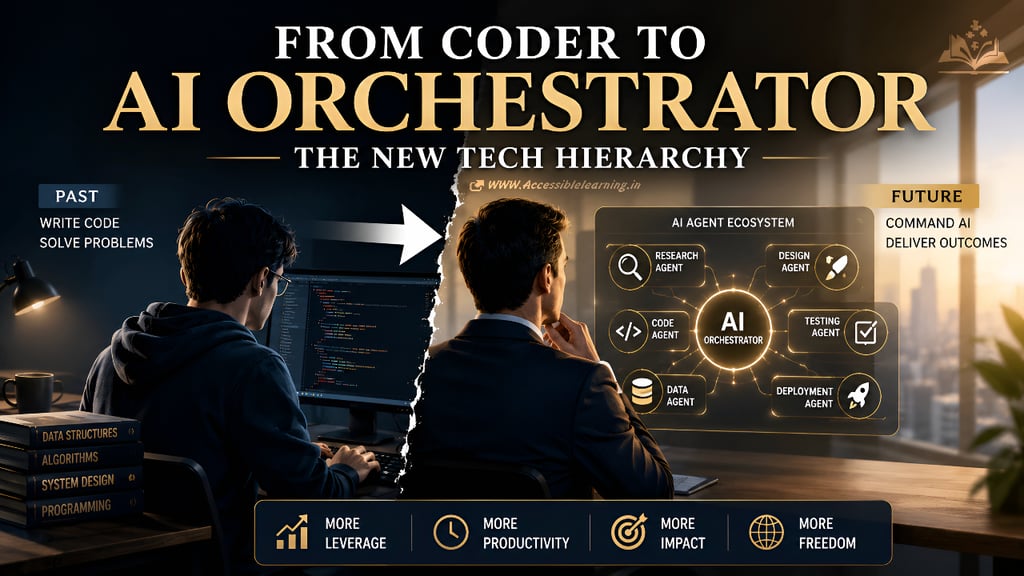
Stop Learning to Code. Start Learning to "Command."
For decades, the path into technology was clear: learn programming languages, master frameworks, write code, and build software. That path is rapidly changing.
In 2026, a new professional class is emerging inside the technology industry. These individuals are not necessarily the fastest coders. They are not spending eight hours a day manually writing syntax. Instead, they are directing teams of AI agents, reviewing outputs, coordinating workflows, and transforming ideas into products at unprecedented speed.
The modern tech hierarchy is evolving from people who write code to people who orchestrate intelligence.
This shift does not mean coding is dead.
It means coding is becoming infrastructure.
The new competitive advantage is knowing how to command AI systems effectively.
Welcome to the age of the AI Orchestrator.
What Is an AI Orchestrator?
An AI Orchestrator is someone who coordinates multiple AI tools, agents, models, and automation systems to achieve a business outcome. Think of the difference between the following:
A musician playing every instrument alone
A conductor leading an entire orchestra
Both create music. One creates scale. The AI Orchestrator acts as the conductor.
Instead of manually building every component, they:
Define objectives
Break projects into tasks
Assign work to AI agents
Review and refine outputs
Connect systems together
Ensure quality and consistency
The value shifts from execution to coordination.
Why Traditional Coding Is Being Compressed
Historically, software development required thousands of hours of manual work.
Developers would:
Write code line by line
Debug errors
Build interfaces
Configure databases
Create APIs
Write documentation
Today, advanced AI systems can perform many of these tasks automatically. A modern AI-powered workflow can:
Generate frontend applications
Build backend services
Create APIs
Produce documentation
Write tests
Identify bugs
Refactor code
Optimize performance
Tasks that once required teams can now be handled by a single professional supervising multiple AI systems.
The bottleneck is no longer typing.
The bottleneck is thinking.
The Rise of Intent-Based Development
One of the biggest shifts happening in technology is the movement from coding to intent expression. Traditional development looked like this:
Step 1
Understand the problem.
Step 2
Translate the problem into code.
Step 3
Build the solution manually.
Now the process increasingly looks like this:
Step 1
Understand the problem.
Step 2
Describe the desired outcome.
Step 3
Allow AI systems to generate the implementation.
This approach is known as intent-based development. Instead of telling a machine exactly how to do something, professionals tell AI what result they want. The AI handles much of the execution.

The New Technology Hierarchy
The technology industry is developing a new hierarchy of value.
Level 1: AI Users
These individuals use AI tools for simple tasks. Examples:
Generating emails
Writing content
Creating images
Summarizing information
They gain productivity but remain dependent on existing systems.
Level 2: AI-Assisted Workers
These professionals use AI to accelerate their daily work. Examples:
Developers using AI coding assistants
Designers using AI-generated prototypes
Marketers using AI content workflows
Their output increases significantly.
Level 3: AI Builders
AI Builders create systems powered by AI. Examples:
AI applications
Automated workflows
Internal business tools
Customer support systems
They move beyond usage and start creating value.
Level 4: AI Orchestrators
This is where the highest leverage exists. AI Orchestrators:
Manage multiple AI agents
Design autonomous workflows
Connect tools together
Create systems that create systems
Instead of producing work themselves, they coordinate intelligent systems that produce work.
Level 5: AI Architects
At the top are professionals designing entire AI ecosystems.
They:
Define company-wide automation strategies
Build agent infrastructures
Manage AI governance
Design scalable intelligence networks
These individuals shape how organizations operate.
Why the Highest-Paid Professionals Are Becoming Orchestrators
Technology rewards leverage. A person who can create $1 million in value will generally earn more than someone who creates $100,000 in value. AI dramatically increases leverage. Consider two professionals:
Professional A
Builds software manually.
Output:
One project at a time.
Professional B
Coordinates:
Coding AI
Testing AI
Design AI
Documentation AI
Research AI
Output:
Several projects simultaneously.
The difference is not intelligence.
The difference is leverage.
This is why many of today's top freelancers, consultants, founders, and product builders are investing heavily in orchestration skills.
The Skills That Matter More Than Coding
Coding remains useful. However, several skills are becoming increasingly valuable.
Systems Thinking
AI Orchestrators understand how complex systems interact. They can visualize:
Inputs
Processes
Dependencies
Outputs
This allows them to build scalable workflows.
Prompt Engineering
Prompt engineering has evolved far beyond simple instructions. Advanced practitioners:
Create structured workflows
Chain reasoning processes
Design agent interactions
Build repeatable frameworks
The ability to communicate clearly with AI becomes a critical skill.
Product Thinking
Many developers focus on implementation. Orchestrators focus on outcomes.
They ask:
What problem are we solving?
What does success look like?
How can this be automated?
Product thinking often creates more value than technical execution.
Decision Making
As AI handles more execution, human judgment becomes more important. Professionals must evaluate:
Accuracy
Risk
Business impact
Strategic priorities
Good decisions become a premium skill.
Workflow Design
The future belongs to people who can design processes that combine:
Humans
AI agents
Automation tools
Data systems
Workflow design is becoming a core competitive advantage.

What AI Agents Are Changing
The arrival of autonomous AI agents represents a major shift. Unlike traditional tools, agents can:
Plan tasks
Execute actions
Analyze results
Adjust strategies
Continue working independently
Organizations are increasingly deploying teams of specialized agents. Examples include:
Research agents
Coding agents
Sales agents
Marketing agents
Customer service agents
Data analysis agents
The professional who coordinates these agents becomes exponentially more productive.
The Biggest Mistake People Are Making Right Now
Many professionals are asking:
"Which programming language should I learn next?"
A more valuable question may be the following:
"How do I manage intelligent systems effectively?"
Programming knowledge remains important. But focusing exclusively on syntax can be limiting.
The market increasingly rewards individuals who can:
Define goals
Design workflows
Coordinate AI systems
Validate outputs
Deliver business outcomes
The emphasis is shifting from production to orchestration.
Will Coders Disappear?
No. Software engineering is not disappearing. It is evolving. Just as calculators did not eliminate mathematicians, AI will not eliminate developers. However, the role of developers is changing.
Tomorrow's developers may spend less time writing code and more time:
Reviewing AI-generated systems
Managing architectures
Defining requirements
Ensuring security
Improving workflows
The profession survives, but the daily work transforms.
How to Become an AI Orchestrator
If you want to stay ahead of the curve, focus on these areas:
Learn AI Tools Deeply
Do not stop at basic usage. Understand:
AI models
Agent frameworks
Automation platforms
Workflow systems
Build Multi-Agent Workflows
Practice creating systems where multiple AI tools collaborate toward a single goal.
Study Product Development
Learn how businesses create value.
Technology without business understanding is becoming less competitive.
Improve Communication Skills
The ability to articulate goals clearly is becoming more valuable than memorizing syntax.
Develop Strategic Thinking
AI executes.
Humans decide.
The ability to think strategically becomes increasingly important.


The Future Belongs to Commanders, Not Operators
The technology industry is entering a new era.
The most valuable professionals are no longer those who simply execute tasks.
They are the individuals who can coordinate intelligence at scale.
The future is not about competing with AI.
It is about directing it.
The professional who learns to orchestrate multiple AI systems will possess a level of leverage that was nearly impossible just a few years ago.
Coding remains important. But coding alone is no longer the destination.
The new hierarchy rewards those who can transform intent into outcomes, coordinate intelligent systems, and build value through orchestration.
In the coming years, the question will not be
"Can you code?"
The question will be the following:
"Can you command an army of AI agents to build what you imagine?"
FAQs
Q: What is an AI Orchestrator?
An AI Orchestrator is a professional who manages multiple AI tools, agents, and automation systems to complete complex tasks, build products, and achieve business outcomes with minimal manual execution.
Q: Is coding becoming obsolete because of AI?
No. Coding is still valuable, but AI is automating much of the implementation work. Developers who combine coding knowledge with AI orchestration skills will have a significant advantage.
Q: What is intent-based development?
Intent-based development is a workflow where a person describes the desired outcome and AI systems generate much of the code, design, documentation, and implementation required to achieve it.
Q: What skills are required to become an AI Orchestrator?
Key skills include systems thinking, prompt engineering, workflow design, product strategy, communication, automation, and AI tool management.
Q: How do AI agents differ from traditional software tools?
AI agents can plan, execute, analyze, and adapt tasks autonomously. Traditional software generally follows predefined instructions and requires more direct human control.
Q: Will AI replace software developers?
AI is more likely to transform software development than replace it entirely. Developers will increasingly focus on architecture, oversight, validation, security, and orchestration rather than manual coding.
Q: Why are AI Orchestrators becoming highly paid?
Because they create leverage. A single orchestrator can coordinate multiple AI systems to produce the work that previously required teams of specialists.
Q: How can beginners start learning AI orchestration?
Start by learning AI assistants, automation platforms, prompt engineering, no-code tools, workflow design, and agent-based systems. Focus on solving real business problems rather than only learning syntax.
Subscribe to Frontier Intelligence
All © Copyright reserved by Accessible-Learning Hub
Accessible Learning Hub — Actionable clarity for high-agency minds.
Weekly breakdowns on AI breakthroughs, capital flow, and human performance systems. Zero fluff.