

Free Notes and Study Guides for Competitive Exams: The Complete Preparation Blueprint
Get access to a complete guide on using free notes, study guides, and open learning resources for competitive exams. This article explains where to find reliable free material, how to judge quality, how to study effectively, and how to combine notes with PYQs, mock tests, and AI tools. It is designed to help aspirants prepare smarter without spending money on expensive courses.
A LEARNINGEDUCATION/KNOWLEDGE
Shiv Singh Rajput
12/18/20255 min read
Preparing for competitive exams takes time, focus, and the right study material. The challenge is not the lack of resources but the overwhelming number of them. The good news is that you can cover most of your syllabus using free notes, study guides, and open learning resources if you know how to use them correctly.
This article breaks down everything you need to know: where to find reliable free notes, how to judge quality, how to use them strategically, and how to combine them with AI tools and PYQs for a complete exam preparation system.
What “Free Notes and Study Guides” Mean Today
Free notes today are not limited to simple chapter summaries. They include:
Topic-wise PDFs for every subject
Chapter-wise study guides
One-page summaries and mind maps
Formula sheets and memory tricks
Previous Year Question (PYQ)-based notes
Concept maps and flowcharts
Practice worksheets
Free online modules and open course materials
Current Affairs capsules (daily/weekly/monthly)
These materials belong to a larger ecosystem of free educational content, which has grown rapidly with digital learning, open education platforms, and AI-based study tools.
Exams You Can Prepare for Using Free Notes
You can prepare for almost every major exam, including
Government Exams
UPSC CSE
State PCS
SSC (CGL, CHSL, CPO, MTS, GD)
Banking (SBI, IBPS, RBI, Insurance exams)
Railways (RRB Group D, NTPC, ALP)
Teaching exams (CTET, UPTET, REET)
Defence exams (NDA, CDS, AFCAT, CAPF)
Entrance Exams
CUET
CLAT
MBA exams
B.Ed and other state entrance tests
Technical & Engineering Exams
GATE
AE/JE exams
Polytechnic & diploma-level exams
Free notes cover:
General Studies and Awareness
Quantitative Aptitude
Reasoning
English
Current Affairs
Technical Subjects
Best Places to Get Free Notes & Study Guides
Public and Academic Sources
These are reliable because they follow official guidelines and academic standards.
Examples include:
School-level textbooks and digital modules
Online open courses
Free lecture notes and structured learning modules
These help build a strong foundation in subjects required for Government and entrance exams.
Free Sections of Exam Prep Platforms
Many educational websites provide free:
Subject-wise notes
Topic summaries
Chapter explanations
Mini quizzes
Mock tests
PYQs
Current affairs PDFs
These platforms often provide well-structured notes that follow the latest exam patterns.
Open Learning Repositories
Global OER (Open Educational Resource) repositories provide:
University-level lecture notes
Textbooks
Practice sets
Topic-specific guides
Academic explanations
You can use these for deep topics like statistics, economics, environmental science, physics, chemistry, etc.
AI-Powered Study Tools
Modern AI tools help you convert any free note into:
Summaries
Flashcards
Question banks
Concept explanations
Revision guides
These tools act as a personal assistant for doubt solving and quick revision.
How to Check if Free Notes Are Actually Good
Not all free PDFs are worth your time. Use this checklist:
Syllabus Alignment
A good note must clearly match the syllabus of your exam.
Avoid notes that mix multiple exams or skip important topics.
Updated Content
For static subjects (history, polity), older notes are fine.
For dynamic subjects (economy, current affairs), use recent material only.
Depth + Clarity
A high-quality note includes:
Clear definitions
Concept explanation
Examples
PYQ-style questions
Practice exercises
Easy Language
The best notes are structured and easy to read.
Well-Organized Layout
Look for:
Headings and subheadings
Bullet points
Charts
Tables
Diagrams
These make revision faster.


Smart Strategies to Use Free Notes Effectively
Start With Standard Sources
Build your base using:
NCERT-style foundational content
Conceptual guides
Well-explained free videos
Then use free notes for revision and quick reference.
Create a Study Folder System
Organize your notes like this:
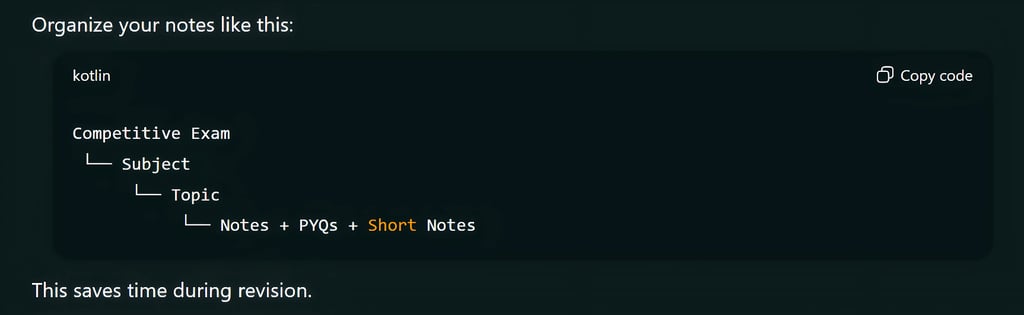
This saves time during revision.
Use Free Notes in Stages
Learning stage: Use detailed notes and long explanations
Revision stage: Switch to short notes and summaries
Mock test stage: Use PYQ-based notes and error logs
Combine Notes with PYQs
This is the most important study method.
For every topic:
Study concept
Solve PYQs
Attempt topic-wise tests
Add mistakes to an error notebook
Follow a Revision Pattern
Use spaced revision:
Day 1
Day 3
Day 7
Day 15
Day 30
This helps you retain information for the long term.
How to Use AI Tools With Free Notes
AI tools enhance your preparation without replacing traditional study material.
Use AI for
Simplifying difficult concepts
Generating topic-wise MCQs
Creating revision summaries
Doubt solving
Converting long notes into flashcards
Creating personalized study plans
Avoid using AI for
Direct answers to test questions
Memorizing facts
Replacing standard books
AI should be used as a support tool, not the main source of knowledge.
Subject-Wise Tips for Using Free Notes
Quantitative Aptitude
Look for notes that include:
Formulas
Solved examples
Short methods
Topic-wise question sets
Follow a routine:
Concept → Examples → PYQs → Practice test
Reasoning
Use notes with:
Clear explanation of question types
Solved examples
Step-by-step solutions
Reasoning improves with exposure and pattern recognition.
General Awareness
Use daily, weekly, and monthly free notes for:
Government schemes
Summits
Reports
Committees
Economy
Budget highlights
Revise frequently to avoid forgetting.
General Studies (UPSC & State PSC)
Use layered studying:
Start with basic books
Use free notes for quick understanding
Add value-added notes
Revise repeatedly
Solve PYQs
English Language
Use free notes that cover:
Grammar rules
Vocabulary lists
Reading comprehension strategies
Practice passages
Daily reading improves natural comprehension.

Build Your Own “Ultimate Free Study Guide”
To avoid drowning in PDFs, create your own master guide:
Make a Syllabus Document
Break it into micro-topics.
Attach the Best Notes for Each Topic
Do not collect hundreds of PDFs.
Add Your Own Short Notes
This makes revision faster.
Maintain Your Own Error Log
Write down mistakes and weak areas.
Follow a Revision Cycle
Plan monthly review sessions.
This becomes your personalized, long-term resource.
Common Mistakes to Avoid
Downloading too many PDFs
Not following the syllabus
Studying outdated current affairs
Relying only on summaries
Ignoring PYQs
Changing sources frequently
No revision schedule
Free notes and study guides can be powerful if you use them wisely. You don’t need expensive courses to clear competitive exams. What you need is:
A structured plan
Quality free notes
Consistent practice
Smart use of PYQs
AI tools for revision
A disciplined revision schedule
FAQ's
Q: Are free notes enough to clear competitive exams?
Free notes can cover a major part of the syllabus, but they should be combined with standard books, PYQs, and mock tests. Notes are great for concept clarity and revision, but practice and test-taking strategies matter just as much.
Q: Which exams can I prepare for using free study materials?
You can prepare for most exams, including UPSC, State PSC, SSC, Banking, Railways, Defence exams, CUET, MBA entrances, and various teaching and technical exams. Free notes work especially well for subjects like Quant, Reasoning, English, and General Awareness.
Q: What type of free notes are most useful?
The most helpful ones include
Topic-wise PDF notes
Chapter summaries
Formula sheets
One-page mind maps
PYQ-based notes
Current affairs capsules
Practice question sets
Choose notes that are updated, accurate, and aligned with your syllabus.
Q: How do I know if a free note or PDF is reliable?
Check for these points:
Follows your exam syllabus
Updated recently
Clear explanations with examples
Contains practice questions
Well-structured headings and diagrams
If the content feels confusing, outdated, or superficial, skip it.
Q: Can I prepare current affairs only from free resources?
Yes. Free daily, weekly, and monthly current affairs PDFs are enough if you revise regularly. Combine them with a monthly MCQ test for better retention.
Q: How should I organize my free notes?
Create a folder system on your phone or laptop:
Exam → Subject → Topic → Notes + PYQs + Short Notes
Keep only the best notes for each topic to avoid clutter.
Q: Are AI tools useful for studying from free notes?
Yes. AI tools help you:
Turn notes into summaries
Create MCQs from any topic
Solve doubts instantly
Build flashcards
Generate revision plans
Use AI for clarity and revision, not as a replacement for reading.
Q: Should I rely on short notes for full preparation?
No. Short notes are for revision only. For the learning stage, use detailed explanations, concept videos, and structured study guides. After you understand a topic, switch to short notes.
Q: How often should I revise free notes?
Follow a spaced pattern for better memory:
Day 1
Day 3
Day 7
Day 15
Day 30
This keeps concepts fresh and improves long-term retention.
Q: Do free notes include PYQs and mock tests?
Many platforms offer free PYQs, topic-wise questions, and sample papers. These are essential because competitive exams repeat concepts and patterns every year. Always combine notes with practice.
Q: Can I prepare for exams without paid coaching?
Yes, many candidates clear exams using free notes, YouTube lectures, PYQs, and mock tests. What matters most is consistency, discipline, and a smart study plan.
Q: What is the best way to study using free notes daily?
A simple routine:
Pick a topic from the syllabus
Read detailed notes
Solve 15–20 PYQs
Practise a short quiz
Make your own 5–10 line short notes
Revise at the end of the week
This builds both understanding and speed.
Subscribe to Frontier Intelligence
All © Copyright reserved by Accessible-Learning Hub
| Terms & Conditions
Accessible Learning Hub — Actionable clarity for high-agency minds.
Weekly breakdowns on AI breakthroughs, capital flow, and human performance systems. Zero fluff.