

Forgiveness Sunday: Meaning, Traditions, and the True Power of Letting Go
Forgiveness Sunday is a powerful day of reconciliation, humility, and emotional renewal observed before Great Lent begins. Rooted in Orthodox Christian tradition, it encourages people to ask forgiveness, forgive others sincerely, and enter Lent with a peaceful heart. In this guide, explore the meaning of Forgiveness Sunday, its traditions like Forgiveness Vespers, and practical ways to practice real forgiveness in modern life.
EVENT/SPECIALCELEBRATION/FESTIVALS
Kim Shin
2/11/20267 min read
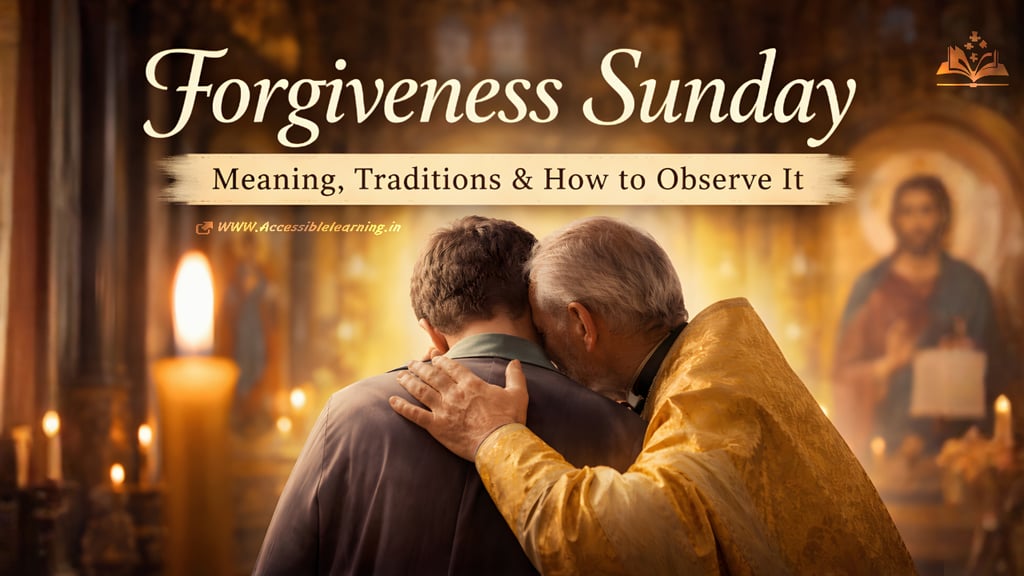
Forgiveness Sunday is one of the most meaningful and emotionally powerful days in the Christian spiritual year. It’s not just a religious observance. It’s a reminder of something deeply human: we all hurt others, we all get hurt, and we all need a path back to peace.
Observed mainly in Eastern Orthodox and Byzantine Catholic traditions, Forgiveness Sunday marks the final day before Great Lent begins. It invites people to enter the season of Lent not with pride or unresolved conflict, but with humility, reconciliation, and inner freedom.
In a time when misunderstandings spread fast, relationships break over small things, and people carry emotional weight for years, Forgiveness Sunday feels more relevant than ever.
What Is Forgiveness Sunday?
Forgiveness Sunday is the last Sunday before Great Lent in the Orthodox Christian tradition. It is dedicated to:
asking forgiveness from God
asking forgiveness from other people
forgiving others sincerely
preparing the heart for Lent
It is also called:
Forgiveness Sunday
Forgiveness Vespers
Cheesefare Sunday (in many Orthodox calendars)
This day emphasizes that spiritual growth can’t happen without emotional honesty. If Lent is a journey of purification, forgiveness is the first step.
When Is Forgiveness Sunday Celebrated?
Forgiveness Sunday does not fall on a fixed calendar date. It depends on the date of Orthodox Easter (Pascha).
It is observed on the Sunday immediately before Clean Monday
✅ Clean Monday marks the start of Great Lent
That’s why Forgiveness Sunday changes each year.
Why Forgiveness Sunday Matters (Even Beyond Religion)
Forgiveness Sunday carries a message that is bigger than tradition. It answers a universal need: healing.
It teaches emotional release
Resentment quietly drains people. It makes the mind heavy and the heart bitter. Forgiveness is not forgetting; it’s unclenching.
It sets the tone for Lent
Many people treat Lent like a to-do list: fasting rules, prayers, attending church. But Forgiveness Sunday reminds believers that Lent begins inside the heart.
It restores broken connections.
Sometimes the greatest harm in life isn’t conflict; it’s distance. Forgiveness Sunday pushes people to rebuild what ego destroyed.
It turns spirituality into action
Forgiveness isn’t an abstract idea. It demands humility. It requires a person to be brave enough to admit, “I was wrong.”
The Biblical Foundation of Forgiveness Sunday
Forgiveness Sunday is deeply connected to Christian teachings about mercy and repentance. Forgiveness is considered a central requirement in Christian life because:
humans rely on God’s mercy
forgiveness must be practiced, not just requested
prayer without forgiveness becomes hollow
The meaning is simple:
If you want grace, you must give grace.
What Happens on Forgiveness Sunday? (Traditions and Practices)
Forgiveness Sunday is observed through church services, family gatherings, and deeply personal moments.
The Sunday Liturgy
In many Orthodox churches, people attend Divine Liturgy in the morning. The themes often include:
humility
reconciliation
preparing for Lent
repentance
living with peace
Forgiveness Vespers (the most emotional moment)
In the evening, churches hold a special service called Forgiveness Vespers. It is widely known as one of the most moving services of the year.
At the end:
the priest bows and asks forgiveness from the congregation
the congregation bows and asks forgiveness from the priest
everyone asks forgiveness from each other one by one
A traditional exchange is:
“Forgive me.”
“God forgives. Forgive me.”
This ritual is powerful because it breaks pride. It makes forgiveness real, not theoretical.
A shift in tone
This is also when many churches change to more solemn Lenten tones:
darker vestments
slower spiritual rhythm
more reflective hymns
emphasis on repentance and inner purification


Why It’s Also Called Cheesefare Sunday
In Orthodox Christian fasting tradition, Lent begins gradually. Forgiveness Sunday is also known as Cheesefare Sunday because it is:
the last day dairy is traditionally eaten
the final “feast” before the strict Lenten fasting rules begin
Many families prepare meals with:
cheese
butter
milk
eggs
pastries
It’s not only about food. It symbolizes a transition: from comfort to discipline, from indulgence to spiritual focus.
The Deep Meaning of Asking for Forgiveness
A powerful part of Forgiveness Sunday is not just forgiving others but asking forgiveness sincerely. Many people struggle with apologies because it threatens their ego. But Forgiveness Sunday teaches that apology is not humiliation. It is liberation.
A genuine apology includes:
admitting the wrong without excuses
acknowledging the other person’s pain
asking forgiveness without demanding it
being willing to change behavior
What weak apologies sound like:
“Sorry if you got hurt.”
“You misunderstood me.”
“Let’s forget it.”
Forgiveness Sunday pushes people toward real maturity, not social politeness.
Forgiving Others: What It Really Means (and What It Doesn’t)
This is one of the most misunderstood topics.
Forgiveness DOES mean:
✅ letting go of revenge
✅ choosing peace over bitterness
✅ releasing emotional poison
✅ refusing to carry resentment
✅ healing your inner world
Forgiveness DOES NOT mean:
❌ pretending nothing happened
❌ tolerating abuse
❌ removing boundaries
❌ trusting the person instantly
❌ staying in unsafe relationships
Forgiveness can be internal even if the relationship stays distant.
Forgiveness Sunday and Self-Forgiveness
For many people, the hardest forgiveness is not for others. It’s for themselves.
People carry guilt for years over:
past mistakes
failed relationships
harsh words spoken in anger
missed opportunities
wrong decisions
Forgiveness Sunday also offers a chance to say,
“I admit I was imperfect. I release myself from permanent punishment.”
Self-forgiveness is not ignoring responsibility.
It is choosing growth instead of endless self-hate.
Forgiveness Sunday in Modern Life (Why It Feels So Relevant Today)
In today’s world, people don’t argue only face-to-face. They fight through:
WhatsApp chats
Instagram stories
comments and replies
silent blocking/unfollowing
passive-aggressive posts
Forgiveness Sunday becomes a strong reminder that:
not every issue should become permanent hatred
not every misunderstanding deserves lifelong silence
not every conflict is worth the emotional cost
It encourages people to stop living in “revenge mode” and return to peace.
How to Observe Forgiveness Sunday at Home (Practical, Human-Centered Ideas)
Even if you are not Orthodox, you can still practice the spirit of Forgiveness Sunday in a meaningful way.
Write a forgiveness message
Send a message to someone you’ve hurt or distanced yourself from:
“I’ve been thinking about things. If I ever hurt you knowingly or unknowingly, I’m truly sorry. I want peace between us.”
This can heal relationships instantly.
Make a “peace list.”
Write down:
whom you need to forgive
whom you need to apologize to
what you need to forgive yourself for
Seeing it written is powerful.
Light a candle or sit in silence
Spend 10 minutes with no phone, no distraction.
Ask yourself:
What am I holding inside?
Is this anger helping me?
What would peace look like?
Practice forgiveness with boundaries
Forgiveness is not always reconnection. Sometimes the healthiest version is:
you forgive
you set limits
you move on without hate
That is still real forgiveness.


What Forgiveness Sunday Teaches the Soul
Forgiveness Sunday is not a “nice idea.” It is a spiritual truth:
ego creates separation
humility creates healing
bitterness chains the heart
forgiveness sets it free
The day teaches a strong message:
You cannot begin a new season while holding on to old poison.
Forgiveness Sunday Is a Reset for the Heart
Forgiveness Sunday is a rare kind of holiday. It doesn’t celebrate power, achievement, or status. It celebrates something softer and deeper:
humility
peace
healing
emotional rebirth
It’s not about becoming perfect.
It’s about becoming light again. Because forgiveness, in the purest sense, is not giving someone a gift. It is giving yourself freedom.
FAQ's
Q: What is Forgiveness Sunday?
Forgiveness Sunday is the final Sunday before Great Lent begins in Orthodox Christianity. It is a day focused on asking forgiveness from God and from other people and forgiving others sincerely to start Lent with a clean heart.
Q: When is Forgiveness Sunday celebrated?
Forgiveness Sunday is celebrated on the Sunday immediately before Clean Monday, which marks the beginning of Great Lent in the Orthodox tradition. The date changes every year because it depends on the Orthodox Easter (Pascha) calendar.
Q: Why is Forgiveness Sunday important before Lent?
Forgiveness Sunday is important because Lent is a season of repentance and spiritual renewal. Orthodox Christians believe forgiveness is necessary before beginning Lent, since prayer and fasting are incomplete without humility and reconciliation with others.
Q: What happens during Forgiveness Vespers?
Forgiveness Vespers is a special church service held on Forgiveness Sunday evening. At the end of the service, the priest and congregation ask forgiveness from one another, often by bowing and saying, “Forgive me,” followed by the response, “God forgives.”
Q: What do people say to each other on Forgiveness Sunday?
A common greeting on Forgiveness Sunday is:
“Forgive me,” or “Please forgive me.”
The typical reply is“God forgives,” or “God forgives, and I forgive.”
Q: Is Forgiveness Sunday only for Orthodox Christians?
Forgiveness Sunday is mainly observed in Orthodox and Byzantine Catholic churches, but anyone can practice its message. The day promotes universal values like humility, apology, reconciliation, and emotional healing.
Q: What is the meaning of Cheesefare Sunday?
Cheesefare Sunday is another name for Forgiveness Sunday in Orthodox tradition. It refers to the last day when dairy products like milk, butter, and cheese are allowed before Great Lent fasting rules begin.
Q: What is Clean Monday, and how is it related to Forgiveness Sunday?
Clean Monday is the first day of Great Lent in Orthodox Christianity. It comes right after Forgiveness Sunday and represents a spiritual “clean start,” beginning Lent with prayer, fasting, and inner purification.
Q: Does forgiving someone mean you must reconcile with them?
No. Forgiveness does not always mean rebuilding a relationship. Forgiving someone means letting go of resentment and bitterness, while reconciliation depends on trust, safety, and genuine change.
Q: Does forgiveness mean forgetting what happened?
No. Forgiveness does not mean forgetting or excusing harm. It means choosing peace over anger and refusing to carry emotional pain that controls your heart and mindset.
Q: How can someone observe Forgiveness Sunday at home?
You can observe Forgiveness Sunday at home by:
apologizing to someone you hurt
forgiving someone you’ve held resentment toward
praying or reflecting quietly
making peace within the family
practicing self-forgiveness and letting go of guilt
Q: What is a good message to send on Forgiveness Sunday?
A simple Forgiveness Sunday message is:
“Happy Forgiveness Sunday. Please forgive me for anything I have done knowingly or unknowingly. I wish peace between us.”
Subscribe to Frontier Intelligence
All © Copyright reserved by Accessible-Learning Hub
| Terms & Conditions
Accessible Learning Hub — Actionable clarity for high-agency minds.
Weekly breakdowns on AI breakthroughs, capital flow, and human performance systems. Zero fluff.