

ExxonMobil: Comprehensive Guide to the Energy Giant
Discover ExxonMobil's 2024-2025 performance, the $59.5B Pioneer acquisition, carbon capture leadership, and the 2030 growth strategy. Latest data, financial insights & climate initiatives.
USAEMPIRES/HISTORYCOMPANY/INDUSTRY
Sachin K Chaurasiya
1/16/202611 min read
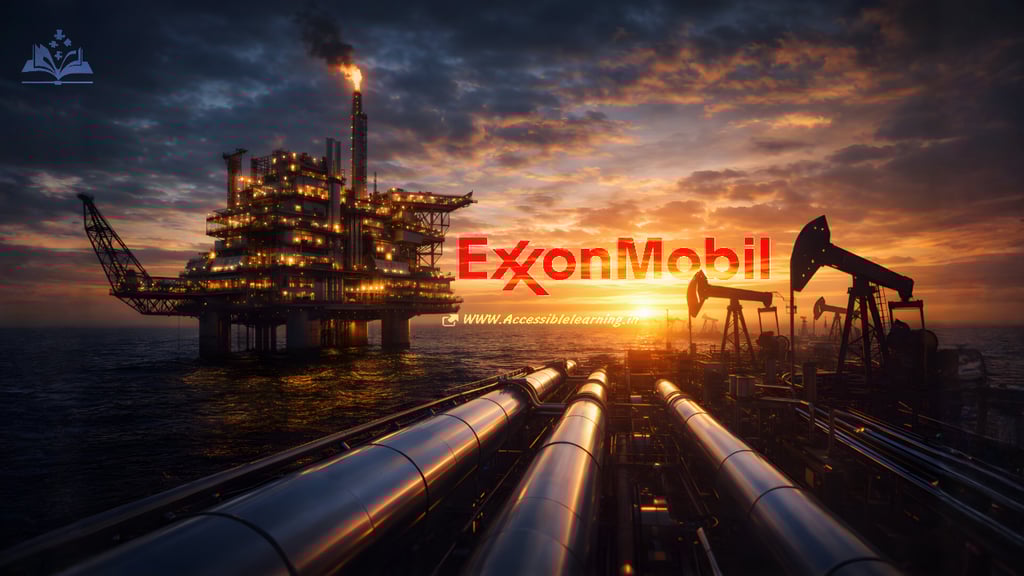
Understanding the Global Energy Leader
ExxonMobil stands as one of the world's largest publicly traded international energy companies, with a market capitalization exceeding $467 billion as of late 2024. The company reported 2024 earnings of $33.7 billion and cash flow from operations of $55.0 billion, cementing its position as an industry leader in both financial performance and operational scale.
This comprehensive guide explores ExxonMobil's operations, strategic initiatives, financial performance, and role in the global energy transition, providing insights valuable for investors, industry analysts, and anyone interested in understanding modern energy systems.
Company Overview: Heritage and Global Presence
Corporate Structure and History
ExxonMobil Corporation operates through three primary business segments that collectively serve global energy and chemical markets. The company's modern structure emerged from the 1999 merger of Exxon and Mobil, creating what was then an $81 billion transaction that reshaped the energy industry.
Today, ExxonMobil's operations span the complete energy value chain, from exploration and production to refining, chemicals manufacturing, and low-carbon solutions. This integrated business model provides strategic advantages, allowing the company to optimize operations across market cycles and capture value at multiple points in the energy system.
Business Segments
Upstream Operations: The Upstream segment focuses on exploration, development, and production of crude oil and natural gas. In 2024, the upstream business delivered $25.4 billion in earnings, making it the largest contributor to company performance. Key production areas include the Permian Basin in the United States, offshore Guyana, and liquefied natural gas (LNG) projects globally.
Energy Products: Formerly known as Downstream, this segment encompasses petroleum refining and marketing operations. The division produces transportation fuels, lubricants, and other petroleum products for consumer and industrial markets worldwide.
Chemical Products: ExxonMobil manufactures and markets petrochemicals, including olefins, aromatics, polyethylene, and polypropylene. The chemical business targets high-value product markets and continues to invest in advanced materials and specialty products.
Low Carbon Solutions: The company has demonstrated leadership in carbon capture and storage, having cumulatively captured more CO₂ than any other company—120 million metric tons—accounting for approximately 40 percent of all anthropogenic CO₂ ever captured. This relatively new segment focuses on carbon capture and storage, hydrogen production, and other emissions reduction technologies.
Strategic Transformation: Doubling Down on Core Strengths
Pioneer Natural Resources Acquisition
In May 2024, ExxonMobil completed one of the energy industry's most significant transactions in decades. The company closed its acquisition of Pioneer Natural Resources Company, more than doubling ExxonMobil's Permian footprint and creating an Unconventional business with the largest high-return development potential in the Permian Basin.
The $59.5 billion all-stock transaction combined Pioneer's 850,000 net acres in the Midland Basin with ExxonMobil's existing 570,000 acres, creating a combined position of over 1.4 million net acres with an estimated 16 billion barrels of oil equivalent resource. ExxonMobil's Permian production volume more than doubled to 1.3 million barrels of oil equivalent per day based on 2023 volumes, with expectations to reach approximately 2 million barrels per day by 2027.
Beyond production growth, the acquisition brings environmental benefits. ExxonMobil leveraged its greenhouse gas reduction plans to accelerate Pioneer's Scope 1 and 2 net-zero emissions goal by 15 years, moving the target from 2050 to 2035.
2030 Corporate Plan: Ambitious Growth Targets
In December 2025, ExxonMobil updated its Corporate Plan through 2030, with the increased earnings and cash flow outlook reflecting stronger contributions from advantaged assets, a more profitable business mix, and lower operating costs.
The updated plan demonstrates the company's confidence in its transformation strategy. According to CEO Darren Woods, "By 2030, we now expect $25 billion in earnings growth and $35 billion in cash flow growth versus 2024 on the same constant price and margin basis," all while maintaining capital expenditures at current levels.
The company projects a return on capital employed exceeding 17% by 2030, positioning ExxonMobil ahead of industry peers in profitability metrics.
Financial Performance: Industry-Leading Results
2024 Full-Year Performance
For full-year 2024, ExxonMobil reported earnings of $33.7 billion and $55.0 billion in cash flow from operations—the third-best year in a decade. While this represented a decrease from 2023's $36.0 billion in earnings, the company maintained strong performance despite industry headwinds, including lower refining margins and natural gas prices.
The company's return on capital employed led the industry for the year at 12.7% and for the five-year average at 10.8%, demonstrating consistent value creation across market cycles.
Fourth Quarter 2024 Results
In the fourth quarter of 2024, ExxonMobil announced earnings of $7.6 billion, with cash flow from operating activities of $12.2 billion and free cash flow of $8.0 billion. Capital and exploration expenditures totaled $7.5 billion for the quarter, bringing full-year spending to $27.6 billion, in line with company guidance.
Shareholder Returns and Dividend Growth
ExxonMobil maintains a strong commitment to shareholder value through both dividends and share repurchases. The company declared a first-quarter 2025 dividend of $0.99 per share and raised its fourth-quarter dividend by 4%, increasing its annual dividend for 42 consecutive years.
The company delivered industry-leading total shareholder returns of 11%, 25% and 14% for the last one, three and five years, respectively. As previously announced, ExxonMobil plans to extend its annual $20 billion share-repurchase program through 2026.
The company's balance sheet remains robust, with a debt-to-capital ratio of 13% and a net-debt-to-capital ratio of 6%, reflecting a period-end cash balance of $23.2 billion.
Recent Quarterly Performance
In the third quarter of 2025, ExxonMobil announced earnings of $7.5 billion, with cash flow from operating activities of $14.8 billion and free cash flow of $6.3 billion. The company returned $9.4 billion to shareholders in the quarter, including $4.2 billion in dividends and $5.1 billion in share repurchases.

Operational Excellence: Cost Leadership and Efficiency
Structural Cost Savings Program
One of ExxonMobil's most significant competitive advantages lies in its relentless focus on cost efficiency. Since 2019, the company has achieved $12.1 billion of cumulative Structural Cost Savings, well beyond what any competitors have achieved, more than offsetting inflation and growth.
This included $2.4 billion in savings during 2024 alone, with $0.8 billion achieved in the fourth quarter. The company expects to deliver $18 billion of cumulative savings through the end of 2030 versus 2019, providing a substantial competitive advantage in any commodity price environment.
Volume Growth from Advantaged Assets
ExxonMobil focuses capital deployment on what it terms "advantaged" assets—projects and operations that deliver superior returns across a range of market conditions. Strong advantaged volume growth, including record production from Guyana and the Permian, and record high-value product sales volumes more than offset lower base volumes from non-strategic asset divestments and scheduled maintenance.
The company's Guyana operations exemplify this strategy. Guyana operations remain profitable at oil prices around $30 per barrel, with the energy-rich, low-cost production from Guyana's offshore oil region having a breakeven price around $30 per barrel, serving as a key growth driver and boosting overall cash flows.
Safety and Operational Performance
ExxonMobil demonstrates industry-leading execution through its safety history, with a workforce Lost-Time Incident Rate for 2020-2024 of 0.02 per 200,000 work hours, substantially better than industry benchmarks.
The company's focus on operational excellence extends to environmental performance, with corporate flaring intensity reduction exceeding 60% in 2024 versus 2016, achieving this milestone 6 years ahead of its 2030 plan.
Low Carbon Solutions: Leading the Energy Transition
Carbon Capture and Storage Leadership
ExxonMobil positions itself as a leader in carbon capture and storage (CCS) technology, viewing it as essential for achieving global climate goals while maintaining energy security. The company operates the largest CO₂ pipeline network in the United States, spanning more than 1,300 miles.
The company has demonstrated CCS leadership with approximately 9 million metric tons per year of CO₂ under contract with third-party customers and what it calls the world's first large-scale end-to-end CCS system. The company claims its facilities account for approximately 35% of all human-produced CO₂ ever captured.
CCS Infrastructure and Customer Base
ExxonMobil signed two additional customers in 2024 – CF Industries' nitrogen plant in Mississippi and the NG3 natural gas gathering facility in Louisiana—bringing total CCS commitments to more than 14 million tons of CO₂ per year. The company estimates its U.S. Gulf Coast network can ultimately remove up to 100 million metric tons per year of captured CO₂..
Notable customer agreements include partnerships with Calpine Corporation for power generation and New Generation Gas Gathering for natural gas processing. In April 2025, Calpine entered into an agreement with ExxonMobil to transport and permanently store up to 2 million metric tons of CO₂ annually from Calpine's Baytown Energy Center.
Lower-Emission Investment Strategy
ExxonMobil is pursuing up to $30 billion in lower-emission investments from 2025 through 2030, with about 65% directed toward reducing the emissions of other companies. This includes investments in carbon capture and storage, hydrogen production, lithium extraction for electric vehicle batteries, and advanced biofuels.
The company is growing new businesses that have the potential to reach $13 billion in earnings by 2040 as lower-emissions markets mature, including technology-driven Proxxima™ systems and carbon materials.
Hydrogen Production Plans
ExxonMobil is developing what would be the world's largest low-carbon hydrogen production facility. The company is working to develop a plant to produce virtually carbon-free hydrogen with approximately 98% of CO₂ captured and stored, with planned capacity that meets nearly 10% of the U.S. National Hydrogen Program Plan's projected 10 million metric tons of hydrogen per year by 2030.
Lithium for Electric Vehicles
The company aims to become a substantial lithium supplier by 2030, using direct lithium extraction technology in Arkansas. This innovative process has far less environmental impact than traditional hard rock mining and positions ExxonMobil to supply a critical component for the electric vehicle revolution.
Critical Perspective on Climate Strategy
ExxonMobil's climate initiatives face scrutiny from environmental organizations and scientific communities. Critics argue the company's reports misrepresent conclusions from both the IPCC and IEA by denying the importance of a fossil fuel phaseout to meet climate goals and instead focusing on carbon capture and storage as the essential solution.
Research suggests challenges with CCS deployment. A 2020 peer-reviewed study found that roughly 90% of proposed CCS projects in the power sector were never built, and many that became operational missed their capture targets by between 15 and 50%.
Environmental groups also note that the majority of captured carbon has historically been used for enhanced oil recovery rather than permanent storage, though ExxonMobil's current strategy focuses on permanent geological storage.

Global Energy Outlook and Market Position
2025 Global Outlook
ExxonMobil regularly publishes comprehensive projections of global energy trends extending decades into the future. The Global Outlook serves multiple purposes, establishing the basis for long-term business planning while providing insights on economic advantages and environmental considerations in the future of energy.
The projections represent ExxonMobil's most likely view of the world in 2050, based on internal data and analyses as well as publicly available information from sources including the International Energy Agency.
Looking back at previous projections provides insight into energy transition challenges. Solar and wind grew nearly twice as much as projected in the 2015 Outlook, with over half the difference occurring in China, driven by policy incentives and technology cost declines. However, even with faster growth, solar and wind still only made up approximately 3% of the world's energy mix in 2024, illustrating the massive scale of the global energy system.
Stock Performance and Market Position
ExxonMobil shares reached a new 52-week high recently, positioning the stock just 4% below its all-time high of $126.34 per share reached in October 2024. This occurred despite WTI crude oil prices falling nearly 20% year-to-date in 2025.
The company's integrated business model helps explain this resilience. While upstream production faces pressure from lower oil prices, downstream refining and chemical operations can capture margins when crude costs decline, providing a natural hedge against commodity volatility.
Industry Trends and Competitive Position
Consolidation Wave in Energy Sector
The Pioneer acquisition was part of a broader consolidation trend across the U.S. energy sector. The energy sector saw 14 deals exceeding $5 billion completed in 2024, with half surpassing $10 billion. Following ExxonMobil's move, Chevron announced a $53 billion acquisition of Hess Corporation, while Diamondback Energy purchased Endeavor Energy Resources for $25.8 billion.
This consolidation reflects strategic realities in the oil and gas industry. With the most productive acreage already identified and developed, companies seek growth through acquisition rather than exploration, creating operational synergies and economies of scale that benefit shareholders.
Competitive Advantages
By year-end 2024, ExxonMobil stood head and shoulders above its nearest competitor, Chevron, boasting a market capitalization of $467 billion against Chevron's $257 billion. The company's integrated operations, technological capabilities, financial strength, and operational scale create formidable competitive advantages.
Key differentiators include:
Technology and Innovation: Proprietary technologies in exploration, production, refining, and chemical manufacturing that competitors cannot easily replicate.
Financial Strength: A strong balance sheet enabling counter-cyclical investments and sustained shareholder distributions through all market conditions.
Operational Scale: Global operations providing diversification across geographies, products, and market cycles.
Cost Leadership: Industry-leading structural cost savings programs delivering sustainable competitive advantage.
Navigating Energy's Complex Future
ExxonMobil represents a company in transformation, balancing its dominant position in traditional oil and gas with investments in lower-carbon technologies. The Pioneer acquisition and 2030 Corporate Plan demonstrate confidence in long-term hydrocarbon demand even as the company develops carbon management solutions.
With a return on capital employed of 12.7% in 2024 and consistent delivery of industry-leading shareholder returns, ExxonMobil maintains financial discipline while pursuing growth opportunities. The company's integrated business model, operational excellence, and technological capabilities position it to navigate an evolving energy landscape.
As global energy demand continues rising, particularly in developing economies, ExxonMobil's strategy reflects a view that oil, gas, and petrochemicals will remain essential for decades, even as lower-carbon technologies gradually capture market share. Whether this balanced approach proves optimal depends on factors including technology development, policy evolution, and societal choices about energy priorities.
For investors, industry analysts, and energy observers, ExxonMobil offers a window into how traditional energy companies are positioning themselves for a future where both energy security and emissions reduction matter. The company's performance in executing this complex strategy will significantly influence both shareholder returns and the pace of global energy transition.

Frequently Asked Questions
Q: What is ExxonMobil's main business?
ExxonMobil operates as an integrated energy company with three main business segments: Upstream (oil and gas exploration and production), Energy Products (refining and marketing), and Chemical Products (petrochemicals manufacturing). The company also operates a Low Carbon Solutions business focused on carbon capture, hydrogen, and other emissions reduction technologies.
Q: How did ExxonMobil perform financially in 2024?
ExxonMobil delivered strong financial results in 2024, earning $33.7 billion with cash flow from operations of $55.0 billion—the third-best year in the company's decade. The return on capital employed led the industry at 12.7%, demonstrating superior capital efficiency compared to peers.
Q: What was the Pioneer Natural Resources acquisition?
In May 2024, ExxonMobil completed a $59.5 billion all-stock acquisition of Pioneer Natural Resources, more than doubling its Permian Basin footprint. The merger combined over 1.4 million net acres with an estimated 16 billion barrels of oil equivalent resource, positioning ExxonMobil as the dominant producer in North America's largest oil field.
Q: Does ExxonMobil pay dividends?
Yes, ExxonMobil has increased its annual dividend for 42 consecutive years, declaring a first-quarter 2025 dividend of $0.99 per share. The company combines strong dividend growth with substantial share repurchases, planning to continue its $20 billion annual buyback program through 2026.
Q: What is ExxonMobil doing about climate change?
ExxonMobil pursues a multi-faceted climate strategy focused on reducing operational emissions while developing low-carbon technologies. The company has captured more CO₂ than any other company (120 million metric tons cumulatively) and is pursuing up to $30 billion in lower-emission investments from 2025 through 2030. However, environmental groups criticize the company for focusing on carbon capture rather than reducing fossil fuel production.
Q: Where does ExxonMobil operate?
ExxonMobil maintains global operations across six continents. Key production areas include the Permian Basin in Texas, offshore Guyana, Papua New Guinea, Qatar, and various other international locations. The company's integrated downstream and chemical operations serve customers worldwide.
Q: How profitable is ExxonMobil's Guyana operation?
Guyana represents one of ExxonMobil's most advantaged assets, with operations remaining profitable even at oil prices around $30 per barrel. The offshore region's low-cost, energy-rich production serves as a key growth driver with minimal capital requirements once facilities are operational.
Q: What are ExxonMobil's 2030 goals?
ExxonMobil's updated 2030 Corporate Plan targets $25 billion in earnings growth and $35 billion in cash flow growth versus 2024 (at constant prices and margins), while maintaining current capital spending levels. The company expects to achieve a return on capital employed exceeding 17% and deliver $18 billion in cumulative structural cost savings by 2030.
Q: Is ExxonMobil investing in renewable energy?
ExxonMobil's low-carbon strategy focuses primarily on carbon capture and storage, hydrogen production, and lithium extraction for EV batteries rather than wind and solar power. The company believes its competitive advantages lie in molecule management and large-scale industrial projects rather than renewable electricity generation.
Q: How does ExxonMobil compare to other oil companies?
ExxonMobil leads major integrated oil companies in market capitalization ($467 billion), significantly ahead of Chevron ($257 billion). The company consistently delivers industry-leading returns on capital employed and total shareholder returns. Its structural cost savings program exceeds competitors, providing sustainable competitive advantage across commodity price cycles.
Subscribe to Frontier Intelligence
All © Copyright reserved by Accessible-Learning Hub
| Terms & Conditions
Accessible Learning Hub — Actionable clarity for high-agency minds.
Weekly breakdowns on AI breakthroughs, capital flow, and human performance systems. Zero fluff.