

EU Weekly Update: Policies, Pressures, and Power Shifts Across Europe
A comprehensive overview of the most important European Union developments from last week, covering politics, economy, security, technology, migration, and climate policy. This article highlights how EU decisions and debates are influencing Europe’s direction and global role.
EUROPEAN UNIONNEWS/CURRENT AFFAIRSNEPOTISM/SOCIAL ISSUES
Kim Shin
12/29/20255 min read
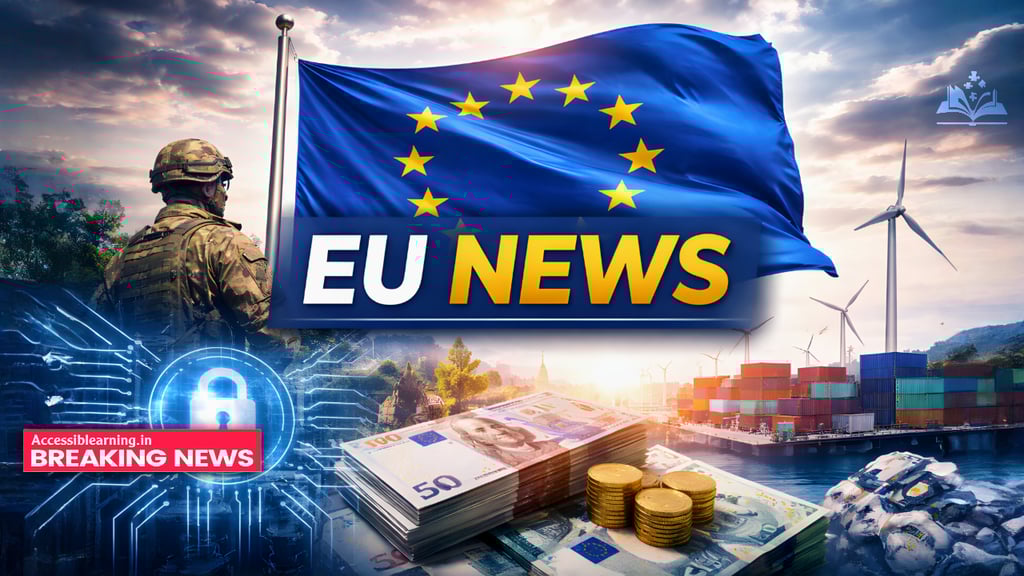
Last week, the European Union stood at the crossroads of global responsibility and internal reform. Key decisions taken across Brussels and member states reflected how the EU is responding to geopolitical tensions, economic uncertainty, technological change, and climate challenges. From strengthening security commitments to refining digital and migration policies, these developments reveal how Europe is shaping its future in a rapidly changing world.
EU Leaders Reinforce Long-Term Support for Ukraine
European Union leaders gathered in Brussels for a high-level summit where Ukraine remained at the center of discussions. Member states unanimously reaffirmed their political, military, and financial backing for Kyiv, making it clear that EU support will continue for as long as necessary. The leaders also emphasized tightening coordination on defence production, strengthening sanctions enforcement against Russia, and preparing long-term security guarantees. Alongside Ukraine, discussions included EU enlargement, migration management, and strategic defence autonomy, setting the tone for EU priorities ahead of 2026.
European Parliament Approves Plan to Phase Out Russian Gas
The European Parliament took a major step toward reshaping Europe’s energy future by approving legislation aimed at ending imports of Russian natural gas. The plan covers both pipeline gas and liquefied natural gas and is designed to fully eliminate dependency by 2027. Lawmakers highlighted the risks of energy dependence on geopolitically unstable suppliers and pushed for faster investments in renewables, hydrogen, and alternative supply routes. This move reflects the EU’s broader effort to strengthen energy security while accelerating its green transition.
EU–China Trade Tensions Rise Over Dairy Tariffs
Trade relations between the EU and China came under renewed strain after Beijing announced steep provisional tariffs on European dairy products. The duties affect a wide range of exports, including milk, cheese, and cream, hitting farmers and producers across several EU countries. European officials criticized the decision as economically unjustified and politically motivated, warning that it could escalate into a broader trade dispute. The situation highlights growing competition and strategic rivalry between the two economic powers, particularly in sectors linked to green technology and industrial subsidies.
Transatlantic Friction Grows Over Digital Regulations
Relations between the European Union and the United States faced new tension after Washington imposed visa restrictions on several European figures connected to digital policy enforcement. The move followed disagreements over EU regulations governing online platforms, content moderation, and data responsibility. EU officials defended their digital laws as necessary to protect users and democratic processes, while warning that unilateral actions could damage transatlantic cooperation. The episode reflects deeper differences in how the EU and US approach tech regulation, free speech, and platform accountability.
Farmer Protests Highlight Internal Economic Pressures
Agricultural unrest intensified in parts of the EU last week, most notably in Greece, where farmers staged large-scale protests. Demonstrators blocked highways, ports, and border crossings, demanding delayed subsidy payments, lower fuel costs, electricity price relief, and compensation for climate-related crop damage. These protests underline broader dissatisfaction among European farmers, many of whom feel squeezed by rising costs, climate policies, and slow bureaucratic processes. The issue is increasingly becoming a political challenge for EU institutions and national governments alike.
EU Boosts Global Chemical Weapons Oversight
The European Union strengthened its role in global security by providing significant financial support to international efforts aimed at preventing chemical weapons use. The funding will support investigations and verification missions related to alleged chemical weapons incidents, particularly in conflict zones such as Syria and Ukraine. EU officials stressed that the contribution reflects the bloc’s commitment to international law, accountability, and non-proliferation at a time when global security norms are under growing strain.


Debate Intensifies Over EU Competition and Investment Rules
A growing debate emerged last week over whether EU competition policies are limiting Europe’s ability to build globally competitive technology companies. Senior industry leaders argued that strict antitrust rules and regulatory hurdles are discouraging large-scale investment and forcing companies to sell off strategic assets. EU officials responded by defending competition law as essential for fair markets and consumer protection, while acknowledging the need to balance innovation, growth, and regulation. The discussion points to an ongoing struggle within the EU to align economic ambition with regulatory oversight.
EU Reaches Preliminary Deal on AI Liability Rules
Last week, EU negotiators reached a provisional agreement on new rules that define who is responsible when artificial intelligence systems cause harm. The framework is designed to protect consumers and businesses by making it easier to claim compensation if AI-driven products fail or cause damage. The agreement complements the EU AI Act and aims to balance innovation with accountability, especially in sectors such as healthcare, finance, and autonomous systems.
Eurozone Inflation Shows Signs of Stabilization
New economic data released last week showed that inflation across the eurozone is continuing to slow, offering cautious optimism to policymakers. While food and service prices remain elevated in some countries, energy costs have eased, helping overall inflation trend closer to the European Central Bank’s target. This development has fueled debate about the timing of future interest rate cuts and the broader outlook for economic recovery in 2026.
EU Advances Migration Pact Implementation Plans
The European Commission outlined the next phase of implementation for the EU’s migration and asylum pact, focusing on border procedures, relocation mechanisms, and faster asylum processing. Member states discussed funding allocations and operational readiness, particularly for countries facing higher migrant arrivals. The talks highlighted ongoing divisions within the bloc but also a shared recognition that coordinated action is necessary to manage migration pressures more effectively.
EU Expands Sanctions Enforcement Against Evasion Networks
EU authorities announced new measures aimed at strengthening enforcement of existing sanctions by targeting networks that help bypass restrictions. The focus is on financial intermediaries, shipping routes, and shell companies operating across multiple jurisdictions. Officials emphasized that enforcement, not just legislation, is now a top priority as the EU seeks to close loopholes and ensure sanctions have a real economic impact.
Digital Euro Pilot Discussions Gain Momentum
Discussions intensified last week around pilot testing for a potential digital euro. EU institutions and national central banks reviewed progress on privacy safeguards, offline payment functionality, and limits on holdings. While no final decision has been made, officials stressed that preparation is essential as digital payments evolve and global competition around central bank digital currencies increases.
EU Climate Adaptation Strategy Updated Ahead of Extreme Weather Risks
The European Commission presented updates to its climate adaptation strategy, focusing on preparedness for floods, droughts, and heatwaves. The plan encourages member states to invest more in resilient infrastructure, early warning systems, and water management. With extreme weather events becoming more frequent across Europe, the EU is shifting attention from long-term climate goals to immediate adaptation and risk reduction.
Last week’s developments show a European Union working to maintain stability while preparing for long-term transformation. Whether through economic adjustments, digital regulation, climate adaptation, or migration management, the EU continues to balance immediate pressures with strategic goals. These decisions may not always make headlines, but together they are shaping Europe’s political strength, economic resilience, and global influence in the years ahead.
Subscribe To Our Newsletter
All © Copyright reserved by Accessible-Learning Hub
| Terms & Conditions
Knowledge is power. Learn with Us. 📚

