

Ethical Risks of AI in Law: Key Challenges Every Lawyer Should Know
Understand the ethical risks of using AI in law, including bias, lack of transparency, data privacy concerns, and accountability challenges. Learn how AI is shaping legal practice and what professionals must consider to use it responsibly.
AI/FUTUREA LEARNINGGOVERNMENT SKIM
Sachin K Chaurasiya
4/22/20265 min read
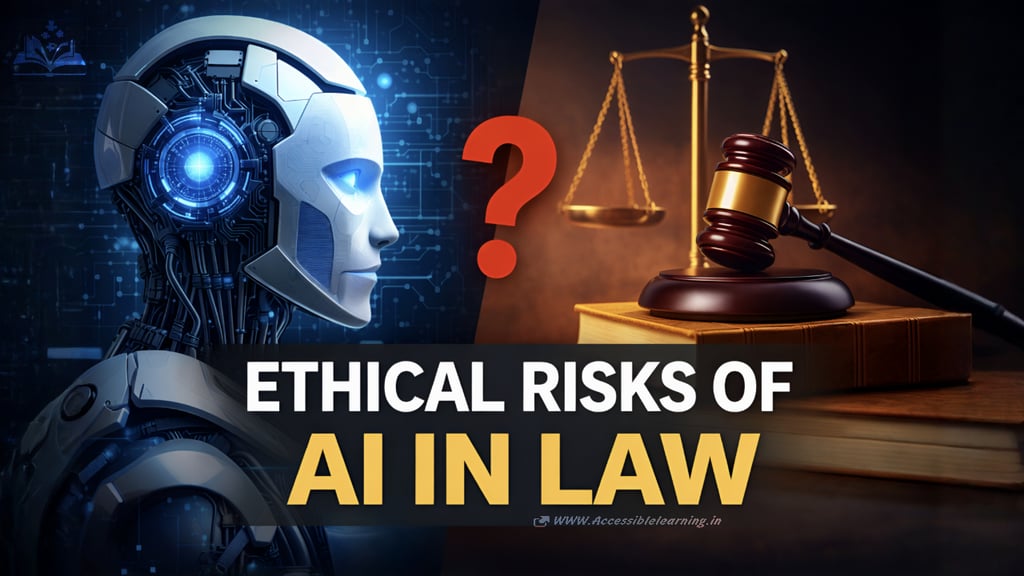

Artificial Intelligence is steadily becoming part of legal workflows. From automating contract review to predicting case outcomes, AI offers clear efficiency gains. But law is not just about speed. It is about fairness, accountability, and trust.
As AI adoption grows, so do ethical concerns that are not always obvious at first glance. This article explores those risks in a grounded, practical way.
Bias in Legal AI Systems
AI systems rely on historical legal data, which is far from neutral.
What’s Actually Happening:
Legal datasets often reflect past inequalities. When AI learns from them, it can inherit the same patterns.
Real-World Concern:
Risk assessment tools used in criminal justice have shown bias against certain demographic groups. Even if unintended, the outcomes can influence bail decisions, sentencing, or parole.
Deeper Insight:
Bias in AI is harder to detect than human bias because it hides behind mathematical models. That makes it more dangerous, not less.
Lack of Transparency in Decision-Making
Legal systems demand clear reasoning. AI does not always provide that.
The Issue:
Many AI models function like a black box. They produce outputs without showing the full reasoning path.
Why It Matters:
A lawyer cannot confidently defend an AI-generated recommendation in court if they cannot explain how it was derived.
Practical Risk:
This creates a gap between legal reasoning (which must be explainable) and AI reasoning (which often is not).
Accountability Becomes Blurred
AI introduces multiple stakeholders into a single decision.
The Problem:
Developer builds the model
Firm adopts the tool
Lawyer uses it
Client is affected
When something goes wrong, responsibility is unclear.
Real Consequence:
If an AI tool gives flawed legal advice, the lawyer is still accountable. But the root cause may lie elsewhere.
Key Reality:
AI does not remove responsibility. It complicates it.
Confidentiality and Data Exposure
Legal work involves some of the most sensitive information possible.
The Risk:
Uploading documents into AI systems, especially cloud-based tools, creates exposure points.
Practical Scenarios:
Client contracts used as training data without consent
Third-party AI vendors storing sensitive legal files
Accidental data leaks through unsecured integrations
Ethical Line:
Even a small breach can violate attorney-client privilege, which is fundamental to legal practice.
Over-Reliance on Automation
Efficiency can quietly turn into dependency.
What’s Changing:
AI tools can draft documents, summarize cases, and suggest arguments. This reduces manual effort.
Hidden Risk:
Lawyers may begin to accept outputs without proper verification.
Long-Term Effect:
Reduced analytical thinking
Weaker legal reasoning skills in early-career professionals
Increased chances of unnoticed errors
AI should assist thinking, not replace it.
AI Hallucinations and False Information
AI can generate content that sounds accurate but is completely incorrect.
Real Incidents:
There have been cases where lawyers submitted AI-generated citations that did not exist.
Why This Happens:
AI predicts language patterns, not truth. It does not “know” law in the human sense.
Ethical Impact:
Submitting false legal information, even unintentionally, can damage cases and reputations.

Inequality in Access to AI Tools
Not every legal professional has equal access to advanced AI.
The Reality:
Large firms can invest in high-quality AI systems. Smaller firms and independent lawyers may not.
Result:
Uneven efficiency across the industry
Competitive imbalance
Potential disadvantage for clients with fewer resources
Bigger Concern:
Technology meant to democratize legal services could actually widen the gap.
Rapid Adoption Without Regulation
AI is moving faster than legal frameworks can keep up.
Current Situation:
There is no universal standard for how AI should be used in legal practice.
Risks:
Firms experimenting without clear guidelines
Inconsistent ethical standards across jurisdictions
Potential misuse without accountability
What This Means:
Lawyers are operating in a space where the rules are still evolving.
Predictive Justice vs Human Judgment
AI is increasingly used to predict legal outcomes.
The Shift:
Instead of analyzing each case individually, systems estimate outcomes based on patterns.
The Concern:
This can lead to decisions influenced by probability rather than fairness.
Ethical Question:
Should justice be influenced by what is likely or what is right?
Risk of Manipulation and Misuse
AI is a tool. Like any tool, it can be misused.
Possible Misuses:
Generating misleading legal arguments
Creating fabricated evidence
Producing convincing but false narratives
Emerging Threat:
Deepfake technology combined with legal AI could challenge how evidence is verified in the future.
Vendor Dependence and Hidden Risks
Many law firms rely on third-party AI providers.
The Issue:
Firms often do not fully understand how these tools are built or trained.
Risks Include:
Hidden biases in proprietary models
Lack of control over data handling
Sudden changes in tool behavior after updates
Practical Insight:
Outsourcing intelligence means outsourcing part of your ethical responsibility.
Erosion of Professional Judgment
Law is not just technical. It is interpretive.
What AI Misses:
Context
Nuance
Human emotion
Ethical judgment
Risk:
If lawyers lean too heavily on AI, decisions may become technically correct but ethically shallow.


Client Trust and Perception
Clients expect human expertise, not automated outputs.
The Reality:
If clients feel their case is being handled by AI rather than a professional, trust may decline.
Ethical Dimension:
Transparency about AI use is becoming increasingly important.
Practical Ways to Use AI Responsibly in Law
A balanced approach can reduce many of these risks:
Always review and verify AI outputs
Avoid uploading sensitive data to unsecured systems
Use AI as a support tool, not a decision-maker
Choose tools that offer explainability
Stay updated on evolving regulations
Maintain clear internal policies for AI usage
AI is not replacing lawyers. But it is changing how law is practiced. The real ethical challenge is not whether AI should be used, but how carefully it is used.
Legal systems depend on trust, fairness, and accountability. These cannot be automated. AI can support legal work, but the responsibility for justice will always remain human.
FAQ's
Q: What are the biggest ethical risks of using AI in law?
The biggest risks include biased decision-making, lack of transparency, data privacy concerns, and over-reliance on AI-generated outputs. These issues can affect fairness, accuracy, and trust in legal processes.
Q: Can AI be trusted for legal decision-making?
AI can assist in legal tasks, but it should not be fully trusted for final decisions. Human oversight is essential because AI can produce errors, biased outcomes, or incomplete reasoning.
Q: How does AI create bias in legal systems?
AI learns from historical legal data. If that data contains bias, the system may replicate or even amplify those patterns, leading to unfair outcomes in areas like sentencing or risk assessment.
Q: Is using AI in legal work a violation of client confidentiality?
It can be if proper safeguards are not in place. Uploading sensitive client data to unsecured or third-party AI platforms may expose confidential information and breach legal ethics.
Q: What are AI hallucinations in legal contexts?
AI hallucinations refer to situations where AI generates false or fabricated legal information, such as incorrect case citations or laws, while presenting them as accurate.
Q: Who is responsible when AI makes a legal mistake?
The legal professional using the AI remains responsible. Even if the error originates from the tool, accountability typically falls on the lawyer or firm handling the case.
Q: How can lawyers use AI ethically in their practice?
Lawyers should verify AI outputs, avoid sharing sensitive data with unsecured tools, ensure transparency with clients, and use AI as a support system rather than a replacement for professional judgment.
Q: Will AI replace lawyers in the future?
No, AI is more likely to augment legal work rather than replace lawyers. Human judgment, ethical reasoning, and interpretation remain essential in the legal field.
Q: Why is transparency important in legal AI tools?
Transparency ensures that legal professionals can understand and explain how decisions or recommendations are made, which is critical for accountability and trust in legal proceedings.
Q: Are there regulations governing AI use in law?
Regulations are still evolving. While some guidelines exist, there is no universal global standard yet, making it important for legal professionals to stay updated and cautious.
Subscribe to Frontier Intelligence
All © Copyright reserved by Accessible-Learning Hub
| Terms & Conditions
Accessible Learning Hub — Actionable clarity for high-agency minds.
Weekly breakdowns on AI breakthroughs, capital flow, and human performance systems. Zero fluff.