

Emerging Tech Trends in 2026 Every Learner Should Watch
Explore the most important emerging technology trends shaping learning in 2026. This in-depth guide explains how AI, automation, immersive tools, and digital skills are transforming education, helping learners stay relevant, adaptive, and future-ready in a rapidly evolving world.
A LEARNINGEDUCATION/KNOWLEDGEDIGITAL MARKETING
Kim Shin
1/24/20265 min read
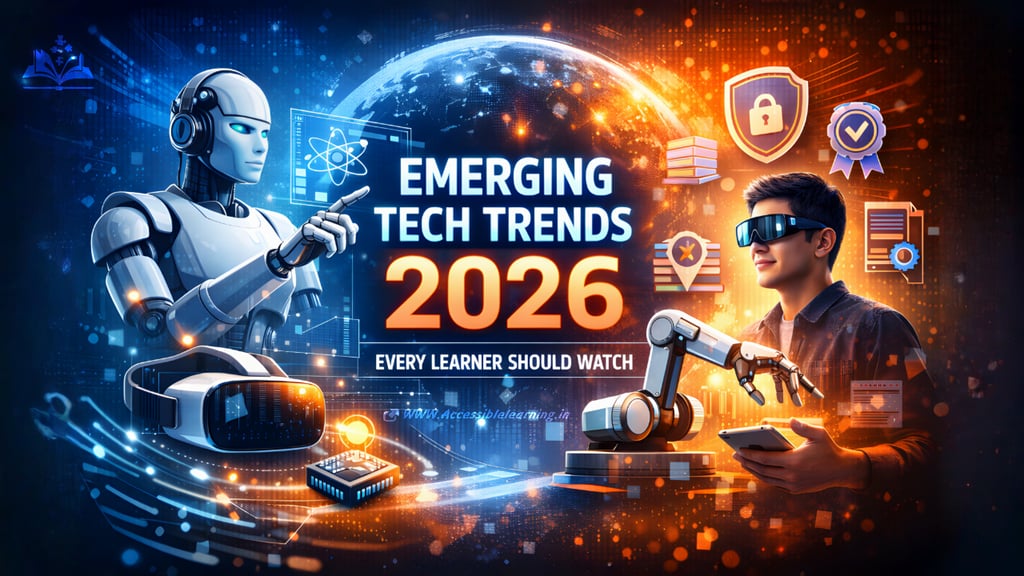
Learning in 2026 is not just evolving; it is being redefined. Technology is no longer a supporting tool in education. It has become an active participant in how learners think, practice, verify, and apply knowledge. For students, professionals, creators, and lifelong learners, understanding these emerging tech trends is critical for staying relevant and confident in a fast-changing world.
Below is an expanded, in-depth view of the most important technology trends in 2026 that every learner should pay attention to.
Multi-Agent AI Learning Systems
AI is shifting from single-response chatbots to multi-agent systems where different AI agents collaborate. Each agent performs a specific role, such as planning lessons, explaining concepts, generating examples, testing knowledge, and reviewing progress.
For learners, this creates:
Structured learning paths instead of random answers
Continuous feedback and improvement cycles
Personalized pacing based on strengths and weaknesses
Learning becomes more like working with a digital study team than using a search tool.
Domain-Specific and Industry-Trained AI Models
General AI is giving way to models trained specifically for industries like education, medicine, finance, law, design, and engineering.
These models:
Understand professional terminology deeply
Provide more accurate, real-world explanations
Reduce misinformation in complex subjects
Learners gain higher-quality guidance and must also learn to evaluate accuracy and assumptions.
AI Tutors With Adaptive Intelligence
AI tutors in 2026 adjust their teaching style based on how a learner responds. If a concept is not understood, the AI changes explanations, provides analogies, or switches formats.
Benefits include:
Personalized teaching styles
Learning through examples, visuals, or practice
Reduced fear of asking “basic” questions
This creates a more inclusive and confidence-building learning environment.
AI-Native Development and No-Code Platforms
Learners can now build digital tools, applications, dashboards, and automations without advanced coding knowledge.
This trend enables:
Faster project-based learning
Practical experimentation
Turning ideas into functional prototypes
The key learning focus shifts to logic, design thinking, and user experience.
Wearable AI and Continuous Knowledge Capture
Wearable AI devices capture spoken thoughts, lectures, meetings, and real-world interactions, then organize them into summaries and insights.
For learners, this supports:
Learning beyond classrooms
Reflection-based education
Better retention of real-life lessons
The real advantage comes from reviewing and applying these insights, not just collecting them.
Spatial Computing and Immersive Learning
Augmented Reality (AR), Virtual Reality (VR), and Mixed Reality (MR) are becoming more practical and accessible.
Learners can:
Explore historical events in immersive environments
Practice skills in simulated real-world scenarios
Learn complex concepts visually and interactively
Spatial learning improves understanding and long-term memory, especially for technical and practical fields.
Physical AI and Human–Machine Collaboration
AI-powered machines and robots are increasingly present in workplaces, healthcare, logistics, and homes.
Learners need to understand:
How machines assist rather than replace humans
Workflow automation and supervision
Ethical and safety considerations
Jobs increasingly require collaboration with intelligent systems.
Digital Provenance and Authentic Learning Proof
With AI-generated content becoming common, proof of learning is shifting toward process documentation.
This includes:
Drafts and version histories
Learning journals and reflections
Demonstration of thinking and problem-solving
Authenticity becomes a core educational value.
Privacy-First Learning and Confidential Computing
As AI tools handle sensitive personal and academic data, privacy protection becomes critical.
Learners must develop:
Responsible data-sharing habits
Awareness of digital footprints
Understanding of ethical AI use
Privacy literacy becomes part of professional competence.

AI-Powered Cybersecurity Awareness
AI-driven security tools predict and prevent threats, but human awareness remains essential.
Learners should practice:
Safe account management
Scam and misinformation detection
Secure digital collaboration
Cyber awareness is now a life skill, not just a technical one.
On-Device AI and Offline Intelligence
AI is increasingly running directly on personal devices, enabling:
Faster responses
Reduced dependency on the cloud
Greater data privacy
Learners benefit from private, always-available assistance without constant connectivity.
AI in Content Creation and Knowledge Expression
AI tools help learners create videos, presentations, simulations, articles, and visual explanations.
This supports:
Multi-format expression of knowledge
Creative learning projects
Clear communication of complex ideas
Understanding how to guide AI creatively becomes a valuable skill.
Micro-Credentials and Skill-Based Certification
Traditional degrees are increasingly supplemented by micro-credentials that validate specific skills.
These credentials:
Are faster to earn
Focus on practical ability
Support lifelong learning
Learners must curate skill portfolios rather than rely on single qualifications.
Personalized Learning Analytics
AI analyzes learning behavior to show:
Strengths and weaknesses
Optimal learning times
Areas needing revision
Data-driven self-awareness helps learners study smarter, not harder.
Ethical AI and Responsible Technology Use
Ethics is becoming a core part of tech education.
Learners are expected to understand:
Bias in algorithms
Fair and inclusive AI design
Responsible use of automated systems
Ethical awareness builds long-term trust and professionalism.
Global Learning With Local Adaptation
Technology tools and policies differ by region. Learners must adapt to:
Platform availability
Data regulations
Cultural and legal differences
Flexibility and global awareness are essential skills.
The Core Learning Shift in 2026
The most important trend is not a tool but a transformation in how learning works.
Successful learners in 2026:
Focus on learning systems, not shortcuts
Verify information instead of accepting it blindly
Combine human judgment with machine intelligence
Continuously update skills and mindset
Technology will continue to advance, but learners who understand how to learn with technology will always stay ahead.
In 2026, education is not about keeping up with machines.
It is about evolving as a thinker, creator, and responsible digital human.

FAQ's
Q: What is the most important tech trend learners should focus on in 2026?
The most important trend is learning with AI systems, especially multi-agent and adaptive AI tutors. These tools help learners plan, practice, test, and improve knowledge in a structured way, rather than just consuming information.
Q: Will AI replace teachers and traditional learning?
No. AI is becoming a support system, not a replacement. Teachers, mentors, and institutions still play a critical role in guidance, ethics, motivation, and real-world context. AI mainly enhances personalization and accessibility.
Q: How can non-technical learners benefit from emerging tech trends?
Non-technical learners can use AI for personalized tutoring, project building, content creation, and skill validation. Understanding workflows, critical thinking, and digital safety is more important than learning advanced coding.
Q: Are degrees becoming less important because of micro-credentials?
Degrees still matter, but they are no longer enough on their own. Micro-credentials and skill-based certifications help learners prove practical abilities and stay updated in fast-changing industries.
Q: How can learners prove originality in an AI-driven world?
By documenting the learning process. Keeping drafts, notes, reflections, and project versions helps demonstrate authentic thinking and problem-solving, which is increasingly valued by educators and employers.
Q: What digital skills are becoming essential for all learners?
Core skills include AI literacy, information verification, cybersecurity awareness, privacy management, and the ability to collaborate with intelligent systems.
Q: Is wearable AI really useful for education?
Yes, when used correctly. Wearable AI helps capture real-life learning moments, lectures, and discussions. Its real value comes from reviewing summaries and applying insights, not passive recording.
Q: How should learners prepare for future job changes caused by AI?
Learners should focus on adaptability, continuous learning, and system-level thinking. Combining human judgment with AI assistance and regularly updating skills is the best long-term strategy.
Q: Are privacy and data security real concerns for learners?
Absolutely. As learning tools handle personal data, understanding privacy, ethical AI use, and safe digital practices is essential for protecting identity and professional credibility.
Q: What mindset should learners adopt in 2026?
Learners should see technology as a partner, not a shortcut. Curiosity, verification, ethical awareness, and lifelong learning will matter more than mastering any single tool.
Subscribe To Our Newsletter
All © Copyright reserved by Accessible-Learning Hub
| Terms & Conditions
Knowledge is power. Learn with Us. 📚

