

Early Life and Spiritual Upbringing of Guru Gobind Singh Ji
Guru Gobind Singh Jayanti celebrates the birth of the tenth Sikh Guru, a fearless spiritual leader, warrior, poet, and reformer. This article explores his life, sacrifices, teachings, the creation of the Khalsa, and why his message of courage, equality, and justice remains deeply relevant today.
CULTURE/TRADITIONEVENT/SPECIALINDIA/BHARATCELEBRATION/FESTIVALS
Keshav Jha
12/26/20254 min read
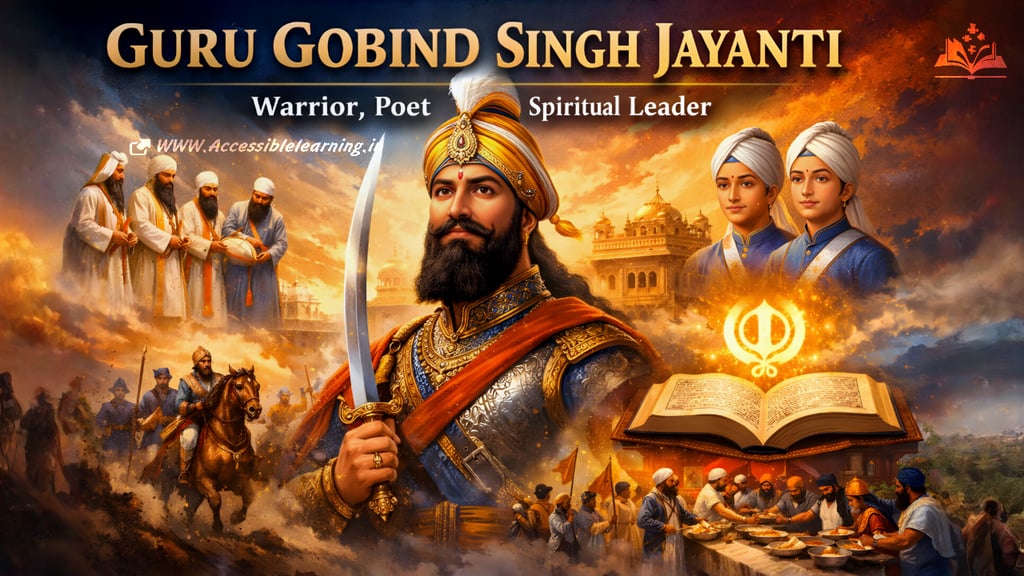
Guru Gobind Singh Jayanti commemorates the birth anniversary of Guru Gobind Singh Ji, the tenth Guru of Sikhism and one of the most influential spiritual leaders in Indian history. This sacred occasion is not only a religious celebration but also a reflection on courage, sacrifice, equality, and moral responsibility. Guru Gobind Singh Ji’s life and teachings continue to inspire millions across cultures and generations.
Early Life and Spiritual Foundation
Guru Gobind Singh Ji was born on 22 December 1666 in Patna Sahib, Bihar. His childhood was shaped by spiritual learning, martial training, poetry, and philosophy. He mastered multiple languages, including Sanskrit, Persian, Braj, and Punjabi, which later allowed him to communicate profound ideas to people from different backgrounds.
After the martyrdom of his father, Guru Tegh Bahadur Ji, Guru Gobind Singh Ji assumed Guruship at just nine years old. This event deeply influenced his worldview and strengthened his commitment to defending religious freedom and human dignity.
Role as a Warrior-Saint
Guru Gobind Singh Ji embodied the ideal of a saint-soldier. He believed that spiritual purity must be accompanied by the strength to resist injustice. Unlike rulers who fought for power, Guru Ji fought only to protect righteousness and the oppressed.
He led several battles against tyranny, not for territorial expansion, but to uphold moral law. His life proved that the use of force, when guided by ethics and compassion, could be a form of service rather than domination.
The Khalsa Panth and Collective Identity
The formation of the Khalsa in 1699 was a revolutionary step that reshaped Sikh society. Guru Gobind Singh Ji removed divisions of caste and social hierarchy, creating a collective identity where all members were equal.
He gave the Khalsa a clear code of conduct:
Moral discipline and honesty
Readiness to sacrifice for truth
Brotherhood and sisterhood beyond social labels
Fearlessness rooted in faith
By initiating the Panj Pyare and later taking Amrit from them himself, Guru Ji demonstrated humility and equality, reinforcing that leadership exists to serve, not to rule.
Significance of Sikh Names: Singh and Kaur
Guru Gobind Singh Ji introduced the titles Singh (lion) for men and Kaur (princess) for women. This was a powerful social reform aimed at dismantling caste-based surnames and empowering women.
These names symbolize courage, dignity, and equality, reminding Sikhs of their responsibility to live boldly and honorably.
Supreme Sacrifice and Family Legacy
Guru Gobind Singh Ji’s life was marked by immense personal sacrifice. All four of his sons attained martyrdom at a young age while standing firm in their faith. Despite unimaginable loss, Guru Ji remained steadfast, teaching that devotion to truth is greater than personal grief.
His sacrifices stand as one of the most powerful examples of spiritual resilience and moral strength in world history.
Declaration of the Guru Granth Sahib as Eternal Guru
Before leaving his earthly form in 1708, Guru Gobind Singh Ji made a defining decision by declaring the Guru Granth Sahib as the eternal Guru of the Sikhs. This ensured that spiritual authority would rest in divine wisdom rather than individuals.
This act preserved unity within the Sikh community and emphasized the importance of knowledge, humility, and shared guidance.
Universal Human Values in His Teachings
Guru Gobind Singh Ji’s teachings transcend religion and geography. Key principles include:
Respect for all faiths and belief systems
Resistance against oppression in any form
Balance between devotion and action
Fearlessness guided by moral clarity
Service to humanity as worship
His philosophy encourages people to live actively in the world while staying spiritually grounded.

Cultural and Global Celebrations
Guru Gobind Singh Jayanti is celebrated worldwide with devotion and unity. Observances include:
Continuous reading of the Guru Granth Sahib
Devotional singing and spiritual discourses
Nagar Kirtans showcasing Sikh heritage
Community service and charitable acts
Free community kitchens reinforcing equality
These celebrations strengthen communal bonds and spread the Guru’s message of unity and service.
Influence on Modern Leadership and Society
Guru Gobind Singh Ji’s ideas on leadership remain highly relevant today. He promoted:
Ethical leadership over authority
Collective responsibility over individual dominance
Courage guided by conscience
Education as a tool for empowerment
His vision offers valuable lessons for modern leaders, educators, and youth seeking purpose in a complex world.
Guru Gobind Singh Jayanti is a celebration of courage guided by compassion, faith strengthened by action, and equality rooted in dignity. Guru Gobind Singh Ji was not only a religious leader but also a reformer, philosopher, poet, and protector of human values.
Remembering him means more than honoring history. It means living with integrity, standing for justice, respecting all humanity, and serving the world with fearless humility.
FAQs
Q: Why is Guru Gobind Singh Jayanti celebrated?
Guru Gobind Singh Jayanti is celebrated to honor the birth anniversary of Guru Gobind Singh Ji, the tenth Sikh Guru. The day recognizes his contributions to Sikhism, his teachings on justice and equality, and his role in establishing the Khalsa.
Q: What is the importance of Guru Gobind Singh Ji in Sikhism?
Guru Gobind Singh Ji shaped the modern Sikh identity by founding the Khalsa, introducing the Five Ks, and promoting equality, courage, and selfless service. He also declared the Guru Granth Sahib as the eternal Guru, ensuring unity and spiritual continuity.
Q: What was the Khalsa, and why was it created?
The Khalsa was created in 1699 to form a disciplined, fearless, and morally strong Sikh community. It was established to protect righteousness, eliminate caste divisions, and encourage Sikhs to stand against injustice.
Q: Why did Guru Gobind Singh Ji give the titles Singh and Kaur?
Guru Gobind Singh Ji introduced the titles "Singh" for men and "Kaur" for women to remove caste-based identities and promote equality. These names symbolize courage, dignity, and self-respect.
Q: How is Guru Gobind Singh Jayanti celebrated?
The day is observed through prayers, Kirtan, Nagar Kirtans, community service, and Langar at Gurdwaras. Sikhs also reflect on Guru Ji’s teachings and try to apply them in daily life.
Q: What are the core teachings of Guru Gobind Singh Ji?
His teachings emphasize faith in one God, equality of all people, courage to fight injustice, respect for all religions, and living a balanced life of spirituality and responsibility.
Q: Why did Guru Gobind Singh Ji make the Guru Granth Sahib the eternal Guru?
He ended the line of human Gurus to prevent division and placed spiritual authority in sacred scripture. This ensured that Sikh guidance would always be based on divine wisdom rather than individuals.
Q: What makes Guru Gobind Singh Ji relevant today?
His message of standing for truth, protecting human rights, ethical leadership, and fearless compassion remains highly relevant in today’s world of social and moral challenges.
Subscribe to Frontier Intelligence
All © Copyright reserved by Accessible-Learning Hub
| Terms & Conditions
Accessible Learning Hub — Actionable clarity for high-agency minds.
Weekly breakdowns on AI breakthroughs, capital flow, and human performance systems. Zero fluff.