

Digital Kinesthesis: Why Constant Multitasking Is Draining Your Brain and Blocking Learning
Digital Kinesthesis explains why constant multitasking, endless notifications, and having too many tabs open leave you mentally exhausted. Discover how continuous partial attention affects memory, focus, learning, and cognitive performance in the digital age.
MODERN DISEASESNEW YOUTH ISSUESAI/FUTUREA LEARNING
Kim Shin | Shiv Singh Rajput
6/13/20268 min read
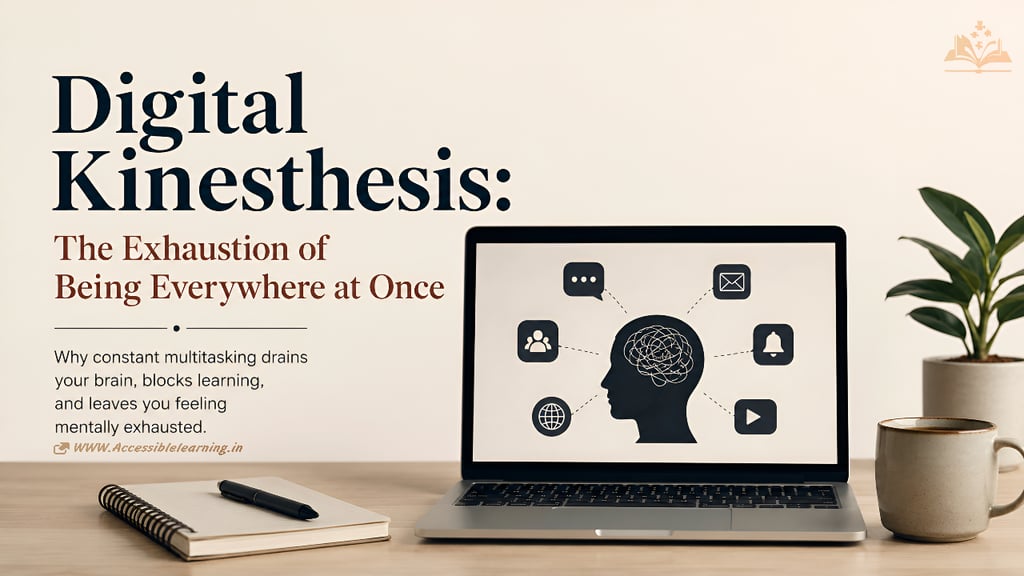
Why Having 15 Tabs Open Makes You Feel Busy, but Learn Nothing
You start a video lecture.
Five minutes later, a notification appears. You quickly check a group chat. While replying, you open a new tab to search for something mentioned in the lecture. A social media notification flashes in the corner of your screen. You glance at it for just a second. Then you return to the lecture, only to realize you've missed the last three minutes.
At the end of the hour, you've technically spent sixty minutes learning.
Yet somehow, you remember almost nothing.
This is becoming one of the defining cognitive problems of the digital age. Modern learners are no longer focused on one task at a time. Instead, they exist in a state of continuous partial attention, constantly shifting between information streams without fully engaging with any of them.
The result is a growing phenomenon that can be described as Digital Kinesthesis: the exhausting sensation of mentally existing in multiple digital spaces simultaneously.
While it creates the illusion of productivity, it often leaves people mentally drained, anxious, and unable to retain what they consume.
What Is Digital Kinesthesis?
Traditionally, kinesthesis refers to the body's awareness of movement and position. Digital kinesthesis is different. It describes the psychological experience of constantly moving through digital environments:
Switching between tabs
Monitoring multiple conversations
Watching videos while reading articles
Listening to podcasts while checking notifications
Managing several digital identities across platforms
Your brain begins to feel as though it must be present everywhere at once. The modern internet rewards this behavior. Every app competes for attention. Every notification signals urgency. Every platform encourages immediate engagement.
As a result, many people spend their day mentally jumping between dozens of digital locations without ever settling into one. The brain experiences constant movement, even when the body remains completely still.
The Myth of Productive Multitasking
One of the most persistent misconceptions in modern learning is the belief that multitasking improves efficiency. Research in cognitive psychology consistently shows the opposite. The brain does not truly multitask on complex activities. Instead, it performs something called task switching.
Each switch forces the brain to:
Disengage from the current activity
Reorient attention
Recall context
Resume the original task
These transitions happen rapidly, but they consume mental energy. The more often they occur, the greater the cognitive cost. For example:
Watching a lecture
Answering messages
Checking social media
Reading emails
may feel simultaneous, but the brain is actually alternating between them dozens or hundreds of times. Every switch reduces comprehension and increases mental fatigue.
Continuous Partial Attention: The New Normal
Unlike traditional distraction, continuous partial attention isn't accidental. It's a permanent operating mode. People intentionally keep multiple information streams active because they fear missing something important.
This behavior creates a state where attention is never fully committed. Instead of concentrating deeply on one activity, attention becomes fragmented across many.
Common examples include:
Attending virtual meetings while checking messages
Reading articles while monitoring notifications
Studying with social media open
Watching educational videos while browsing unrelated content
In every case, the brain remains partially engaged everywhere and fully engaged nowhere. This fragmented attention significantly reduces learning quality.
Why Your Brain Treats Notifications Like Threats
Human brains evolved to notice sudden changes in the environment. A rustling bush thousands of years ago could signal danger. Today, a notification sound triggers a similar response.
Each ping activates alert systems designed to prioritize potentially important information. Even when the notification is harmless, the nervous system briefly shifts into a heightened state of awareness.
Over hundreds of interruptions per day, this creates a continuous cycle of activation. The body begins operating in a low-level version of the fight-or-flight response. Symptoms often include:
Mental restlessness
Increased anxiety
Difficulty focusing
Fatigue despite minimal physical activity
Constant feelings of urgency
Many people interpret these sensations as being busy. In reality, they may be experiencing cognitive overload.

How Digital Overload Blocks Long-Term Memory
One of the most damaging consequences of digital kinesthesis involves memory formation. Learning occurs in stages:
1. Attention
Information must first capture focused attention.
2. Encoding
The brain converts information into a storable format.
3. Consolidation
The information becomes integrated into long-term memory.
Constant interruptions disrupt the very first stage.
Without sustained attention, encoding becomes weak.
Without proper encoding, consolidation never fully occurs.
This explains why people can spend hours consuming content and still struggle to remember key details later. The information briefly passes through awareness but never receives enough cognitive resources to become lasting knowledge.
The Illusion of Learning
Digital platforms often make people feel informed without actually increasing understanding. This phenomenon occurs because exposure feels similar to learning.
For example:
Watching educational clips
Reading summaries
Scanning headlines
Listening to podcasts while distracted
creates familiarity. Familiarity can be mistaken for mastery. However, genuine learning requires the following:
Reflection
Retrieval
Application
Deep processing
Without these steps, information remains shallow. People often believe they are becoming more knowledgeable because they consume enormous amounts of content. Yet when asked to explain concepts in detail, they discover very little was retained.
The Hidden Cost of Open Tabs
The famous "15 tabs open" problem is not just a joke. Each open tab represents unfinished cognitive business. Psychologists refer to this as the Zeigarnik Effect, where incomplete tasks continue occupying mental resources. Even when not actively viewing them, open tabs can create subtle mental pressure.
The brain keeps reminders running in the background:
Finish reading this article
Watch that video later
Respond to that message
Check that research source
Individually, these demands seem minor. Collectively, they create significant cognitive clutter.
Many people feel overwhelmed not because of the complexity of their work but because their attention is stretched across too many unfinished mental commitments.
Why Being "Always Connected" Feels So Draining
Humans were not designed for continuous connectivity. Historically, attention cycles included the following:
Work
Rest
Reflection
Social interaction
Recovery
Digital technology has compressed these boundaries. Today, information arrives continuously. There is rarely a clear stopping point.
Messages wait. Feeds refresh. Videos autoplay. News updates appear instantly.
The brain receives few signals that it can safely disengage. As a result, mental recovery becomes increasingly rare. The nervous system remains active long after the workday ends.
The Neurological Consequences of Constant Switching
Over time, excessive task switching can influence cognitive habits. Many people report:
Shorter attention spans
Increased distractibility
Reduced reading endurance
Difficulty completing long-form work
Greater impatience with slow tasks
The brain adapts to its environment. When constantly exposed to rapid information changes, it becomes conditioned to expect novelty. Deep concentration begins to feel uncomfortable.
Silence feels strange. Long-form reading feels difficult. The mind starts craving stimulation even when stimulation is the source of exhaustion.

The Difference Between Information Consumption and Knowledge Creation
The internet provides unprecedented access to information. But information alone does not create expertise. Knowledge emerges when information is:
Organized
Connected
Practiced
Recalled
Applied
A learner who spends one hour deeply studying a concept often learns more than someone who spends five hours rapidly consuming fragmented content.
Depth beats volume.
Understanding beats exposure.
Retention beats endless scrolling.
How to Escape Digital Kinesthesis
The solution is not abandoning technology. The goal is creating healthier relationships with attention.
Single-Task Learning
Dedicate blocks of time to one activity.
Close unrelated tabs and applications.
Notification Control
Disable nonessential alerts.
Reduce unnecessary interruptions.
Active Learning
Take notes, summarize concepts, and test recall.
Engagement improves retention.
Create Attention Boundaries
Separate learning time from communication time.
Avoid mixing study sessions with social media use.
Schedule Recovery Periods
Allow the brain moments of genuine silence.
Mental recovery is essential for memory consolidation.
Limit Open Cognitive Loops
Close tabs, complete small tasks, and reduce digital clutter.
The fewer unfinished mental commitments, the easier concentration becomes.
The Future Challenge: Protecting Human Attention
The next great productivity challenge may not be managing time. It may be protecting attention.
Modern technology has become extraordinarily effective at capturing awareness. Every platform seeks engagement. Every notification competes for focus. Every algorithm fights for another moment of attention.
In such an environment, the ability to focus deeply is becoming increasingly valuable.
People who can resist constant switching, sustain concentration, and engage deeply with information gain a significant advantage in learning, creativity, and decision-making.
The future may belong not to those who consume the most information, but to those who can actually remember, understand, and apply it.
Digital kinesthesis is the invisible exhaustion created by existing in multiple digital spaces at once. It is the feeling of having dozens of tabs open, multiple conversations active, and endless streams of information competing for attention.
While this state creates the appearance of productivity, it often undermines the very thing people are trying to achieve: meaningful learning.
The brain cannot build deep knowledge while constantly shifting between distractions. Continuous partial attention keeps the nervous system alert, fragments memory formation, and leaves people feeling mentally exhausted despite accomplishing little.
In a world designed to divide attention, the ability to focus may become one of the most important cognitive skills of the twenty-first century.
The challenge is no longer finding information. The challenge is staying present long enough to learn from it.


FAQ's
Q: What is digital kinesthesis?
Digital kinesthesis refers to the mental exhaustion caused by constantly switching between multiple digital environments, such as tabs, apps, social media feeds, emails, messages, and online content. It creates the feeling of being mentally present everywhere at once, reducing focus, learning, and productivity.
Q: Why do I feel tired after spending hours online, even if I haven't done physical work?
Mental fatigue often results from continuous task switching, information overload, and frequent notifications. Even when sitting still, the brain expends significant energy processing interruptions, making decisions, and shifting attention between digital tasks.
Q: Does multitasking actually reduce learning and memory?
Yes. Research shows that multitasking typically involves rapid task switching rather than true simultaneous processing. This constant switching weakens attention, reduces comprehension, and makes it harder for the brain to encode information into long-term memory.
Q: How do notifications affect the brain?
Notifications trigger the brain's alert systems, drawing attention away from the current task. Frequent interruptions can keep the nervous system in a state of heightened alertness, increasing stress levels and reducing the ability to concentrate deeply.
Q: What is continuous partial attention?
Continuous partial attention is a state in which a person constantly monitors multiple sources of information without fully focusing on any single one. Examples include studying while checking messages, watching videos while scrolling social media, or working while monitoring email notifications.
Q: Why do I forget information from videos, articles, or online courses so quickly?
Information retention depends on focused attention and active engagement. When learning is interrupted by distractions, the brain struggles to properly encode information, making it more likely to be forgotten shortly afterward.
Q: Can having too many browser tabs open affect concentration?
Yes. Multiple open tabs can create cognitive clutter and increase mental load. Each unfinished task represented by an open tab may occupy attention in the background, making it harder to focus on the task at hand.
Q: What are the signs of digital overload?
Common signs include:
Difficulty concentrating
Mental fatigue
Increased anxiety
Shorter attention span
Constant urge to check devices
Trouble remembering recently learned information
Feeling busy but accomplishing little
Q: How can I improve focus in a digital environment?
Effective strategies include:
Closing unnecessary tabs
Disabling nonessential notifications
Using dedicated focus sessions
Practicing single-tasking
Taking regular screen breaks
Separating learning time from social media use
Q: Is digital kinesthesis the same as digital burnout?
Not exactly. Digital kinesthesis describes the cognitive strain of constantly shifting attention across digital spaces, while digital burnout is a broader state of emotional, mental, and physical exhaustion caused by prolonged digital stress and overwork.
Q: How does digital kinesthesis impact students and online learners?
Students often experience reduced comprehension, weaker memory retention, lower academic performance, and increased cognitive fatigue when they attempt to learn while simultaneously engaging with social media, messaging apps, and other distractions.
Q: Can reducing screen time improve memory and focus?
Reducing unnecessary screen exposure, especially during study or work sessions, can improve concentration, reduce mental fatigue, and support better memory formation. The quality of screen use often matters more than the total number of hours spent online.
Q: Why does scrolling social media feel productive even when it isn't?
Social media provides a constant stream of new information and stimulation, creating an illusion of engagement and learning. However, passive consumption rarely leads to deep understanding, critical thinking, or long-term knowledge retention.
Q: What is the best way to learn effectively in the digital age?
The most effective learning methods include focused attention, active note-taking, retrieval practice, spaced repetition, and minimizing distractions. Deep engagement with information consistently outperforms passive content consumption.
Q: Will attention become one of the most valuable skills in the future?
Many experts believe so. As digital distractions continue to increase, the ability to focus deeply, think critically, and learn without constant interruption may become one of the most valuable cognitive and professional skills of the modern era.
Subscribe To Our Newsletter
All © Copyright reserved by Accessible-Learning Hub
| Terms & Conditions
Knowledge is power. Learn with Us. 📚

