

Devshayani Ekadashi: The Day India Puts God to Sleep and Starts a Four-Month Spiritual Shutdown
Devshayani Ekadashi marks the beginning of Chaturmas, a four-month spiritual period when Vishnu Ji enters divine sleep. Discover its history, cultural impact, economic influence, fasting traditions, and why millions still observe it across India.
CULTURE/TRADITIONINDIA/BHARAT
Jagdish Nishad
7/12/20263 min read
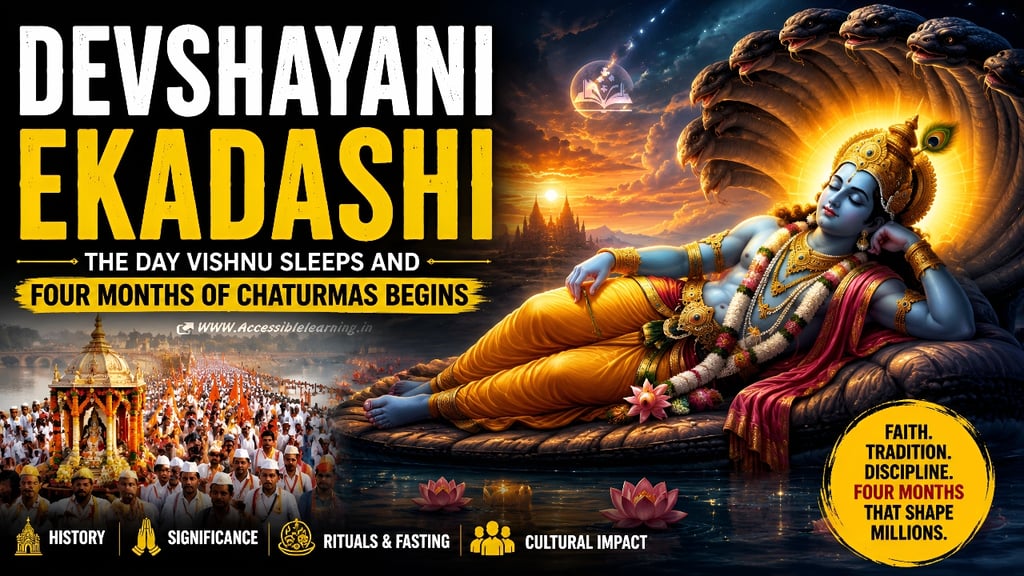
Devshayani Ekadashi marks one of the most consequential dates in the Hindu calendar. According to tradition, Vishnu Ji enters a cosmic sleep on this day, triggering a four-month period known as Chaturmas. During these months, millions of Hindus postpone weddings, major celebrations, and several religious ceremonies. Few festivals influence social behavior at this scale.
Devshayani Ekadashi Is More Than a Festival. It Is a Cultural Pause Button.
Most festivals encourage activity. Devshayani Ekadashi does the opposite.
Observed on the eleventh day (Ekadashi) of the bright fortnight in the Hindu month of Ashadha, the festival signals the beginning of Chaturmas. Religious tradition states that Vishnu Ji retreats into Yoga Nidra, a state of divine cosmic sleep, and remains there until Prabodhini Ekadashi four months later.
The practical result? Entire communities slow down.
Marriage halls see cancellations. Priests stop scheduling auspicious ceremonies. Families delay housewarmings, business launches, and other milestone events. A single religious belief reshapes social calendars across large parts of India.
The Hidden Logistics Behind Chaturmas
People often describe Devshayani Ekadashi as a day of fasting and prayer. That explanation barely scratches the surface. The real story lies in what happens afterward.
Chaturmas historically aligned with India's monsoon season. Ancient travelers faced flooded roads, disease outbreaks, and dangerous journeys. Religious authorities embedded practical restrictions into spiritual doctrine.
Instead of telling people, "Travel is risky," tradition said, "The preserver of the universe is sleeping."
The message worked.
Monastic orders stayed in one location. Pilgrims reduced long-distance movement. Communities focused on local worship rather than constant travel.
What appears purely spiritual also served as an effective social management system.
Pandharpur's Massive Human Wave
If Devshayani Ekadashi has a physical epicenter, it is the town of Pandharpur in Maharashtra. Every year, hundreds of thousands of Warkari devotees walk for days and sometimes weeks to reach the temple of Vitthal.
The pilgrimage, known as the Wari, transforms highways into rivers of humanity.
People sing devotional songs, carry symbolic palanquins of saints, and endure harsh weather conditions with remarkable discipline. The scale challenges infrastructure, traffic management, sanitation systems, healthcare services, and local administration.
This is not a quaint religious gathering.
It is one of the largest recurring human movements in India.
Fasting Is Only Part of the Story
Devshayani Ekadashi fasting often dominates popular discussion, but focusing only on food misses the broader objective. The fast acts as a visible symbol of restraint.
Participants avoid grains, follow dietary restrictions, spend more time in prayer, and commit to spiritual discipline. Many devotees use the day to reassess habits, reduce excess consumption, and reset personal priorities.
In a culture increasingly driven by constant stimulation, Devshayani Ekadashi promotes deliberate limitation.
Whether people follow it for faith or self-control, the underlying principle remains the same: stop consuming mindlessly.
The Economic Impact Nobody Talks About
Religious observances do not exist outside economics. When millions postpone weddings and ceremonies, entire industries feel the effect.
Event planners, banquet halls, decorators, caterers, jewelers, photographers, and travel businesses often experience seasonal fluctuations linked directly to Chaturmas.
Meanwhile, pilgrimage destinations receive enormous inflows of visitors and spending.
Devshayani Ekadashi does not merely influence spiritual life. It redistributes economic activity across regions and industries. That reality rarely appears in devotional discussions, but it remains impossible to ignore.

Why Devshayani Ekadashi Still Matters in Modern India
Critics dismiss such traditions as outdated. Supporters defend them as sacred. Both sides miss the larger point.
Devshayani Ekadashi survives because it continues to perform multiple functions simultaneously. It preserves religious identity, regulates community behavior, supports pilgrimage networks, strengthens cultural continuity, and creates a shared calendar followed by millions.
Few modern institutions command that level of voluntary participation.
In an era of fragmented attention and shrinking cultural consensus, Devshayani Ekadashi still persuades vast numbers of people to align their behavior around a common belief. That alone makes it significant.
The Real Legacy of Devshayani Ekadashi
Devshayani Ekadashi is not simply a fasting day. It is a centuries-old mechanism that blends faith, social organization, seasonal adaptation, economic influence, and mass participation into a single observance.
The festival's most remarkable achievement is not that people believe Vishnu sleeps.
It is that a belief powerful enough to reshape the routines of millions has survived for generations and continues to influence modern India long after the conditions that created it have changed.
Subscribe To Our Newsletter
All © Copyright reserved by Accessible-Learning Hub
| Terms & Conditions
Knowledge is power. Learn with Us. 📚

