

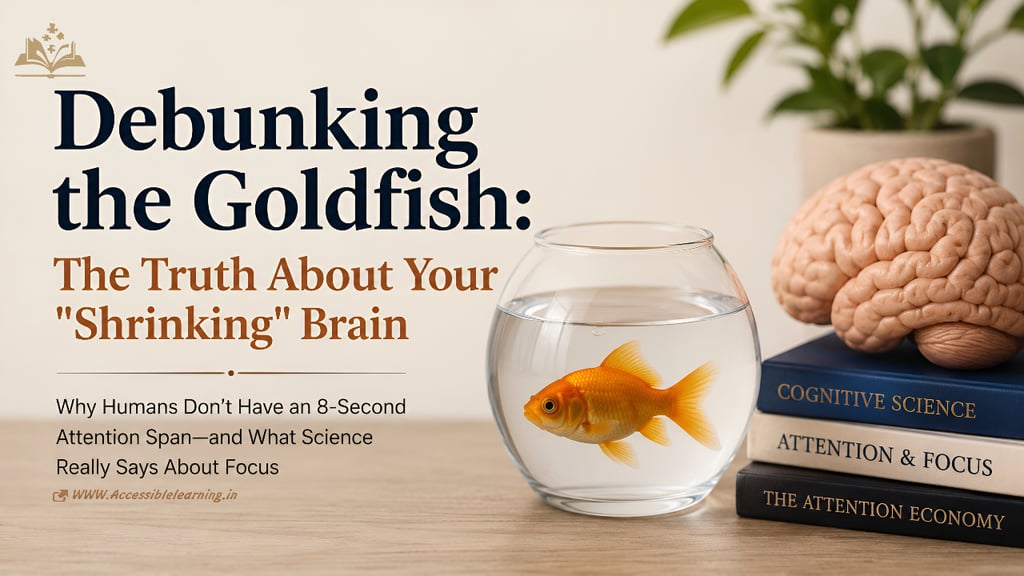
Debunking the Goldfish: The Truth About Your "Shrinking" Brain!
Think humans now have a shorter attention span than a goldfish? Think again. Discover the truth behind the famous 8-second attention span myth, how the attention economy hijacks focus, and what science really says about concentration in the digital age.
ACCESSIBLE LEARNING
Shiv Singh Rajput
6/10/20267 min read
You Don't Have an 8-Second Attention Span (And Neither Does a Goldfish)
You've probably heard the claim before.
"The average human attention span is now just 8 seconds, shorter than a goldfish's 9 seconds."
It's one of the most repeated facts in modern discussions about smartphones, social media, and digital distraction. The statistic appears in articles, presentations, productivity seminars, and even marketing reports.
The problem? It's not true.
Neither science nor goldfish behavior supports the claim. Yet the myth has become so widespread that many people have accepted it as evidence that technology is literally shrinking our brains.
Ironically, the real story is far more interesting and far more concerning.
Humans have not lost their ability to focus. Our brains are not suddenly incapable of concentration. Instead, we live inside digital environments specifically engineered to compete for our attention every second of the day.
The issue isn't that our attention spans are shrinking. The issue is that our attention is constantly under attack.
Where Did the Goldfish Myth Come From?
The famous "8-second attention span" statistic exploded across the internet around the mid-2010s. Many articles cited a report claiming that humans had an attention span of 8 seconds while goldfish maintained attention for 9 seconds.
The claim sounded believable because it fit a growing cultural narrative:
Smartphones were everywhere.
Social media was expanding rapidly.
Notifications were becoming constant.
People felt more distracted than ever.
Unfortunately, researchers examining the claim discovered a major problem. There was no solid scientific evidence supporting it.
The statistic appears to have originated from marketing materials rather than rigorous cognitive science research. Over time, the number was repeated so frequently that it gained the appearance of legitimacy.
This phenomenon has a name:
The Illusory Truth Effect.
The more often people hear something, the more likely they are to believe it, regardless of whether it's true. The goldfish comparison became a perfect example.
Do Humans Really Have an Attention Span?
The first mistake is assuming that attention works like a stopwatch. Attention isn't a single fixed measurement. Instead, psychologists describe attention as a collection of different cognitive abilities, including the following:
Sustained attention
Selective attention
Divided attention
Executive control
Working memory
Each serves a different purpose. A person may struggle to read a boring report for five minutes but can spend three hours immersed in a favorite video game.
Someone might ignore a textbook chapter but binge-watch an entire documentary series. The capacity to focus hasn't disappeared.
The willingness to focus depends heavily on context, motivation, reward, and environmental conditions. This is why the "8-second attention span" claim fails scientifically.
Human attention isn't one number. It's a dynamic system.
The Evidence Against the Myth
If humans truly possessed an average attention span of only eight seconds, many everyday activities would become impossible. Consider:
Reading Novels
Millions of people regularly read books containing hundreds of pages.
Watching Movies
Feature films often run between 90 and 180 minutes.
Learning New Skills
Programming, music, language learning, and professional training all require prolonged concentration.
Competitive Gaming
Professional esports players maintain intense focus for hours.
Scientific Research
Researchers routinely spend entire days analyzing data, reading papers, and solving complex problems.
These activities continue to happen every day. Clearly, humans remain capable of sustained attention. The real challenge lies elsewhere.

What Has Actually Changed?
While attention span itself may not be shrinking, the environment surrounding attention has changed dramatically. For most of human history, distractions were limited.
Today, attention exists inside an economy. And attention is valuable. Some of the largest companies in the world make money by capturing and holding user attention.
The longer people stay engaged, the more advertisements they see, the more data gets collected, and the more revenue is generated. This creates a powerful incentive:
Design products that continually pull attention back.
The Attention Economy
Modern platforms don't simply provide information. They compete aggressively for engagement.
Features commonly used include:
Infinite scrolling
Autoplay videos
Push notifications
Variable rewards
Personalized recommendations
Social validation metrics
These systems leverage psychological mechanisms that evolved long before smartphones existed.
Human brains naturally pay attention to:
Novelty
Social information
Potential rewards
Unexpected events
Emotional content
Digital platforms exploit these tendencies exceptionally well. The result is not reduced intelligence. It's increased competition for cognitive resources.
Why It Feels Like Your Attention Is Worse
Many people genuinely feel less focused today than they did years ago. That feeling is real. But it doesn't necessarily mean attention capacity has decreased. Instead, several factors make distraction more noticeable.
Constant Interruptions
Research consistently shows that interruptions carry a cognitive cost.
Even brief distractions can disrupt concentration and require time to recover from.
A notification that lasts two seconds may create several minutes of lost focus.
Task Switching
People often believe they are multitasking.
In reality, the brain usually performs rapid task switching.
Each switch requires mental resources.
Frequent switching creates fatigue and reduces performance.
Information Overload
Humans now consume more information in a single day than previous generations encountered in much longer periods.
The brain must continuously filter incoming content.
This filtering process consumes attention.
Dopamine-Driven Feedback Loops
Social media platforms frequently provide unpredictable rewards:
Likes
Comments
Shares
New messages
Viral content
The unpredictability makes checking behavior difficult to resist.
Deep Focus Is Not Dead
One of the most important findings from cognitive science is that the brain remains remarkably adaptable. People still enter states of deep concentration regularly. Psychologists often refer to this as flow.
Flow occurs when:
Challenge matches skill level.
Goals are clear.
Feedback is immediate.
Distractions are minimized.
During flow states, people may lose track of time entirely.
Writers experience it.
Artists experience it.
Athletes experience it.
Developers experience it.
Students experience it.
If attention spans had truly collapsed to eight seconds, flow would no longer exist. Yet it remains a common human experience.

The More Dangerous Myth
The goldfish story seems harmless. But it carries a hidden risk. If people believe their brains have permanently degraded, they may stop trying to improve their focus.
They may assume distraction is inevitable. It isn't. Attention is not a fixed trait. It functions more like a muscle.
The way attention is used influences how effectively it operates.
The more frequently people practice sustained concentration, the easier it becomes.
The more frequently attention gets fragmented, the harder deep focus feels.
The capacity remains.
The habits determine access to it.
How to Reclaim Your Focus
The solution isn't abandoning technology. The goal is creating conditions where attention can thrive.
Turn Off Nonessential Notifications
Every notification competes for cognitive resources.
Removing unnecessary interruptions reduces mental fragmentation.
Create Dedicated Focus Periods
Even 30 to 60 minutes of uninterrupted work can significantly improve productivity.
Limit Context Switching
Grouping similar tasks together reduces mental overhead.
Design Your Environment
Place distractions farther away.
Make focused work easier to begin.
Consume Content Intentionally
Instead of reacting to every piece of content, choose what deserves attention.
Attention improves when it becomes deliberate rather than automatic.
Practice Boredom
Moments without stimulation help rebuild tolerance for sustained concentration.
Constant entertainment trains the brain to expect continuous novelty.
The Future of Human Attention
Artificial intelligence, personalized algorithms, virtual reality, and increasingly sophisticated recommendation systems will intensify competition for attention.
The battle for focus is unlikely to disappear.
In fact, it may become one of the defining challenges of the digital age.
The individuals who learn to protect and direct their attention will possess a significant advantage.
Not because they have better brains.
But because they manage their cognitive resources more effectively.
Attention is rapidly becoming one of the most valuable assets a person owns.
The claim that humans now have shorter attention spans than goldfish is a myth. There is no scientific evidence proving that the average human can focus for only eight seconds.
More importantly, the myth distracts from the real issue. Human attention has not vanished. Human attention has become a target.
Modern technologies are designed to capture, redirect, and monetize focus at an unprecedented scale. That reality can make concentration feel more difficult, but it does not mean the brain is broken.
The ability to think deeply, learn complex ideas, create meaningful work, and sustain concentration remains one of humanity's defining strengths. The challenge isn't recovering a lost attention span. It's protecting the one we've always had.
FAQ's
Q: Is it true that humans have an 8-second attention span?
No. The widely cited claim that humans have an 8-second attention span is not supported by scientific research. The statistic became popular through marketing reports and internet repetition rather than peer-reviewed cognitive science studies.
Q: Do goldfish really have a longer attention span than humans?
No. There is no reliable scientific evidence showing that goldfish have a 9-second attention span or that humans have a shorter one. The comparison is a myth that has been widely misquoted over the years.
Q: Are smartphones reducing our attention span?
Smartphones do not necessarily reduce the brain's ability to focus. However, constant notifications, app switching, and endless streams of content can make sustained attention more difficult by increasing distractions and interruptions.
Q: What is the difference between attention span and focus?
Attention span refers to the ability to maintain attention over time, while focus is the act of directing attention toward a specific task. A person can have strong attention capabilities but struggle to focus in highly distracting environments.
Q: Why do people feel more distracted today?
People often feel more distracted because modern digital platforms compete aggressively for attention through notifications, personalized feeds, autoplay videos, and other engagement-driven features. This creates frequent interruptions that fragment concentration.
Q: Can attention span be improved?
Yes. Attention is trainable. Practices such as deep work, mindfulness, reading long-form content, reducing distractions, and scheduling focused work sessions can strengthen concentration and improve mental endurance over time.
Q: What is the attention economy?
The attention economy is a business model in which companies compete to capture and retain user attention. Many digital platforms generate revenue through advertising and engagement, making attention one of the most valuable resources online.
Q: Has social media changed the way people focus?
Social media has changed how people consume information by encouraging rapid content switching and frequent engagement. While it hasn't eliminated the ability to focus deeply, excessive use can make sustained concentration feel more challenging.
Q: What is deep focus, or "flow state"?
A flow state is a period of intense concentration where a person becomes fully immersed in a task. During flow, distractions fade, productivity increases, and time often seems to pass quickly. It demonstrates that humans are still capable of prolonged focus.
Q: How can I protect my attention in a digital world?
You can protect your attention by turning off unnecessary notifications, limiting multitasking, setting dedicated focus periods, reducing screen distractions, and intentionally choosing where to direct your mental energy.
Q: Is multitasking harming my productivity?
Research suggests that true multitasking is rare. Most people rapidly switch between tasks, which can reduce efficiency, increase mental fatigue, and make it harder to maintain deep concentration.
Q: Why is the goldfish attention span myth still popular?
The myth persists because it is simple, memorable, and aligns with common concerns about technology and distraction. Repeated exposure has helped it spread despite the lack of scientific evidence supporting it.
Subscribe to Frontier Intelligence
All © Copyright reserved by Accessible-Learning Hub
Accessible Learning Hub — Actionable clarity for high-agency minds.
Weekly breakdowns on AI breakthroughs, capital flow, and human performance systems. Zero fluff.