

Dark Skies Tourism: The Search for Actual Silence and Shadow
Discover the rise of dark skies tourism, where travelers seek real silence, natural darkness, and star-filled skies. Explore how this growing trend blends stargazing, sustainability, and mindful travel in some of the world’s least light-polluted destinations.
SPACE MISSIONENVIRONMENTSPACE/TECHTRAVEL LIFE
Jagdish Nishad | Kim Shin
4/18/20266 min read
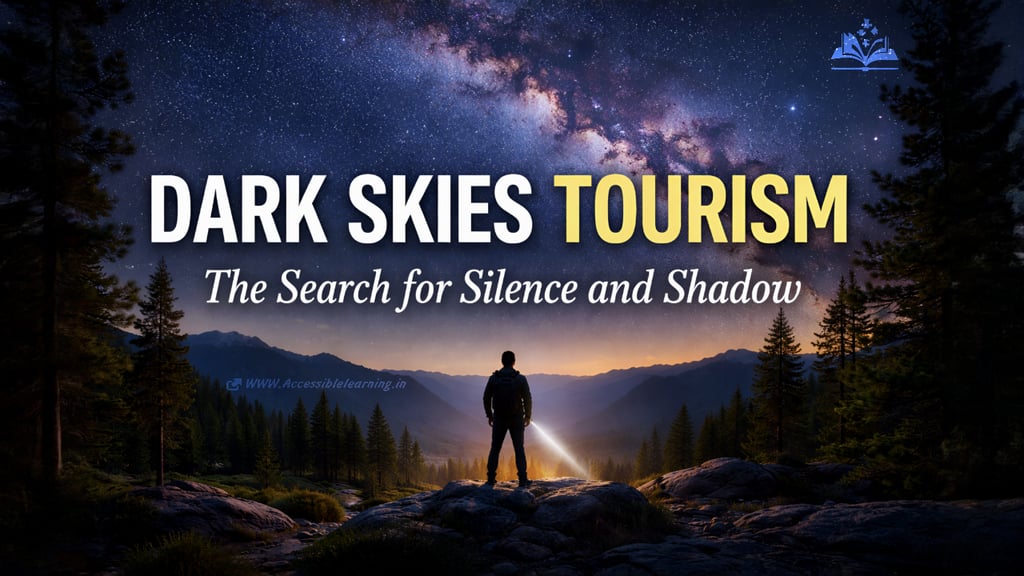
In a world where artificial light erases the night and constant noise fills every gap, darkness has become something people now travel to experience. Dark-sky tourism is not just about looking up at stars. It’s about stepping into an environment where time slows down, senses sharpen, and silence becomes noticeable again.
This form of travel is growing because it offers something modern life rarely does: true absence of light, of noise, of distraction.
A Deeper Look: What Makes a Sky “Dark”?
A genuinely dark sky isn’t just about fewer lights. It’s measured scientifically using tools like the Bortle Scale, which ranks sky darkness from Class 1 (pristine) to Class 9 (inner-city sky).
Class 1–2: You can see the Milky Way casting shadows
Class 3–4: Clear galaxy structure visible
Class 8–9: Only the brightest stars are visible
More than 80% of the world’s population lives under light-polluted skies, and nearly one-third of humanity has never seen the Milky Way in its natural state. That statistic alone is driving curiosity and demand.
The Hidden Luxury: Darkness as a Premium Experience
Ironically, darkness is becoming a form of luxury. High-end eco-resorts and remote lodges now market:
Private observatories
Zero-light architecture
Night-silence retreats
This is creating a new category: “luxury minimalism," where the absence of stimulation is the product itself. Instead of more amenities, travelers pay for less interference.
The Sound of Silence: What People Don’t Expect
One of the most surprising aspects of dark skies tourism is not visual—it’s auditory. In remote dark sky zones:
Ambient noise drops drastically
Human-made sound almost disappears
Natural sounds become more pronounced
People often report hearing things they’ve never noticed before:
Wind patterns
Insect rhythms
Distant animal movement
This level of silence can feel unfamiliar at first, even uncomfortable, because most people are not used to true acoustic emptiness.
Astrophotography Boom: Capturing the Invisible
Dark-sky tourism has fueled a massive rise in astrophotography. Modern cameras can capture the following:
Nebulae invisible to the naked eye
Star trails showing Earth’s rotation
Deep-space objects like Andromeda Galaxy
Social media has amplified this trend, turning night skies into a visual storytelling medium. Entire travel itineraries are now planned around getting “that one perfect shot.”
Timing is Everything: Planning Around the Sky
Unlike traditional travel, dark-sky tourism depends heavily on celestial timing:
New Moon phases for maximum darkness
Meteor showers like Perseids and Geminids
Planet visibility cycles
Seasonal Milky Way positioning
This creates a unique planning behavior where travelers schedule trips based on astronomical calendars rather than holidays.
Dark Sky Destinations Are Spreading Globally
While early dark-sky destinations were concentrated in North America and Europe, the map is expanding rapidly.
Emerging regions include:
Rural parts of India (Ladakh, Spiti Valley)
Middle Eastern deserts
African savannas
South American high-altitude regions
These areas offer naturally low light pollution and are now being recognized for their astrotourism potential.

The Role of Technology (and Its Paradox)
Technology plays a strange dual role in this space.
It helps:
Apps identify constellations in real time
Smart telescopes enhance visibility
AI-powered cameras capture deep space
But it also harms:
Overuse of screens disrupts night vision
Flash photography adds light pollution
Drones introduce noise and light intrusion
The best experiences often come when technology is used minimally or intentionally.
The Physiology of Darkness
Spending time in natural darkness has measurable biological effects:
Increased melatonin production (better sleep)
Reduced cortisol (lower stress)
Improved circadian alignment
Some researchers suggest that even 2–3 nights in a natural dark environment can begin resetting the body’s internal clock.
Cultural Stories Written in the Sky
Different cultures interpret the night sky in unique ways:
Indigenous communities often map stories, ancestors, and navigation routes onto constellations
Ancient civilizations used stars for agriculture and timekeeping
Mythologies across continents are deeply tied to celestial patterns
Dark skies tourism is increasingly incorporating local storytelling, turning stargazing into a cultural experience rather than just a scientific one.
The Environmental Movement Behind the Trend
Dark skies tourism is closely linked with a broader environmental effort to reduce light pollution.
Key practices include the following:
Shielded lighting (downward-facing lights)
Warm color temperature bulbs
Motion sensors instead of constant lighting
These changes don’t just improve sky visibility—they also:
Protect nocturnal wildlife
Reduce energy waste
Improve human health
Unexpected Challenges Travelers Face
Despite its appeal, dark-sky tourism comes with realities that many don’t anticipate:
Extreme temperatures at night (especially deserts and mountains)
Limited connectivity (no internet or signal)
Accessibility issues in remote regions
Weather dependency (cloud cover can ruin visibility)
This makes preparation essential and adds a layer of unpredictability.
The Emotional Impact: Why It Stays With You
What makes this form of travel memorable isn’t just what you see—it’s what you feel.
People often describe:
A sense of insignificance, but in a positive way
Deep calm and introspection
A break from constant mental stimulation
This emotional imprint is why many travelers return to dark sky destinations again and again.
The Future: From Niche to Necessity
As urban lighting continues to grow, dark skies may shift from being a niche attraction to a protected global resource.
Future developments may include:
Stricter light pollution regulations
Urban “dark sky zones” within cities
Integration with wellness tourism
Educational tourism for astronomy and climate awareness
Darkness may soon be treated not as an absence but as something that needs active preservation.
Dark-sky tourism is more than a travel trend. It reflects a deeper shift in what people are searching for—less noise, less light, and fewer distractions. In chasing darkness, travelers are not escaping the world. They’re reconnecting with it in its most natural state. And in that quiet, under a sky filled with stars, something rare happens:
you finally notice how loud life has been—and how peaceful it can be without it.


FAQ's
Q: What is dark skies tourism?
Dark skies tourism is a form of travel focused on visiting places with minimal light pollution to experience natural night environments. It includes activities like stargazing, astrophotography, and night-sky observation in protected areas such as Dark Sky Parks and reserves.
Q: Why is dark skies tourism becoming popular?
It is gaining popularity because people are seeking quieter, more meaningful travel experiences. With increasing light pollution in cities, many travelers want to reconnect with nature, experience real darkness, and see celestial objects like the Milky Way that are no longer visible in urban areas.
Q: Where are the best dark sky destinations in the world?
Some of the most recognized dark-sky destinations include:
Aoraki Mackenzie International Dark Sky Reserve (New Zealand)
Death Valley National Park (USA)
Atacama Desert (Chile)
NamibRand Nature Reserve (Namibia)
Ladakh (India)
These locations offer extremely low light pollution and clear atmospheric conditions for stargazing.
Q: When is the best time to go for dark skies tourism?
The best time depends on celestial conditions rather than seasons. Key factors include:
New moon phases (for maximum darkness)
Clear weather conditions
Meteor shower events (like Perseids or Geminids)
Milky Way visibility (varies by location and time of year)
Planning around these factors ensures the best experience.
Q: What equipment do you need for stargazing?
You don’t need expensive gear to enjoy dark skies. Basic essentials include:
Naked eye (for general viewing)
Binoculars (entry-level enhancement)
Telescope (for detailed observation)
Tripod and DSLR/mirrorless camera (for astrophotography)
Star map or mobile app for navigation
Even without equipment, a dark-sky location offers a powerful experience.
Q: Is dark skies tourism eco-friendly?
Yes, it is considered a sustainable form of tourism. It promotes:
Reduced energy consumption
Protection of wildlife affected by artificial light
Preservation of natural night environments
However, responsible travel is important to avoid disturbing fragile ecosystems.
Q: Can you experience dark skies tourism in India?
Yes, India has emerging dark-sky destinations. Regions like:
Hanle
Spiti Valley
Rann of Kutch
offer excellent conditions due to high altitude, dry climate, and low light pollution.
Q: Is dark skies tourism safe for beginners?
Yes, but preparation is important. Beginners should:
Travel with guides or join organized tours
Check weather and visibility forecasts
Carry warm clothing and essentials
Avoid isolated areas without planning
With basic precautions, it’s a safe and rewarding experience.
Q: How does light pollution affect stargazing?
Light pollution brightens the night sky, making stars and celestial objects difficult or impossible to see. It reduces visibility, disrupts ecosystems, and affects human sleep cycles. Dark sky destinations actively manage lighting to preserve natural darkness.
Q: What is the difference between astrotourism and noctourism?
Astrotourism focuses specifically on astronomy-related experiences like stargazing and observing celestial events.
Noctourism is broader and includes all nighttime travel experiences, such as night safaris, moonlit hikes, and cultural night tours.
Dark skies tourism sits at the intersection of both.
Q: Do you need to book special tours for dark sky experiences?
Not always. Many dark sky locations are accessible independently. However, guided tours can enhance the experience by offering:
Expert knowledge of constellations
Telescope access
Structured night-sky sessions
Cultural storytelling
Q: What makes a location officially a “Dark Sky Place”?
A location must meet strict criteria set by organizations like the International Dark-Sky Association. These include:
Measured low light pollution levels
Strong lighting regulations
Public education programs
Long-term conservation commitment
Only then can it receive official designation.
Subscribe to Frontier Intelligence
All © Copyright reserved by Accessible-Learning Hub
| Terms & Conditions
Accessible Learning Hub — Actionable clarity for high-agency minds.
Weekly breakdowns on AI breakthroughs, capital flow, and human performance systems. Zero fluff.