

Cyber-Physical Ecosystems: Learning Beyond the Screen
Explore how Cyber-Physical Ecosystems are transforming education beyond traditional screens. Learn how XR, AR, AI, digital twins, and spatial computing are creating immersive, hands-on learning experiences that make high-quality education more accessible, scalable, and effective for learners worldwide.
BIOTECH & HEALTH SCIENCES
Sachin K Chaurasiya | Shiv Singh Rajput
6/13/20267 min read
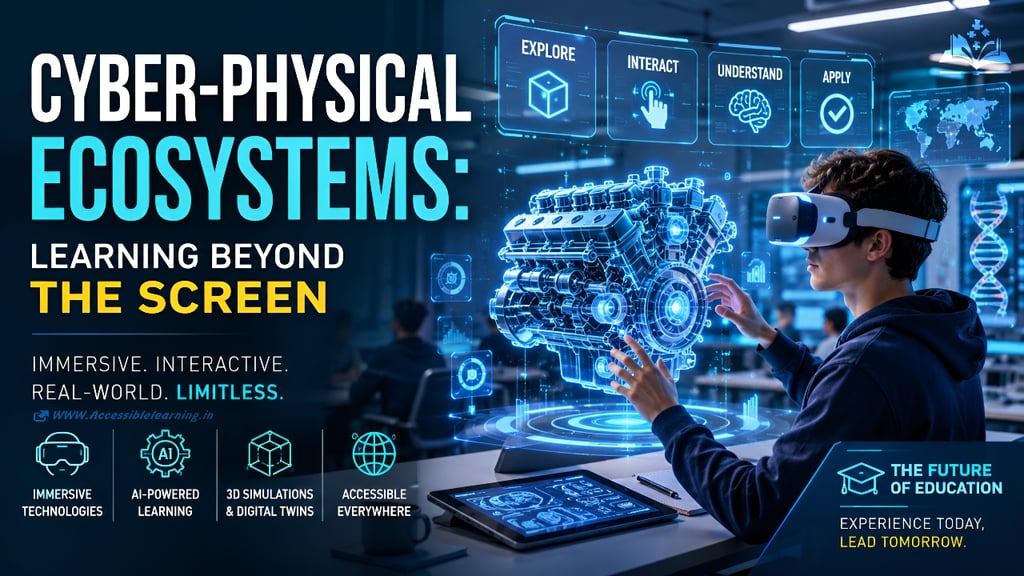
The Screen Is Dead. Welcome to the Cyber-Physical Classroom.
For decades, education has been trapped behind glass.
First, it was textbooks. Then laptops. Then video calls. The promise was always the same: more access, more convenience, more knowledge. Yet despite all the advances, most digital learning still boils down to staring at a flat screen and consuming information.
The problem is obvious. Humans were not designed to learn exclusively through rectangles. We learn by touching, moving, experimenting, failing, observing, and interacting with the physical world.
That is why the next major transformation in education is not another learning management system, another video platform, or another AI chatbot.
It is the rise of Cyber-Physical Ecosystems.
In 2026, education is moving beyond screens and into immersive environments powered by Extended Reality (XR), Augmented Reality (AR), Artificial Intelligence, spatial computing, digital twins, and connected physical devices. Instead of reading about complex systems, students can walk inside them. Instead of watching demonstrations, they can perform them. Instead of memorizing information, they can experience it.
The future classroom is no longer a place. It is an intelligent ecosystem where the digital and physical worlds merge.
What Is a Cyber-Physical Ecosystem?
A cyber-physical ecosystem is an environment where digital systems and physical reality continuously interact to create real-time learning experiences.
In simple terms, it combines:
Physical spaces
Digital simulations
AI-driven guidance
AR and XR interfaces
Sensors and connected devices
Real-world interaction
The result is learning that feels less like studying and more like doing. Traditional education separates theory and practice. Cyber-physical education removes that boundary. Imagine learning automotive engineering.
The old model:
Read a textbook chapter
Watch instructional videos
Complete a quiz
Wait months before touching a real engine
The cyber-physical model:
Put on an XR headset
Project a life-size engine into your room
Disassemble every component
Observe internal mechanics in real time
Receive AI coaching during the process
Practice repeatedly without damaging equipment
The difference is not incremental. It is transformational.
Why Traditional Screen-Based Learning Is Reaching Its Limits
Online education expanded rapidly because it solved accessibility problems. But it introduced new limitations.
Passive Consumption
Most learners become spectators rather than participants.
Watching is not the same as doing.
Limited Spatial Understanding
Subjects like engineering, medicine, architecture, chemistry, and manufacturing require three-dimensional thinking.
Flat screens struggle to communicate spatial relationships effectively.
Weak Knowledge Retention
Information learned passively is forgotten quickly.
Experiential learning creates stronger memory pathways.
Engagement Fatigue
Zoom fatigue is real.
Hours of staring at screens reduce focus, motivation, and retention.
The issue isn't technology.
The issue is that education digitized content without redesigning the learning experience.
Cyber-physical ecosystems solve that problem by making learning interactive, immersive, and embodied.


The Technologies Driving Cyber-Physical Learning
Several technologies are converging simultaneously. Their combined impact is creating an entirely new educational model.
Extended Reality (XR)
XR serves as the umbrella category for immersive technologies.
It includes:
These tools create environments where learners can interact with digital objects as though they exist physically. Instead of reading about anatomy, students can explore a full-scale human body. Instead of studying astronomy diagrams, they can walk through a solar system simulation.
Augmented Reality (AR)
AR overlays digital information onto the real world. A smartphone, tablet, or headset can project educational content directly into a learner's environment.
Examples include:
Interactive science experiments
Historical reconstructions
Engineering models
Language-learning visual aids
Technical maintenance instructions
AR bridges theory and reality in ways textbooks never could.
Artificial Intelligence
AI acts as the adaptive layer within cyber-physical ecosystems.
It can:
Personalize instruction
Monitor progress
Identify knowledge gaps
Generate simulations
Provide real-time feedback
Adjust learning difficulty dynamically
Every learner effectively gains access to a personal tutor operating continuously in the background.
Digital Twins
A digital twin is a virtual replica of a physical object, process, or environment.
Industries already use digital twins to model factories, aircraft, power plants, and cities.
Education is beginning to adopt the same approach.
Students can practice on virtual versions of expensive or dangerous systems before interacting with the real thing.
Mistakes become learning opportunities rather than costly failures.
Spatial Computing
Spatial computing allows computers to understand and respond to physical space. This technology enables the following:
Gesture-based interactions
Environmental awareness
Natural movement
Context-sensitive learning experiences
The classroom becomes responsive rather than static.
The Rise of Experiential Learning at Scale
Historically, hands-on learning was expensive. Medical schools required labs.
Engineering programs required equipment. Trade schools required workshops.
Field research required travel. These requirements limited access.
Cyber-physical ecosystems dramatically reduce these barriers.
A student in a remote village can access immersive experiences once available only in elite institutions.
A future surgeon can practice procedures repeatedly.
An aspiring engineer can interact with complex machinery.
An architecture student can walk through building designs before construction begins.
The experience becomes scalable without sacrificing quality. That changes everything.
How Different Industries Are Using Cyber-Physical Education
Healthcare Training
Medicine has always relied on practical experience. XR allows students to:
Practice surgeries
Explore anatomy
Simulate emergencies
Learn diagnostic procedures
Mistakes happen in simulation rather than on patients. This creates safer and more effective training environments.
Engineering Education
Engineering concepts become dramatically easier to understand when students can manipulate systems directly. Learners can:
Assemble machinery
Analyze structures
Test designs
Simulate failures
Complex concepts become tangible.
Manufacturing and Industrial Training
Factories increasingly use immersive environments to train workers. Employees can learn:
Equipment operation
Safety procedures
Maintenance protocols
Production workflows
Training becomes faster, safer, and more consistent.
Architecture and Design
Architects no longer need to rely solely on blueprints. Students can:
Walk through structures
Evaluate layouts
Test lighting conditions
Explore materials
Design decisions become easier and more informed.
Science Education
Scientific concepts often involve invisible processes. XR can visualize:
Chemical reactions
Atomic structures
Biological systems
Environmental processes
Abstract concepts become observable experiences.

Why Cyber-Physical Learning Creates Better Outcomes
The science behind immersive learning is compelling. Humans remember experiences more effectively than information. When learners actively participate, multiple cognitive systems engage simultaneously.
This improves:
Retention
Experiential learning creates stronger memories.
Understanding
Complex concepts become easier to visualize.
Confidence
Practice reduces uncertainty.
Skill Transfer
Learners apply knowledge more effectively in real-world situations.
Motivation
Immersive experiences increase engagement.
The result is education that produces competence rather than mere completion.
The Affordability Revolution
The biggest reason cyber-physical learning is accelerating in 2026 is cost. Five years ago, immersive technology was largely confined to research labs and enterprise environments.
Today:
Headsets are cheaper
Mobile AR is widespread
Processing power is more affordable
Cloud rendering reduces hardware requirements
AI lowers content-creation costs
The economics have changed. Educational institutions no longer need massive budgets to deploy immersive learning programs. More importantly, learners can access many experiences from home. This democratization is what transforms cyber-physical learning from a niche innovation into a global movement.
The Equity Argument Nobody Is Talking About
Critics often assume advanced technology increases inequality. In many cases, the opposite is happening.
The traditional education model favors those with access to:
Elite schools
Specialized equipment
Geographic proximity
Professional networks
Cyber-physical ecosystems reduce these advantages.
A student in a rural region can access experiences previously available only in major cities.
A learner without expensive lab access can perform virtual experiments.
A developing nation can provide world-class training without building massive physical infrastructure.
Access becomes more dependent on connectivity than location.
That is one of the most powerful educational shifts of the decade.
The Challenges Ahead
Cyber-physical learning is not a magic solution. Several obstacles remain.
Infrastructure Gaps
Reliable internet and hardware access are still uneven globally.
Content Development
Creating high-quality immersive experiences requires expertise and investment.
Educator Training
Teachers must learn entirely new instructional methods.
Privacy and Data Security
Immersive systems collect significant amounts of behavioral data.
Proper governance is essential.
Digital Overdependence
Not every learning experience benefits from immersion.
Some subjects still require discussion, reflection, writing, and human interaction.
The goal is not replacing traditional education.
The goal is enhancing it.
What Education Looks Like by 2030
The next generation of learning environments will be hybrid by default. Students may:
Attend virtual laboratories from home
Collaborate in shared XR spaces
Interact with AI mentors
Practice on digital twins
Learn through physical simulations
Transition seamlessly between digital and real-world environments
The distinction between online and offline learning will gradually disappear. Education will become contextual, immersive, and continuous. Learning won't happen on a screen. It will happen around you.

The age of screen-centered education is ending. Not because screens are disappearing, but because they are no longer enough.
Cyber-physical ecosystems represent the next evolution of learning. They combine immersive technology, artificial intelligence, spatial computing, and real-world interaction to create experiences that traditional classrooms and online courses simply cannot match.
The most important shift is not technological. It is educational.
For the first time, high-quality experiential learning can be delivered at a global scale. Students no longer have to imagine how systems work. They can explore them. They no longer need to wait for access to specialized equipment. They can interact with digital equivalents instantly. They no longer have to be physically present to gain practical experience.
The screen was a bridge.
Cyber-physical learning is the destination.
And for education, the future has already arrived.
FAQs
Q: What is a Cyber-Physical Ecosystem in education?
A Cyber-Physical Ecosystem in education is a learning environment that combines physical spaces with digital technologies such as AI, Augmented Reality (AR), Virtual Reality (VR), Mixed Reality (MR), sensors, and connected devices. It enables learners to interact with immersive simulations and real-world scenarios rather than relying solely on traditional screens.
Q: How is cyber-physical learning different from online learning?
Traditional online learning primarily involves watching videos, reading content, and completing digital assignments. Cyber-physical learning goes further by allowing students to interact with 3D models, digital twins, AR experiences, and virtual simulations, creating hands-on learning opportunities regardless of location.
Q: What technologies power cyber-physical classrooms?
Cyber-physical classrooms are powered by technologies such as:
Artificial Intelligence (AI)
Augmented Reality (AR)
Virtual Reality (VR)
Mixed Reality (MR)
Digital Twins
Spatial Computing
Internet of Things (IoT) devices
Cloud Computing
Together, these technologies create immersive and interactive educational experiences.
Q: What are the benefits of Cyber-Physical Ecosystems for students?
Key benefits include the following:
Improved knowledge retention
Better practical skill development
Increased learner engagement
Real-world experience through simulations
Personalized learning paths powered by AI
Access to advanced training regardless of geographic location
Q: Can cyber-physical learning make education more accessible?
Yes. Cyber-physical learning can reduce barriers related to location, infrastructure, and access to specialized equipment. Students in remote or underserved regions can participate in advanced laboratory simulations, technical training, and immersive educational experiences without needing physical access to expensive facilities.
Q: Which industries benefit most from cyber-physical education?
Industries that benefit significantly include:
Healthcare and medical training
Engineering
Manufacturing
Architecture and construction
Aviation
Science and research
Skilled trades and vocational education
These sectors require hands-on experience that can be effectively replicated through immersive technologies.
Q: What role does AI play in Cyber-Physical Ecosystems?
AI acts as an intelligent learning assistant by analyzing student performance, adapting content difficulty, providing real-time feedback, identifying skill gaps, and personalizing educational experiences. This creates a more efficient and customized learning journey.
Q: Will Cyber-Physical Ecosystems replace traditional classrooms?
Not entirely. The most likely future is a hybrid model where physical classrooms, digital learning platforms, and immersive technologies work together. Cyber-physical ecosystems enhance learning experiences rather than completely replacing teachers, schools, or face-to-face education.
Q: What is the future of cyber-physical learning by 2030?
By 2030, experts expect cyber-physical learning environments to become more affordable, accessible, and widespread. Students may routinely use AI tutors, digital twins, AR-based lessons, and immersive simulations as part of everyday education, making experiential learning a standard rather than a luxury.
Q: Why are Cyber-Physical Ecosystems considered the future of education?
Cyber-Physical Ecosystems bridge the gap between theory and practice. They allow learners to experience concepts rather than simply study them, leading to deeper understanding, stronger engagement, improved skill development, and more equitable access to high-quality education worldwide.
Subscribe to Frontier Intelligence
All © Copyright reserved by Accessible-Learning Hub
Accessible Learning Hub — Actionable clarity for high-agency minds.
Weekly breakdowns on AI breakthroughs, capital flow, and human performance systems. Zero fluff.