

Chhatrapati Shivaji Maharaj Jayanti: Rethinking Power, Leadership, and Swarajya
Chhatrapati Shivaji Maharaj Jayanti is more than a birth anniversary. This in-depth article explores the lesser-known ideas, systems, and philosophies behind Shivaji Maharaj’s leadership, governance, and Swarajya. Moving beyond commonly repeated facts, it reveals how his ethical warfare, decentralized administration, intelligence networks, and cultural vision shaped one of the most resilient political models in Indian history.
CULTURE/TRADITIONINDIAN HISTORYCELEBRATION/FESTIVALS
Keshav Jha
2/8/20266 min read
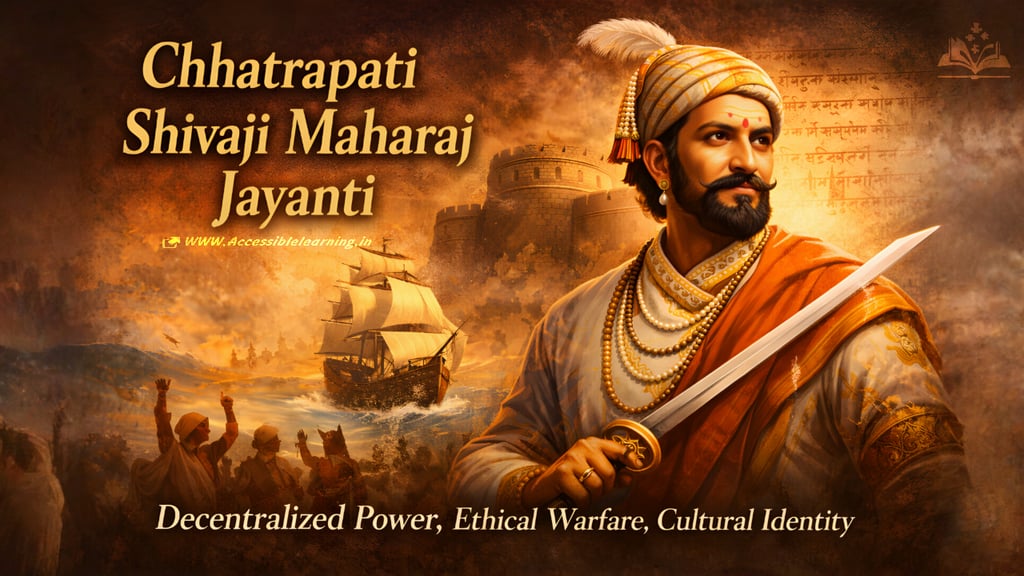
Chhatrapati Shivaji Maharaj Jayanti is often described as a celebration of bravery and nationalism. That is true, but incomplete. At its core, this day marks the birth of a radically different idea of governance in medieval India. An idea built on ethics, local power, social mobility, and strategic intelligence rather than brute empire-building.
This article goes beyond the textbook narrative. Instead of repeating what is already known, it focuses on lesser-discussed dimensions of Chhatrapati Shivaji Maharaj and why his legacy feels increasingly relevant in today’s world.
Shivaji Maharaj Was Not Building an Empire. He Was Building a System
Most rulers of the 17th century measured success by territorial expansion. Shivaji Maharaj measured it by administrative resilience. His Swarajya was designed to survive even if the king was absent. This was rare for that era.
Unknown but critical facts:
Power was intentionally distributed across officers to prevent collapse if one leader failed.
Forts were autonomous administrative units, not just military bases.
Revenue, justice, and defense were separated functions to avoid concentration of power.
In modern terms, Shivaji Maharaj was creating a fault-tolerant governance model.
His Military Genius Was More Psychological Than Physical
Guerrilla warfare is often cited, but what is rarely discussed is why it worked so well. Shivaji Maharaj understood something advanced for his time:
Wars are won first in the mind, then on the battlefield.
Lesser-known strategies:
He deliberately spread uncertainty among enemies using misinformation and rapid mobility.
Attacks were timed to disrupt morale, not maximize casualties.
He avoided symbolic victories if they risked long-term instability.
This makes him closer to a modern strategic thinker than a medieval warlord.
Jayanti Is Also a Celebration of Ethical Warfare
Shivaji Maharaj introduced rules of war that were unheard of in the subcontinent then.
Often ignored facts:
Looting civilian property was punishable, even during campaigns.
Women, religious places, and farmers were protected by royal orders.
Enemy officers were sometimes released if captured dishonorably.
This moral framework is one reason his administration earned loyalty instead of fear.
His Navy Was a Silent Revolution
India’s maritime history often overlooks Shivaji Maharaj’s naval vision.
What is rarely emphasized:
He understood that coastal control meant economic independence.
His navy was built to counter European colonial powers, not just regional rivals.
Forts like Sindhudurg were designed specifically for sea-based defense, which was unusual in Indian kingdoms at the time.
In effect, Shivaji Maharaj anticipated colonial threats decades before they fully emerged.
Social Mobility Was a Core Principle, Not an Accident
Unlike most monarchies of his era, Shivaji Maharaj did not restrict power based on birth alone.
Hidden but powerful realities:
Several top commanders came from non-elite backgrounds.
Skill, loyalty, and competence mattered more than caste lineage.
Promotions were performance-based, not hereditary.
This created a culture where common people felt invested in the state, not alienated by it.
Language as Resistance
One of Shivaji Maharaj’s quiet revolutions was linguistic. Instead of Persian or Arabic dominating administration:
Marathi and Sanskritized Marathi were actively promoted.
Legal and administrative documents were localized for accessibility.
This strengthened cultural identity without imposing religious uniformity.
Language became a tool of empowerment, not exclusion.
Why Shivaji Maharaj Jayanti Still Matters Today
Shivaji Maharaj Jayanti is not just about remembering a historical figure. It is about revisiting a governance philosophy that feels strikingly modern.
His legacy speaks to:
Decentralization in leadership
Ethical use of power
Cultural confidence without intolerance
Strategic thinking over brute force
In an age of centralized authority and information warfare, his ideas feel less historical and more instructional.

The Fort Network Was an Information System, Not Just Defense
Shivaji Maharaj controlled over 300 forts, but their real value was information flow, not walls. Less-known insights:
Each fort functioned as an intelligence relay point.
Signal systems using fire, flags, and messengers allowed rapid coordination.
Fort commanders were rotated to prevent local power capture.
This created an early form of distributed command and control, centuries before modern military doctrine.
He Practiced Economic Warfare Without Destroying Economies
Most rulers crippled enemy regions through destruction. Shivaji Maharaj did the opposite.
Unknown strategies:
He avoided burning agricultural land, even in enemy territories.
Trade routes were disrupted selectively, not permanently.
Merchants were taxed fairly and protected, encouraging economic migration into Swarajya.
As a result, Swarajya grew economically while rival regions weakened internally.
Religious Policy Was Strategic Neutrality, Not Just Tolerance
Shivaji Maharaj’s religious approach is often oversimplified. Reality:
He separated governance from personal faith.
Appointments were based on trust and skill, regardless of religion.
Religious institutions were protected because social stability depended on them.
This wasn’t symbolic tolerance. It was statecraft rooted in social psychology.
Intelligence Over Assassination
Contrary to popular belief, Shivaji Maharaj avoided unnecessary killings. Rarely highlighted facts:
Spies were used more than soldiers.
Psychological pressure often replaced direct conflict.
Many victories were achieved without large-scale battles.
His intelligence system included traders, monks, farmers, and even traveling performers.
This made Swarajya hard to predict and harder to defeat.
Women Were Indirect Stakeholders in Governance
While women rarely held formal posts, their protection was policy-driven, not emotional. Important but ignored aspects:
Crimes against women carried strict punishments.
Captured women from enemy camps were returned safely with dignity.
This policy earned civilian trust and reduced resistance during campaigns.
In effect, Shivaji Maharaj understood that social ethics strengthen military authority.
His Coronation Was a Political Declaration, Not a Ritual
The coronation at Raigad was not about royalty. It was about legitimacy. Hidden meaning:
It formally challenged Mughal political supremacy.
It established an indigenous model of kingship.
It sent a message that local rule could coexist without imperial approval.
Jayanti commemorates the birth of political self-rule, not just a ruler.
Why Shivaji Maharaj Jayanti Is Observed on Different Dates
Many people are unaware that Jayanti is observed based on:
Tithi (lunar calendar)
Gregorian calendar (19 February)
This dual observance reflects India’s layered historical timekeeping and cultural continuity, not confusion.
Shivaji Maharaj as a Leadership Case Study
Modern leadership theory unknowingly echoes his principles:
Mission-first thinking
Ethical constraints on power
Decentralized authority
Adaptive strategy
This is why his life is studied in military academies, management discussions, and governance debates.
Reframing Chhatrapati Shivaji Maharaj Jayanti
Chhatrapati Shivaji Maharaj Jayanti is not nostalgia. It is a reminder that India once produced a ruler who combined strategy, ethics, inclusion, and foresight.
He did not wait for perfect conditions.
He built systems that survived imperfect ones.
That is why remembering Shivaji Maharaj is not about the past.
It is about understanding how leadership should work when the stakes are real.


FAQ's
Q: Why is Chhatrapati Shivaji Maharaj Jayanti celebrated beyond his birth anniversary?
Chhatrapati Shivaji Maharaj Jayanti is not only about commemorating the birth of Chhatrapati Shivaji Maharaj. It represents the emergence of an indigenous governance model based on Swarajya, ethical leadership, decentralized administration, and social accountability. The day symbolizes political self-respect and system-building rather than personal glorification.
Q: What makes Shivaji Maharaj’s governance different from other medieval rulers?
Unlike most medieval rulers who focused on dynastic expansion, Shivaji Maharaj prioritized sustainability of governance. His administration emphasized local autonomy, accountability of officers, protection of civilians, and economic continuity. These principles made his state resilient even under constant military pressure.
Q: Was Shivaji Maharaj only a military leader or also a political thinker?
Shivaji Maharaj was a strategic political thinker first and a military leader second. His wars were tools to establish stable rule, not ends in themselves. He invested heavily in intelligence networks, administrative reforms, maritime security, and cultural identity, which are hallmarks of long-term statecraft.
Q: Why is Shivaji Maharaj considered a pioneer of ethical warfare?
Shivaji Maharaj enforced strict codes of conduct for his soldiers. Harm to civilians, women, religious institutions, and farmers was punishable by law. This approach was rare in 17th-century warfare and helped him gain popular legitimacy instead of ruling through fear.
Q: What is the significance of Swarajya in today’s context?
Swarajya was not just freedom from external rule. It meant self-governance rooted in local needs, cultural confidence, and moral authority. In today’s context, Swarajya aligns with ideas like decentralized governance, community participation, and leadership accountability.
Q: Why is Shivaji Maharaj Jayanti celebrated on different dates?
Shivaji Maharaj Jayanti is observed based on two systems:
Tithi (lunar calendar), followed traditionally in Maharashtra
Gregorian calendar (19 February), used officially
This dual observance reflects India’s historical blend of cultural and administrative timekeeping systems.
Q: How did Shivaji Maharaj promote social mobility in his kingdom?
Shivaji Maharaj appointed individuals based on merit, loyalty, and competence rather than birth or caste. Many of his key commanders and administrators rose from non-elite backgrounds, creating a governance structure where talent mattered more than lineage.
Q: What role did forts play in Shivaji Maharaj’s administration?
Forts under Shivaji Maharaj were administrative and intelligence centers, not just military structures. Each fort managed local revenue, security, and communication, allowing the state to function efficiently even during conflict. This networked model was advanced for its time.
Q: Why is Shivaji Maharaj relevant to modern leadership and governance studies?
Shivaji Maharaj’s leadership principles mirror modern concepts such as mission-based leadership, decentralization, ethical power use, and adaptive strategy. His life is often cited in discussions on military strategy, public administration, and crisis leadership.
Q: What does Chhatrapati Shivaji Maharaj Jayanti truly stand for?
Chhatrapati Shivaji Maharaj Jayanti stands for dignity in leadership, intelligence over aggression, ethics over domination, and systems over personalities. It is a reminder that strong governance does not require oppression, only clarity of purpose and moral authority.
Subscribe to Frontier Intelligence
All © Copyright reserved by Accessible-Learning Hub
| Terms & Conditions
Accessible Learning Hub — Actionable clarity for high-agency minds.
Weekly breakdowns on AI breakthroughs, capital flow, and human performance systems. Zero fluff.