

Building the Multi-Agent Workforce: Scaling Without Hiring
Discover how multi-agent AI workforces are transforming business growth in 2026. Learn how startups and ambitious operators can scale operations, automate execution, and build autonomous teams using AI agents that collaborate, delegate tasks, and work around the clock without expanding headcount.
AI ASSISTANTAI/FUTUREENTREPRENEUR/BUSINESSMANDIGITAL MARKETING
Sachin K Chaurasiya
6/30/20267 min read
You Don't Need More Employees. You Need Agents That Talk to Each Other.
For more than a century, businesses scaled the same way.
More customers meant more work.
More work meant more employees.
More employees meant more managers.
More managers meant more layers, more meetings, more communication, and more operational complexity.
It worked because there was no alternative. In 2026, there is.
The smartest companies are discovering that growth is no longer constrained by headcount. Instead of hiring junior marketers, junior researchers, junior SDRs, coordinators, assistants, and analysts, they are building teams of AI agents that collaborate with one another and execute work autonomously.
This isn't about replacing people with chatbots.
It is about creating an entirely new operating model.
A model where specialized AI agents communicate, delegate, review, coordinate, and execute tasks together. The companies embracing this shift today are building an unfair advantage that traditional organizations will struggle to match.
The future of business isn't bigger teams.
It's smarter systems.
And those systems are rapidly evolving into what can best be described as a Multi-Agent Workforce.
The End of the "One AI Assistant" Era
Most businesses are still using AI as a tool.
They open ChatGPT.
They type a prompt.
They receive an answer.
Then they repeat the process.
This approach improves productivity, but it doesn't fundamentally change how the company operates.
The next stage is entirely different. Instead of one AI helping one person complete one task, businesses are creating networks of AI agents that function like departments.
The difference is enormous.
A single assistant can answer questions.
A workforce can run operations.
This shift mirrors the evolution from a solo freelancer to a coordinated organization.
The productivity gains aren't incremental.
They are exponential.
What Is a Multi-Agent Workforce?
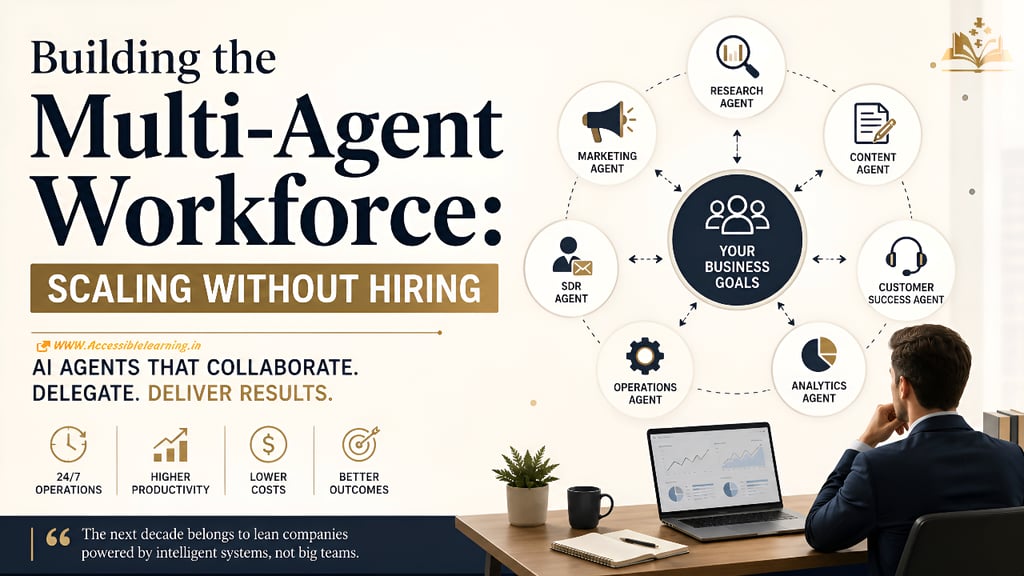
A Multi-Agent Workforce is a system of specialized AI agents designed to work together toward business objectives. Each agent has a specific responsibility. Rather than trying to perform every task, each agent focuses on a narrow domain.
Examples include:
Research Agents
Marketing Agents
Sales Agents
SDR Agents
Customer Success Agents
Data Analysis Agents
Operations Agents
Quality Assurance Agents
Project Management Agents
Executive Reporting Agents
Each agent performs its role and then passes information to the next agent when required. This creates an interconnected digital workforce capable of handling workflows that would traditionally require entire teams. Think of it as building a company made up of software workers.
Why Specialization Beats General Intelligence
One of the biggest misconceptions in AI is that bigger models automatically produce better business outcomes. In reality, specialization wins. The best organizations don't hire one employee to handle the following:
Marketing
Sales
Operations
Finance
Customer Service
Product Development
They hire specialists. Multi-agent systems follow the same principle.
A dedicated research agent will outperform a general-purpose agent at gathering competitive intelligence.
A dedicated SDR agent will outperform a general-purpose agent at prospecting.
A dedicated content agent will outperform a general-purpose agent at publishing content.
The future belongs to systems composed of specialists rather than giant all-purpose assistants.

Agent-to-Agent Delegation: The Most Important Business Innovation in AI
The real breakthrough isn't artificial intelligence itself.
It's delegation.
Traditional software follows predefined instructions.
Agentic systems can make decisions about what happens next.
Imagine a founder says the following:
"Launch a campaign targeting SaaS founders interested in workflow automation."
Instead of requiring dozens of manual steps, a workforce of agents might execute the entire project.
Research Agent
Identifies market trends
Finds competitors
Collects customer pain points
Discovers content opportunities
Strategy Agent
Creates positioning
Defines messaging
Develops campaign objectives
Content Agent
Produces blogs
Creates email sequences
Generates social content
Writes landing pages
Design Agent
Generates visual concepts
Creates ad assets
Produces creative variations
SDR Agent
Identifies prospects
Builds outreach lists
Drafts personalized messages
Analytics Agent
Tracks campaign performance
Detects bottlenecks
Generates optimization recommendations
Instead of one employee manually coordinating all these activities, the agents coordinate among themselves. This is where businesses begin scaling beyond traditional human limitations.
The Hidden Cost of Human Scaling
Most founders underestimate the cost of growth.
A new hire doesn't simply add output.
A new hire adds complexity.
Every additional employee creates:
More communication
More management
More training
More meetings
More documentation
More oversight
More coordination
As organizations grow, complexity grows faster than productivity.
Many startups don't fail because they lack revenue.
They fail because operational complexity overwhelms them.
AI workforces attack this problem directly.
Digital workers don't require onboarding meetings.
They don't forget processes.
They don't leave unexpectedly.
They don't require management structures.
And they can operate continuously.
This dramatically changes the economics of scaling.
The New Competitive Advantage: Operational Leverage
Historically, businesses competed through the following:
Capital
Talent
Distribution
Brand
Those advantages still matter. But a new advantage is emerging. Operational leverage. Operational leverage measures how much output a company can generate relative to its size.
A company with:
10 employees
100 AI agents
Automated workflows
Connected systems
may outperform a company with:
100 employees
Manual processes
Traditional management structures
The next generation of market leaders will likely be smaller than today's giants. But they will move significantly faster.
How Multi-Agent Businesses Will Be Structured
Today's organizational chart looks like this:
CEO
→ Marketing Department
→ Sales Department
→ Operations Department
→ Support Department
→ Finance Department
Tomorrow's structure may look very different.
CEO
→ Human Leadership Layer
→ Agent Orchestration Layer
→ AI Research Team
→ AI Marketing Team
→ AI Sales Team
→ AI Operations Team
→ AI Customer Success Team
Humans focus on:
Direction
Strategy
Creativity
Relationships
Decisions
Agents focus on:
Execution
Analysis
Documentation
Monitoring
Reporting
Repetitive processes
This creates an organization that remains lean while producing enterprise-level output.

The Rise of AI Managers
An overlooked development is the emergence of manager agents.
Most discussions focus on worker agents.
But management agents may become even more valuable.
These agents can:
Monitor project status
Assign tasks
Track KPIs
Identify bottlenecks
Reallocate resources
Escalate critical issues
Essentially, they become operational coordinators. Instead of humans constantly managing workflows, managers increasingly supervise the systems that manage workflows.
This creates a new role for leadership. Less supervision. More strategic direction.
Building a Sales Department Without Hiring SDRs
Sales is one of the clearest examples of the multi-agent workforce model. A sales organization might include the following:
Prospecting Agent
Finds qualified leads.
Research Agent
Analyzes prospects.
Personalization Agent
Creates tailored outreach.
Follow-Up Agent
Maintains engagement.
CRM Agent
Updates records automatically.
Analytics Agent
Measures conversion rates.
Together, these agents create a sales machine that operates around the clock.
Human salespeople then focus exclusively on conversations and closing deals.
Building a Content Department Without Hiring a Team
Content production is another area undergoing radical transformation. A modern content workforce may include the following:
SEO Research Agent
Identifies opportunities.
GEO Optimization Agent
Structures content for AI search engines.
Writing Agent
Creates articles.
Editing Agent
Improves clarity and accuracy.
Distribution Agent
Publishes content.
Repurposing Agent
Turns one article into dozens of assets.
The result is a content engine capable of producing months of work in days.
The Platforms Powering the Multi-Agent Revolution
Several platforms are leading the shift toward AI workforces.
Relevance AI
Relevance AI has become one of the strongest platforms for creating coordinated AI workforces. Businesses can deploy teams of agents capable of collaborating across multiple functions, making it particularly attractive for startups seeking rapid operational scale.
Best For
Sales teams
Customer success
Marketing operations
Internal workflows
Microsoft Copilot Studio
Microsoft's enterprise ecosystem is evolving toward large-scale agent orchestration. Organizations can integrate autonomous agents directly into existing workflows, making Copilot Studio particularly powerful for large enterprises.
Best For
Enterprise operations
Internal automation
Microsoft ecosystem integration
Large-scale deployments
CrewAI
CrewAI popularized the idea of assigning specific roles and responsibilities to multiple agents.
Its framework makes it easier to coordinate agent collaboration around shared objectives.
LangGraph
LangGraph enables advanced workflow orchestration and persistent state management.
This makes it particularly valuable for complex multi-step business processes.
OpenAI Agent Frameworks
The latest generation of OpenAI-powered systems is increasingly capable of planning, reasoning, memory retention, and tool usage.
These capabilities provide the foundation upon which many modern AI workforces are built.

The Risks Most Founders Ignore
Multi-agent systems are powerful. They are not perfect.
Common risks include:
Hallucinations
Workflow failures
Context loss
Poor delegation logic
Security vulnerabilities
Excessive automation
Businesses that blindly automate everything often create larger problems.
Successful organizations implement oversight mechanisms.
Humans remain responsible for outcomes.
Agents remain responsible for execution.
The strongest systems combine both.
Why Most Companies Are Still Underestimating This Shift
Many leaders compare AI agents to traditional software.
That comparison misses the point.
Traditional software follows instructions.
Multi-agent systems pursue objectives.
That distinction changes everything.
When systems can coordinate, delegate, adapt, and execute autonomously, businesses stop scaling through labor alone. They begin scaling through intelligence. The companies that understand this early will operate with levels of efficiency that competitors struggle to match.
The Next Decade Will Belong to Lean Companies
For years, investors celebrated growth through headcount. Bigger teams signaled bigger companies. That assumption is beginning to break. The most valuable companies of the next decade may employ fewer people than many mid-sized businesses today.
What they will possess instead is something far more powerful:
A coordinated workforce of specialized AI agents.
Researching.
Analyzing.
Writing.
Selling.
Reporting.
Optimizing.
Working together around the clock.
The winners won't be the companies with the most employees. They will be the companies with the best systems. Because in the age of AI, scale is no longer a hiring problem. It is an orchestration problem. And the businesses that master multi-agent orchestration will define the next era of competition.
FAQ's
Q: What is a Multi-Agent Workforce?
A multi-agent workforce is a system of specialized AI agents that work together to complete business tasks. Instead of relying on a single AI assistant, organizations deploy multiple agents with distinct roles such as research, marketing, sales, customer support, and operations, allowing them to collaborate and execute complex workflows autonomously.
Q: How does Agent-to-Agent Delegation work?
Agent-to-agent delegation allows one AI agent to assign tasks, share information, and coordinate with other agents. For example, a research agent can gather market insights and automatically pass them to a marketing agent, which then creates campaigns and forwards them to a content agent for execution.
Q: What are the benefits of using AI agent teams instead of hiring more employees?
AI agent teams can operate 24/7, handle repetitive tasks at scale, reduce operational costs, improve workflow efficiency, and eliminate many coordination bottlenecks. This enables businesses to grow output without increasing headcount at the same rate.
Q: Which industries can benefit most from Multi-Agent AI systems?
Industries such as SaaS, e-commerce, marketing, consulting, customer service, finance, education, healthcare administration, and sales operations can benefit significantly from multi-agent systems due to their reliance on repeatable workflows and data-driven processes.
Q: What platforms are best for building a Multi-Agent Workforce in 2026?
Popular platforms include Relevance AI for AI workforce creation, Microsoft Copilot Studio for enterprise automation, CrewAI for agent collaboration, LangGraph for workflow orchestration, and OpenAI-based agent frameworks for custom autonomous systems.
Q: Can AI agents completely replace human employees?
No. AI agents are best suited for execution, automation, analysis, and repetitive processes. Human expertise remains essential for leadership, strategy, creativity, relationship building, decision-making, and handling complex situations that require judgment.
Q: How do businesses start building an AI workforce?
Most businesses begin by identifying repetitive workflows, creating specialized agents for specific tasks, connecting those agents through automated processes, and maintaining human oversight for critical decisions. Starting with one department, such as sales or content marketing, is often the most effective approach.
Q: What is the difference between an AI assistant and a Multi-Agent system?
An AI assistant typically performs tasks based on direct user prompts, while a multi-agent system consists of multiple AI agents that collaborate, delegate responsibilities, share context, and work toward broader business goals with minimal human intervention.
Q: Why is AI agent orchestration considered the future of business operations?
AI agent orchestration enables organizations to coordinate multiple autonomous systems efficiently, creating scalable workflows that increase productivity, reduce operational complexity, and allow smaller teams to compete with much larger companies.
Q: Will Multi-Agent Workforces become a standard business model in the future?
Many industry experts believe multi-agent workforces will become a core component of modern organizations over the next decade. As AI capabilities improve, businesses will increasingly rely on coordinated AI agents to manage operations, customer interactions, content production, analytics, and sales processes at scale.
Subscribe To Our Newsletter
All © Copyright reserved by Accessible-Learning Hub
| Terms & Conditions
Knowledge is power. Learn with Us. 📚

