

Bonalu Festival Begins: Telangana’s Fierce Tribute to Mahakali Is More Than a Celebration
Discover the Bonalu Festival of Telangana, a powerful celebration dedicated to Maa Mahakali. Explore its history, rituals, Pothuraju traditions, cultural significance, economic impact, and the realities behind one of India's most vibrant religious festivals.
CULTURE/TRADITIONINDIA/BHARATEVENT/SPECIAL
Jagdish Nishad
7/7/20264 min read
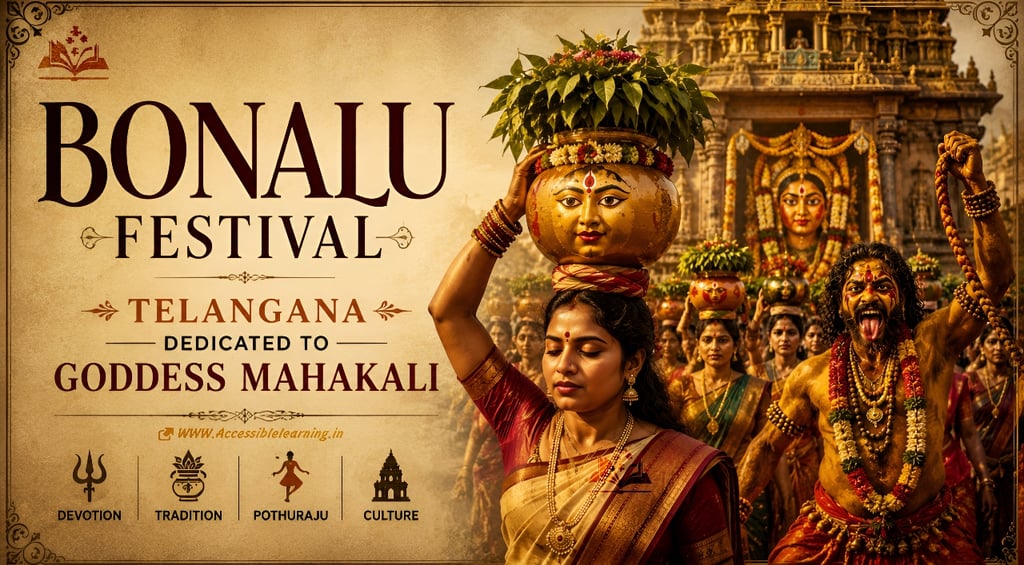
Bonalu Is Not a Festival of Entertainment. It Is a Public Declaration of Faith.
Every year, when Bonalu begins across Telangana, millions of devotees carry decorated pots filled with rice, jaggery, curd, and neem leaves to temples dedicated to Maa Mahakali. This ritual looks colorful on social media, but its origins come from something far darker: fear of disease, death, and survival.
Bonalu emerged from a belief that Maa Mahakali protected communities from deadly epidemics, especially plague outbreaks that devastated parts of the Deccan during the nineteenth century. The offering itself, called "Bonam," literally means a meal presented to the Mother Goddess in gratitude for protection.
Unlike many festivals that have evolved into commercial spectacles, Bonalu still carries an unmistakable sense of urgency. Devotees do not simply celebrate. They fulfill promises, repay spiritual debts, and seek protection for the year ahead.
Mahakali Dominates Telangana's Cultural Identity
Bonalu belongs to Telangana in a way few festivals belong to any region.
While India hosts countless religious events, Bonalu remains deeply rooted in local identity. Temples dedicated to Mahakali become the center of public life. Entire neighborhoods reorganize around processions, offerings, and temple schedules.
The most prominent celebrations take place in Hyderabad and Secunderabad, where temples such as the historic Mahakali shrines attract enormous crowds. Streets transform into religious corridors. Traffic plans collapse under pressure. Businesses adjust operating hours. Police deployments increase dramatically.
This is not a side event on Telangana's cultural calendar.
It is one of the defining expressions of regional heritage.
The Real Centerpiece: Women Carry the Festival
Tourism campaigns often focus on decorated temples and colorful processions. They miss the most important fact. Women drive Bonalu.
Thousands of women carry elaborately decorated Bonam pots on their heads while dressed in traditional attire. The ritual requires preparation, discipline, and physical endurance. The act symbolizes devotion, gratitude, and the responsibility of maintaining the spiritual bond between family and deity.
Without these women, Bonalu would lose its core identity. The visual power of the festival comes directly from their participation, not from government-sponsored stages or promotional campaigns.
Pothuraju Steals Attention, But His Role Runs Deeper
No image of Bonalu attracts more attention than Pothuraju.
Bare-chested, covered in turmeric, wearing bells, and moving through crowds with explosive energy, Pothuraju represents the protective brother of Mahakali. His presence creates some of the festival's most dramatic moments.
Many outsiders see performance.
Locals see protection.
Traditionally, Pothuraju leads processions and symbolically clears the path for the Goddess. His aggressive movements reflect the festival's underlying theme: confronting danger rather than avoiding it.
Bonalu never presents divinity as gentle or distant. It presents divine power as active, fierce, and capable of destroying threats.
The Logistics Behind the Devotion Are Brutal
The spiritual atmosphere often overshadows a practical reality.
Managing Bonalu is a massive logistical operation.
Authorities must coordinate crowd control, emergency services, sanitation teams, traffic diversions, surveillance systems, and temple management across multiple locations. During peak celebrations, tens of thousands of people can converge on a single area.
The challenges grow every year.
Urban expansion brings larger crowds. Social media attracts more visitors. Infrastructure struggles to keep pace. Residents frequently deal with congestion, noise, and transportation disruptions.
Yet participation continues to rise.
That fact reveals the festival's real strength.
People tolerate inconvenience because they view Bonalu as a necessity, not an optional cultural event.
Politics Never Stays Away From Bonalu
Anyone claiming Bonalu exists outside politics ignores reality.
Political leaders routinely appear at major temples. Public officials understand the festival's symbolic value. Participation signals cultural alignment with Telangana's identity and traditions.
Government agencies also invest heavily in festival arrangements, security measures, and public outreach campaigns.
This relationship creates ongoing debates.
Supporters argue that official backing preserves heritage and improves safety.
Critics question whether political visibility sometimes overshadows genuine religious devotion.
Either way, Bonalu remains impossible to separate from the broader social and political landscape of Telangana.

Bonalu's Economic Impact Reaches Far Beyond Temples
The festival generates substantial economic activity.
Flower vendors, textile sellers, jewelry shops, transport operators, food businesses, artisans, musicians, and temporary market vendors all benefit from the seasonal surge in demand.
Local economies experience a noticeable boost during the celebration period. However, the financial gains remain uneven.
Major commercial areas often capture the largest benefits, while smaller participants face rising costs and fierce competition. Like many large cultural events, Bonalu creates winners and losers.
The difference is that faith continues to drive spending regardless of economic conditions.
Why Bonalu Still Matters
Many traditional festivals lose relevance as societies modernize. Bonalu has moved in the opposite direction. Its crowds keep growing. Its cultural influence keeps expanding. Its connection to Telangana's identity keeps strengthening.
The festival survives because it addresses something modern life still cannot eliminate: uncertainty.
Disease, financial hardship, personal loss, and social anxiety remain part of human experience. Bonalu offers a framework for confronting those fears through collective action, ritual, and belief.
Strip away the music, decorations, and headlines, and one truth remains.
Bonalu is not merely a festival dedicated to Maa Mahakali.
It is Telangana's annual reminder that communities survive not only through infrastructure and economics, but also through shared faith, collective memory, and a stubborn refusal to forget where they came from.
FAQs
Q: What is the Bonalu Festival?
Bonalu is a traditional Hindu festival celebrated primarily in Telangana, dedicated to Maa Mahakali. Devotees offer a special meal called "Bonam" to seek protection, blessings, and prosperity.
Q: Why is Bonalu celebrated in Telangana?
Bonalu originated as an expression of gratitude to Maa Mahakali for protecting communities from epidemics and diseases. Over time, it became one of Telangana's most important cultural and religious festivals.
Q: When does the Bonalu Festival start?
Bonalu usually begins in the Hindu month of Ashada, which falls between June and July. Celebrations continue for several weeks across different Mahakali temples in Telangana.
Q: What is the significance of the Bonam offering?
The Bonam is a decorated pot containing cooked rice, jaggery, curd, and neem leaves. Devotees offer it to Goddess Mahakali as a symbol of devotion, gratitude, and prayer for protection.
Q: Who is Pothuraju in the Bonalu Festival?
Pothuraju is believed to be the guardian brother of Maa Mahakali. He leads festival processions with energetic dances and symbolizes strength, protection, and the removal of evil forces.
Q: Which are the most famous Bonalu celebrations in Telangana?
Major Bonalu celebrations take place at temples such as Sri Ujjaini Mahakali Temple, Lal Darwaza Mahakali Temple, and Golconda Mahakali Temple.
Q: Is Bonalu a public holiday in Telangana?
Yes, the Telangana government typically declares a public holiday for the main Bonalu celebrations in Hyderabad and surrounding regions, though dates may vary each year.
Q: What makes Bonalu unique among Indian festivals?
Bonalu stands out for its strong connection to Maa Mahakali, the central role of women carrying Bonam offerings, the iconic Pothuraju processions, and its deep association with Telangana's cultural identity.
Subscribe To Our Newsletter
All © Copyright reserved by Accessible-Learning Hub
| Terms & Conditions
Knowledge is power. Learn with Us. 📚

